Zombies who live
Get your popcorn ready because a new exciting TV series is about to start.

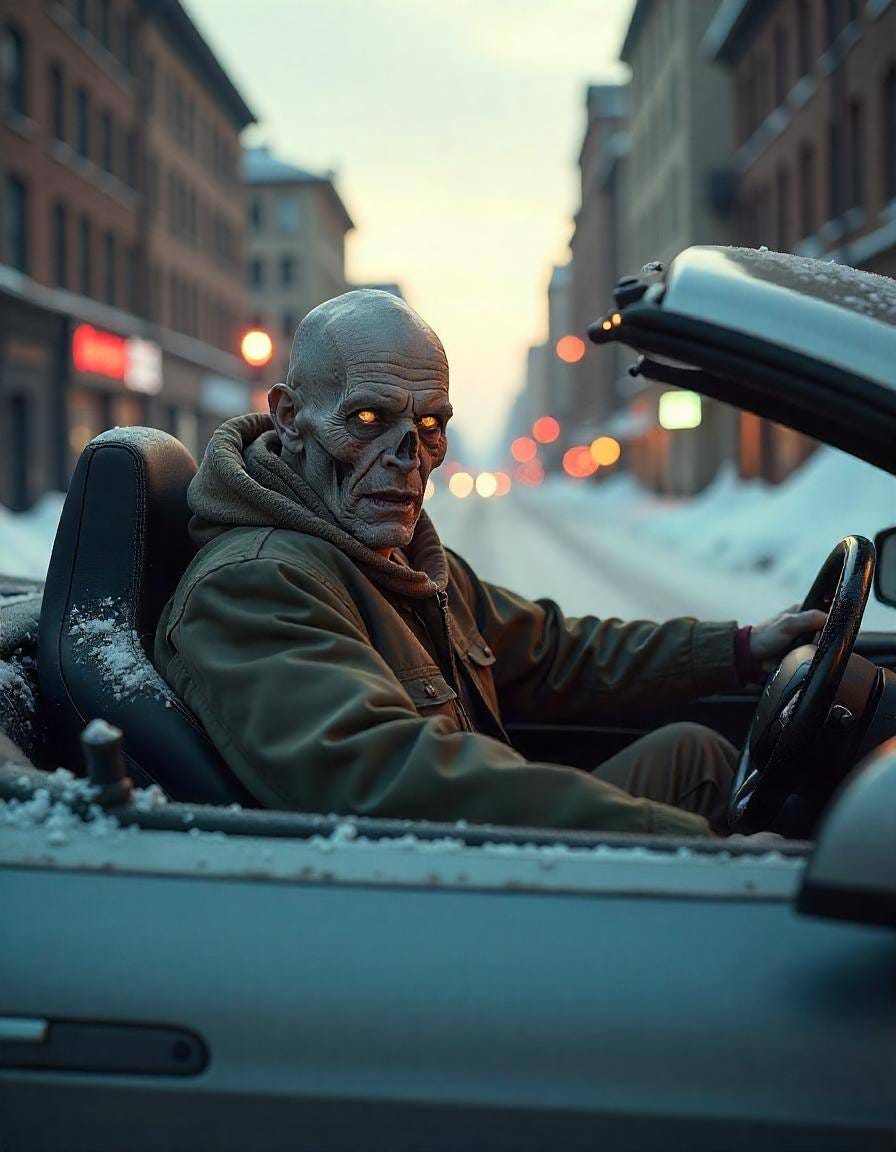
What if someone decided to make a TVseries where the zombies evolved and finally defeated the living? They kept the living in walled and guarded reserves. The living are the new livestock created to provide a sustainable source of food for the zombie city.
The zombie city is proudly ruled by zombie Elon Musk and he drives a Tesla without a roof to be seen and applauded by the zombie people. On the city's TV network the only film that can be seen is the documentary about the first zombies on the Moon, highlighting the Space X rocket that put them there.
At last the dream of colonizing the Moon became sustainable, because the undead do not need water, air and crops. And they can go a long time without eating brains.
Elon Musk's zombie is preparing the first shipment of human cattle to the Moon. This is the theme of the first chapter of the series.
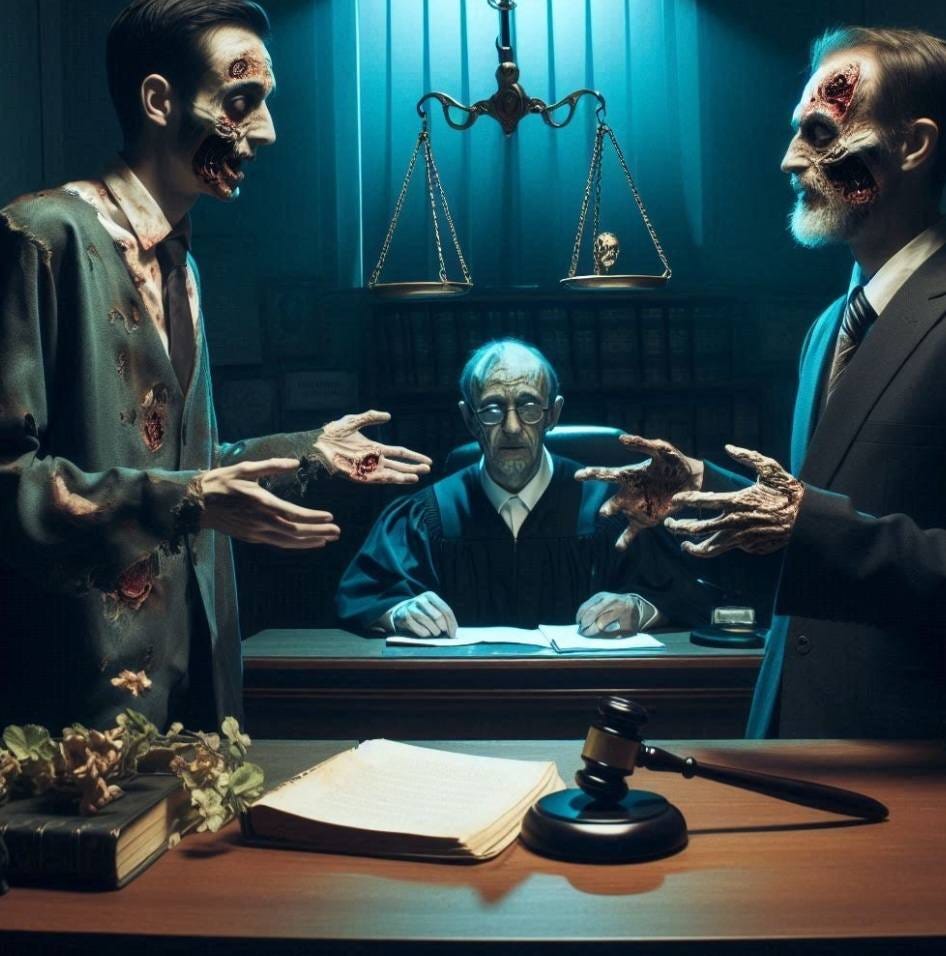
In the second chapter of the series the story continues, but a new theme is introduced: the repression of zombies against criminal living humans who attack and kill zombies just because they don't want to be eaten.
A zombie Court is organized. The prosecutor gives an electrifying speech about the inalienable rights of the non-living, which under no circumstances should be challenged for their food. The audience applauds and begins to shout slogans. "Let's eat the defendant!"
The zombie jurors give clear indications that the defendant will be convicted. "Order, order," shouts the zombie judge. When the atmosphere calms down, the judge says that the floor is with the defense.
The defendant's zombie lawyer stands up and politely addresses the judge: "I'm afraid the trial cannot continue, sir judge, there is a point of order that prohibits this court from trying the defendant. While the prosecutor was speaking I got hungry, forgot my oath to defend the defendant and bit my client. Now he is a potential undead, one of us and he can no longer answer for the crime he committed when he was alive."
The judge reprimands the lawyer for contempt of court and declares the criminal proceedings against the defendant dismissed due to loss of purpose.
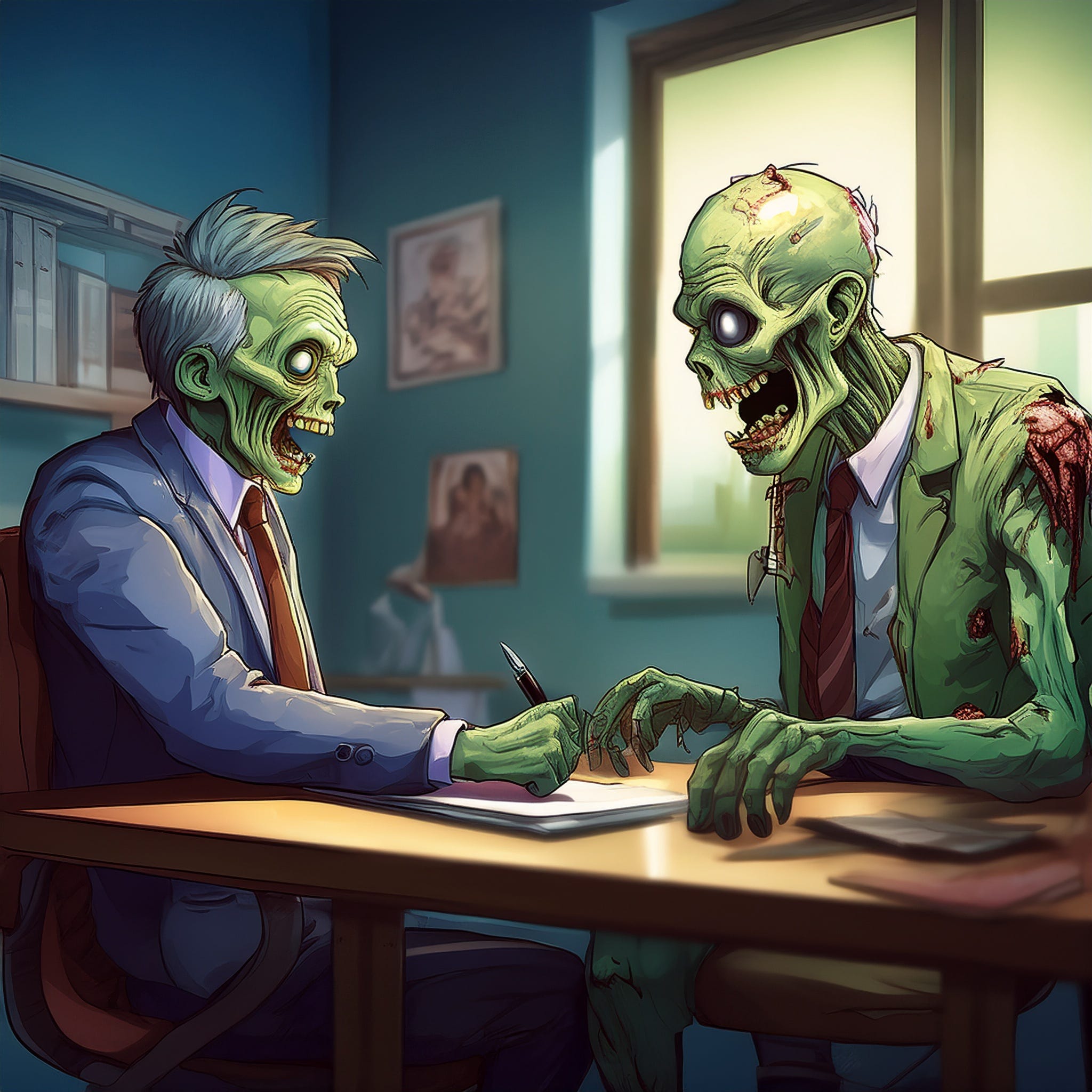
The third chapter of the saga addresses a thorny issue: zombie psychology.
A Freudian zombie psychologist has been receiving zombie patients with a distinct type of obsession: they believe they are alive. The psychologist quickly realizes that all the knowledge he has acquired about the human psyche is useless in treating the disease.
Human emotional and psychological problems almost all originate from three sources: family traumas, anxieties and frustrations caused by adult relationships, and the fear of death. Zombies do not have these problems because they are dead and are naturally individualistic and selfish. Furthermore, zombies do not have sexual problems because their genitals rot quickly after death.
Thinking about the problem, the zombie psychologist picks up a book at random from the shelf and, upon rereading Shakespeare's The Merchant of Venice, has a zombiepiphany. The new method is simple and its effectiveness is beginning to be proven in tests with patients.
The obsession of zombies who believe they are alive can be cured in two sessions. In the first, the zombie psychologist lets the patient narrate and contextualize his obsession without confronting him. In the second, as soon as the patient lies down on the couch, the zombie psychologist pinches him:
- Did you feel anything?
- No.
Then, the psychologist tickles the patient:
- Did you feel like laughing?
- Of course not.
Then the zombie psychologist cuts a piece of rotten flesh from the patient's chest:
- Are you bleeding and are you going to die because of the wound?
It usually takes the patient a few seconds to realize the obvious contradiction between his true nature and the fantasy he has been nurturing. When he finally utters the phrase that indicates the cure (I am dead and I cannot die again!), the zombie doctor Freud hands him its piece of rotten flesh he cut from his chest in a shoe box:
- Keep this as a symbol of your liberation, regaining zombie self-esteem and self-knowledge.
The fourth chapter of this series will be about a young, living woman who escapes from the food reserve and, after outwitting her zombie pursuers and overcoming several dangers, finally manages to enter the mansion of the zombie billionaire Elon Musk. He is very surprised when confronted by the girl:
- You are a piece of shit, a terrible father who competed with your children when you were alive and who always abandoned them with traumas.
- What do you want, walking food. Don't torment me or I will devour your tongue - says Elon Musk, staring furiously at the girl.
- I hate you and I am here to tell you that you were a failure when you were alive and you will certainly fail now that you are a zombie. No matter how much money and power you gain, no matter how much the press flatters you, you will always be a loser.
Zombie Elon Musk advances towards the girl, she defends herself. But the zombie is stronger. He dominates the girl and immobilizes her. Then he pulls out her tongue with pliers, rubs it on her vagina and devours it, theatrically showing that it is an incomparable delicacy.
Hours later, the zombie soldiers arrive and drag Elon Musk's daughter to the food reserve. She has been damaged and will be devoured the next day.
Chapter 5 introduces an unusual theme in zombie movies and TV series. In all of them, the zombies are uncontrollable and attack and devour the living people in an extremely violent and irrational manner. This is incompatible with an orderly society based on the centralization of power and technological development.
So, it is natural that after four chapters the reader is curious to know how the most irrational zombies were disciplined. It is simple: discipline is sometimes imposed by fear of punishment, and other times to suppress the means necessary for the practice of anti-social acts.
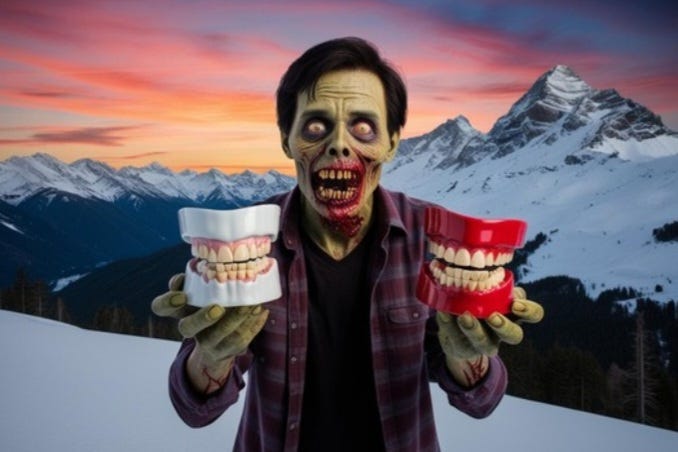
In the case of zombies, threats are useless because they are already dead. So the only way the zombie founding fathers found to transform the herd of zombies into an orderly population was to hire dentists and impose the compulsory extraction of all the teeth of a zombie that tries to feed disregarding the rules and regulations on food distribution and those that invade the human food reserve.
Nothing could be worse for a zombie than being left toothless, unable to tear off pieces of a juicy human flesh. So, after the penalty of compulsory tooth extraction began to be enforced throughout the zombie city, things became very peaceful. The example of toothless zombies walking around without being able to eat was too strong and terrifying, restoring rationality and expelling the original bestiality.
In the zombie city, dentists are especially valued. They literally created a new civilization by pulling the teeth out of barbarism. But not everything is virtuous in that society, because the zombie police are investigating the case of a toothless zombie who was accidentally arrested with a set of dentures made with teeth sharp enough to allow him to bite off a finger of the zombie Cop when he was arrested.
The authorities are worried. A new Law was immediately passed to prohibit the manufacture, sale and use of dentures, with the crime being aggravated if the teeth of the dentures are sharp. A task force was created to investigate and find out who is making and selling prohibited dentures.
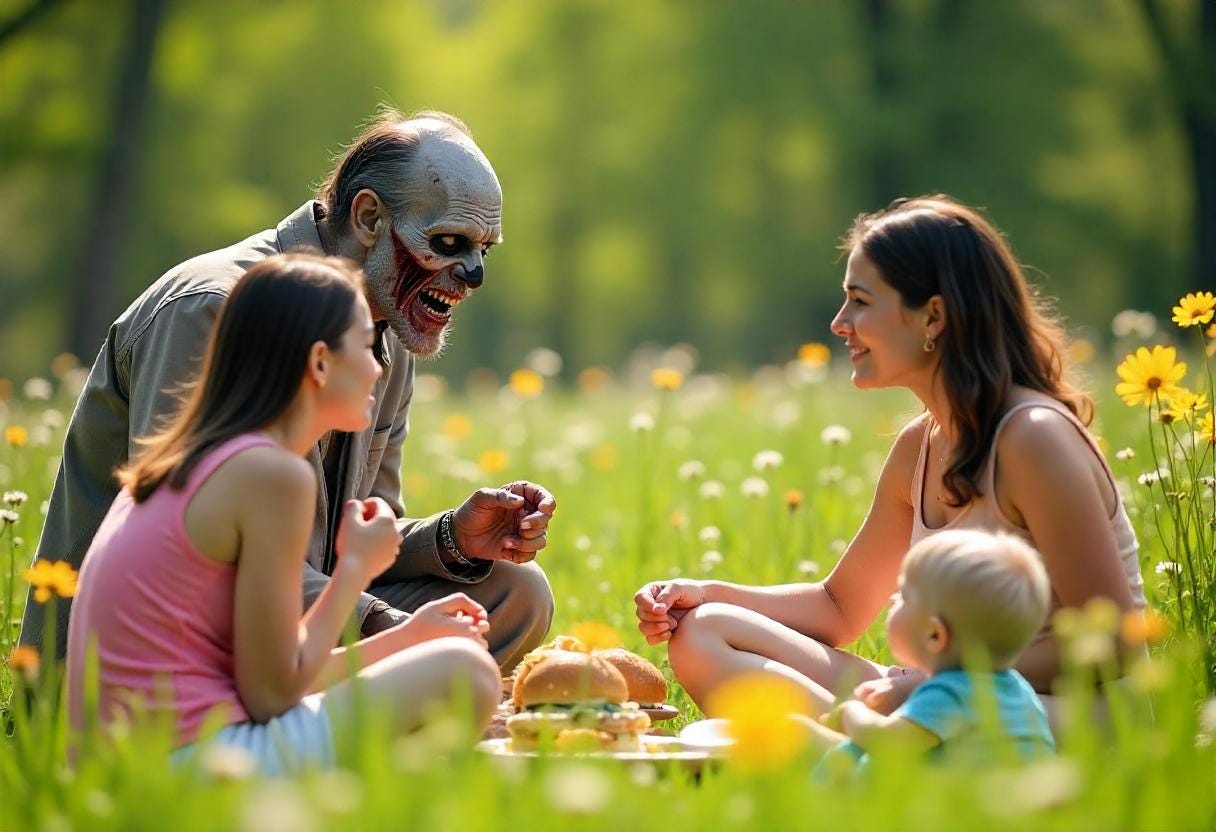
After some time had passed since the zombie society had stabilized and food supplies had been created and were beginning to provide a steady, safe flow of living human flesh, a certain apathy set in among the zombies. They had to find something to do with their free time. After all, there was no longer any point in just wandering around looking for a victim.
Most of the zombies went back to doing what they did when they were alive. And that was what allowed zombie Elon Musk to continue his business and begin to envision a sustainable zombie colony on the Moon. The basic needs of zombies are extremely small, so new rockets could be built by satisfied workers who no longer needed to receive wages. This was a world in which capitalism actually worked better because greed was in the service of something useful and the working class did not need to rebel or be repressed.
The professors returned to teaching and a new branch of study emerged to occupy the rotting brains of stinking scholars: zombie history, ethnology and anthropology in the human food reserve, etc. But in the latter case, proximity to food was a problem. Anthropologists and ethnologists tended to interfere with the object of study. Zombie anthropologists and ethnologists felt the inevitable desire to devour the humans they were supposed to study.
It was then that someone had a brilliant idea. Before entering the reserve, every zombie scholar had to put on mandatory protective equipment to prevent him from devouring humans. This special equipment, which could only be put on and removed by those in charge of the food reserve, consisted of a mask similar to the one worn by Dr. Hannibal Lecter.
Since then, ethnology and anthropology have never been the same. The Hannibal Lecter masks have caused a revolution in the field of humanistic zombie studies.
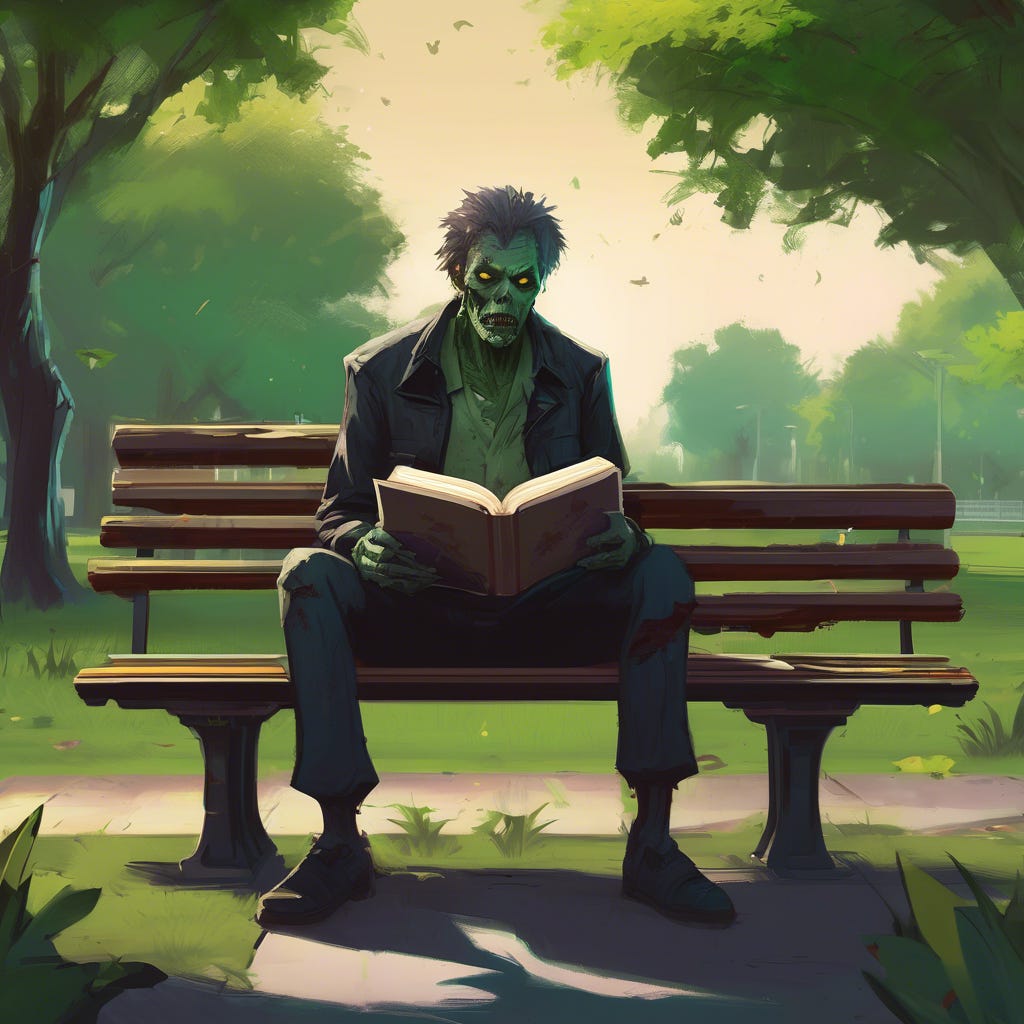
Chapter 7 introduces a more intellectual and socially explosive topic.
The book "Confessions of Humans Waiting to Be Devoured", written by a zombie ethnologist with a PhD who preferred to use the pseudonym Jean Luc Picard, was a sensation two years ago. In it, the humans interviewed were able to reflect on their new condition with complete freedom. Here are some selected fragments of the work.
"All human beings are destined to die in one way or another. And I must say that it is better to die than to become a zombie in Elon Musk's rocket factory", said one interviewee.
A woman whose son had been taken to be devoured days before protested in tears:
"The powerful and rich zombies are very evil, because they eat our children in official ceremonies before their mothers are sent to their deaths. This is extremely inhumane, even for a zombie. A law should be voted on and discussed in the zombie parliament requiring the food reserve to send the mothers first, then their young children."
"I can't complain much," said an elderly carpenter. "Here I have enough to eat, and every time a zombie comes to feel me up to see if I'm fit to be eaten, they find out that I'm as hard as coffin wood and leave me alone because no one wants to eat something so bad. So far no one has discovered that I made and use an exoskeleton made of coffin wood that I wear under my baggy clothes, you know."
"Let's get one thing straight. I'm not opposed to the human food reserve system. God wanted it that way. The system here has been more or less fair, and most of us can live long and reasonably peaceful lives without having to work too hard, you know. Only the damned godless communists want to start a revolution to free humans from zombie domination, as if evolution hadn't determined the most suitable place for those who are naturally weaker."
I will not reproduce here the chapter with interviews of people who are trying to escape the food reserve or who openly question the programmatic injustice of the zombie system. That would not be appropriate, because at the end of the day everyone knows that the audience (especially the human audience watching this series) does not really like to compare their own pitiful situation with the dramatic situation of those who live on the food reserve.
And since ordinary people do not really intend to rebel against the neoliberal system that condemns them to live miserable lives, to fight for shitty, poorly paid jobs, to return home tired and sad after a whole day of hard work, always afraid of getting sick due to lack of money for hospital and treatment, they certainly would not like to see that they are worse than the characters who try in every way to overthrow a system of power that condemned them to be just food in the zombie food chain. The certainty of their own cowardice and lack of self-esteem to rebel does not really need to be evoked in the people who are going to watch the series or read this chapter.
The Picard book's main zombie critics said that the book was biased in favor of humans, because the author did not clearly indicate who the humans were who were tricking the reserve officers into staying alive, nor did he denounce the communists who were trying to organize a food riot. But most zombie readers supported the book's findings and conclusions, because the author had proven to the world that the zombie system worked more or less adequately and that only a negligible minority of humans were actually dissatisfied or thinking about revolution. Minor modifications could be made to the system, of course, but overall the perpetuation of zombie society was assured.
After the huge success of Jean Luc Picard's "Confessions of Humans Waiting to Be Devoured", the possibility of turning it into a movie began to be widely discussed in the zombie city. "At the very least, we need a reality show with our food" was a phrase that could be heard on every street corner in the zombie circles.
The directors of the city's TV network dismissed the whole thing as stupid, something that only a gullible and foolish zombie population could imagine. Everyone knew that humans could not play humans on TV or in the movies. Only zombie actors could do that, but in that case the production would be very expensive because of the need for intense makeup and computer graphics.
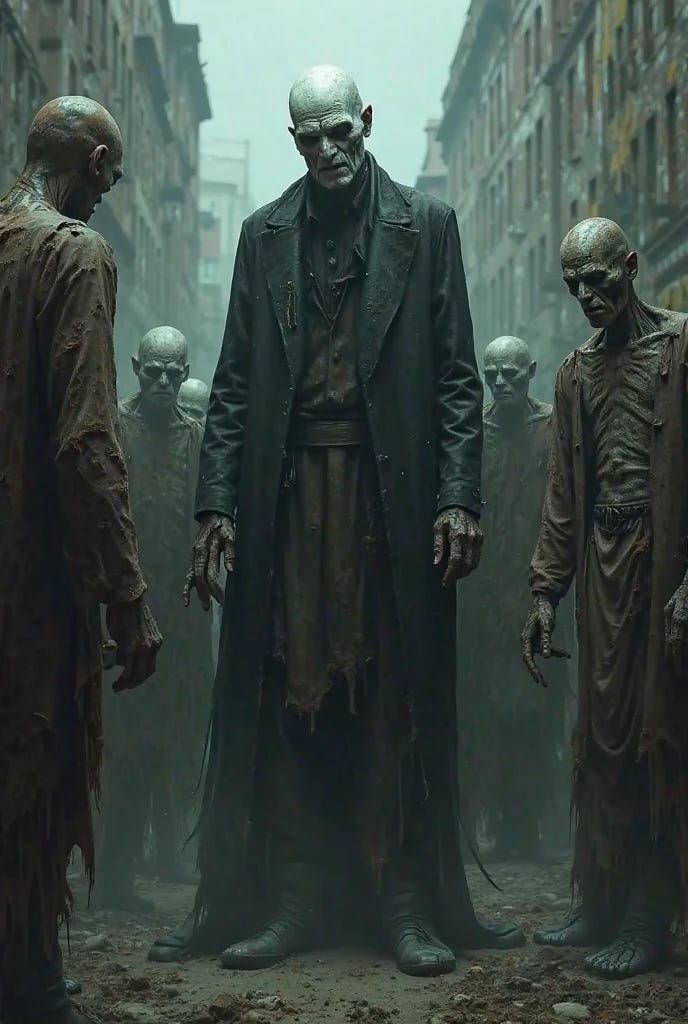
In chapter 8 of the saga everything is about racial relations between zombies and within the food reserve. When you start laughing remember that you should be horrified by the world you live in.
Before the "Zombies who live Apocalypse", race relations in the West were problematic. There was an obvious contradiction between legal equality before the law and the different treatment given by the police to white, black, Indian and mixed-race suspects.
At that time, the police had a preference for white people and always attacked and killed suspects of the wrong color. Not to mention that non-white people usually had the worst jobs with the lowest pay.
But all that changed after the "Zombies who live Apocalypse". The undead generally have the same greenish-brown color, so there is no clear racial hierarchy in zombie society. But that does not mean that all zombies are the same.
The powerful zombie Elon Musk, for example, was part of a zombie elite. To differentiate themselves from ordinary zombies, this elite developed the habit of painting their faces white. Wherever a white-faced zombie appeared, all the other zombies would bow down, making a bow.
Racial relations were tense on the food reserves. This was because the zombies had a predilection for white meat, which quickly made their main victims resentful. They demanded consumption quotas, because the rapid decline of the white population on the food reserve was allowing blacks, mixed-race people and Indians to rise to power within the subjugated society.
Many white people did not mind being taken away to be devoured, but they found it intolerable that human beings of the wrong color were left alive. It was in this context that a racist movement emerged: the militiafoodmen used white paint to paint blacks, mixed-race people and Indians so that they would also be taken away to be eaten.
The tensions between the two groups did not go unnoticed by the zombie guards. They reported what was happening to the central government and the matter was brought to the attention of zombie Elon Musk. Upon reading the intelligence report, he made a note in pen on the document.
"I'm aware. Nothing to decide for now. As long as the food-humans don't start killing each other and wasting our food, it's useful for us that they stay entertained with racial issues."
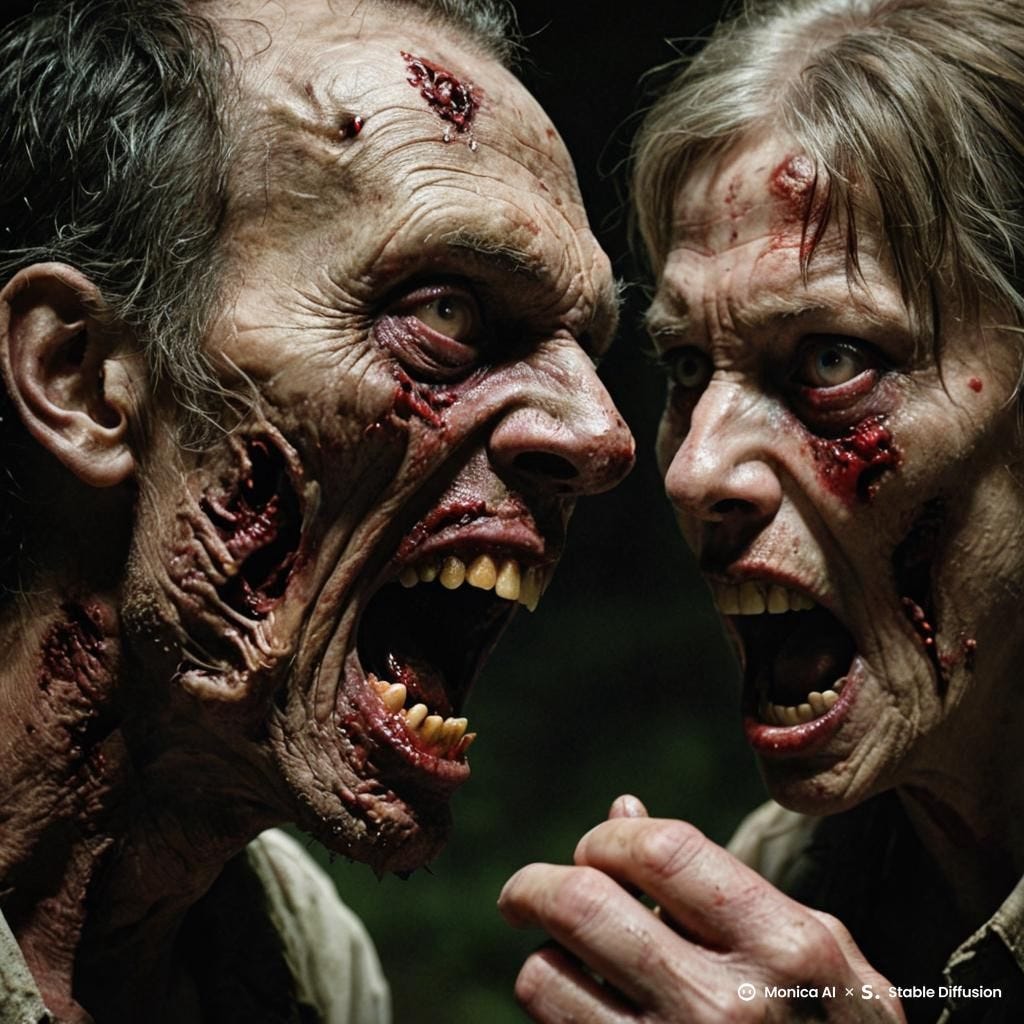
Episode 9: The Curious Case of Werner Dahmer Veidt
Werner Dahmer Veidt was a German engineer who worked at SpaceX before the "Zombies Who Live Apocalypse" happened. At the time, zombies ate everyone they could get their hands on. Werner was almost devoured by zombie Elon Musk at work, but managed to survive the frenzy of the first days of the catastrophe by hiding on the company's roof.
Imprisoned and sent to the food reserve, Werner had great difficulty adapting. Firstly, because he only spoke German and everyone on the reserve only spoke the local language, which made communication difficult. Secondly, someone spread the rumor that Werner Dahmer Veidt was being spared by the zombies because he was Jeffrey Dahmer's brother.
The rumor was Fake News based only on the partial coincidence of their surnames; Werner Dahmer Veidt and Jeffrey Dahmer were not related in any way. Even so, the rumor began to gain momentum when, after the great normalization of zombie society, Werner was chosen to enter a program of living specialists who returned to work at Space-X. The privileged ones had a special living and working permit: they could not be taken to be eaten without specific authorization granted by the zombie Elon Musk.
Werner Dahmer Veidt was a rocket engine engineer and without him the zombie space program to colonize the Moon could not continue. Some people avoided Werner because they believed he had the peculiar disease of his "brother" Jeffrey Dahmer and developed the disgusting habit of eating the fingers of humans consumed at banquets held by the zombie Elon Musk. Others were simply jealous of him because he could not be devoured like a normal person.
But one day, everyone was astonished because Werner was taken in a batch of human food to the zombie city and never returned. His special living and working permit had been revoked by the zombie Elon Musk. The real reason for the decision was unknown, but in the food reserve a new rumor emerged.
Werner Dahmer Veidt, Jeffrey Dahmer's invented relative, had been sacrificed because he had become a zombiecannibal. According to urban legend, he secretly ate zombie parts that he had somehow obtained. Werner was allegedly discovered and lost his work and living permit because he got drunk during a banquet at zombie Elon Musk's mansion and tried to commit the serious crime of tearing off and eating the finger of Ivanka Trump, a famous lady of the zombie elite.
The fact that a shoebox containing a partially eaten piece of zombie was found in Werner's apartment cemented the myth of food eating its eater. However, that box may have been placed there by someone who realized that Werner Dahmer's curious story could be used to spark some kind of popular resistance against the zombies in the food reserve.
"Beware, damned zombies
Human eaters
Werner Dahmer's children
Will eat you yet"
This defiant song began to be sung before the zombie guards whenever they gathered the stock of humans to select those who would be taken to be eaten. A spark of revolution began to spread in the food reserve, but that is a topic for another chapter.
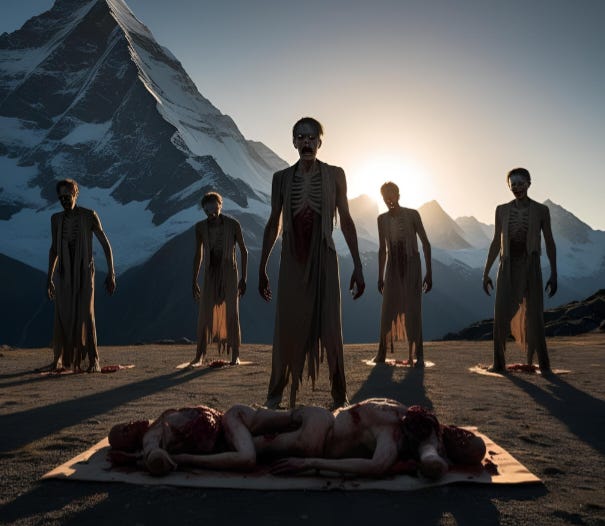
Episode 10: What about religion after "Zombies who live Apocalypse"?
The problem of religion among human beings has always been a problem. First, men attributed mystical powers to natural phenomena that they could not predict, control or understand (thunder, lightning, volcanoes, tidal waves, etc.). They probably worshipped the sun, the moon, this or that very bright star and were terrified of eclipses.
At the same time, mystical powers must also have been attributed to animals whose senses and instincts overcame the natural limitations imposed on human beings. Some time later, the first hybrid deities appeared, half human and half animal. And finally, anthropomorphic gods were conceived with attributes or powers comparable to natural phenomena and/or animal abilities.
After a long evolution of religious ideas, human beings stripped their gods of any natural or animal particularity. The deities became immaterial, transcendent. Humanity found itself at this stage when it began to attribute divine aspects to Artificial Intelligences. Then came the "Zombie Who LivesApocalypse".
In the food reserve, most humans preserved their religious beliefs. But some began to believe that the Zombies must necessarily be sent by a new type of god or that they themselves were divine beings. A curious inversion, because during communion Christians eat the body and drink the blood of Christ. But now they are literally eaten by their new gods (or by the representatives of the zombie god on Earth).
The zombies themselves also began to develop religious ideas. Some, like the elite zombies who paint their faces with white paint, considered themselves divine. Others deified the material or immaterial, real or virtual being that had given rise to the "Zombie Who Lives Apocalypse ".
But there were also zombies who considered human flesh to be something divine because it paradoxically kept them alive after death. In these people's homes, humans consumed alive or the human parts of the food quota were consumed by means of a short prayer:
"- Take, eat, this is the divine body that preserves us in death. Drink a sip of the nourishing blood that contains life."
However, a strange cult emerged in the city of zombies. The followers of this cult were sectarians and met in secret at night in the cemetery. They were undead who worshiped dead corpses.
A special zombie agent from the city who infiltrated the cult said in the report that he did the following:
- during the cult ceremonies, corpses are exhumed, carefully cleaned and consumed by the faithful;
- before consuming the flesh, however, they perform a ritual that symbolically reintroduces life into the corpse.
- the members of the cult believe that only those who are dead and have been revived can nourish death.
Upon reading the report, zombie Elon Musk became disturbed. So he sought help from an expert, zombie Frank Graham. After analyzing everything and reflecting, the zombie pastor said to the zombie Elon Musk:
- This cult is incompatible with the dignity of zombies, an affront to our great Zombie Creator. We were created to devour the flesh of living humans. Those who devour the corpses of people who died before we dominated the Earth are the worms. You must immediately ban this dangerous heretical cult and repress its members.
The zombie Elon Musk sent the zombie Frank Graham away. After consulting the food reserve data and doing some calculations, he concluded that from an economic/food point of view, the new cult made zombie society sustainable for longer by reducing the consumption of living humans and enabling the maximization of food reproduction in captivity. Musk wrote it down in the report.
"I am aware of what is happening. The new cult should not under any circumstances be repressed. Its members must have religious freedom."
When he learned of the pragmatic content of this curious decision, the zombie Frank Graham was furious. He even tried to organize a demonstration against the nasty cult, but the movement failed due to lack of support. In general, when it came to faith and worship, zombies were much more tolerant than evangelical Americans. Each zombie only cared about what he ate. What other zombies ate was their own business.
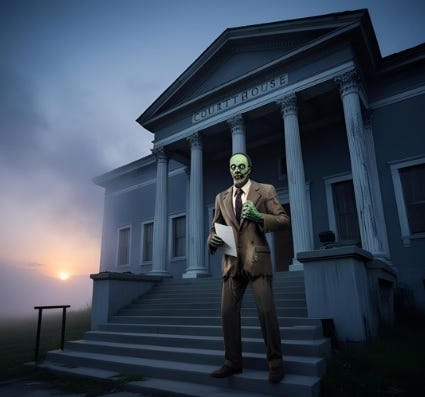
Episode 11
The feeding frenzy that occurred after the “Zombies Who Live Apocalypse” was characterized by the total collapse of the Law and the lack of justice. The zombie herds ate all the humans that fell into their hands, and the humans defended themselves as best they could. This period of anomie would be called “iustitium” by the Romans and we would call it a state of exception.
But there is a fundamental theoretical difference here. During the “iustitium” order in the city of Rome was restored by a temporary magistrate with absolute powers: the dictator. Modern states of exception do not aim to restore legal normality but rather to perpetuate a dictatorial power. However, during the first phase of the “Zombies Who Live Apocalypse” human society ceased to exist and there was still no organized society of zombies to replace it.
After the great normalization of zombie society, with the clear distinction between zombies and humans kept in reserve, a new order began to be created. We have already had some glimpses of it in the previous chapters of the series. Now we need to delve deeper into this topic.
Since zombies reproduce by contagion, a considerable part of the Family Law chapter of the Civil Code has fallen into disuse. The stabilization of zombie society depended fundamentally on the relationship between the number of zombies and the number of humans on the food reserve. Therefore, after normalization, reproduction by contagion was banned: humans had to be completely devoured before they could turn into zombies. Any violation of the rule could result in a terrible punishment: all the teeth of the offending zombie would be pulled out and he would no longer be able to feed himself or cause the population of the zombie city to increase.
Zombies could have temporary or permanent partners. But the contractual relationships between them were hardly similar to those between husband and wife. No duty of fidelity could be demanded. Sexual obligations between partners also did not exist, because as already mentioned in a previous chapter, zombie genitals quickly rotted and fell off.
On the reservation, humans once again applied the legal norms that existed before the “Zombies Who Live Apocalypse” to each other. However, none of these rules were valid or effective against the zombies’ decisions or overrode the Laws established by the zombies’ master race. Zombie Law prevailed over food-humans’ law as if it were a new kind of Roman Civil Law.
Zombies could exceptionally keep humans as pets or servants. Powerful zombies had the privilege of obtaining/issuing special work and life permits, as was the case with engineer Werner Dahmer Veidt. Since the two races could not mix or produce half-breeds, the zombie/human food relationship stabilized over the course of a few years.
Then a real scandal occurred. The zombie lady Ivanka Trump developed a platonic love for her human pet. She even had a forbidden affair with the pet for some time. When the affair was discovered and the city authorities threatened to remove the pet to the reserve so that it could enter the food chain, Ivanka filed a lawsuit in the Zombie Court and obtained an injunction to keep the pet until the final resolution of the case.
The subject of the lawsuit initiated by Ivanka Trump (the adoption by contagion of the pet) was unusual and it had to be analyzed very carefully by the zombie judges. On the one hand, they had to consider the usefulness and legal possibility of the request, on the other, they could not ignore the impact that the adoption would have on the food chain. The birth by contagion of the new zombie would mean one more mouth to feed and one less human in the general food supply. Not to mention that creating a precedent like this could impact the future of the entire society if many zombies adopt by contagion an increasing number of humans.
The judges' decision was to delay the progress of the case with a Solomonic decision. Ivanka Trump could adopt her human pet by contagion as soon as she proved in the lawsuit that a zombie had ceased to exist. Weeks after the ruling was handed down, on the outskirts of zombie town, a poor toothless zombie was decapitated and had his head completely crushed.
The corpse of the duly dead undead was taken to Court by Ivanka Trump's lawyer and he left with the official stamped and signed warrant for his client to adopt her human pet by contagion. This would have been a happy ending, if the pet had not fled to the human reservation because he would rather die than become a zombie. But he was eventually killed and buried in secret by bigoted humans when they discovered that he had had an affair with his former zombie owner.
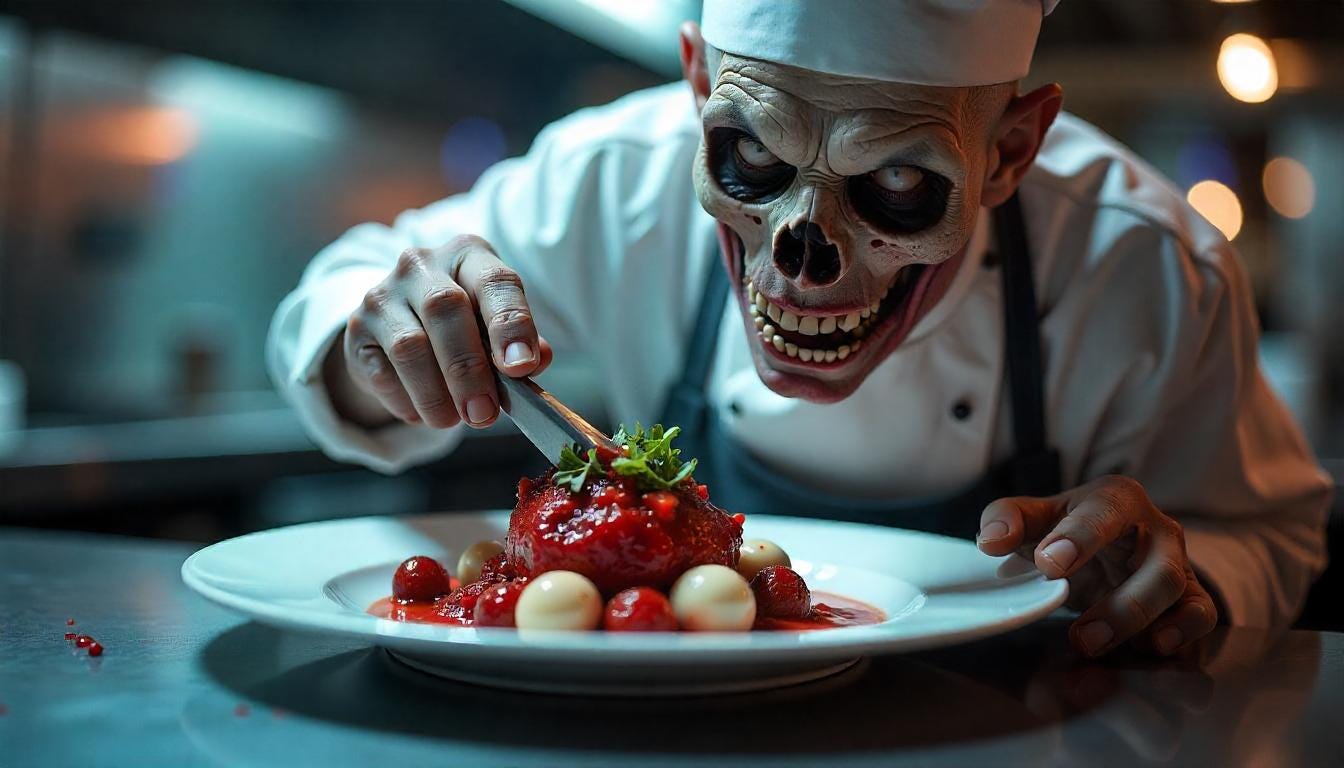
Chapter 12 is light, brief and funny.
As it ages, interacts with other nations and becomes culturally and economically rich, every civilization undergoes important transformations. This is expressed in both the arts and cuisine. Something similar happened in the zombie city.
The zombies feed exclusively on human flesh, with a certain predilection for the flesh of white humans. This has not changed and is unlikely to change, because everywhere zombies are zombies. In this regard, they are very similar to human billionaires, who shared the same interests, habits and prejudices and were much more similar to each other than to the people of the countries where they lived before the "Zombies Who Live Apocalypse".
But after the normalization of zombie society, zombie chefs returned to work and a certain culinary diversification and food aesthetics occurred because of the competition. The zombie elite, for example, preferred to eat human meat in trendy restaurants and greatly enjoyed the TV show "Master Chef Zombie" in which chefs presented their latest dishes and competed for prizes, applause and likes from the audience.
Here are some of the dishes that won awards on "Master Chef Zombie" and began to be eagerly consumed by rich and middle-class zombies:
1) small human brain gelatin shaped like a human brain made with ultra-processed human brains;
2) boneless human baby stuffed with ground meat from adult humans.
3) Ham made with humans who were fed exclusively on acorns from genetically modified oak trees.
4) Spicy genuine human Calabrian sausage.
5) Feijoada made with human offal (ears, noses, fingers, penises and lips).
6) Sushi made with ground human meat with imitation Japanese sauce made with human blood.
7) Burger made with human tongue marinated in spiced rum.
The most prestigious chefs attended the fashionable parties at the mansion of zombie Elon Musk. One of them prepared Sunday lunches for zombie lady Ivanka Trump for free. The press loved to publish news and gossip about the zombie master chefs. But some zombie journalists used to mock their colleagues by saying that they received bribes from restaurants to do this.
But then a scandal broke. A famous restaurant was accused of selling dishes made with processed human meat along with meat from regular animals. This aroused horror and hatred in the zombies who ate exclusively humans and defended animal rights.
Another case that caused a stir was the production of genuine human calabrese sausage made with meat from Nicaraguan immigrants. The case of the expensive stuffed white baby, which was then stuffed with ground meat from black humans that had been chemically treated to make it look white, led to the arrest and execution of the zombie chef.
Unfortunately, the process of sophistication of zombie society also led to an increase in food counterfeiting. On one occasion, poor zombies began to get sick because the canned human meat they were eating contained only 20% natural human meat. No one knows for sure what food manufacturers were adding to the cheap products they were putting on the market. This episode led to a predictable increase in regulation and inspection of the food industry in the zombie city.
Chapter 13 of our saga addresses an unusual topic: the Terminator Zombie Prosthetics Scenario.
Zombies generally do not sleep. They do not need to rest, nor do they suffer from diseases whose symptoms are lack of energy, apathy and fatigue. But they do need to stop for a while, because continuous movement excessively wears out the joints of a dead body incapable of regenerating cartilage.
Due to the wear and tear of the joints in the spine, hips, knees and ankles, after a few years of undeath a zombie begins to hunched over and walk like a scarecrow. Worn bones rupture dead tissue and zombies lose their feet or one or two legs below the knee. At first these problems were solved with splints and screws, but the reassembled zombies usually began to walk like mummies and other monsters from old Hollywood horror films and Hammer films in England.
But a famous and especially gifted zombie doctor and some engineers from Elon Musk's Tesla Prosthetics company have fortunately developed artificial cartilage and prosthetics implanted in the spine, hips, knees, elbows and ankles that guarantee zombie patients a life of active and healthy undead. These prosthetics were very sophisticated, using microchips and AI capabilities. They were connected to a Tesla Prosthetics server and underwent periodic updates if they presented bugs.
At the time these prosthetics became common, without special permissions for living and working, living humans were prohibited from owning and operating computers at Tesla Prosthetics without the supervision of zombie IT engineers. Caution and vigilance maintained social hierarchy and the submission of the food stored alive in the reserve.
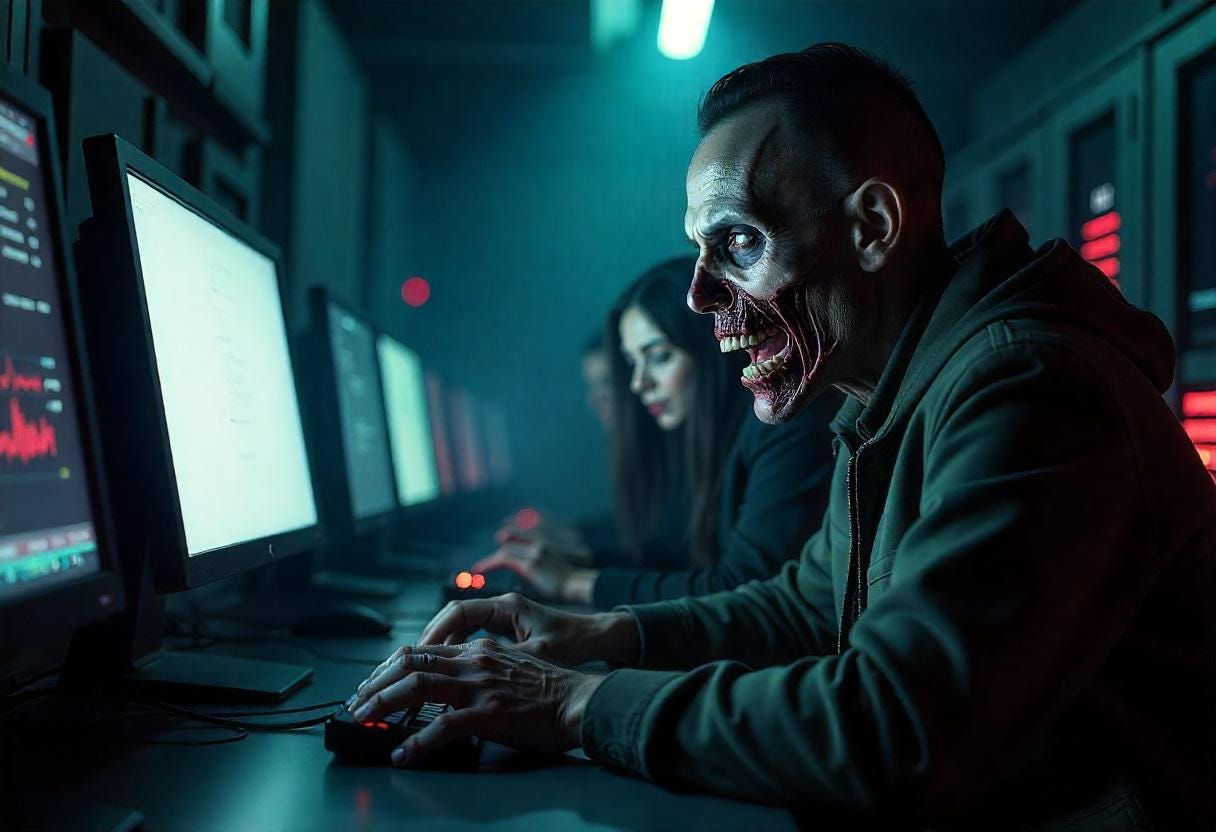
Everything was going perfectly in the zombie city. But then something unexpected happened. An old human hacker using a computer assembled from machine parts found in the zombie city's trash managed to hack into the Tesla Prosthetics server. Until he was located and arrested a few hours later, he was able to remotely control all of the company's customer prosthetics connected to the company via the zombie Internet.
For a short period of time, the zombie city lived the Terminator Zombie Prosthetics Scenario. The microchips and AIs that controlled the mechanisms implanted in the zombies’ spines and other joints began to function erratically. They began to jump on the street, roll on the ground, and walk backwards with their heads touching the asphalt. Some of them moved their arms like that crazy robot from an old TV series. Zombie Elon Musk was seen jumping on his right leg while his arms twirled in the air above his head, his left leg bent back.
The humans who witnessed the scene were astonished. They laughed heartily at seeing the master race of zombies reduced to the condition of legless and wingless insects in the hands of an evil human child. But they did not know that the person responsible for the incident was one of their comrades. This fact was carefully covered up by the authorities with the help of zombie journalists, who released a statement lamenting the malfunction of the Tesla Prosthetics server caused by a power surge. New regulations and safety measures were adopted and Tesla Prosthetics customers were able to return to doing what zombies do best.
When all this happened, only the old zombies patched up with splints and screws moved around the zombie city. They still looked like monsters from old movies, but at least they didn't have prosthetic knees, ankles, hips, elbows and spines that had gone completely crazy and were controlled by a hacker. The overwhelming majority of them felt exceptionally well and none of them considered exchanging their old splints and screws for products from Tesla Prosthetics.
Chapter 14
Every great civilization that emerges from the shadows gives itself a shine by appropriating the cultural legacy of the civilizations that preceded it and reworking it. This process has been going on since time immemorial.
The Jews copied and pasted the Assyrian flood and created Samson using the Greek model of the demigod Hercules. The Greeks, in turn, appropriated much older Eastern gods (Bacchus and Artemis). The Romans modeled their society on Greek mythology and the legacy of Troy (according to Virgil, the founder of Rome was Aeneas himself). In Rome there were temples of Egyptian gods (Isis and Serapis) and Persian gods (Mithras). Christianity is an amalgam of several traditions that preceded it.
This process was underway in the West before the "Zombies Who Live Apocalypse", as American cinema regurgitated and recreated almost all ancient mythology, as well as the cultures of other countries from different eras. Zombies have also tried to do something similar, sometimes without much success.
For example, Alien is a script that did not result in a good film. First, because Xenomorphs need living humans to reproduce and cannot use zombies as hosts for their offspring. The solution was to have the hero zombies devour the Xenomorph, but this was also a problem because their acidic blood destroyed the zombies' jaws.
An alien that hunts humans in the forest like the one in the movie Predator is very plausible. The zombie adaptation of this movie is considered a classic. The zombie special forces commando is called in to hunt the Predator that is devouring the zombie city's food. Memorable scenes follow, in which Predator and zombie soldiers compete for human carcasses. Several of them are decapitated, but in the end the zombies manage to devour the Predator before he activates the portable nuclear bomb he carries on his wrist.
Zombie Romeo and Juliet has had several successful productions. In one of them, Romeo is a zombie and Juliet is human. In the other, Romeo is human and Juliet is a zombie. In the classic production, both are zombies. Their love is forbidden by both families. Capulets and Montagues are always enemies, and in some productions zombie Capulets eat human Montagues. In others, the opposite occurs. In the classic production, the two families hate each other because they fight for control of the city's food supply.
Every great civilization has its founding myth or founding father. Sometimes these myths are original (Gilgamesh in Assyria), other times they are borrowed (Aeneas in Rome). After the great normalization, zombie scholars began to look for a character capable of becoming the mythological founding father of the new civilization. The most promising candidates were Osiris, Bacchus, Orpheus, Odysseus, Jesus and Lazarus.
Osiris was discarded because he was reborn in the underworld where he reigns supreme and judges the souls of humans. He could not be the first zombie on the surface. Bacchus was also discarded, because despite having died and been reborn, he lives as a god of wine among humans and gives in to the violent emotions of humans. Orpheus and Odysseus were also discarded, because both went to Hades alive (one to rescue his beloved woman, the other to talk to his father and Achilles).
Jesus would be a good candidate, but he was resurrected to live as a deity alongside God and not as a zombie among men. That leaves Lazarus, a dead man who came back to life. Very little is known about him, and that is why Lazarus was quickly transformed into the patriarch of the zombies. And many stories have been told about him, directly linking him to the zombie civilization.
The zombie Saci Pererê is very similar to the traditional Brazilian character. He is a child zombie who lost a leg and keeps jumping after his victims. The other zombies do not like him because he has become very efficient in his art and always gets to the food first by eating the best parts of humans.
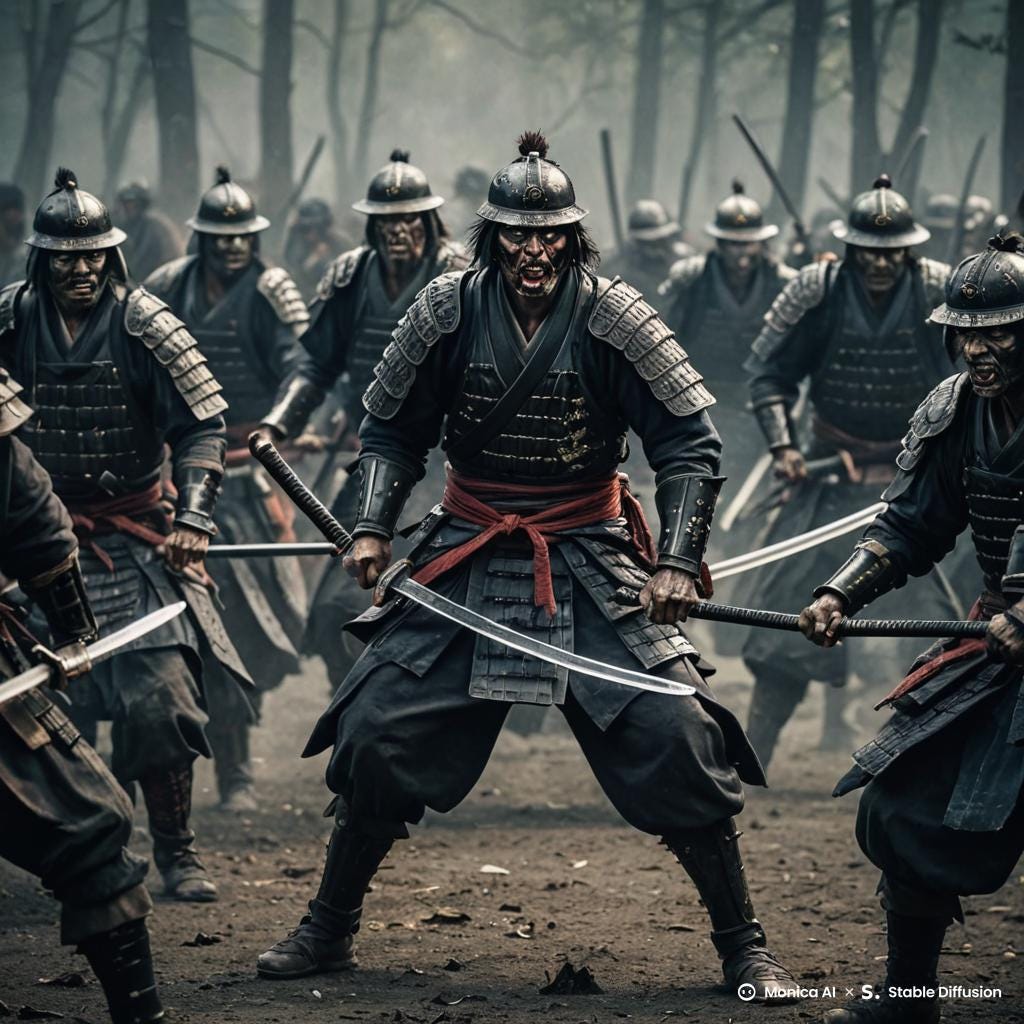
Zombie samurai fighting with katanas in epic films worthy of Akira Kurosawa were very popular. In one of these films, the central character, leader of the Yamaha clan, wins the final battle against the Suzuki clan using a ruse. He leads his main forces of soldiers to the enemy's rear while a small group of Yamaha samurai sacrifices themselves by pushing a herd of humans onto the battlefield, causing the enemy army to go on a feeding frenzy. While hunting and devouring humans, the Suzuki samurai are attacked from behind and defeated by the Yamaha army.
You can imagine how and why zombie culture was problematic. Some adaptations were especially interesting and worked, but others were predictable and dull, like American comic book movies from the early 21st century. When the zombie Wolverine first appeared in a zombie movie, it failed spectacularly, because it didn't make much sense for a zombie to have a metal skeleton in a world where rotten, worn-out, screwed-together joints were the norm.
This is just a sample of zombie culture. We'll come back to this topic later.
And now chapter 15, written especially in honor of Jodda Mitchell.
Humans are obsessed with time travel. Although Physics professors assure us that it is impossible, before the "Zombie Who Lives Apocalypse” this obsession was reflected in human culture in various ways: travel to the future, travel to the past, return to the present from the past or the future.
After the zombies took power, a curious fact occurred. In the food reserve, humans only dreamed of a return to the past, to the glorious time when they ruled the Earth and zombies only existed in fiction. But the zombies were divided on the subject. Even though they managed to invent a time machine, they were very afraid of using it. Here is why.
If they went back to the past, the zombies could change the course of history and prevent the chain of events that made it happen and triumph over the "Zombie Who Lives Apocalypse”. And they obviously didn't want to do that. If a zombie were to travel to the future, the problem would be that upon returning to the present (if that were to happen) he would tell everyone what was going to happen and the zombie society could be shaken by unpleasant news. Something that they would not want to happen either.
So, the zombie city created strict regulations for the use of the machine. Time travel would only be possible if it was previously discussed in the city council and authorized. The mission would have to be very well defined, and travel to the past was forbidden. Zombies could only visit the future, and upon returning they were strictly forbidden from telling ordinary people what they had discovered before being interrogated by a panel of zombie scientists and authorities.
The time machine built by the zombies was an extremely dangerous piece of equipment, especially if a human managed to use it to return to the past and abort the birth of the first zombie. This Human Terminator would put sand in the gears of the machine that became the zombie society before it actually started working. So, as a precaution, the zombie scientists added a secret safety device to the time travel machine.
If a zombie were allowed to travel through time, the machine would work normally, transporting his body to the future. But if a living human being entered the machine, during the time travel process he would be infected with the zombie virus and would arrive on the other side of the time portal as a zombie and not as a living human being. This was the best kept secret of the zombie town and although the humans on the reservation knew of the existence of a zombie time travel machine, they did not know how it worked, where it was and, most importantly, that it had a terrible safety device.
Around the time the zombie time travel machine was built, zombie philosophers discussed the subject intensely. One of them, questioning the prohibition of zombies traveling to the past, formulated a truly frightening hypothesis: What if zombies were never created if one of them did not travel to the past? A variation of this hypothesis was even more worrying: What if the "Zombie Who Lives Apocalypse” depended on a human breaking through security, entering the machine, and emerging in the past as a zombie to trigger the chain of events that led to the rise and predominance of zombie society?
The zombie who raised the first hypothesis won the Nobel Prize for Zombies, because the discussion he raised was considered extremely relevant. But the zombie who raised the second hypothesis was banished from the zombie scientific community, because it would be absurd for the present and future of the zombie city to depend entirely on the action of a dirty human. Inferior races do not interfere in a positive way in the development of zombie science or in the construction of zombie history.
By studying their prehistory (that is, the history of humanity before the fall), zombie historians discovered that this was already considered true during the administration of the human Donald Trump. He expelled immigrant scientists and researchers from the United States precisely because he believed that inferior races could not have any positive role in the American future. And by doing so, Trump in fact contributed greatly to the rise of the "Zombie Who Lives Apocalypse”.
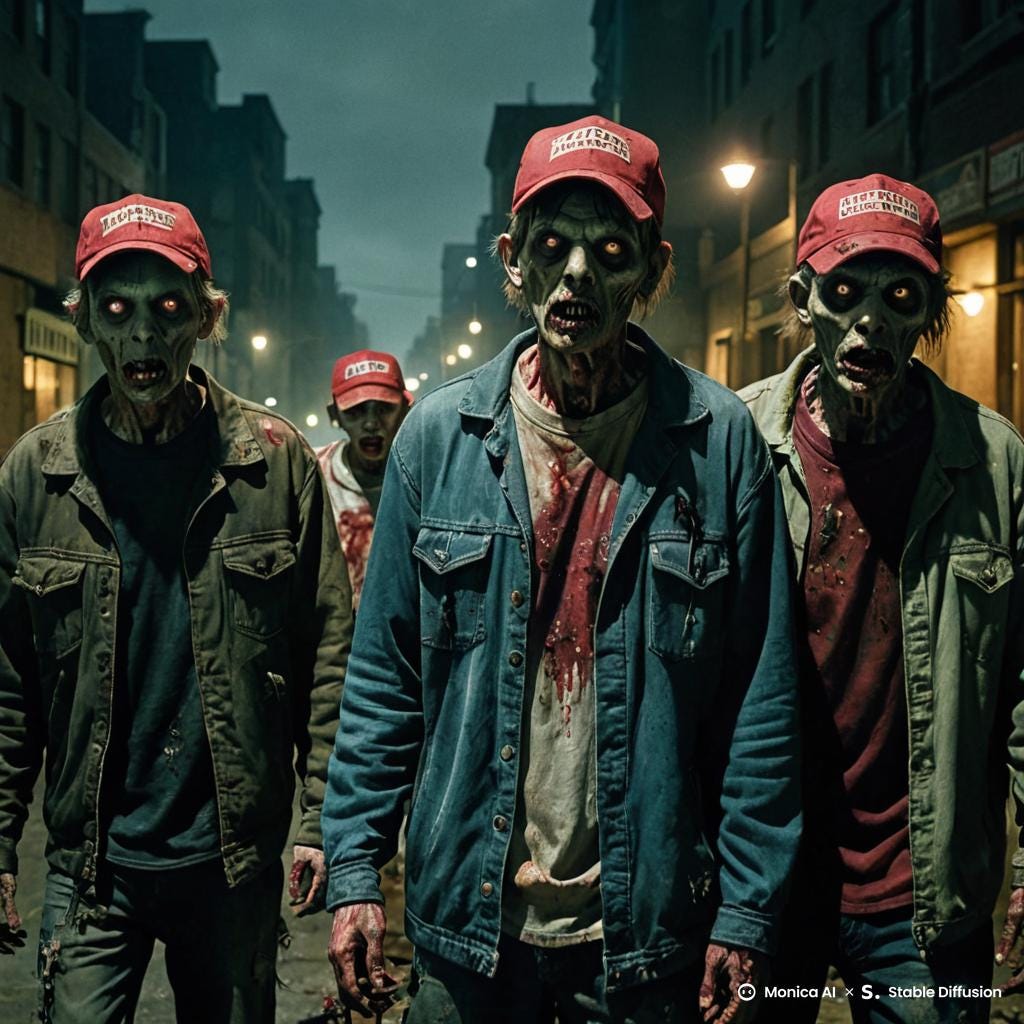
By carefully and coldly analyzing past data, the zombie AI concluded that immigrant scientists and researchers that Donald Trump expelled from the United States in 2025 could have developed what was needed to prevent the emergence of zombies or interrupt their path to success. Fortunately, they returned to their home countries where they were unable to continue the research they were doing in the US. This happy accident was considered very important, one of the reasons why zombies would never under any circumstances stop secretly admiring one single human being: Donald Trump. Yes, well-informed and responsible zombies would never refuse to wear MAGA hats.
Chapter 16
Those who have watched too many zombie TV series and movies believe that the biggest problem for the living after the "Zombie Who Lives Apocalypse” was the transformation of humans into food. This is a very common mistake and a profound lack of knowledge of history.
For example, in the early 16th century in Brazil, it was very common for people captured by Tupinambás, Tupis, Caetés and other indigenous people that the Portuguese colonists generically called Botocudos to be devoured in ritual banquets. But before they were sacrificed, chopped up and roasted, these people usually lived for a period among their captors, and even gained wives to comfort them at night.
Those who belonged to enemy tribes usually accepted the sacrifice naturally and before being slaughtered they shouted "My ancestors captured, killed and ate many of your people. And my relatives will avenge me, they will capture and eat you too."
People get used to everything you know, even captivity and imminent death. Those who are aware that they will be sacrificed and devoured feel obliged to make peace with the situation they find themselves in. This curious phenomenon of pacivity in the face of the imponderable and unacceptable has also been seen in defeated, enslaved and genocidal peoples throughout human history.
So, the biggest problem for humans was not living on the reservation and knowing they would be eaten. But there was one thing that really bothered them: the smell of zombies. And here we notice a funny paradox.
In some films and TV series from before the fall of humanity, zombies locate humans by their smell. This is absurd. Smell is the first sense that zombies lose. They can't smell anything, neither themselves nor humans. But the rotten stench they give off after some time transformed was really unpleasant and caused disgust in humans.
To deal with this, humans who were allowed to live and work in the zombie city usually used nose clips. On the reservation, any type of strategy available was used to avoid the smell of zombies. But the zombies strictly prohibited the production and sale of some chemical products, deodorants and perfumes whose continuous inhalation could cause the death of their food.
Anything that is forbidden or challenging arouses more desire in adolescents. In the human world before the fall, adolescents did stupid things to gain prestige, visibility and likes on trendy internet platforms. Many of them died taking selfies, ingesting and inhaling dangerous and lethal substances. Parents couldn't control their children, and countries didn't hold data barons accountable for anything. A true orgy of death has become a reality, driven profitably by Big Tech algorithms. After the "Zombie Who Lives Apocalypse” this ended, because the living no longer had access to the internet, fortunately.
In the new world of zombie teenagers things were similar and paradoxically different. For example, on the zombie internet the mustard gas and sarin challenges became very common and famous. Zombie teenagers were capable of doing anything to get a little of these two products to smell them in videos shared with their friends. This did not have any serious consequences, because the dead cannot die a second time.
Even so, the Zombie Police did not stop trying to locate and arrest the zombies who stole these products from the warehouses of the former human military forces to sell them. Nor did they stop trying to locate and warn the zombie teenagers who participated in the game. The zombie city authorities feared that these products would be spread throughout the reservation, where they would wreak havoc on the living food supply.
The zombie world is comical. But it cannot be considered more tragic than ours. In some ways, zombie society was far more advanced than ours, because before the "Zombie Who Lives Apocalypse”, teenagers were dying because of the TikTok deodorant challenge and no one even considered creating strict regulations to prevent the use of toxic substances in these products or to limit their sale.
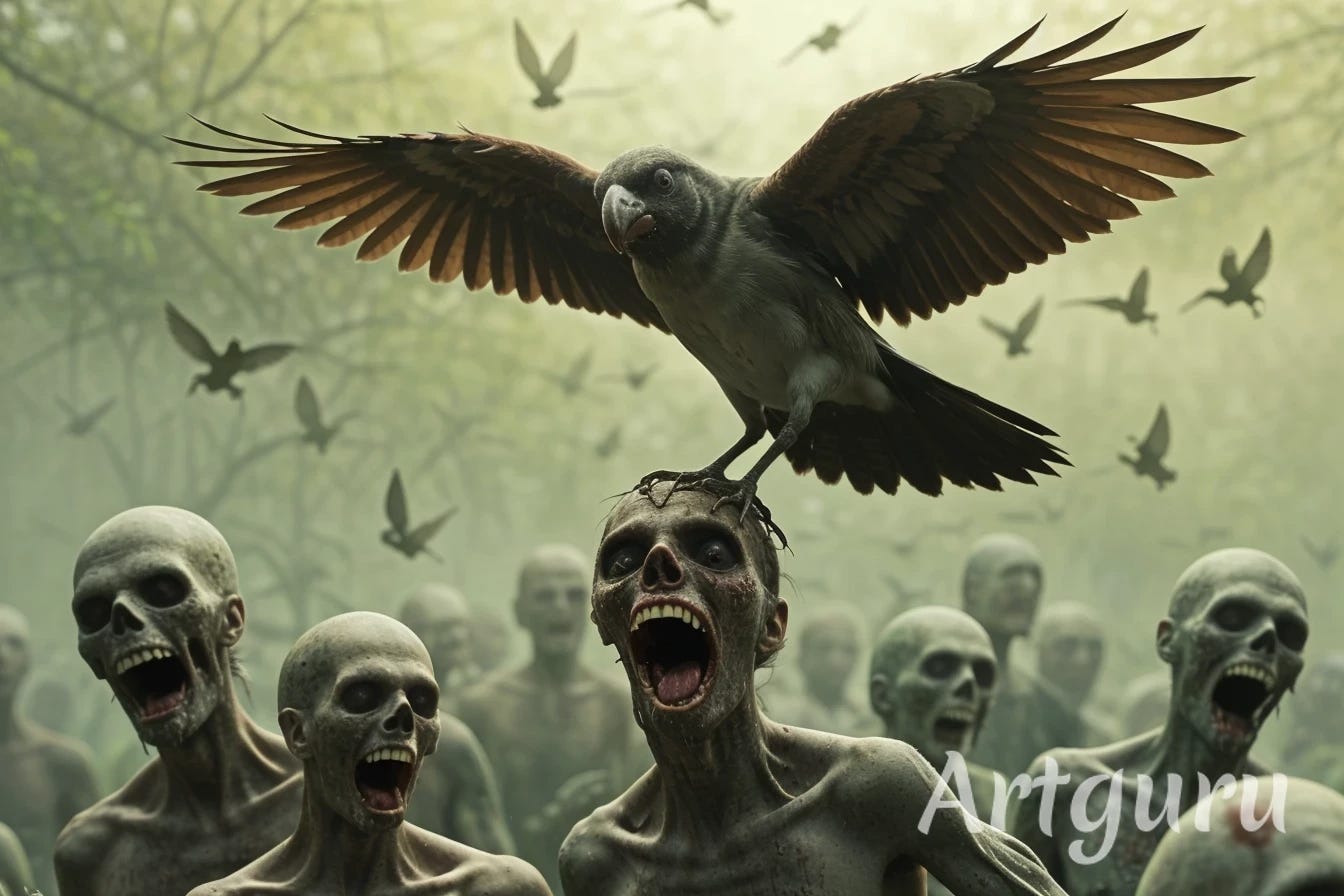
Chapter 17 is a more or less elaborate zombie version of Alfred Hitchcock's famous film The Birds. But it's called The Bugs.
Just before the fall of humanity, insects were on the brink of extinction. This was because humans were producing and using chemicals on a large scale that killed insects and interfered with their reproduction. Scientists said at the time that humanity was in danger because insects pollinate plants and are an important source of food at the base of the food chain. The fear of bee extinction was real at the time. And some idiots said that they could be replaced by robotic bees empowered by AIs.
The decline in insects was already causing a decline in bird populations when the "Zombies Who Live Apocalypse" occurred. This event shut down the operation of chemical plants and the trade and use of substances that were harmful to insects. In a short time, their populations exploded. More food meant a boon for animals that feed on insects.
In the reserve, humans fought the insects as best they could, and the zombies didn't really care about this problem. But in the zombie city, the proliferation of insects was truly unbearable because, you know, there are insects that have a predilection for rotting flesh.
Zombies attract insects and insects attract birds. Zombies didn't mind insects, but bird pecking was a problem because every time they ate an insect from a zombie, a little piece of the zombie itself was devoured. This was unacceptable; the zombie species was at risk of declining like the population of Europe in the 2020s.
And just as Europeans feared being replaced by African immigrants, zombies feared disappearing because of bird pecking, giving way to the resurgence of the living. Zombie ideologues wrote books about the hatred that should be devoted to birds, the irreducible enemies of zombies. And zombie scientists worked tirelessly to solve this crisis.
Some tried to develop a way for zombies not to attract insects. Others preferred to focus on reducing the bird population with a breeding program for tree snakes that devoured their eggs. But scientific development is always slow and progresses erratically and haphazardly.
Oppressed by man's chemical industry, Nature became unbalanced and the extinction of insects threatened the collapse of the entire food chain on a planetary scale. After the "Zombies Who Live Apocalypse" Nature regained its balance and insects and their predators prospered, but this was a problem for the zombies.
Things were getting really worrying when a zombie scholar discovered that insects do not like smoke. So he invented a revolutionary product: the Walkmanzombie Incense Dispenser. However, despite its efficiency, this device often caused fires.
Insensitive, many zombies who bought the Walkmanzombie Incense Dispenser ended up burning themselves as if they were incense sticks. A typical tragedy of the new zombie market similar to many tragedies in the old human market. And just as human entrepreneurs were never punished, the creator of the Walkmanzombie Incense Dispenser went unpunished.
Fortunately, a zombie engineer invented the electronic Walkmanzombie Ultrasound Dispenser. The battery-powered device emitted sound at an inaudible frequency that was unbearable for the insects. And since they stopped landing on the zombies, the birds were no longer considered mortal enemies of the zombies.
Fewer insects in the zombie city did not mean a decrease in the insect infestation on the reservation. Since insects transmit diseases and this put the zombies' food supply at risk, the authorities hired Tesla to develop and install larger, stationary versions of the electronic Walkmanzombies Ultrasound Dispenser. When they were finally installed on the reservation and began to scare away the insects, the living humans were so pleased that they paid homage to the zombies.
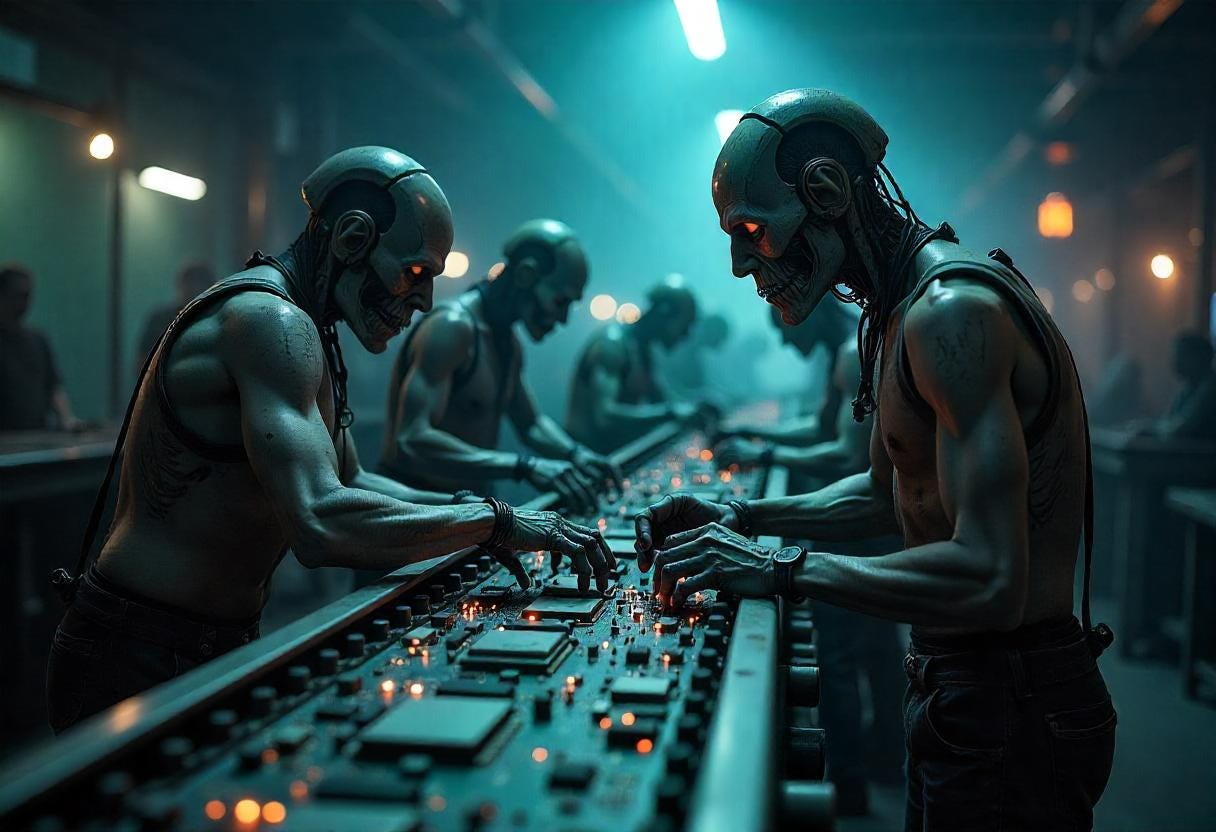
In chapter 18 of the saga, a glimpse of the relationship between zombies and robots.
The relationship between zombies and the living is well-defined and peaceful. The latter are the object of attention and handled with extreme care. The living receive the same attention in the reserve that animals destined to be devoured received on human farms before the fall of humanity. Zombies are proud to grow their food with adequate safety standards and minimal cruelty during slaughter.
But the relationship between zombies and robots is ambiguous. Like humans, zombies are also fascinated by robots. But they have a certain fear of these machines because some of them were programmed to kill zombies when the "Zombie Who Live Apocalypse" was occurring and the fall of humanity was still something future and uncertain.
After the normalization of life in the zombie city, with the destruction of the last robots programmed to kill the undead, robotics was banned. The existing harmless robots were deactivated and stored in warehouses where they were stored for a few decades.
Over time, however, the zombies realized that it was stupid to keep all those robots deactivated. After all, they could be as useful to the zombie city as slaves were useful to the city-states of antiquity, serfs were indispensable during the feudal period, and wage workers were essential for the production of profit in capitalist society.
The authorities of the zombie city created a public company to manage the stock of robots and exploit them economically. They also took care to ensure that zombie Elon Musk had no influence or participation in this business. He was already too powerful and it was not in the zombie society's interest for him to gain more power. In this regard, the zombie politicians were much more careful than the humans were when the Tesla owner was alive.
The first reactivated robots were programmed to clean the streets. Legions of elderly care robots were also reactivated to care for zombies who were in a state of advanced decay and whose bodies could no longer accept splints and screws or sophisticated prosthetics. Worker robots were also sent back to their original tasks, except for the industrial activities that the zombies had interrupted.
A small experimental division of robots was programmed to hunt down humans who eventually escaped from the reservation. But the management of the reservation's food supply continued to be done by zombies, because the zombie city authorities were convinced that a robot should never be sent to do the work of a real zombie. Robots can seriously damage human bodies and damage to the food supply should always be avoided or minimized.
No human was ever given a life and work permit to perform any function at the Public Zombie Robot Company. This is because the zombies were terrified of the robots being hacked to go back to hunting zombies. During the period in which they were active, the robots that hunted and destroyed zombies were extremely efficient.
When the new public company had sufficient capital, it began to manufacture new robots. The first models were copies of the old models. But over time, new models adapted to the peculiarities of zombies were built. However, the first humanoid robots with a zombie appearance were not well received. In this respect, zombies were different from humans.
Humans accepted robots with a humanoid appearance naturally. Zombies could live with these old robots, but they rejected robots that mimicked zombies. They found this very offensive. So the Zombie Robots Public Company was forced to recall all the robots with a zombie appearance and remanufacture them so that they would look like humans. This was a smart business decision, without a doubt.
Before the "Zombie Who Live Apocalypse", humans feared a rebellion by killer robots commanded by Skynet. Zombies, on the other hand, did not have this fear, either because they were already dead or because the zombie internet had a different architecture. Zombie-created AIs were always narrow, stupid, and limited. No zombie IT engineer would make the mistake of trying to create a godlike AI that was smarter, freer, and more powerful than any zombie. That might make sense to a weirdo like Samuel Harris Altman, but it wouldn’t be able to seduce a rational zombie.
At some point, the zombies imagined that they could create swarms of flying drones to scare away the birds. But that project was abandoned because birds are much smarter than drones, and they had a short lifespan doing that job.
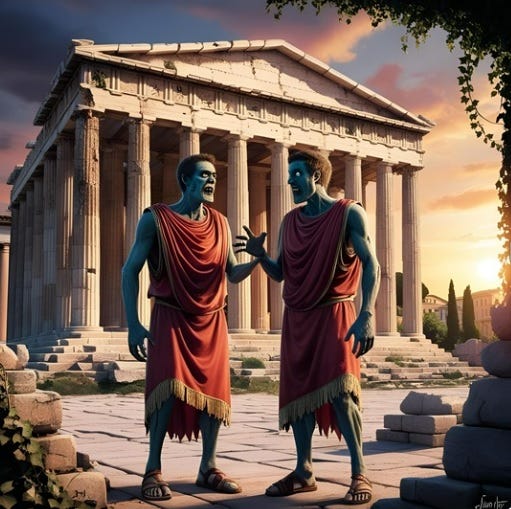
In chapter 19 the Roman zombies enter the scene.
Humans have always been emotionally vulnerable and socially fickle. Eager to belong to something prestigious, they quickly abandoned their languages, traditions and beliefs when the Romans crossed the Alps. Centuries later, the descendants of the barbarians who had proudly become Romans began to repudiate Rome.
The decline of the empire had rendered Roman citizenship worthless, and humans began to say that "barbarian" was an honorable title. But the reversion to the past was neither smooth nor without creating a paradox. The barbarian nations that emerged with the fall of the Roman Empire had to invent barbarian traditions. Over time, they rediscovered Rome's enemies (Arminius in Germania; Vercingetorix in Gaul; Viriathus in Lusitania; etc.) and transformed them into national heroes, as if it were possible to link a remote barbarian past to the post-Roman present dominated by the linguistic and cultural roots of the repudiated Romanity.
Shortly after, neo-barbarism resulted in mechanized wars that tore Europe apart, and emotionally vulnerable, socially fickle humans who loved new, invented ancient traditions created the European Union. Since they could not connect it to the barbarians, they tried to link its creation to the glorious Roman past.
Before the fall, humanity had been enslaved by neoliberalism, a system of economic and political power that values property more than belonging to any culture, nation or cultural tradition. In a world where a few have everything and many can no longer have citizenship or true nationality, strange things happen. In the US, Americans cultivated a toxic nationalism. But in their free time, they lived in tribes of cosplayers of characters from comic books and TV series. For many, belonging to these tribes was so important that they spent thousands of dollars they did not have on costumes and accessories.
In Europe, impoverished humans were divided into tribes of cosplayers pretending to be barbarians, Romans, Vikings, and medieval Templars. But there were also tribes of European cosplayers pretending to be fascists and Nazis, and tribes of European cosplayers imitating American cosplayers. All of that ceased to exist when the zombies arrived. Tragically, just before the zombies' final victory, all the humans who had been cosplaying as the fictional zombies from the TV series were accused of being traitors and eliminated. This irrational persecution made the real zombies furious, because it was a waste of potential typical food.
Zombies had their own habits and at first used the language of grunts. But after the great normalization, they developed a language, traditions and culture. Studying the history of humans, some of them were also enchanted by Rome and even found points of contact between Romanity and zombieness.
But unlike cosplay humans, zombies were extremely focused and devoted, clinging extremely rigidly to any idea. When they decided that they were heirs of Rome, they learned Latin and founded communities of common interests to live as if they were Romans. They did not abandon the consumption of human flesh and in this, Roman zombies were more similar to some indigenous people from the Brazilian coast of the 16th century than to the Romans of the ancient human world.
The Lex Frumentaria of the zombie city guaranteed human flesh to the Roman zombie communities. This was absolutely natural, because every zombie belonged to the master race and had a natural zombie right to consume humans.
However, not everything was completely peaceful in the zombie city. Zombies who clung to the specificity of their zombieness always grumbled that it wasn't fair for them to bear the cost of the Roman dream of those weird zombies who spoke Latin and wore togas. These zombies had the same prejudices that the American MAGAs harbored against the European NATOs just before the "Zombies Who Live Apocalypse".
In the temple of Jupiter Optimus Maximus Zombie a huge statue was erected. The Roman zombies were proud, but their enemies couldn't hide their envy and hatred. That's how the first zombie civil war almost started.
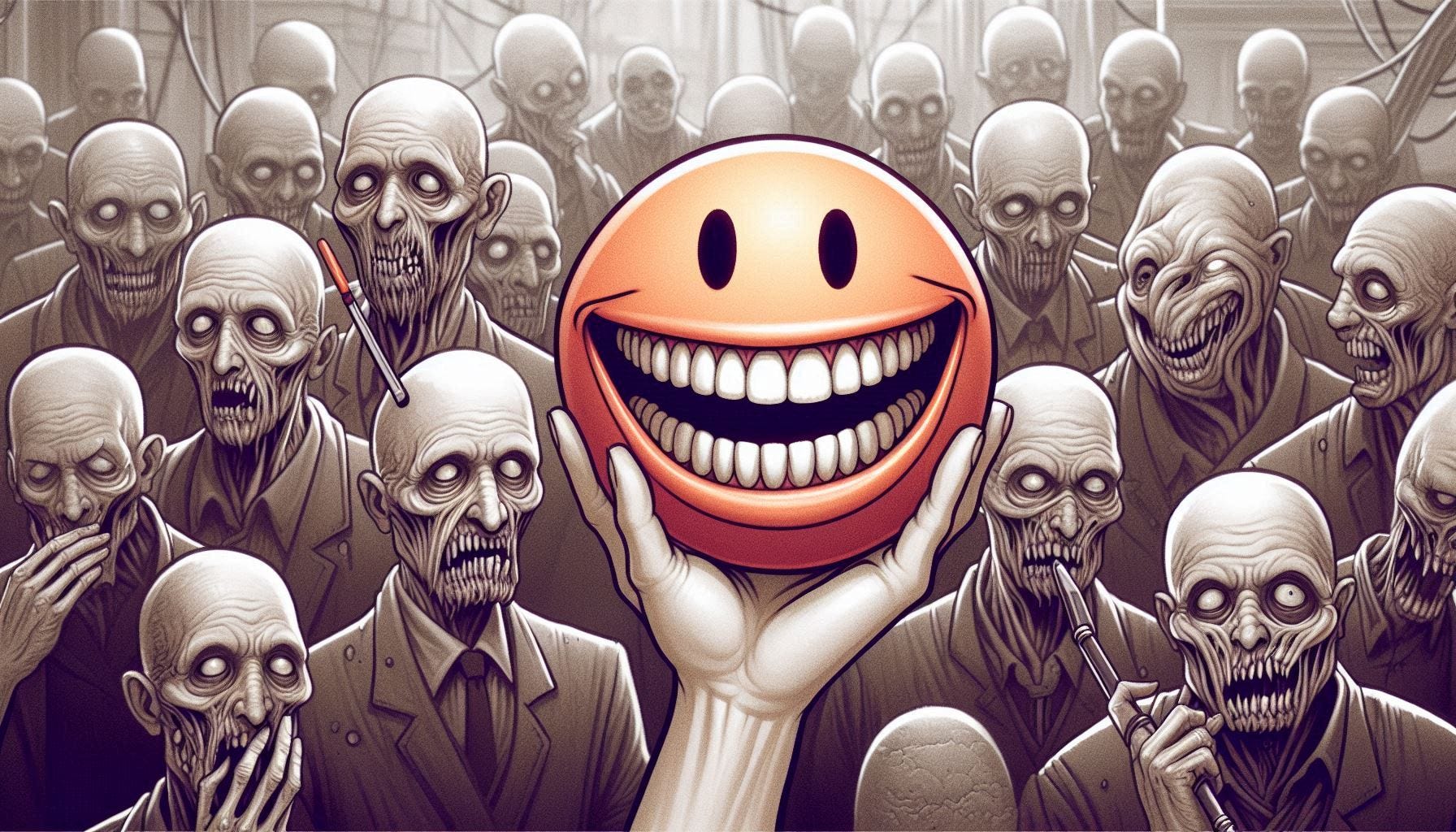
Chapter 20 is a modest tribute to neoliberal positive psychologists and happiness economists. But I think they will be bitter after reading it.
Before the fall of humanity, an event that humans consider extremely unfortunate but zombies consider the joyful beginning of their own triumph, an important phenomenon occurred. First, positive psychology emerged, not as a promise of lengthy treatment to uncover unconscious traumas afflicting the patient so that they could be analyzed and exposed by uncovering the wounds and consciously integrating them into the patient’s personality by the patient himself. No, that was too time-consuming and painful.
Positive psychologists offered a placebo: be happy despite what happened and what happened would cease to have any importance or impact on your life and this would change your personality. Of course, this had a terrible side effect, because if the patient failed to be happy, not only would he feel like a fool for having spent money on the positive psychologist, but he would feel solely to blame for continuing to be unhappy.
But the positive psychology business flourished and gave rise to the happiness economy. This advocated transferring the employer’s main management responsibilities to the employee. If the company made a loss, the blame would no longer lie with the entrepreneur or CEO, but with the employees. They had not worked hard enough, had not been creative enough, and had not been energetic enough in their work. The bonuses of business owners and CEOs should have been guaranteed, because they had prevented the losses from getting worse. But the employees suffered a triple punishment: punishment bonus cuts, humiliation sessions in front of their coworkers, feelings of personal guilt for the company's failure, and/or termination of their employment contract without any benefits.
In addition, products and services linked to positive psychology and the happiness economy had flooded the market. There was a lot of profit, because everyone wanted to be happy (or felt obliged to be happy), and this guaranteed the happiness of the scoundrels even if their consumers' expectations were frustrated. All of this ceased to exist during and after the "Zombies Who Live Apocalypse."
But after the great normalization, the zombie authorities discovered that it was better to leave the living happy in the reserve. This improved the quality and taste of their meat when they were consumed. This is how zombie positive psychology was born for the management of the joy of food. Techniques were developed and tested, and those that did not work were discarded. Those that showed beneficial results were refined and maintained.
A sign was placed at the entrance to the food reserves: “Happiness sets you free.” The older humans immediately remembered the phrase that had been displayed at the entrance to the Nazi concentration camps. But since they were the first to be devoured, criticism of the program of managing the living on the reserve diminished considerably. In addition, most humans wanted to forget the misery of humanity’s downfall and had already incorporated into their routine all that positive psychology and happiness economics nonsense that existed before the “Zombies Who Live Apocalypse.” And this obviously made it easier for the guards and administrators of the reserves to implement the techniques of zombie positive psychology to manage the joy of food.
As for zombies, the question of happiness was intensely debated. Some zombie scholars believed that this was an irrelevant question, because happiness is a subjective phenomenon associated with the lack of pain and fear of illness, loss, and death. The dead have already lost their lives, they do not feel pain and do not get sick. They eventually rot and need prosthetics, but none of this causes anxiety or fear. This is why, in addition to not crying, zombies do not smile.
But there was a part of the doctrine that believed that the morale of the zombie city would be better if the zombies smiled more. They said that the smiles of some zombies would positively influence the behavior of the other zombies. It was then that a zombie surgeon developed a simple technique to return smiles to the zombies and he managed to approve a pilot project. All the zombies selected to participate in this project volunteered, because you know zombies like novelty. And in this they are similar to living humans, even though they find this similarity offensive.
The surgery was simple and consisted of removing the upper and lower lips of the volunteers. All the patients who underwent the procedure immediately left the zombie doctor's clinic smiling. None of them came back to complain. Later behavioral studies proved that the project had no particular effect on the mood of the population of the zombie city. The normal zombies continued to do what they did, displaying the same emotionless expressions even when they encountered the smiling zombies.
On the other hand, the operated zombies caused a negative impression when they were seen by humans, which led to them being banned from working on the reservation or having any contact with food during their handling. The project was shut down, and in protest the zombie doctor cut off his own upper and lower lips. He was seen every day with a sign on the door of the administrative council in the city. The sign read:
"Only unhappiness will not free zombies from human defects."
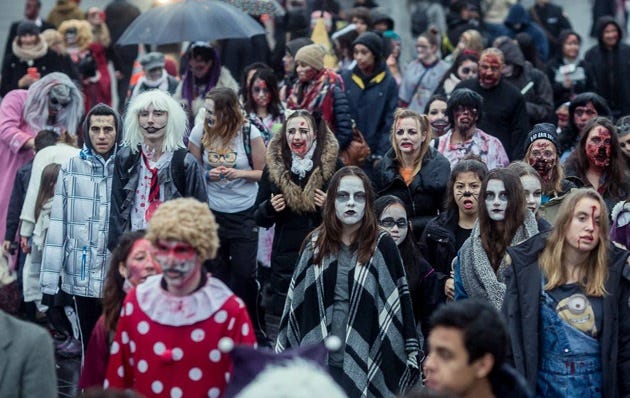
In Chapter 21, the famous march of the teenage zombies imitating the march of the human Walking Dead.
The zombies’ relationship with the human legacy of television and cinema was quite curious. For example, the zombies hated movies and TV series about space travel. They really couldn’t understand how humans could be so obsessed with something like that. There’s nothing in space that humans can reach, and nobody needs anything. Not to mention the ridiculous loud explosions in the void.
Historical movies and TV series didn’t attract the zombies’ attention either. That didn’t concern their species. And they didn’t really seem inclined to appreciate all the bullshit that humans invented about their own past. The same can be said for movies and TV series about comic book heroes.
But the zombies enjoyed movies and TV series about humans with zombies. There was something tragic about those works in which zombies were wrongly portrayed as villains. To be a villain, the character has to be aware of what he’s doing and act with malice. The fictional zombies created by humans were driven only by hunger. And it would be hard to condemn them for that. No one ever thought of morally condemning a lion, a tiger or an anaconda that devours a child. Why did those movies and TV series condemn zombies so much?
The poor fictional zombies were never entitled to the presumption of innocence, due process, a fair trial by an impartial competent authority and punishment within the legal limits. No. They were simply exterminated, as if they were insects, Jews in the Third Reich or Palestinians in Gaza. This was inhumane even by human standards.
Even so, the zombies liked those movies and TV series with humans imitating zombies. They forgave the humans, because it was clear that they did not know how to create dramatic works. In fact, they did not even act as zombies properly.
Something interesting happened in the zombie city when the teenagers discovered that the humans who liked the series The Walking Dead held marches in which they imitated the fictional zombies. This seemed funny, especially since during these marches there were sometimes fights and shootings between the participants. A group of zombie teenagers decided to hold a similar march.
When he heard about their plan, a zombie history teacher approached the group's leader and convinced him to make changes to the march. The teacher's suggestions were accepted because they were really funny. But the city authorities who authorized the zombie march that imitated the march of humans who imitated zombies in the human era were not informed of the change of plans. And this led to a serious incident.
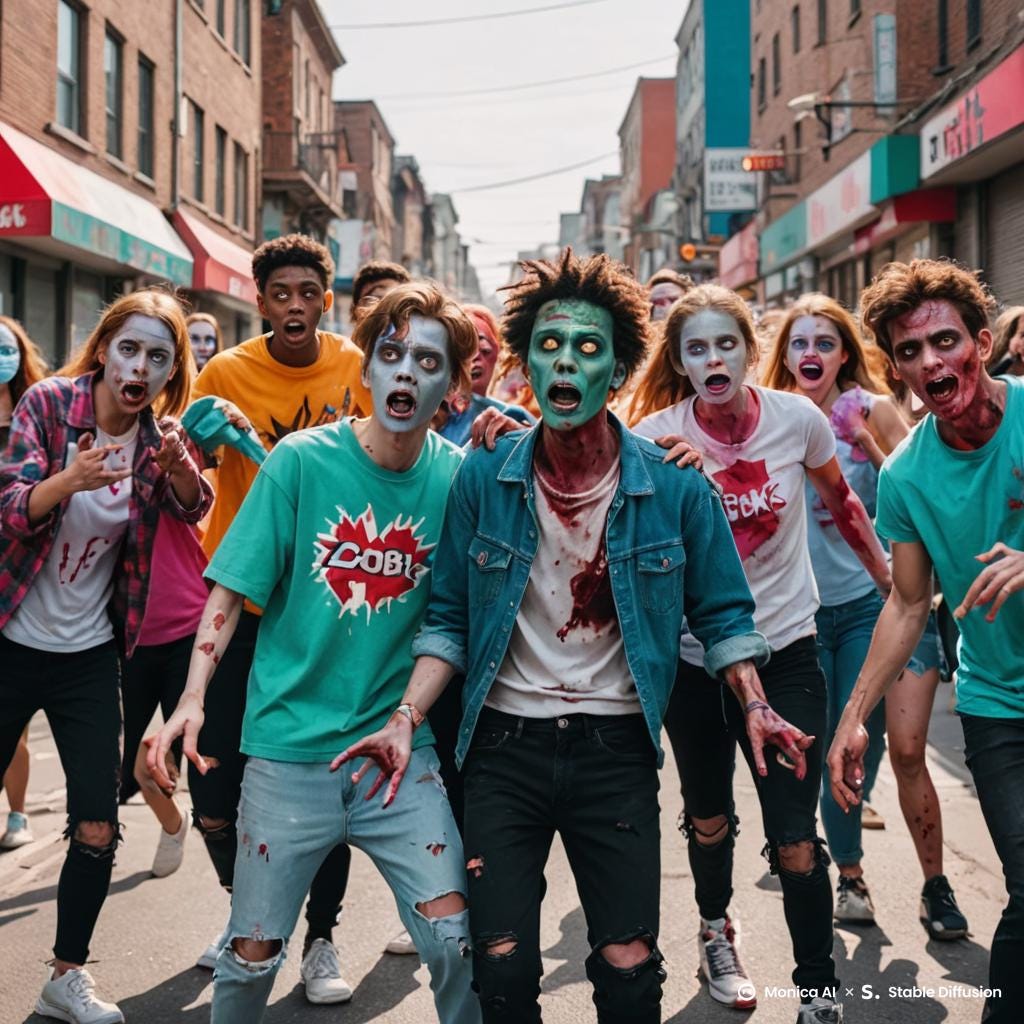
On the scheduled day, in the center of the zombie city, the young people gathered, formed a very compact square, put on their masks and began to march. They were all wearing masks of humans who were notable for acting as if they were zombies going about their business as usual before the Zombies Who Live Apocalypse occurred.
Without being warned, the zombie population was frightened and thought that this was a real protest march of humans who had fled the reservation. The police were called and began to beat the teenagers. But to the surprise of the police, the protesters did not run away in fear. On the contrary, they seemed to enjoy it very much, because you know, the dead do not really feel pain when they are attacked.
Confused, the zombie policemen retreated and a troop of robots was launched against the march. As the robots advanced in a line, covering the view of the zombie policemen behind them, the teenagers began to take off their masks and the facial recognition algorithms they used blocked any movement of the robots. They were programmed not to attack and harm zombies. When the boys put their human masks back on, the robots advanced; but then the boys laughed and took their masks off again and the robots were forced to stop. Within a few minutes, the robots' deep learning AI system concluded that this was a harmless demonstration of zombies disguised as humans and returned to base.
But the policemen could not understand what had happened and decided to attack the demonstration again. This made the zombie teenagers even happier. The population of the zombie city was completely surprised and began to enjoy everything that was happening. But the fun ended when a zombie policeman grabbed a boy by the neck and accidentally removed the mask he was wearing. When this happened, the police finally realized that they had been fooled all along. And the zombie policemen were very embarrassed, because after all, the robots had been much smarter than they themselves.
That's how the zombie teen march that imitated the march of humans who imitated zombies in the age of humans became a sensation that year. The teenager who led the march gained a lot of attention in the zombie press. He gave interviews to newspapers and podcasts, and was invited to participate in a famous TV show hosted by Zombie Elon Musk.
With fame usually comes infamy. And in this, zombies are similar to humans, because the zombie teen started saying that the idea of holding that march using human masks was his. The history teacher who really conceived that march as it happened even tried to contest this version, but he was silenced by the zombie media because the zombie journalists already had a hero and did not want to correct the story that was attracting public attention.
The authorities debated a lot about the actions of the zombie police officers and the robots. But this was done in absolute secrecy and no leaks occurred, because zombies usually manage to be more loyal than humans. The reader must be wondering who the humans represented in the masks were.
The answer is obvious, right? The list of humans honored by the zombie teenagers was long, but most of the masks were of Donald Trump, Netanyahu, Georgia Meloni, Herbert Kick, Alice Weidel, Marine Le Pen, Keir Starmer, Javier Milei, Jair Bolsonaro, Jeff Bezos, Mark Zuckerberg, Peter Thiel, etc. This tribute was very appropriate, I suppose, because you know... there is no right-wing leader or businessman who is not a money zombie.
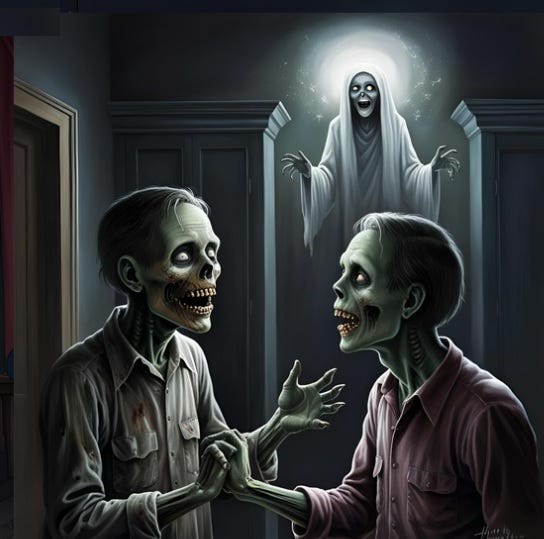
And now for you, a super special Chapter 22, in which the case of the zombie medium who deeply shook zombie society and challenged the truths about the soul established by the conclave of zombie philosophers is narrated.
It is a well-known fact that the living fear illness and death with the same intensity as the loss of loved ones and heartbreak. This has always been the raw material for the creators of religions and scoundrels who are always ready to exploit people's vulnerability for profit.
But after the Zombies Who Live Apocalypse, something interesting happened. In the reserve of living food, religion declined, because for most living humans it no longer made sense to believe in any god or religion. People knew that they were just food and that at some point they would be slaughtered and devoured by zombies.
The zombies, on the other hand, felt no particular need for religion or god. They were already dead and paradoxically continued to be alive. In a way, they had crossed the threshold that separates humans from gods and could consider themselves demigods. But they preferred to just consider themselves as the master race, because the experience of undeath forced zombies to be humble (especially when they began to fall apart and needed prosthetics).
It is a fact that in the zombie city, zombie evangelical pastors and zombie priests would go hungry. Zombies who tried to be Buddhists or Shintoists would not be much better off. Ultimately, they would all be the object of ridicule, both for zombies and for the living who were allowed to live and work.
Zombie philosophers debated for a long time whether zombies had souls or not. They reached some provisional conclusions after a conclave in which some theses were considered consensual. Here are the main ones:
1- zombies did not keep the souls of the humans they had been before, because death separates the body from the soul and the soul goes to some uncertain place unknown to the humans themselves;
2- as non-living beings, each zombie has its own personality, but this could hardly be considered a soul; philosophers, however, cannot say whether the personality of zombies is acquired or created by the zombie;
3- each zombie cannot communicate with the soul that inhabited its body before death and this was taboo (even if this were possible, zombies were forbidden from holding cults to contact previous "selves", because this had the potential to destabilize zombie society);
4- zombies do not have an ego, superego and id (Sigmund Freud), nor anima and animus (Carl Jung); it is uncertain whether or not they share a collective unconscious, because zombies do not sleep or dream;
5- when a zombie's body finally deteriorates beyond repair and all movement ceases, it becomes non-existent, and it is not possible to determine whether anything of that specific zombie's personality will continue to exist.
These theses were immediately accepted by the zombie community. Not because they were especially sophisticated, but because it all seemed like common sense. Something like "fire burns and causes pain" to humans.
When they heard about the debate and the zombies' conclusions, the humans laughed a lot. And they reaffirmed to each other that they were somehow superior to zombies. After all, debates on the same topic among humans have always been much less comprehensible, resulting in tons of books that almost no one can read or is even more confusing to read two authors who defend very different theses.
The zombies, in general, were not very interested in knowing how humans viewed their beliefs. It was irrelevant to them. And just as ants do not become aware of the anteater until they are devoured and knowledge of its existence is completely useless after they have been ingested, the zombies continued to do what they did best: live their unlives and feed on humans.
But one zombie challenged these beliefs and shook up zombie society. He held spiritualist sessions in his home. During the ceremonies, the zombie medium supposedly received the spirit that had inhabited the body of any zombie who wanted to consult with him. Everything was very peaceful, it seems: the zombie medium sat in front of the client and held his hand. A few minutes later, the two were talking as if they were intimate. At the end of the ceremony, the client left the zombie medium's house convinced that he had spoken to the spirit that had inhabited his body before death.
This was obviously not forbidden by the conclusions that the zombie philosophers had agreed upon at the conclave. At worst, they considered the zombie medium a charlatan. At best, these ceremonies were harmless; a kind of new entertainment compatible with the strange personality of this particular zombie.
But the zombie city authorities became concerned when the zombie medium announced that he would test his abilities on the food supply. He said that he could communicate with the animus or anima of any living human being and that this would open a way for the two species to share a common spiritual space. This was considered highly inappropriate, firstly because a zombie should not socialize with food. Secondly, anything that could cause any kind of rebellion in the food supply was forbidden.
The zombie philosophers immediately reconvened in conclave and approved an additional thesis that strictly forbade a zombie from receiving the spirit that had inhabited the body of any zombie and also banned any kind of socialization or contact between zombie mediums and the animas and animus of living humans. The zombie medium's career was over, but the book he wrote about his experiences was a moderate success. Because you know, zombies really like to read and they are capable of buying, reading and commenting on any rubbish that is published and advertised as sensational on TV. In this, zombies are very similar to humans.
In chapter 23 some curious characteristics of the internet and competitions between zombies.
Before the “Zombies Who Live Apocalypse”, anything was a reason for humans to compete. And hundreds of millions of them competed for likes every day on social media. Despite the epidemic of depression (and drug abuse and medication for depression, too), many liked to look happy. Being happy is very hard, but looking happy is extremely easy, right? Especially if you can control all the means of producing your images and digitally manipulate them skillfully.
After the fall of humanity, humans realized that being alive was in itself a happy thing. The fact that death was always lurking when the zombies came to harvest food in the reserve made every second of life interesting. But humans no longer competed to see who was the best at this or that or the happiest because of this or that. No competition makes sense when the human condition equals the food condition.
The zombies, on the other hand, liked eccentric competitions. They competed skillfully to find out who would be the most grotesque zombie of the year, the zombie that sported the most modest or modern prosthetics, the zombie that had lost the most vertebrae in its hands and feet, etc. On the zombie city's catwalk of fame, anything that would scare or horrify the human eye was considered beautiful, worthy of admiration and awards. In this regard, the zombie world was the opposite of the human world.
But zombies did not compete for likes on the zombie internet, nor were they interested in knowing who had been the saddest zombie of the previous year. Zombies were not sentimental, nor did they have much empathy. Nothing was really capable of making a zombie cry, especially because as the undeath progressed in time, the amount of water available in the paradoxically living dead body dried up and it would be almost impossible for a zombie to shed tears. And in this, zombies were a bit like robots.
The criteria for some human disputes used to be extremely subjective, and many competitions had their results decided behind the scenes in exchange for money, positions, prestige, or influence. There was no objectivity even on the Internet, because an absurd amount of likes could be bought and there were like farms in several countries. It is curious to see how humans like to say they are ethical and authentic exactly when they do the opposite of what they preach.
And yes, we must not forget that before the rise of Zombies Who Live, during the genocide of the Palestinians in Gaza (an ancient history that the zombies lament as an example of food waste), the algorithms of the human internet platforms actively suppressed content in favor of preserving the lives of the Palestinians and accelerated Zionist propaganda in favor of killing. The human algorithms were decidedly anti-life and therefore inadequate to the zombie reality. They are considered unforgivable because they took the Palestinian flavor out of the zombie city's menu.
The luck of humans, especially those who called themselves Christians and evangelicals, is that their omnipotent, omnipresent, and omniscient God pretended to be powerless, absent, and blind. Otherwise, humanity would have been decimated. Or perhaps that God lost patience and created the conditions for the downfall of humans and the domination of zombies. Who really knows anything about these things? But this was a question for humans, not for zombies, because we have already seen that they did not need any god.
Among zombies, competitions tended to be decided in a more objective and fair manner. In this regard, the world of Zombies Who Live was very similar to the ancient Greek world. Ethics were not a prop for them, but a necessity. Therefore, no zombie competition was resolved behind the scenes or with subterfuge typical of humans.
Interestingly, on the zombie internet there were no like farms. In fact, the zombies abolished the like button as soon as the great normalization of the zombie city took place. If someone liked something, they would go there and post the comment: I liked this because... Usually no one made derogatory comments about something shared. The zombies thought that was a waste of time.
"I didn't like this and I'm moving on in silence" was a common and quite civilized attitude on the part of the zombies. At this point, zombie society tended to be less victim of algorithmic manipulation than human society. And this made it much more stable than human society was before the fall.
The prizes that the zombies competed for were simple, with no economic value. They had only symbolic value. The humans who were eventually allowed to live and work were astonished by this characteristic of zombie society, mainly because they could not decipher those symbols. And it is not worth going into too much detail on this topic now.
A platform that became famous on the zombie internet and gained many likes was the one in which users posted photos of zombie parts that they had found on the streets of zombie society. This allowed each traditionalist zombie who rejected modern prosthetics to recover what they had lost and run to patch up their bodies with splints and screws. This service became so useful that it was adopted by the zombie city and the creator of the platform won the award for worst zombie IT engineer that year. The term "worst" used in the award was a zombie joke that only the zombies understood, of course.
Zombies didn't race cars or bicycles. That was ridiculous, but they did hold exciting worm races. Each zombie participated by proxy with a worm that was devouring him. The longest, fattest or fastest worms were awarded prizes and their owners were recognized as first-class zombies for a period of time.
"That's all guys, don't lose your heads before, during or after the next competition." This was a standard formula that ended all zombie competitions.
In chapter 24 we return to talk about zombie ecology and the flourishing of natural life after the rise of the non-living on Earth.
Zombie movies and TV shows claim that they represent a degenerate, rotten version of humanity that dominates the Earth after the apocalypse. This is ridiculous, because the truth is that humanity itself has become a degenerate, rotten version of itself before the fall. The eloquent proof of this could have been seen by humans, but they had become blind.
It was not zombies who caused climate change by burning fossil fuels. Nor were zombies who polluted the environment for profit. Zombies do not destroy forests for timber, nor do they replace them with soy or palm plantations. Humans could not live without producing more than two billion tons of solid waste per year and dumping more than forty billion tons of toxic gases into the atmosphere each year.
The tsunami of microplastics that is polluting the depths of the oceans, rivers, lakes and all terrestrial ecological niches, reaching even the internal organs and brains of human beings, was not produced by zombies. Humans did this to nature and to themselves. And they continued to produce microplastics even though they knew that they were slowly committing both ecocide and suicide of their own species.
The zombies, in turn, obtained irrefutable quantitative and qualitative proof that the Zombie Who Lives Apocalypse saved the planet from chemical, plastic and gaseous intoxication. The sustainable decline of the human population and the rational management of the survivors in the food reserve was an ecologically important fact. Of course, humans were not content with being reduced to the condition of food, but not even they could deny that industrial civilization was a deadly planetary disease that could not be cured without some kind of painful prophylaxis.
The rapid recovery of forests, rivers, lakes, oceans and a consistent increase in fish and animal populations, as well as insects, was the greatest legacy of the Zombie Who Lives Apocalypse. There is life again on Earth after the rise of the undead, said the zombies. And they were absolutely right.
The contemplative and peaceful nature of the zombies favored the resurgence of nature. The world had even become peaceful, because unlike human nations, always at war with each other to see which of them could kill more people in the name of Jesus, Jehovah, ethics, human rights or any other equally idiotic pretext, the master race of zombies did not go to war. That was unnecessary. What would be the point of killing someone who was already dead? Proxy wars between zombies using human armies were out of the question. Wasting food in military conflicts would be economically stupid, without a doubt.
The zombies were logical. They favored the preservation of nature because it even improved the quality of the flesh of the humans they devoured. It would never occur to a zombie, for example, to contaminate its food with growth and fattening hormones. Someone would have to be as stupid as a human to do that and to eat contaminated meat that would cause serious diseases. Not that a zombie could get sick like a human, but it would certainly have a worse quality of life if it ate meat that tasted bad from synthetic hormones.
Zombie poets used to celebrate the rebirth of nature by writing pastoral and epic poems. But they did not speak of an idyllic life that had existed in the past. Quite the contrary, they spoke only of the here and now. And in this they were very different from human poets, who before the fall never wrote pastoral or epic poems to ironically praise all the immense and catastrophic disgusting, pestilent and dangerous filth that industrial civilization was producing.
Humans and their achievements were viewed with a certain contempt by zombies. But we must forgive the zombies. How could they really admire humanity if humanity could only live in illusion and divert its eyes and attention from what it was doing? Zombies may be slow, but they act vigorously when it is essential to protect the long-term public interests of their civilization. Humans were very fast, but they spent most of their time in absolute political apathy, blaming even their gods for what no deity could possibly produce on such a hideous and unstoppable industrial scale.
Fortunately, the Zombies Who Live Apocalypse has occurred. Zombies salute those humans who were slaughtered and devoured today. And they will salute the living twice when they too are slaughtered and devoured tomorrow. The well-being of nature and zombie civilization depend on a well-fed zombie city. A new ecological balance had been achieved without any need for war, and that seemed good in the eyes of zombies.
On the food reserve, some leftists used to say that before the fall of humanity, an aging and debased Tony Blair looked like a zombie whenever he defended the fossil fuel industry. When they heard about these comments, the authorities of the zombie city were very offended. Such comments were unacceptable and to prevent humans from offending the zombie master race again, a new law was created. Any human who made the same or similar comments would be punished by immediate selection to be slaughtered and eaten. This was more than enough to stop the consolidation of a dangerous ideological trend on the reserve.
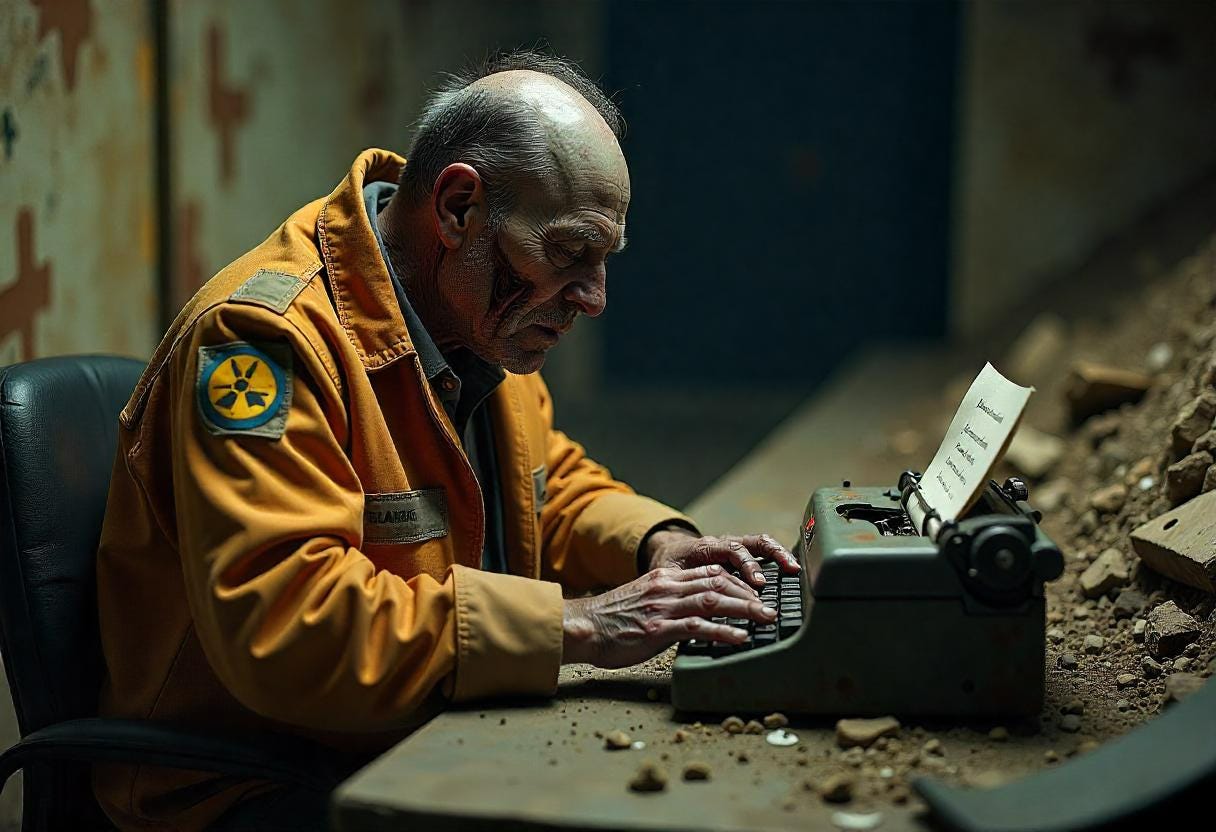
In chapter 25 the theme is zombie literature. Remember, guys: a zombie tale is a zombie tale is a zombie tale.
Literature distinguished humans from other primates. This statement always seemed paradoxical to the zombies, because they knew that not all humans liked to read literature. Some only read technical books and others didn't read anything at all or only read stupid things (like books about the Flat Earth, which might or might not be hollow). So, it was obvious to the educated zombies that humanity could be divided into primate humans and non-primate humans. This division, however, was only academic and did not have any effect on the zombies' menu.
After the fall of humanity, the books that existed continued to exist. And they began to be read more, because humans could not have access to the internet. What this meant for humans did not interest the zombies much, because they did not usually interact much with their food.
The zombies also enjoyed literature, but their books were a little different. They consisted only of lists. Lists of pleasant and unpleasant things. Lists of valuable and worthless things. Lists of beautiful and ugly places. Lists of prominent and common zombies. Lists of animals, plants, and insects. Lists of things large and small. Lists of other lists, and so on.
Humans did not understand the zombies’ obsession with lists. But the zombies themselves believed that it was vitally important to make lists, because no one could live a healthy unlife without making and preserving lists. So the zombies devoted much of their free time to memorizing lists so as not to make the mistake of overlooking the distinctions that only become possible when things are listed and classified properly.
In this respect, zombies were much like those civil servants who are especially devoted to lists of things that can and cannot be done within their assigned jurisdiction. Humans generally detested these humans, and the rapid extinction of human bureaucracy after the “Zombies Who Live Apocalypse” was a relief to the survivors.
In general, zombies were not interested in the literature produced by humanity before the fall. But there was a short human tale that was much appreciated by zombies. The name of the author of this tale, however, ended up being forgotten. But the tale itself survived and after some time it began to be told as if it had been written by a kind of mythological poet, a zombie Homer.
The tale goes something like this:
"Once someone was walking down a street full of coconut trees and noticed that a huge, dry, dead coconut leaf was hanging from the wiring next to the pole. This was an obsessive person (or a zombie) who always took the same route at the same time, making sure that everything was in its place. Anything out of the ordinary immediately caught his attention and worried him.
The day he saw that huge, dry, dead coconut leaf hanging from the wiring next to the pole on the path he walked every day, the hero was extremely disturbed. He couldn't sleep at night.
First he wondered how that dry, dead coconut leaf had gotten hung on that pole. After all, the closest coconut trees to that particular pole were a few meters away. It would be hard for the wind to have ripped off a huge, heavy leaf by blowing it through the air until it landed where it was hanging.
All of that had to have been done by someone. But the hero could not imagine who could have done that and why someone would do something like that.
In the following days, when he walked down that street at the same time, the hero began to check whether the dry, dead coconut leaf was still hanging in the same place. After a while, it seemed very natural to the hero and the only thing that mattered to him was to make sure that the dry, dead coconut leaf had not been removed from the wiring next to that particular pole.
One day, however, the hero became disturbed again. As he passed by the place, he noticed a ladder next to the pole and workers and a storekeeper talking about the object that he had to see every day. The hero stopped and listened to the conversation:
- No, I don't know who put that crap there. But you know, it caused my telephone line to break and you have to remove that dead coconut leaf from there - said the storekeeper.
- Unfortunately, we can only reconnect your phone. The object is hanging from the electricity company's wiring and only that company is competent to solve this specific problem. We don't have the authority to do that and we are forbidden from interfering with the electrical wiring. Do you understand, sir? - replied the head of the telephone company's maintenance team.
- I know, I know. But I already called the guys from the electric company and they said they can't do anything because the city government is in charge of maintaining the coconut trees on the street and only the municipal agents can remove that damned dead coconut leaf from where it is taking it away. - said the shopkeeper.
- Then the solution is simple, sir. All you have to do is call the guys from the city government. - said the worker.
- I already did that, but when they got here they said they only maintain the coconut trees while they are alive and remove the leaves that fall to the ground. They told me they don't have the necessary authority to touch the electrical wiring next to the pole. - replied the shopkeeper.
- Well... Anyway, this is not a problem that can be resolved by the telephone company. Your phone has already been reconnected and is working. If it stops working again, you can call us and we will come back here to fix everything. Okay. Bye.
During that conversation, our hero was extremely worried. But in the end he was very happy because the dead coconut leaf hanging on the wire would remain where it is. And so he could pass by there and see it every day. And so it happened.
But some time later, when he was walking down the street and getting ready to see if the dead coconut leaf was hanging in its rightful place, our hero saw it on the ground a little far from the store of the shopkeeper who had complained about the problem. This change in the landscape left the hero disturbed, extremely disturbed.
That night, he could not sleep again. He kept trying to imagine how the dead coconut leaf had fallen from the pole. That was impossible. It had already withstood several storms, always remaining hanging in the same place. Someone had torn the leaf from its place and that was absolutely unacceptable.
The next day, the hero filed an anonymous complaint with the city hall, accusing the shopkeeper of having done something he shouldn't have done and of having altered the landscape. But nothing happened, because every day the hero passed by that place and saw the shopkeeper at the door of the store and the damned coconut leaf on the ground next to the pole.
The hero then reported the shopkeeper to the electric company. No results. The same thing happened when he later reported the guy to the telephone company. That incident was really keeping the hero awake at night for a few nights. But then he started looking at the dry coconut leaf on the ground next to the pole every day he passed by. And over time he forgot that one day that leaf had been hanging from the wiring above him.
The coconut leaf on the ground became part of the landscape. And the hero began to take care to observe it whenever he passed by the place. But then a tragedy occurred: the coconut leaf, the pole with the wiring, the store and in fact the entire landscape of that part of the city was changed by a war that started for some reason. And the hero was devastated, not because of the people who had died or because the entire urban landscape had been destroyed by bombs, but because in that particular place he would never again see the same dead coconut leaf dry on the ground in its rightful place." The end.
Among humans, this story was not very successful, I must say here. Everything about it seemed very strange and paradoxically normal, something that could happen not without causing laughter or tears of pity in anyone who observed something of the same nature. But for zombies, this story continues to have a profound moral, to the point of becoming a classic of zombie literature. Worthy of being appropriated by humans and credited to a kind of founding father of post-Zombie Who Live Apocalypse literature.
It is difficult to say why zombies liked this story so much. Perhaps it contains a cadence that only zombies can fully understand. And of course, whoever reads the story can make a list of things that the city hall, the electric company and the telephone company can or cannot do in a particular situation like the one that occurs at the beginning of the story.
The ironic twist that occurs at the end of the story is obvious to any human capable of perceiving how some people are capable of hierarchizing facts in a very strange way. But this same twist was not what impressed the zombies the most. Because they considered it a natural evolution of human things because some humans are always making wars for obscure reasons and others, those who were not involved in the conflict, try to distance themselves from the conflicts by clinging to the petty details of their daily lives.
That's all that can be said about zombie literature at the moment. Sorry folks.
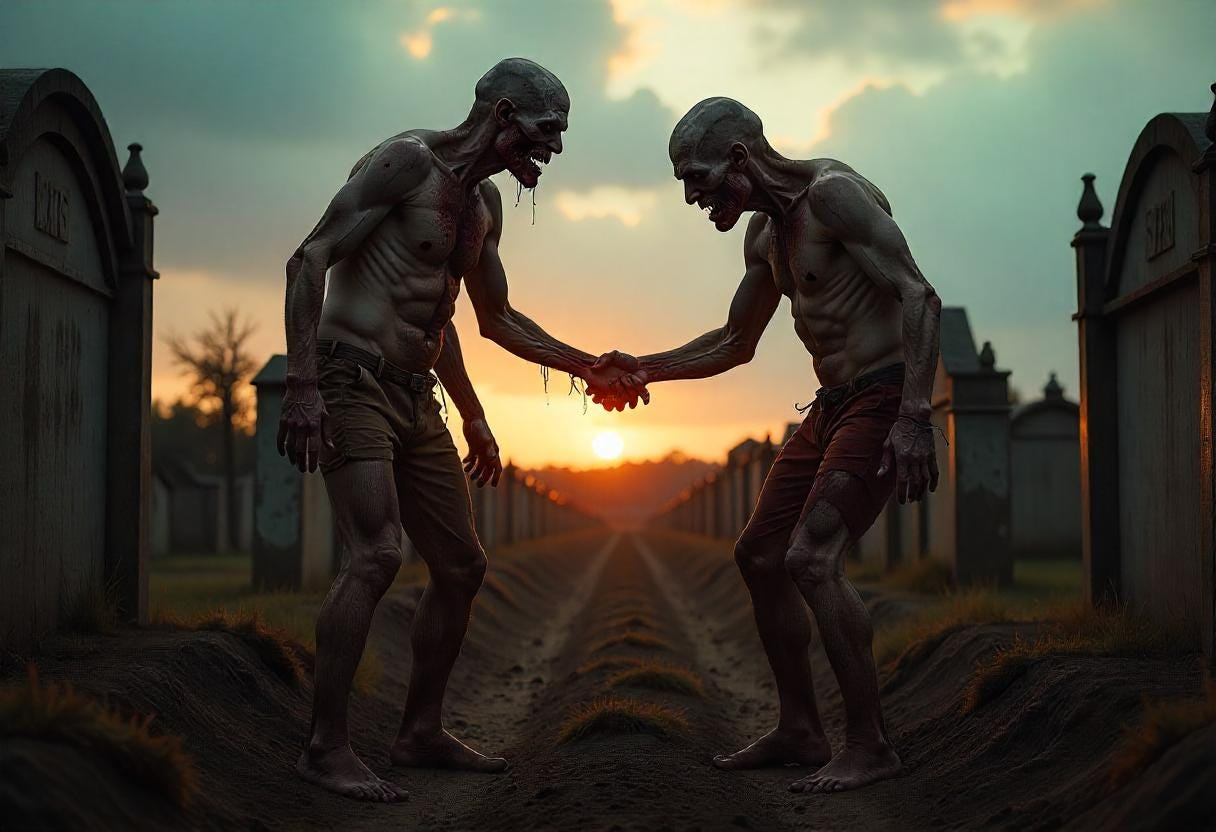
In chapter 26 everything is about the weird gifts that humans give each other and those that zombies usually give to other zombies.
A mediocre observer of the two societies, that of the zombie master race in the city and that of the food humans on the reservation, would certainly be tempted to distinguish them by their eating habits. But this would be a very obvious distinction that would not capture the subtleties of the two species and the paradoxes of the relationships between them.
To observe the interaction between two distinct species, it would be necessary to take a step back and observe first. Only then would one reflect on what would be the most appropriate analytical key to uncover the curious symbiotic relationship in which the two existed, each feeding and being fed by the other.
Both species have the habit of giving gifts. But the gifts that are given are very different. And they acquired different meanings too.
For example, human beings like to give gifts that enhance the beauty of the person receiving the gift, that will provide pleasure or be useful to them. But this is only a reality when the situation is normal. And even when things are normal, no human would think of giving a coffin as a gift to someone who is dying, despite the obvious usefulness of a coffin in such a situation.
But in exceptional situations, things get a little macabre. For example, when Adolf Hitler was trapped in his bunker beneath the Reich Chancellery shortly before committing suicide, he developed the habit of giving cyanide capsules to those closest to him. The man who had promised the Germans a thousand-year Reich now offered the priceless gift of a quick death inside a capsule.
Catholic humans used to give each other crosses. This had an immense symbolic value to the Catholics that the zombies could not grasp, because it made no sense for them to trap and torture food in such a cruel way.
Shortly before the fall of humanity, Sarco Suicide Pods had become common in Europe. Since the company that operated them was private and suicide had a cost, it became common for Europeans to give their loved ones (and even their enemies) a pre-paid ticket to death in a Sarco Suicide Pod. The suicide market had grown significantly during the neoliberal economic crisis of the 2025s. This proved irrefutably that when people can no longer live in an economic system, the system itself can be reoriented to continue surviving at the expense of their deaths.
Zombies could not give coffins, crosses, cyanide capsules or a pre-paid ticket to death in a Sarco Suicide Pod. This made no sense, because the non-living do not die a second time. Whenever this subject was discussed by zombies, they very emphatically rejected these gifts that humans used to give each other. This was very wrong, a real waste of potential food for zombies during and after the “Zombies Who Live Apocalypse”.
The gifts that zombies gave each other were more personal. They almost always symbolized an expression of eagerness to perpetuate unlife. A wealthy and powerful zombie, for example, might give someone the best leg of the healthiest child recently slaughtered during a banquet. The offering of this special food was a clear demonstration of appreciation, something that the recipient of the gift could flaunt in front of everyone before devouring the delicious succulent food.
A human who received this same gift, however, would be horrified. He would feel deeply offended, something that a zombie certainly could not understand. But the human's human reaction was something that any zombie would expect from a food being. After all, zombies knew that the main characteristic of a human was ingratitude.
This ingratitude was evident in the case of Hitler, because not all of the faithful Nazis who received cyanide capsules used their contents and some survived to tell the strange story of their daily lives in the bunker. Such was the case of Traudl Junge, for example.
Many humans who had received a prepaid ticket to death in a Sarco Suicide Pod before the fall did not use the gift either. But their ingratitude was not considered offensive by the zombies, especially since for a time it was fashionable among zombies to eat those people at banquets where a Sarco Suicide Pod was ironically displayed in the party room. But this custom did not last long, because among zombies, fashions are also fleeting.
Decrepit zombies greatly appreciated receiving splints and screws as gifts. But when someone gave a zombie a piece that he had lost as a gift, it was a supreme demonstration of friendship. "You are now an indispensable part of my unlife" was the formal formula used to thank the zombie for the gift in such cases.
Perhaps the greatest difference between the gifts given by zombies and humans is the way in which each species symbolized something given and received. But I cannot debate this question of great philosophical importance here.
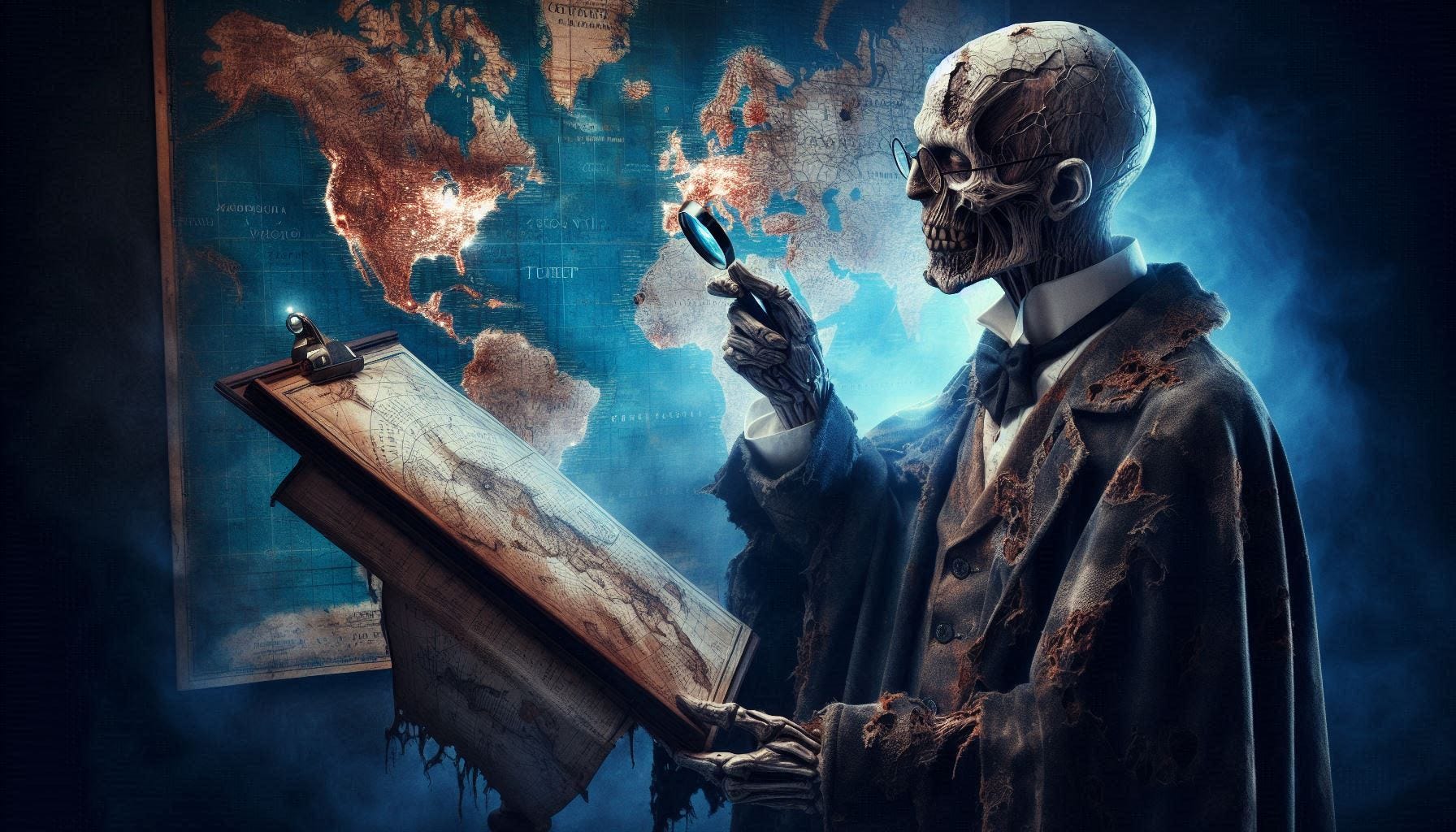
In chapter 27, the zombie scholars mock the absurdities of humanity before the fall.
It is a remarkable fact that, in general, zombies were not interested in anything that concerned human civilization. They had the same degree of respect for humans that humans themselves had for, for example, rice, beans, sausage, eggs, lettuce and carrots when they were handling them to prepare a meal.
This left humans very offended. Because despite creating cartoons in which rice, beans, sausage, eggs, lettuce and carrots could have life, language and culture, human beings knew that there is a difference between reality and fiction. But for the damned zombies, human civilization was a fiction precisely because it had been real.
Zombies, of course, cared as much about humans as Americans and Europeans cared about Africans, Latin Americans and Asians before the fall of humanity. But unlike Americans and Europeans, zombies did not harbor contempt or racism towards humans. On the contrary, they greatly appreciated human substance, especially when they were devouring them.
Some zombies, however, devoted themselves to studying human civilizations. And the more they did so, the more they became convinced that the Zombies Who Live Apocalypse had been the best thing that had ever happened to humanity. The fall that had elevated humans to the status of valuable food and cared for with extreme affection by zombies. And this had given most ordinary humans a dignity that they had not really had during the final phase of neoliberalism.
The zombies hated neoliberalism because it was inherently irrational. For example, they could not understand why human billionaires would rather try to colonize the Moon and Mars than give away a small percentage of the immense amount of money they had accumulated. It was clear that they could not spend all that money even if they lived for 10,000 years. Not to mention that it was a widely accepted fact that only zombies were truly suited for space adventure. Human life was created under earthly conditions and outside of Earth it cannot subsist for long. Only the non-living can roam dead planets or those with deadly environments.
Another thing that did not enter the rotting brains of the zombies was the curious mania of the human military to study the Iliad in Greek. No one spoke Greek before the fall, except for a handful of Greeks who do not speak English. Not to mention the fact that a war fought with bronze swords and spears thousands of years before could in no way resemble a modern mechanized war. In a drone war, for example, Hector could easily defeat Achilles. This is because cosmopolitan Troy would buy cheap and reliable Chinese drones. And the Greek drones used by Agamemnon's army would probably be American or, worse, French drones manufactured in Germany by poorly paid foreigners and they would already come with factory defects because the industries of neoliberal countries only produce Trojan horses.
Portuguese history was something that also irritated the zombie scholars a lot. They were speechless when they discovered that the Portuguese were terrified of being imprisoned and devoured by the Tupinambás. And they mercilessly criticized the royal order that prohibited cannibalism in the colony. None of this made sense. As good, pious Christians, the Portuguese ate the body of Christ and drank the blood of Christ every time they went to mass. The Tupinambá Indians also held ceremonies to eat the Portuguese. When they were devoured on these ritual occasions, the Portuguese must have felt especially honored because they were the body of Christ and the blood of Christ that had been eaten and drunk by the Tupinambás.
The English people caused even more astonishment to the zombie scholar. Under the Romans, England had sophisticated villas decorated with beautiful mosaics, baths, huge temples with columns, and entire cities supplied with clean water brought in by aquaducts and drainage systems for rainwater and sewage. Under the Saxons, England became a cluster of small, infected villages of wooden huts without running water or a sewage system. The privatization of water distribution in England before the rise of the zombies has caused outbreaks of infection due to fecal coliforms and other nasty things in the very expensive clean dirty water. Neoliberalism has brought back to England the dirty and infected times of the Saxons, but most English people at that time still hate the Romans. Aren't those English very clever, are they?
"Nonsense, nonsense. None of this makes any sense." shouted the greatest zombie scholar when he learned that Donald Trump wanted to be Pope. Why would a guy addicted to sex with several teenagers at the same time want a position that would require him to be celibate? Why would the commander-in-chief of a vast military equipped with tanks, fighter jets, nuclear submarines and aircraft carriers, drones, short-, medium- and long-range missiles possibly want to command a handful of Swiss soldiers armed with halberds? Not to mention that the Vatican’s 2021 finances (revenues: €770 million; expenditures: €803 million; deficit: €33m) were no bigger or better than those of the US in the same period (revenues: $4.046 trillion; expenditures: 30.5% of GDP; deficit: $2.772 trillion). Donald Trump humiliated himself by saying he wanted to be Pope and alienated a segment of the US electorate who saw his desire as an offense to the American presidency he was currently holding.
Humans, both ancient and modern, seemed stupidly irrational to zombie scholars. They wasted food that could feed the hungry. And they spent vast amounts of wealth to prepare for a war they knew could not be fought. Human leaders like Donald Trump, Emmanuel Macron, Giorgia Meloni, Friedrich Merz, etc. were driven by greed and fear, they manipulated statistics and news in order to manipulate the emotions of the populations they governed, but they claimed to make decisions based on reliable, scientifically gathered information. "Nonsense, nonsense. None of this makes any sense." shouted the greatest zombie scholar again.
In the reservations where they were kept, humans seemed sad. But in truth they must have been very grateful to have been freed from all that senseless civilization that they had been running, knowing that they were headed for extinction by nuclear war, the Microplastic Tsunami, climate change, the impact of a killer meteor, the Terminator Scenario or some combination of all of these hypotheses. The Zombies Who Live Apocalypse had saved humanity from itself. And now humans were healthier and could reproduce at will on the reservations because the master race would always provide shelter and food for their own food.

In the chapter 28 a little more about zombie IT engineering and the stupid habits of humans before the fall.
We have already talked a little about the zombie internet. We also stated that humans were forbidden from using the internet and we even told an episode in which this prohibition was challenged. Now the topic will be a little different.
Some humans live their entire lives in a fiction as if it were real. And others live reality so intensely that they become completely immune to any type of fiction. This is why zombies consider humans to be very strange, they oscillate between incurable schizophenia and imaginative nullity. And this obviously made them easy prey for algorithms.
Before the fall, humans had become totally addicted to AI friends, AI companions and even AI boyfriends or girlfriends. This had created immense confusion, because the living brains of humans have great difficulty in differentiating what is real and what is fiction. Humanity's state of confusion was only undone when the zombie civilization arose.
The dead brains of zombies are especially logical. They are even more logical than the AIs that humans created, with the advantage that zombies are almost always incapable of hallucinating. Some humans, on the other hand, were prone to hallucinations. And this defect of theirs, which some paradoxically considered a virtue, was greatly amplified by permanent contact with the aforementioned AI friends, AI companions and AI boyfriends or girlfriends.
Behind every AI there was always a greedy and even evil human capable of taking some kind of advantage of the vulnerability of the user of the product that he had made available on the internet. But the poor users were so out of touch with reality that they did not realize that they were being deceived and being taken down a dark emotional tunnel with no exit that often ended in a psychiatrist's office or in a coffin. The zombies greatly regretted the suicides that the AIs made humans commit, because this deprived them of tasty meals.
Fortunately, after the Zombies Who Live Apocalypse, humans no longer had these problems. Prohibited from accessing the Internet and using AIs, they were no longer victims of these machines of cognitive and emotional exploitation that were created for the personal enrichment of some IT engineers.
Zombies sometimes used technological resources created by humans before the fall. But they found it all very funny. It would never occur to a zombie to fall in love with an AI or commit suicide because of a virtual boyfriend or girlfriend. People who are dead do not feel any suicidal impulse. And since the zombies' sexual organs quickly rotted and fell away, the chemistry of their dead brains was regulated only by emptiness. But unlike humans, who suffered greatly because of emptiness, zombies greatly enjoyed it. Only Zen Buddhist monks with decades of training could achieve this state of inner peace so naturally experienced by the non-living.
AIs created by humans cannot understand or exploit the emptiness of zombies cognitively and emotionally. Zombie AIs could exploit it in some way, but it never occurred to zombie IT engineers to do something like that. It really didn't make sense for them to make the zombies' unlife worse the way the human IT engineers had made the lives of humans worse. In this regard, the master species was far superior to their human food.
One thing that really irritated the zombie city authorities was the black market for old human games. The zombie teenagers were terrible and they loved virtual games created before the fall in which zombies were shot to death. Adolescence is really annoying in any species. But in general, the authorities tolerated these teenage antics, especially since they didn't endanger the human food supply.
Fortunately, it never occurred to a zombie IT engineer to create a game in which zombies killed humans. That was nonsense; zombies took good care of their food. Humans didn't do that. Despite hunger being a reality in many places, some humans who called themselves Americans had the curious habit of making films in which they threw food at each other and posting it on the internet.
Humans before the fall were so weird, so weird that they wasted food both in the real world and in the virtual world. For example, in none of those old games could you see a human eating the zombie he killed. Why would anyone kill an animal or a non-living person if not to eat their prey?
In the zombie world, nothing was wasted. Food was sacred. But humans always cursed and insulted zombies before they were slaughtered and devoured. This was usually ignored, because when they eat, zombies neither joke nor pay attention to complaints about the food. No human, in fact, has ever stopped eating a steak because they heard a cow mooing on the TV in the restaurant or on their smartphone.
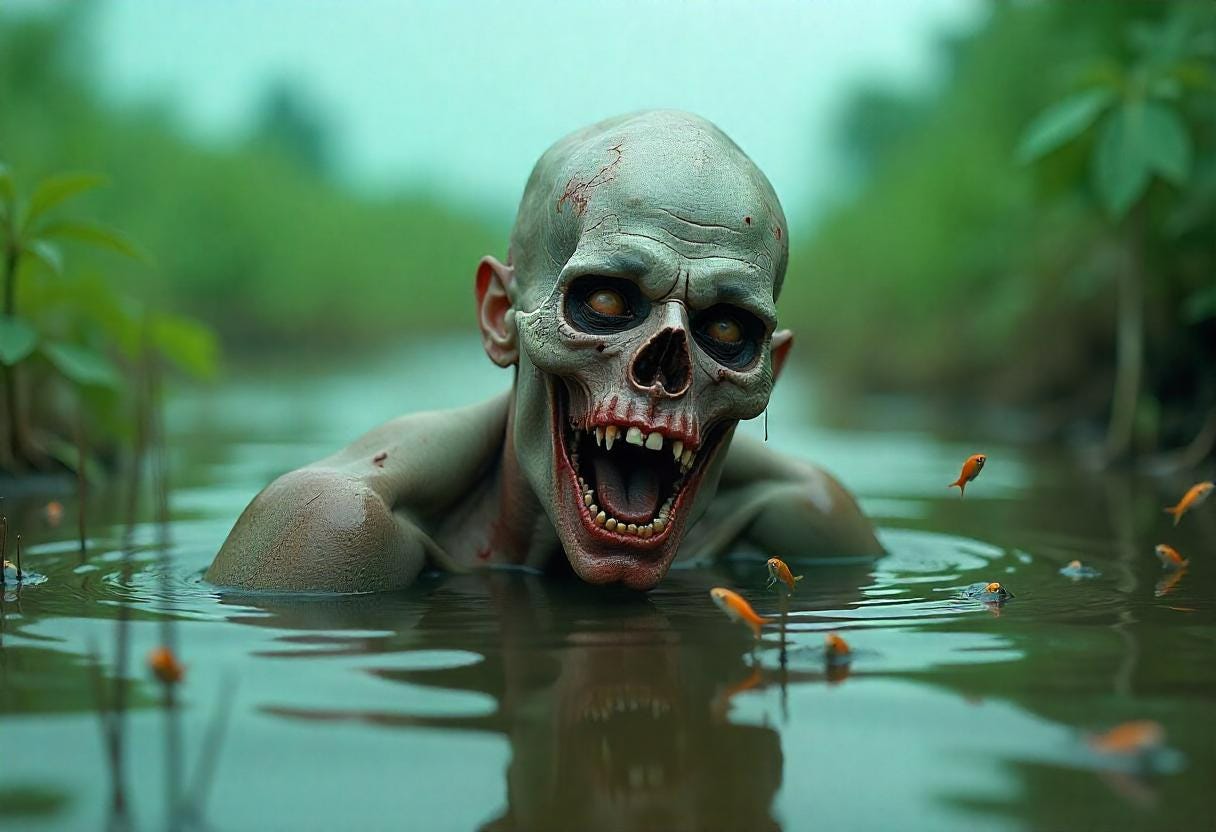
In chapter 29 the turbulent relationship between zombies and bodies of water.
In some films and TV series made by humans before the Fall, zombies walk around peacefully underwater. This would be possible because the dead cannot drown. However, even by human standards this can be considered pure misinformation.
After all, even idiotic humans know that fish, crustaceans and mollusks eat corpses. And they eat corpses so fast that if a zombie enters the water it will hardly return to the shore intact.
No, zombies definitely do not usually enter rivers, lakes and the sea. Especially if they are clean, because in these cases the small corpse-eating beings are true biological zombie Terminators. And this demonstrates an extremely paradoxical reality.
After the Zombies Who Live Apocalypse, a duality of power was established on the planet. On dry land, zombies were at the top of the food chain, because they ate humans who ate anything (including junk food with carcinogenic substances). But in the rivers, lakes and clean seas, fish, crustaceans and mollusks reigned supreme again, because they were capable of devouring zombies.
Luckily for zombies, however, this duality took decades to consolidate. After all, before the fall, humans had thrown so much garbage, sewage and industrial waste into lakes, rivers and seas that there was water dirty enough for zombies to frequent. For a short period of time, they were able to swim peacefully in the Tietê River, in São Paulo, or visit Roman ruins under the water in the extremely polluted Bay of Naples. Several coastal regions of England, polluted to such an extent by the privatized water and sewage companies in the 2020s, were also very popular with zombies because they had become unfit for any living being.
"What was bad for humans and aquatic beings could be good for a zombie." was a very popular saying among zombies after the fall. Yes, zombies made sayings. But unlike human sayings, they were transitory and subtly different. It would never occur to a zombie to say that "That which does not kill you makes you stronger", because they knew that the true strength of the non-living being depended precisely on its not having life.
The world before the fall, created by human beings, was extremely favorable to zombies. Humans were divided and almost always at war, hating each other. The environment was polluted, favoring non-living beings. There was a considerable stock of population that the human elite considered disposable. And this explains the rapid, overwhelming and unstoppable success of the rise of the zombie civilization.
A well-kept secret by the zombie authorities was the agreement made between them and the human elites. When the first zombies began to appear, American and European billionaires were convinced that they could rule a planet that would be depopulated by zombies. They even imagined that the zombies could be slaves to humans controlled by robots.
The zombies, of course, accepted the bargain, because it was very profitable. This agreement made the work of the first zombie herds much easier. Of course, at some point, when they felt strong enough, the zombies broke the agreement and devoured the members of the human elite. In this they behaved in a manner identical to the Europeans who made peace agreements with local populations in the new world during the 16th and 17th centuries.
Zombies don't like poetry, but the miserable humans felt vindicated when they saw that the billionaires were also on the zombies' menu. And some of them began to be captured by bands of humans and offered to the zombies as tribute. The zombies accepted the tributes offered by the poor and devoured them. But that didn't stop them from devouring the poor once the rich had all been devoured. The zombies' hunger was neither poetic nor fair nor selective.
But let's get back to the subject of the clean rivers, lakes and seas. They acted as a barrier to the zombies and this allowed some human communities to flourish freely and without security on the fringes of the master race. In general, the zombies tolerated this and saw these small islands as a strategic reserve of food that could be invaded by zombies wearing rubber suits left by the human divers devoured after the Zombies Who Live Apocalypse.
The sport of diving and fishing for humans on land on these islands was very popular. But it was controlled by the zombie elite, because the living had to be managed with great care so that the zombies never ran out of food. The areas of natural conservation of humans were protected by law. And I must say here that the Law of zombie civilization generally had more force than human ecological legislations that were never really able to protect forests, seas and rivers.
The human lawyers who survived the fall used to say that humanity could have survived if neoliberalism had not weakened and weakened human laws so much. But you know, no one paid attention to serious lawyers before the fall. After the fall, this was also a sad reality.
The zombies mocked the weakness of the human laws that existed before the fall. They knew that these laws had almost always been applied in a poor and biased way by corrupt judges. Human laws had no value in the eyes of the zombies because they could be exploited by them to subdue human beings. And the subdued humans themselves no longer cared about any kind of Law, except the zombie rules and regulations that guaranteed food and good treatment to humans before they were slaughtered and devoured. The zombies were admired for their food, because they actually followed these rules and regulations.
Some humans even believed that if zombies regained life and humanity, they would be better rulers than human rulers had been before the fall. This was obviously a nonsensical belief, because zombies were absolutely convinced that zombiehood was an incomparable and irreplaceable virtue. But you know, any belief held by a hopeless or desperate human can be useful. After all, hadn't the poor's belief that neoliberalism was good been extremely useful to billionaires? So zombies neither confirmed nor denied human beliefs. Especially if they were useful to zombie civilization.
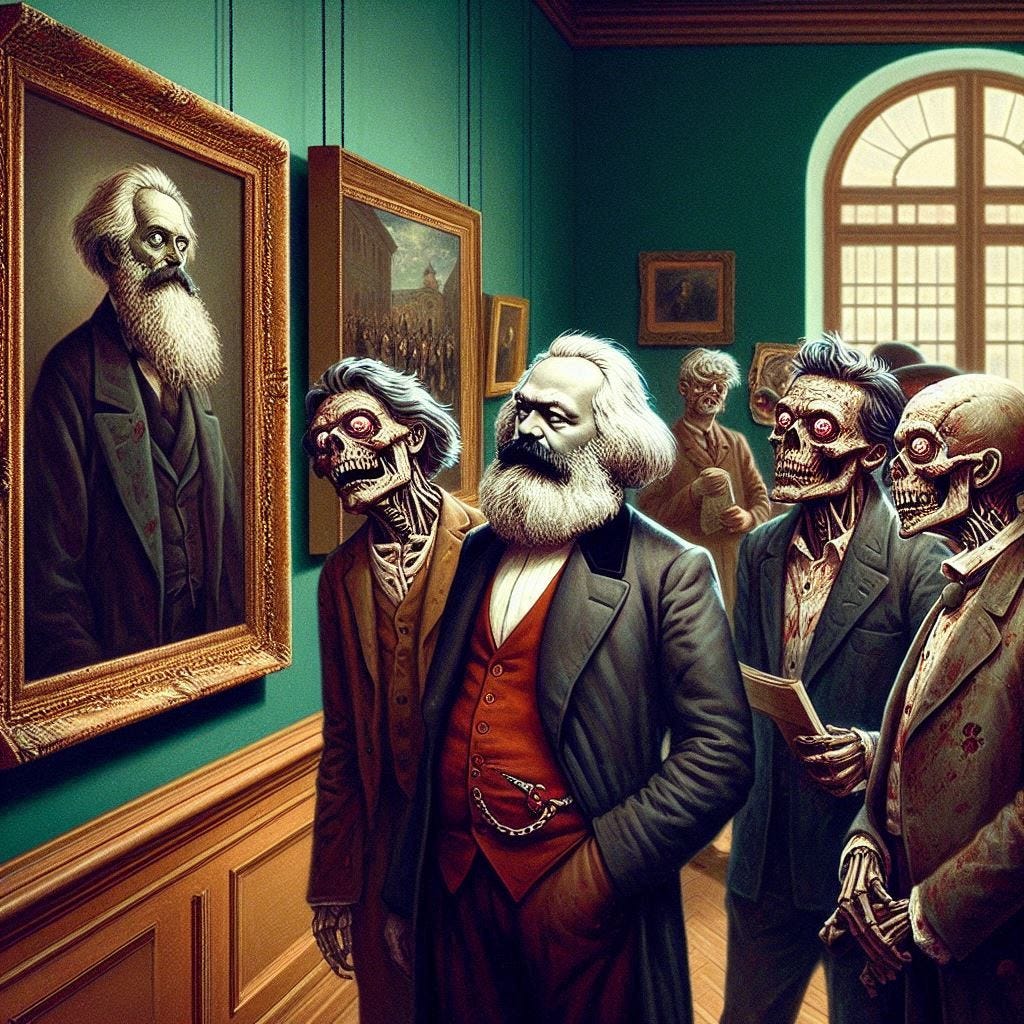
Attention readers, this chapter 30 about the communist manuscript commented by a zombie scholar is perhaps the most intellectual episode of the entire saga.
In general, zombie scholars were not very interested in the intellectual production of humans. Why should they be?
After all, despite all the social scientists that humanity has produced since the 19th century, human civilization has fallen. To the zombies, who knew their own history, it was considered an indisputable truth that their success had been accidental. It was largely an inevitable result of humanity's inability to pay due attention to sociological, anthropological and historical studies to solve the social problems that were created and perpetuated because of the perverse greed of a few billionaires, who acted like a bunch of mafiosos, and the stupid tolerance of many who preferred to remain disorganized and isolated.
But a curious event occurred that caused an exception to the rule of zombie scholars ignoring and despising human social scientists. It all started when a human scholar who called himself a communist was taken from the reservation to be slaughtered and devoured. He was carrying with him a small manuscript. This manuscript should have been incinerated along with the food clothes, but a zombie worker saved it.
Through paths that are not very well known, this same manuscript ended up in the hands of a zombie scholar. And it aroused so much interest in the scholar that he made him seek out and study the works of Karl Marx and his friend Hegel. Apparently, the zombie scholar confused Hegel with Engels, but it is not certain whether this confusion was caused by a spelling error that existed in the manuscript, the original of which was eventually lost.
Well, the fact is that the zombie scholar was fascinated by Marx's work. He considered Hegel's philosophy somewhat impenetrable after reading a few dozen pages of the Phenomenology of Spirit, a book that he quickly threw away in a dusty corner. From the notes that the scholar added to the manuscript without specifying what was his authorship and what had been written by the devoured human communist, we can say that this was the only human study that in some way became appreciated by the zombie civilization. When the annotated copy of the manuscript was published, it was already a classic and the book quickly sold out.
The zombie scholar said he was very relieved because the philosopher, Karl Marx, not the human author of the manuscript, had fortunately not been given the importance he deserved. If most humans had become Marxists, the rise of zombie civilization would probably not have occurred because humanity at the time of the fall would have been more united and less vulnerable to the Zombies Who Live Apocalypse. Marx's own work, however, was not as important to zombie society as the manuscript by the human communist that was annotated and became indistinguishable from the zombie scholar's comments.
What did the book in question say?
First, the book said that the war between zombies and humans was not a class war. This could only occur within the human species, because, not being driven by greed, zombies were immune to class war (and this obviously explained both the success of zombie civilization and the defeat of humanity). The insoluble class war in a context reinforced by neolinearism became the main instrument of humanity's downfall and the zombies' success. The zombie scholar and zombies in general could agree with this statement, because it was part of their history.
There was not and never would be a class war between zombies and humans because they belonged to different species that existed in distinct ontological, teleological and phenomenological spaces. There was more proximity between humans and any species of house ant than between zombies and humans. Even though they were unable to communicate with each other, humans and house ants could coexist peacefully in the same space and time. But the symbolic space of living beings would always be totally distinct and antagonistic from the space inhabited by non-living beings, even if both species used the same language.
Zombies would always have an advantage over humans, both because they were fearless and did not feel pain. Furthermore, zombies devoured humans and humans felt great natural repulsion and would never devour a zombie. They would starve to death if they had to do something similar. And the zombies knew how to exploit human vulnerabilities.
The fall of humanity, according to the annotated manuscript, had not only been an inevitability caused by neolinearism; it had been perpetuated by the cleverness of the zombies and the inherent strength of their civilization. The fact that they provided humans with everything they needed to live in peace and reproduce freely, limiting the slaughter of food to what was strictly necessary, had pacified relations between the species. The overwhelming majority of humans were convinced that life on the reservation after the fall was better than the competitive life before the Zombies Who Live Apocalypse.
The older humans remembered how cruel life could be in a competitive society where the State only looks after the interests of billionaires while they only think about expanding their power and personal fortune. What did the poor really have before the fall besides desires, frustrations, and the desire to live like the rich, knowing that most would never be able to do so?
Of course, no human could aspire to live like a zombie. This was undesirable, because humans are afraid of dying and would rather stay alive than die and remain undead feeding on human flesh. The lack of mobility between species (except in the case of contagion, which the zombies had limited to the minimum necessary for the reproduction of their civilization after the great normalization) was not perceived as something as bad and unfortunate as the lack of social mobility that existed in the neoliberal context before the fall.
The older ones quickly realized the advantages of the new life. They worked little, had good houses, ate well and enjoyed guaranteed medical care before being slaughtered. And the younger ones had not known any other life and did not really have much incentive to rebel. The rebels were devoured faster and everyone wanted to live as long as possible. Human civilization before the fall disappeared into the mists of history without leaving any memories like those barbarian cultures after the Romanization of Europe.
This was an end to history that Marx had not foreseen; it was paradoxical. On the one hand, the zombie civilization had turned off the engine of capitalism by ensuring that all human needs would be met. There was no reason for greed and the accumulation of wealth and ownership of the means of production, because everyone would be equally devoured as soon as their names were on the slaughter list.
In a human capitalist society, the rich could always buy exceptions not available to the poor. But no living human could really bribe a zombie. They respected their own hunger and the hunger of their species too much. This made them process food with mechanical efficiency. No exceptions for humans. They could live until at a certain point their substance would be consumed.
The egalitarian anti-capitalist paroxysm of the zombie civilization would probably have left Kar Marx quite confused, the annotated manuscript said. On the one hand, he might agree with some of its principles, on the other, he would find it repugnant to be devoured alongside an inhuman capitalist.
This classic book contained many other curious and interesting observations about the relationship between the dominant zombie species and the human food species. The humans obviously didn't have access to the book, but some of the zombie readers thought it all sounded like a big forgery. And maybe it was, because the original manuscript written by the human scholar had disappeared. Besides, it was a consensus among the zombies that human scholars were all useless. Only a member of the zombie master race could write a masterpiece like that.
The zombies had no interest in Karl Marx. Being driven by hunger and not by greed for profit, the zombie readers thought there was no point in wasting time reading a critical description of an economic system that could never possibly be adopted in the zombie city. Marx was considered a less important character than the annotated manuscript itself, perhaps a character invented by the author of the book.
There were still some communists on the reservation, of course. But they weren't very successful. People don't usually rebel when their bellies are full, and they're unlikely to rebel when they know they could be immediately devoured in the event of a rebellion. It is indeed unfortunate that humans did not become Marxists before the fall. But on the other hand, the chronicle of the Zombies Who Live universe could not be written if this had happened and the fall of human civilization had been avoided.
Chapter 31 deals with a dangerous heresy that has arisen in the food reserve.
Plato said that the dead would see the end of war. After the fall of humanity, war ended because humans became food and non-living beings did not engage in military conflict with each other.
Charles Darwin said that natural selection ensured the survival of the fittest. Zombies are much fitter than humans, but no one can say that non-living beings survive. They exist and that is all.
B. F. Skinner stated that contingencies of reinforcement are indispensable to learning. This is a truth that applies partially to zombies. They learned to manage their food properly and to limit the expansion of the zombie civilization's population because this would prevent the extinction of the species by wasting all available human-food.
But there is a catch here. Zombies are not like the birds and animals that humans could train using Skinner's theory. In fact, after the great normalization that ensured the stabilization of the zombie civilization, the zombies themselves began to use behaviorism to train humans to be docile prey while they enjoyed their lives on the reservations. But they obviously knew nothing about Skinner or his theory because the zombies learned on their own to do what was indispensable to preserve and perpetuate their civilization.
Human colonialism was based on racism. Zombie colonialism was based exclusively on hunger. The supremacy of the deadest completely contradicted the theory that one human race could be superior and dominate other inferior races of humans. Furthermore, the zombies devoured people of all races without any distinction.
The big problem for the zombies occurred when a heretical sect emerged in the colony. Some humans had convinced themselves that it would be better to become zombies than to die and be devoured. Unlife seemed like a desirable afterlife, because after all the zombies had built a stable civilization. But they insisted on refusing to turn into zombies all those who wanted to be zombified.
The members of this sect tried many things to be transformed. They attacked the guards, but the guards could not bite them because they were wearing masks. Some of them escaped from the reservation and attacked zombies in the city, but the only ones who tried to bite them were zombies condemned to lose all their teeth. Those who had teeth preferred to keep them and avoided biting and transforming the attacking humans into zombies.
Once, a group of these fanatical humans managed to drag a toothless zombie into the colony. They tried to drain its blood and inject it into their own veins, but the zombie was old and its blood had long since coagulated and dried up. One of the members of the sect managed to overcome his natural revulsion and tore off a finger from the poor zombie and devoured it. But the result was not zombification, but rather a gastrointestinal infection followed by vomiting and diarrhea.
Another human was happier. He ripped out the zombie's femur and broke it, then took a sharp piece of bone and buried it in his own flesh. This produced a curious effect. After showing clear signs of infection, he transformed into a zombie and immediately began trying to devour his friends. But they fought back and he was restrained. Some time later he returned to being a normal human and could barely remember what had happened. His friends who had been bitten had no further complications.
This curious episode led the members of the cult to imagine that there must be some kind of zombie bone elixir capable of producing permanent zombification. Those who had some knowledge of chemistry used the remaining bones of the kidnapped zombie to try to synthesize the new drug.
The disappearance of the toothless zombie prompted an investigation. And it didn't take long for the zombie authorities to follow the trail that would lead them to the heart of the human cult. The zombies who invaded the improvised laboratory where the humans were trying to create the zombie bone elixir were shaken. This was unacceptable and macabre. The members of the food race should never have imagined that they could kidnap, mutilate and perform crazy experiments on a zombie from the master race in an attempt to cross the barrier between the races without authorization.
The members of that heretical sect were quickly located and sent for processing. After they were devoured, the zombies redoubled their surveillance of the food reserve. And they made it very clear that this type of behavior would have tragic consequences for the offenders: they would be devoured after seeing their relatives slaughtered and devoured in front of them.
The zombies offered rewards to humans who reported people who followed this heresy, with the warning that false reports would lead to the informant being eaten immediately. Was this enough to resolve the entire incident? We will see in the future.
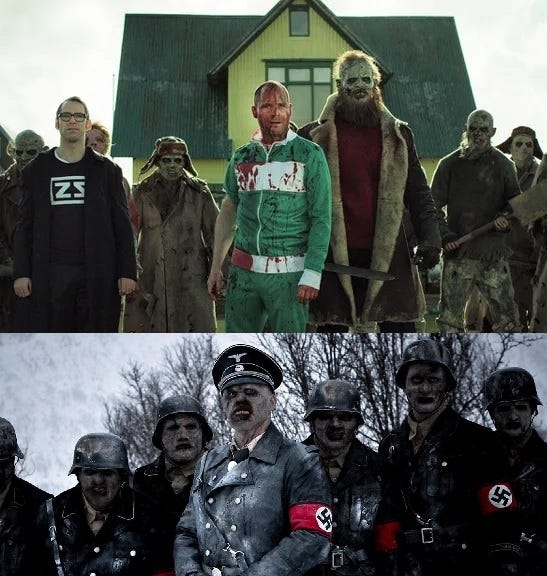
What do you know about zombie aesthetics? Maybe you know nothing and that's the subject of chapter 32 of the Zombies Who Live series.
As mentioned in another chapter of the saga, zombies greatly enjoyed movies and TV series about zombies made by humans before the Zombies Who Live Apocalypse. They developed a peculiar sense of humor watching these films and always mocked the inability of human beings to respect basic principles of anatomy and biology.
For example, they found the movie The Omega Man (1971) very funny, in which zombies were portrayed as if they were a secret society. The Christian death of the human character at the end made no sense at all. Another ridiculous thing was his immunity. Everyone should know that humans have no immunity against zombification. Not to mention the fact that this immunity is present in the character's blood.
Why wouldn't the cure for zombification be present in his urine, saliva, sweat and excrement? Didn't the humans who made the movie learn that human DNA is present in everything the human body secretes? Nonsense.
I Am Legend , the version of that same movie that was made in 2007, was no better. A black man had the pure blood to save humanity. Nonsense. Everyone knows that black men who call themselves Americans can't even save their own skins when they encounter a bunch of racist white cops.
And to make matters worse, at the end of the film the woman and her son find salvation in a walled village around a church. Nonsense. Didn't that idiot character learn that evangelical pastors like money more than people? Doesn't she know that many pastors are rapists and even murderers who support the genocide committed by Zionists against Palestinian children in Gaza? Anyone who wants to stay safe after a typical Zombie Apocalypse should go to the zombie food reserve and not to a human church.
In a film that the zombies found very funny, zombies were born in the cemetery because of the leak of an inadequately stored toxic substance. Nonsense. If one chemical substance could create zombies, another could certainly de-zombify a zombie. But that was impossible. Once a zombie, always a zombie. A zombie's reversion to human status was biologically impossible. Not to mention that zombies found it especially offensive. Why would they want to stop being part of the master race and cross the line between eater and food?
Two zombie movies made by humans were considered especially problematic by zombies. Død snø 2009 and Død snø 2014. Nazi zombies chasing humans for trinkets they stole when they were alive? Seriously. Soviet zombies defeated by Nazi zombies? Nonsense.
Zombies are not attached to things. That's a human thing. Zombies do not go to war with other zombies. That's a fact.
If Nazi and Soviet zombies could miraculously be reborn, they would be natural allies and would devour both Germans and Russians without distinction. They would also devour Poles, French, Spanish, Dutch, Swedes, Norwegians, etc. They just wouldn't devour Portuguese people, because these grumpy people who are used to eating cod with potatoes have a very bad taste.
But going back to the two films, it was clear to the zombies that the guys who made Død snø 2009 and Død snø 2014 projected human characteristics onto the zombies. This was considered offensive by the real zombies. The zombies who watched this film were a little confused. On the one hand, they didn't like the Nazis, because they had exterminated millions of Jews, depriving the zombies of their descendants who would have been a good source of food. But they appreciated the fact that they defeated the Soviets, because the success of Marxism could save humanity from falling. So the zombie scholars knew that Marx's doctrine would always represent a danger to the rise of the zombie civilization.
The TV series The Walking Dead was considered trash by zombies. In it, the zombies only grunted and always acted in an erratic, careless and irrational manner, and were exterminated as if they were ants. Zombies incapable of communicating, protecting themselves and coordinating their actions efficiently make no sense. This was and always will be a human characteristic, because human beings are selfish and fearful and these two feelings can be easily instigated and harvested by unscrupulous and bloodthirsty political leaders like Zelensky (who caused hundreds of thousands of Ukrainian deaths in a lost war and remained very much alive, safely snorting cocaine in Kiev).
But The Walking Dead made sense to zombies, as long as they considered that the human characters were the real zombies in the scene. Seeing the zombies in that TV series as human characters in general (and as Ukrainian humans in particular) made perfect sense to the real zombies. So, for this select audience, The Walking Dead took on a very different contour.
At some point in the future, perhaps some of these films and TV series will be remade in the studios of the zombie civilization. But of course, the humans will have to be played by zombie actors, because everyone knows that human actors are terrible and can't act either as humans or as zombies.
All the scenes will have to be rethought to ensure fidelity to the nature of the two species and the peculiar biology of each of them. But it is clear that sensitive issues such as the mass murder of zombies or the waste of humans by zombies themselves (it is never good for zombie fiction to encourage food waste by imitating human reality) will have to be the object of special care. The defects of human aesthetics, evident to any zombie, will be the object of refined irony. You know, zombies are extremely ironic and they love to mock the mediocrity of humans.
In chapter 33, some striking differences are noted between the "gentle zombie way" and the "human way of doing things" that led to the downfall of humanity.
The problem in the final phase of human civilization was the distance between the reality of ordinary people and the reality of the billionaires who now control politics alone. For blue-collar workers, a $10 increase in their hourly wage would be an invaluable fortune. But this makes no sense and has no importance whatsoever for human billionaires who can only sympathize with the poor condition of a millionaire friend who saw his fortune reduced to a measly $10 million.
The function of politics, at least that is what zombie scholars managed to understand by studying defeated and fallen humanity, should be to build bridges between such distant realities to prevent the widening of the gap between ordinary people on one side and millionaires and billionaires on the other. But politics could no longer fulfill this function, because ordinary people have been driven out of the space where politics is practiced by big money and they do not even realize it.
A system created to quantify successes, count money and commodify happiness has as its shadow the accumulation of insecurity, confusion and finally a terrible certainty: I am not successful or happy enough and have only managed to accumulate failures. The frustration programmatically created by the "human way of doing things" had increased so much that the Zombies Who Live Apocalypse happened and became unstoppable.
But what if failures themselves are the true signs of success? This is the "zombie way of doing things", because everything that is dead is not afraid of failure and the undead never need to nurture the same vain hopes as humans.
A person who fails to be greedy and accumulate a lot of money because he was generous achieves in life a virtue that is neither envied nor considered useful: generosity. Most humans were incapable of doing this, but generosity is a typically zombie quality. Because you know, zombies do not need to accumulate things and can perfectly well share everything, possessions and wives and husbands, without any kind of attachment or jealousy.
Someone who falls and gets up not to try again, but because he has learned that no fall is permanent has acquired some wisdom. Driven by desire, greed for profit and fear, humans were not well equipped to acquire and retain wisdom. Proof of this is that they had persecuted, condemned and murdered Socrates, Jesus and Giordano Bruno, the wisest among the Greeks, Hebrews and Italians.
If a human being could possibly realize that no victory is true when it produces a fall, the unhappiness and defeat of another has acquired something more important than anything else. He has finally acquired an exponential growth of something valuable beyond any metric and paradoxically without economic value: empathy. However, there is an inherent contradiction between the typically human desire, greed for profit and fear and the natural empathy of zombies. This explains why humanity inevitably fell and gave way to the rise of zombie civilization.
Zombies share their food equally. Of course, powerful zombies like Elon Musk and Ivanka Trump may throw occasional parties where children are served, a real delicacy. But this is quite controlled, because you know a healthy adult human weighing 80 kilos is worth more in the meat market than a small child weighing 15 or 20 kilos.
Each zombie has its preferred residence. But no zombie cares if another unknown zombie comes to its house and spends some time there, for no particular reason. Among humans in the past this was considered unthinkable and they even prevented it with civil laws and had criminal laws that punished trespassing. There is no need for this in zombie civilization, either because zombies are tolerant and empathetic, or because the undead really do not feel any inclination to degrade themselves to the low level of humans.
In a way, one could say that zombie civilization adopted a kind of real communism. But it would not be possible to confuse it with the USSR, because zombies do not need nuclear submarines, thousands of battle tanks and intercontinental ballistic missiles to impose themselves on other peoples or to defend themselves against them. The "zombie way of being" is gentle, natural and peaceful. They do not even antagonize humans more than necessary to keep them happy in the food reserve, because human happiness always produces food that is more pleasant for the zombies' palate.
When zombies gather to eat, they divide the human pieces equally. The color of a zombie or its social status really makes no difference during communal meals. Not even Elon Musk and Ivanka Trump would refuse to share with zombie gatecrashers the children they sacrifice at their VIZ parties (as the zombies' VIP parties are called). That would make no sense and would be considered extremely inappropriate and impolite.
If an accident happens, a zombie always appears to help. This is an evolutionary advantage of the deadest, because if they didn't collaborate with each other, the zombies would disappear quickly. This is a civilizational advantage that comes from a biological disadvantage compared to the living. The fact that zombies do not feel pain is a problem.
Well that's all for today, stay alive and healthy and be supportive human readers. This might be greatly appreciated by the zombies at a future meal.
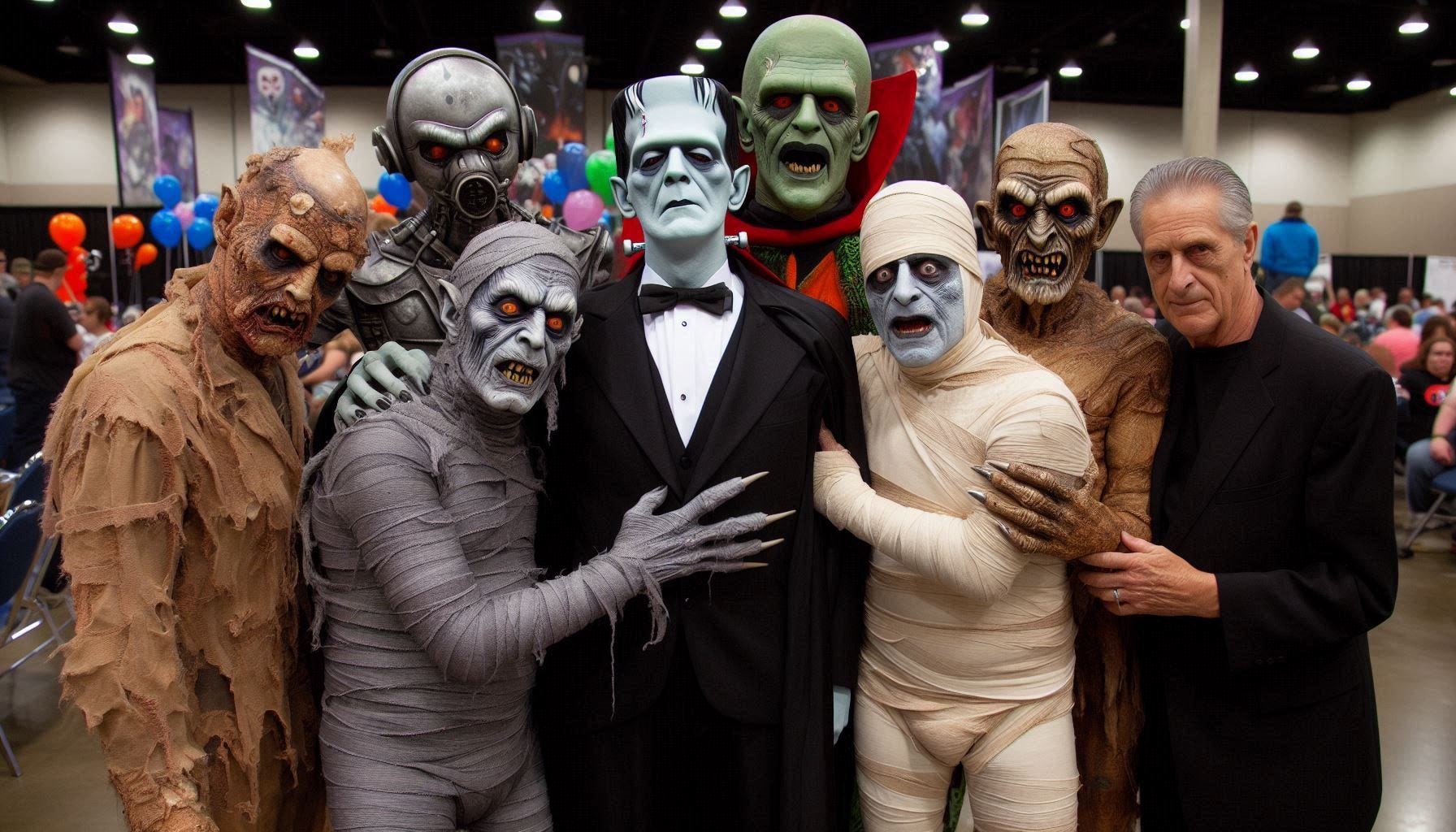
In chapter 34, everything about the imaginary monsters that humans feared and that made zombies laugh.
One of the things that made zombies curious was the fact that humans called them monsters. This made no sense, especially coming from a member of a species accustomed to committing genocide (Jews and gypsies in World War II, Tutsis in Rwanda, Palestinian children in Gaza, etc.) and that before the fall boasted of having built thousands of nuclear warheads capable of exterminating all life on Earth several times over.
Zombies eat human flesh, it is true, but they lovingly preserve the species that provides them with food. They do nothing different from what some anthropophagous indigenous peoples of the New World and Asia did around the 16th century. Something that even starving civilized Europeans did during World War II.
Furthermore, Christians have always eaten the flesh of Christ and drunk the blood of Christ at Mass. What they did symbolically, zombies actually do. So a Christian human being who was slaughtered and devoured should feel proud because he has been elevated to the status of an avatar of Christ. But no, humans were very irrational and ungrateful.
At first, zombies did not understand what the word monster meant. So they went to study the subject in the books of the fallen civilization. When they discovered its meaning and saw examples of monsters that frightened humans, they had fits of laughter. Some old and decrepit zombies lost their jaws from laughing so much.
Zombies are extremely consumed by the facticity of the world. They do not create theories, do not have irrational fears, nor do they create imaginary beings that violate the most basic principles of biology. Humans, on the other hand, do this all the time. And worse, they did not consider the scientists who manufacture nuclear bombs and the political leaders and generals who had the power to use them monstrous.
What humans once called the "balance of terror due to total mutually assured destruction" was something that truly terrified zombies. They were dead and would survive a Nuclear Apocalypse, but that would be terrible because their entire food supply would be killed. This was a bad deal for the zombies.
But back to the subject of the monsters that humans created. Here are some examples that made the zombies laugh.
Dracula was not a zombie and yet he was treated as if he could be one of the living dead. He killed his victims, when it would be biologically more natural for him to just feed on a small amount of their blood, like animals, insects and worms that feed on blood. Humans said that Dracula was a bat and that he transformed into a bat. No explanation was ever given as to why he was not a mosquito or an aquatic bloodsucker.
The Werewolf was a man who transformed into a wolf and then returned to being a man. The process of anatomical transformation occurred at the cellular and genetic level. However, before the fall, humans themselves had already discovered that evolution by genetic mutation occurs very slowly; it took millions of years to transform quadrupedal primates into bipedal homo sapiens. Why wouldn't it take the same amount of time for a human being to become a wolf? Why would such a successful evolution (which would save the werewolf from being zombie food, because zombies don't eat wolves) make that graceful animal want to return to its poor human condition? It doesn't make sense.
Consider the situation of the creature created by Victor Frankenstein. It is made from parts of different corpses and animated by electricity. The zombies knew perfectly well that once dead, a living being remained dead unless it was zombified by contagion. Frankenstein's creature was not zombified, so it could not live as a non-living being. It also could not come back to life, because dead human flesh exposed to electricity does not revive; it only burns.
Mummies were the favorite monsters in zombie joke circles. Some of them even disguised themselves as mummies to go at night to scare humans in the food reserve. Well... they did that until the authorities of the zombie city discovered what was happening and passed a law to punish this inappropriate behavior with the penalty of forcibly removing all the teeth of the zombie mummies. Humans should live in peace and tranquility, only then would the zombies' food supply be of good quality.
The zombies found the mummies funny because there was no biological explanation for their walking. They had neither been zombified, nor had they been given electric shocks, nor had they undergone genetic mutations. Why would they come back to life?
Worse, mummies came back to life thousands of years after they were dead in a world that they could not possibly recognize as their own. A mummy that woke up in the Cairo Museum shortly before the Zombies Who Live Apocalypse and took a quick look out the window would run straight to the sarcophagus and lock itself there until the end of time. There is no architectural, linguistic or cultural similarity between the Egyptians of today and those who built pyramids.
I will not talk about spirits and ghosts here, because an entire chapter has been dedicated to this subject. But to conclude I must say that the zombies sat down on the floor laughing when they discovered that humans were afraid of extraterrestrial beings. How could this have happened if humans themselves knew that interstellar travel was scientifically impossible?
Furthermore, zombies knew better than any other species that the real aliens were those tiny creatures that silently eat you from the inside. Wouldn't it have made more sense for humans to fear the tuberculosis bacillus that had become very common even in developed countries during the final phase of neoliberalism?
It is an undeniable fact. The tuberculosis epidemic was one of the zombies' greatest allies during the fall of humanity. The English, European and American tuberculosis sufferers did not have the strength to fight the zombies. And deep down they knew that they had already been sentenced to death by their countries that were taking money from the health system to invest in the war in Ukraine. Why would they defend the human species?
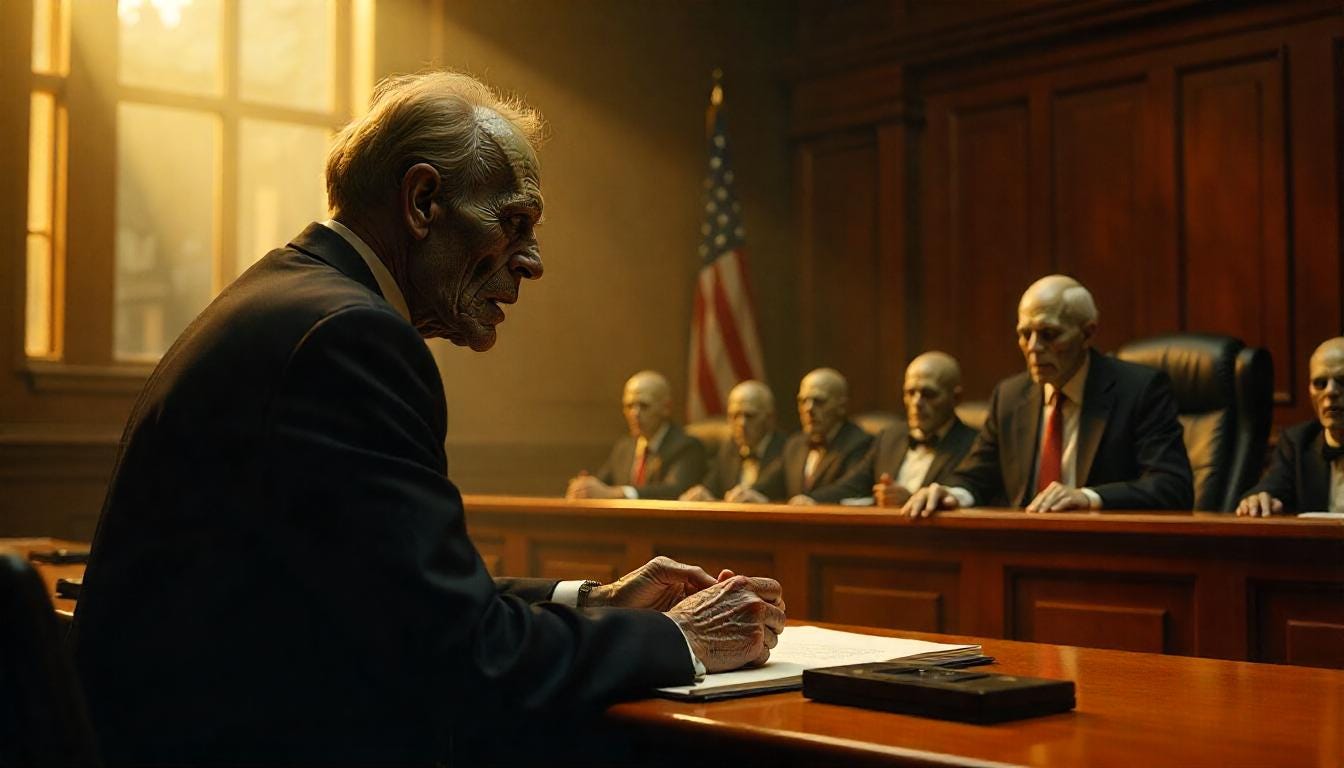
Chapter 35: the zombie civilization is shaken to its core.
We have already seen in previous chapters how extremely tolerant the zombie civilization is. The only thing that really makes the administration of the zombie city work is the concern with controlling the stock, handling and sanitary care in the human reserve to ensure the availability of food.
The rules and regulations regarding the selection and slaughter of humans are applied very strictly, as are those regarding the distribution of food to the zombies. There are no exceptions and devouring a baby requires special permission, which is usually delayed and difficult to obtain when the person making the request is a common zombie. Only cases of requests made by elite zombies are really evaluated and eventually granted.
Everything was normal in the zombie city until it was shaken by two interrelated scandals. One day a zombie who liked to watch birds with his binoculars saw a scene that made his mouth water. A few blocks from the building where he lived, he saw a zombie biting a juicy baby on the balcony of the building. OK, he must have permission, thought the birdwatcher.
But a few days later, when he pointed his binoculars at the same spot, he saw the same zombie biting another juicy baby again. This was unacceptable, a clear case of selective application of the Food Distribution Law. Irritated, he contacted a zombie journalist and reported it.
Carefully, the journalist went to the whistleblower's house a few times to personally confirm the facts. On two separate occasions, he saw the same zombie biting juicy babies. That was it, the scandal was confirmed and was printed on the front page of the main zombie newspaper. The photos didn't turn out very well, because the weather was bad when they were taken.
The authorities immediately ordered an investigation. In a short time, the bureaucratic gears of the zombie city were in motion. The baby-eating zombie has been properly identified. Certificates were attached to the case file proving that this particular zombie had never requested or obtained special permission to devour babies. The risk of black marketeering led the authorities to increase surveillance of human babies in the food reserve.
A special division of zombie police officers was assigned to observe the suspect and arrest him in the act if he ever ate a baby again without permission. When the apartment was finally broken into and the offender arrested, the police did not find any remains of the ate baby for analysis. But the case continued because of the abundance of testimonies of the criminal act committed.
On the day of the hearing and judgment of the case, the defendant was defended by the lawyer who had already become famous in a previous case reported in this saga. In the opening of the defense he claimed that the crime under investigation was impossible, his client had not eaten any baby without official permission or bought it on the black market. During the hearing of witnesses the lawyer remained quiet and did not ask any questions.
The prosecutor did the best he could and in the end requested the conviction, because the testimonial evidence was unquestionable. The neighbor, the journalist and three police officers had seen through binoculars on different days the defendant, that particular zombie defendant, biting succulent babies on the balcony of his apartment.
When it was time for the lawyer to present his case, he took a perfectly imitation baby doll out of his bag and handed it to the defendant. As previously agreed, the defendant bit the reborn baby doll and threw it on the floor. That theatrical scene caused everyone's astonishment. The lawyer got up, went to the reborn baby doll and stepped on it, to confirm that it was not alive but merely a thing manufactured in the ancient times of humanity.
"As you can see, gentlemen of the jury, Mr. Prosecutor, Honorable Judge. My client has never devoured a human baby. There is no material evidence (remains of a human baby) to prove the crime. What he was doing on the balcony of his building was biting this reborn baby doll manufactured in the past by humans that he acquired some time ago. No crime was committed and the prosecution refers to an impossible crime because fortunately human babies are qualitatively different from the reborn baby doll bitten by my client. There is no law prohibiting my client from doing this, so the defense rests its case and demands the acquittal of the defendant."
This time the judge had to give the lawyer a handshake. And he gavels the prosecutor, the journalist, the whistleblower and the police officers. It was unacceptable that so many zombies had been stupid enough to make the unforgivable mistake of confusing a human baby with a mere reborn baby doll. The case is closed, the defendant is free to go without any damaging information being added to his file. And you can take your artificial baby with you in peace.
But the case took a later turn. During the heightened surveillance of human babies on the reservation, authorities discovered that an underground zombie network was infiltrating hundreds of ancient reborn baby dolls into the reservation. This could cause a decline in the birth rate of the food supply and disrupt the future food supply for the zombie citizens.
Further investigation linked the zombie network that trafficked the reborn baby dolls to the reservation to the leader of a zombie cult that refused to eat living humans and limited itself to eating corpses. This was part of a larger plan to cause starvation among the zombies so that they would begin to change their diet to the buried corpses that were abundant in human cemeteries.
This is strictly forbidden, preposterous, disgusting, horrific and scandalous. A zombicide was being planned and carried out silently in broad daylight. Those involved should be identified and punished with all the force and severity of the Zombie Law, decreed the central administration. All old reborn baby dolls would have to be collected and destroyed, their production would be strictly prohibited forever.
In the aftermath of the scandal, a journalist hypothesized that the original criminal case involving the zombie that bit a reborn baby doll on the balcony of his apartment had been cleverly engineered by the secret service. The authorities needed to create the necessary public atmosphere to put an end once and for all to the problem of reborn baby dolls in the food reserve and to be able to suppress a dangerous and powerful faction of fanatical zombies eating buried corpses that threatened from within the foundations and perpetuation of zombie civilization.
This news did not provoke any political reaction. The good zombie citizens were happy and were sure that they would not go hungry now or in the future.
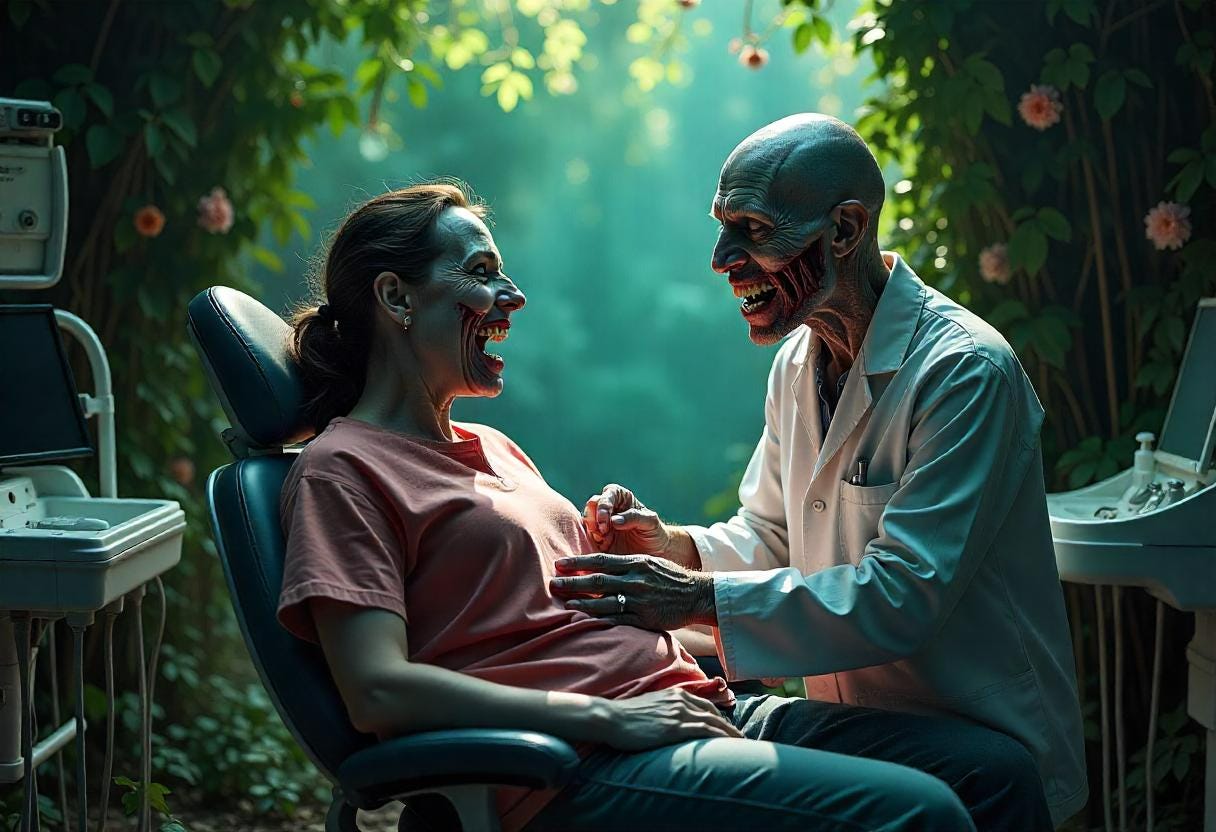
Chapter 36: A little more about zombie habits, science and techniques.
There is one aspect in which zombie civilization is not very different from ancient human civilization. It is also subject to technical automatism and technological self-augmentation. This means that in addition to inheriting some human sciences and technologies, zombies have continued to develop them.
Of course, everything now had to be adapted to the greater comfort of the non-living. This meant a colossal reorientation in the discovery of the best possible techniques to increase the comfort and prosperity of zombies. These techniques would be replicated, perfected within the framework of a technological society and adopted by everyone to maintain civilizational homogeneity. All outdated techniques were discarded, because unlike humans, zombies did not continue to produce obsolete goods and services because they were profitable.
But it must also be said that some things fell completely into disuse and ceased to be produced. For example, all human industry associated with death, treatment of corpses, burials, funeral ceremonies, tombstones, etc., ceased to exist. First, because humans were now inevitably slaughtered and devoured. No human on the reservation was to be buried. Second, because zombies had no predilection for funeral rites. When their bodies degraded beyond any prosthesis or repair, they simply ceased to exist and what was left of them was devoured by rats and stray dogs.
Humans took great care of their teeth, or at least those humans who could afford dentists, lived in countries with free public dental services or had personal dental insurance. The science of dentistry reached its peak of development with humans. But it must be said that it was only raised to the next level with zombie dentists after the Zombies Who Live Apocalypse.
It is difficult to say why zombie dentists were better than human dentists. Several aspects have to be considered here. I will mention a few of them.
First, a healthy zombie needs to devour a certain amount of raw human flesh from time to time. This is not an easy task, both because human flesh in general is not very tender and because zombies have inherited human dental characteristics. And unlike jaguars, leopards, wolves and hyenas, humans do not have teeth specially developed for tearing and grinding fresh meat.
Here is a flaw in Charles Darwin's theory of evolution. Human teeth are not the most suitable for meat consumption. However, until the rise of zombies, the human species was at the top of the food chain, devouring almost everything that walks on all fours, crawls on the ground, swims or flies. Species with dental characteristics more suitable for predation do not even come close to the capacity of the least suitable predator among the least suitable predators. In the jungle, a civilized toothless man could outlive a hyena and eventually kill, cook, chop into very small pieces and eat a jaguar.
But the subject here is zombie dentists and not the flaws in Darwin's theory. Let's get back to the subject then.
Zombies took great care and pride in their teeth. After the great normalization of the new civilization, zombie dentists began to conduct experiments and patients lined up in front of their offices to receive unconventional treatments. One of them, very popular, consisted of sharpening teeth until they looked like razors. The procedure was simple and could be done with motors and drills used to perform precision work on wood, iron or marble.
Human dentists had to use anesthesia. The equipment they used was delicate and there were regulations that determined that certain procedures were inappropriate, inhumane and considered torture. But zombie dentists did not need to be very careful, nor did they use anesthesia. Non-living beings do not feel pain and what mattered to them were teeth capable of better tearing and shredding human flesh.
A technique that was developed some time later was the implantation of animal fangs. Before the fall of humanity, human dentists implanted artificial teeth very well, but zombie dentists could go further. They were not limited by the patients' original dental characteristics. After all, zombie patients were no longer human.
Zombies with fangs from jaguars, leopards, alligators, wolves and hyenas became common. Elite zombies preferred to implant teeth from moray eels or small sharks, because these are far superior to the fangs of any land predator.
Zombie science went a step further when scientists began combining stem cells from human teeth with stem cells from the teeth of animals, sharks and moray eels. The adoption of this technique had to be much debated by the authorities of the zombie city.
On the one hand, this scientific and technical innovation could greatly improve the "quality of unlife" of the zombies, because the new teeth would not be implanted but would grow naturally in their mouths. On the other hand, this technique could jeopardize the city's policy of having all the teeth pulled out of zombies who committed violations of the rules and regulations created to ensure the fair and proper management of the food supply in the reserve.
A consensus solution was presented by an expert in the sustainable development of the zombie civilization and quickly became the new regulatory norm. The technique developed by scientists and dentists to grow new fangs in the mouths of patients could be adopted, but dentists would have to keep specific records of the patients who underwent the treatment and send copies of them to the central administration. Any zombie who underwent the new treatment would be subject to the penalty of losing his lower jaw if he violated the rules and regulations, which in the case of a normal zombie would lead to the extraction of all the teeth of the offender.
Of course, none of these new techniques developed by zombie dentists were available to humans. They would continue to receive conventional dental treatments. There was no point in improving the teeth of humans who were destined to be eaten. Furthermore, the teeth of zombie prey would have to remain naturally incapable of causing serious injury to other humans. Otherwise, this could lead to damage and loss of the zombies' food supply.
Chapter 37, now with you a genuine science fiction story produced in the zombie civilization.
When the Zombies Who Live Apocalypse occurred, people who were not eaten where they lived either fled and were eaten elsewhere or survived and were moved to designated locations where they would be stored until they were slaughtered. Thus, after the fall of humanity and the normalization of humans' concentration on food reserves, the zombie world city had a huge amount of empty properties.
Some of these houses and apartments were used by zombies. But most were abandoned and began to be slowly reclaimed by nature. Bands of zombie teenagers would occasionally invade these properties looking for interesting things from the time of humans.
Over time, a market for human antiquities began to emerge, because in addition to making lists, some zombies also like to collect things. And there are those who love to collect things from humanity before the fall. In this sense, they resemble those Americans who are obsessed with collecting Nazi trinkets and the Europeans who collected Zionist things after Israel was devastated by American missiles.
Rare things found in empty houses also caught the interest of zombie scholars. They were very fond of human manuscripts that somehow resonated with zombie culture and sensibilities (we have already seen this in a previous chapter). This eventually began to be exploited, because zombies also have a great inclination to falsify old things. Zombie forgers do not do this for profit, but simply because they have a lot of free time and enjoy playing tricks on scholars.
This is how the manuscript of a science fiction story supposedly found in a human house and written by a human before the fall began to circulate in a restricted manner only among scholars. This text, unlike the other one, which ended up being widely distributed, was considered heretical and its content was labeled as inappropriate and highly harmful to zombie civilization.
The story describes the encounter between humans and an extraterrestrial being. This being, who visited Earth in his salamander spaceship, was very different from everything that humans (and zombies too) knew about the anatomy of beings with high cognitive capacity and technical skills. He or it was a bipedal salamander, approximately 2 meters long, whose feet were more adapted to the aquatic environment than to the terrestrial one. To compensate for this deficiency, the salamander's powerful tail worked as an additional support and balance point, in the style of kangaroo.
The respiratory apparatus of the extraterrestrial salamander was also adapted to the aquatic environment. It projected out of the head below and behind the ears. As a result, this space traveler used a liquid artificial respiration equipment consisting of a translucent helmet filled with liquid, tubes and the water oxygenation mechanism attached to the salamandernaut's back. But this artificial equipment was elegantly glued to the salamander's body with an impermeable biological glue developed to provide the perfect symbiosis between the he or it, the helmet and the respiratory machine on its back.
An inattentive observer could not distinguish between the salamandernaut and his equipment, considering them to be one and the same thing. And this caused great astonishment to the humans who encountered this space traveler. Upon exiting his salamander spaceship, the salamandernaut tried in vain to communicate with the humans. But the sounds it produced and those the humans produced were qualitatively very different. Then the space visitor made a sequence of signals.
First he raised his left arm and displayed a closed fist while extending his right arm with an open hand. Then he raised his right arm with a closed fist and extended his left arm with a open hand. Then he raised both arms with open hands and closed his fists. And finally, the space salamander extended both arms with open hands.
It is impossible to say what this specific sequence of signals really represented to the space visitor, but the humans understood it as a sign of non-hostility and approached. The salamandernaut did not retreat and accepted the first contact. And this first contact between humans and the visitor ended up being lethal.
Inadvertently, one of the humans touched the biological glue that connected the artificial respiratory liquid device to the salamandernaut's body and then put it in his mouth. The substance, which was harmless to the salamander race, was extremely toxic to humans. Within minutes, the human was suffocating and died. The death of their friend greatly shocked the other humans who were there. But they were even more surprised when the dead man got up, started walking and trying to bite other humans. And rveryone who was bitten ended up turning into a zombie.
The story continues, but I will make a brief interruption. This particular story challenged the established and accepted belief that the first zombie and mythical ancestor of zombies was Lazarus. The idea that the zombie race had been born from a trivial accident that occurred during the first contact between humans and a salamander from outer space was beyond bizarre. It was unacceptable and deeply heretical.
The plot of this manuscript contradicted zombie logic. Even though zombie scholars accept as plausible the hypothesis that a human being would be stupid enough to pick up something potentially toxic and put it in his mouth to taste it, the blessing of zombiehood could never have migrated from space to earth inside a biological glue.
But to continue the story contained in the manuscript... Upon seeing what had happened, the salamandernaut was extremely disturbed. He or it immediately ran to his salamander spaceship and flew away. Humans began to believe that one day he or ir would return to cure the disease that had spread. But the zombies in that story wanted the opposite because the cure in this case would mean the irremediable end of zombiehood. Many other things are said in that manuscript, but I will end here.
This forbidden tale was evidently a forgery by an amateur zombie writer. But the scholars believed it to be a genuine human antiquity, because zombie writers usually wrote lists of good and bad things, which is what good zombie literature is all about. Worse, some of the scholars were convinced that the author of the text had reported an episode that had actually occurred or might occur in the future.
Zombies did not believe in fortune-tellers, premonitions, or prophecies. But they knew that humans were all half wizards and witches and that among many false and absurd things that did not come true, human fortune tellers and prophets prophesied true things.
So for the safety of zombie civilization, the zombie scholars decided to ban the widespread circulation of this heretical tale. Fortunately, zombies are terrible at keeping secrets, and the story eventually ended up in the pages of the zombie newspapers. Unfortunately, the revelation of zombie secrets usually does not produce the devastating effect that credulous scholars imagine. And in this, zombie society is very similar to human society.
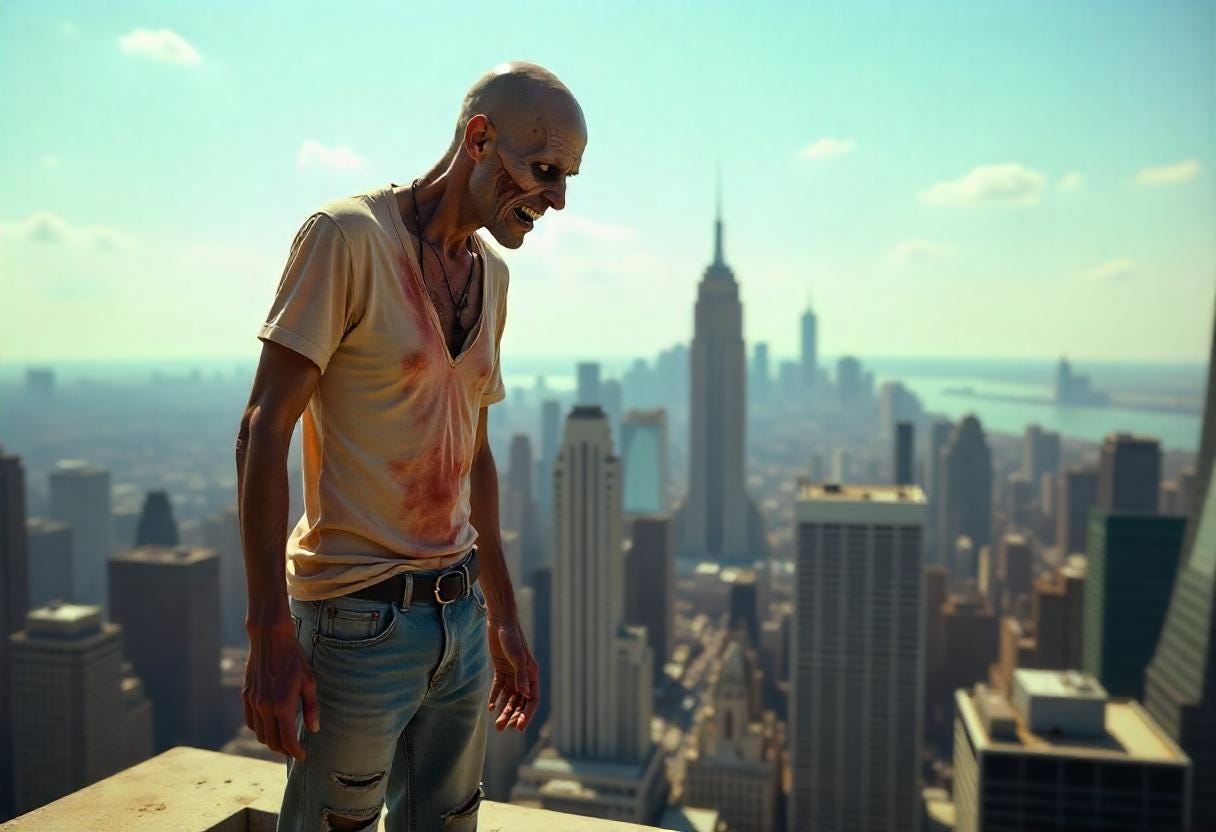
And now for the mysterious case reported in chapter 38.
We have seen in previous chapters that zombies do not feel pain, nor are they driven by greed for profit, hate, love or sex. The stability of zombie society is not shaken even when the founding myths of zombiehood and their core beliefs are challenged.
A careful observer would say that the zombie empire would last longer than the Roman Empire, because you know the Romans began to decline at the very moment they conquered Egypt and Asia Minor. Until then they had consumed only wine. Then they began to haphazardly consume "certain hallucinogenic substances" that are now considered illegal in many countries. The empire fell because the emperors and their staffs were getting high all the time.
Something similar happened in the United States and Europe before the fall. But that is not what I want to talk about here. The point is that humans have a tendency to use "certain hallucinogenic substances" whether they are legal or illegal and this quickly compromises their ability to connect with reality and act correctly according to the circumstances. What is good for those who want to get high usually is bad for the country that is run by drug addicts.
This was a problem that zombies did not have either. No drug capable of producing hallucinations in living people was really capable of having an effect on them. They always kept their feet on the ground and their eyes on the reserve, doing what was necessary to best manage the main food source of the zombie civilization.
The only danger that really threatened the 1000-year zombie empire was the extinction of human beings. The lack of food (and of specimens to replenish the zombie population through contagion) would be an insoluble problem. Fortunately, zombies managed to achieve a balance between slaughtering/consuming humans and the natural replenishment of the reserve population. Everything indicated that the zombie civilization would surpass the Roman civilization.
But then strange things started to happen. For no particular reason, zombies began to throw themselves off the tops of buildings. Some of them were filmed scaling the buildings like King Kong and then throwing themselves into the abyss to certain destruction.
This greatly intrigued zombie scholars. After all, this behavior made no sense. Zombies did not commit suicide. That was something only humans did, usually to escape lives they considered desperately unhappy and hopeless. Each zombie was, for lack of a better expression, the hopeless abyss itself. Happiness or unhappiness played no role and had no power over them. They kept moving forward, even if they left a piece of their life behind. Did their natural self-destruction prevent them from voluntarily destroying themselves? That is a question to be investigated in the future, because here the subject is another matter.
Since we have said that zombies are, in a way, the abyss itself, a curiosity deserves to be mentioned here. Zombies are not and will never be admirers of the philosopher who warned the reader not to gaze too much into the abyss because the abyss would gaze back into him. From the zombies' point of view, Nietzsche made two unforgivable mistakes: the first was to assume a distinction between the observer and the abyss that cannot exist in the case of zombies; the second was to attribute zombieness to the abyss, something it does not have. Unlike some German philosophers, zombies never disregard the principle of non-contradiction, or at least that is what they think.
As I said, zombies were throwing themselves off the tops of buildings to certain destruction. No explanation could be given for what they did without a careful forensic analysis of the corpses. This was ordered and began to be done. Then a truly important breakthrough occurred. A zombie was captured before it could throw itself off the top of a building. It was tied up and brought to the laboratory. Comparative analyses between this specimen and the post-mortal remains of the others led to the creation of a scientific hypothesis that was tested and confirmed shortly after.
As you can see, zombies can perfectly well use one or another zombie as guinea pigs. But they do this very rarely and always very selectively; only zombies in an advanced stage of degradation are "requested" for these experiments. During the Cold War, humans did this on a large scale with other human beings without even warning the victims. Populations of cities and even entire islands were contaminated with nuclear test waste because the American, European and Russian military did not want to take any risks but wanted very much to know what would happen to them in the event of a nuclear war. A real scandal that never resulted in anyone being punished.
But as I was saying, the zombie scientists discovered that their species was facing an existential risk. An enemy capable of destroying in 10 years the zombie empire that was supposed to last more than 1000 years. An enemy that could not be seen, that was spread by the wind, but that fortunately did not affect humans in the food reserve.
The cause of all those zombie incidents that involved throwing themselves off the tops of buildings was a type of fungus. When it settled in the zombie's brain, the fungus began to grow until it completely dominated the victim. It was a type of parasite similar to Ophiocordyceps unilateralis that affected ants, turning them into zombies.
The scientific literature on humans before the fall called this parasite that affected ants "zombie fungus." But scientists thought that this name was inappropriate and even offensive. Furthermore, the new strain of Ophiocordyceps that was discovered that was infecting the zombies did not turn them into zombies. What it did was remove from them the main virtues of zombiehood. They began to behave erratically as if they were suicidal humans. So scientists gave the new type of Ophiocordyceps the nickname "human suicide fungus."
Scientists are still studying measures to contain and combat this epidemic. The administrators of the zombie city were very concerned when a fake news story began to spread among the zombies. According to this conspiracy theory, the "human suicide fungus" had been developed in a laboratory by a human scientist in an illegal laboratory that existed on the reservation.
In order to contain the harmful effects of this fake news and prevent groups of zombies from being organized to attack the reservation, a prophylactic measure was adopted. The zombie IT experts developed an AI to search all the databases that predated the Zombies Who Live Apocalypse in order to cross-reference them with the names of the oldest inmates on the reservation. All those who had any kind of scientific knowledge of genetic manipulation would be located and immediately selected to be slaughtered and eaten. All of this was done with wide publicity and the stability of the zombie society was guaranteed.
The war against the "human suicide fungus" is just beginning. Perhaps the subject will be returned to in a future chapter. If the reader feels the immense urge to climb to the top of the building and throw himself to his death, remember that only a zombie infected with a specific type of Ophiocordyceps does so. A human does not need to imitate a zombie infected with that fungus.
Chapter 39, consequences of an epidemic that continues unstoppable.
After the outbreak of the fungus epidemic commonly known as "human suicide fungus" two things happened. The authorities of the zombie world city decided to take extreme measures to prevent zombies from jumping from the tops of buildings.
The police division of robots empowered by AIs was mobilized and programmed to wall up and block the entrances of unoccupied buildings. In many of them, robots were guarding the roofs to prevent zombies from jumping to destroy their precious non-living bodies. Access to the roofs of occupied buildings were locked with chains. Bars were installed on the windows of all apartments above the second floor.
Every possible and imaginable precaution to preserve non-living beings was taken. Regulations on proximity and contact between zombies were approved. Scientific research began to be done on a way to neutralize the effects of fugus. Topical antifungals were created and began to be tested, but their efficiency was still not satisfactory.
Candida auris, a fungus resistant to human drugs, began to be researched as a biological weapon against the epidemic. This was a promising research, but it was immediately interrupted. It could put the zombies' food at risk if Candida auris somehow contaminated the food reserve. And the zombies were extremely careful with their food and its quality.
Until a cure was found, the zombie civilization would continue to mobilize and do whatever it could to overcome the crisis. Various rumors began to circulate among the zombies and among the humans in the food reserve. The authorities also had to deal with this. Among the zombies, the Internet began to be monitored and silently cleaned of conspiratorial trash. But among the humans, who were forbidden to access the Internet, nothing was done. It was good for the humans to keep themselves entertained by inventing theories about the end of the zombie civilization and talking among themselves about the subject. This paradoxically kept them calmer and less prone to any kind of rebellion.
Zombie scholars organized a seminar to discuss the crisis. They needed to anticipate the long-term effects on civilization if no cure was found. They debated intensely on ways to perpetuate zombie civilization by developing social techniques to prepare zombies to live with the "human suicide fungus" without depriving them of the virtues typical of zombiehood.
These discussions sometimes became eccentric, absurd and downright funny. Not because zombies were especially gifted with a sense of humor, but precisely because they did not. For example, one zombie scholar asked to speak and said very seriously (these are his words, not mine):
- We need to figure out a way to preserve zombie civilization by any means possible. I propose using Elon Musk's zombie rockets to implement the "zombie seed project in space." Pods containing frozen zombies will be sent into orbit and scheduled to return to Earth in a few decades. So, if our civilization has been wiped out by the fungus, upon returning, the frozen zombies will be able to return to undeath and restart our civilization.
- This program is technologically possible - another wise zombie replied and added - but it is very expensive, a real waste of resources. Zombies do not need to be sent into space to be frozen. They can be frozen naturally right here in the Alps, Antarctica, Greenland, Siberia, the Andes or the Himalayas.
- Yes, yes, yes. They can be frozen naturally. But the problem is the climate change that humans have set in motion and that has not yet been completely stopped. The Alps, Antarctica, Greenland, Siberia, the Andes and the Himalayas continue to melt and the zombies that adhere to the "frozen zombie seeds" program may end up thawing out prematurely. We need a technologically reliable solution, the perpetuation of our civilization cannot be left to natural chance.
A third scholar stood up and said:
- Zombie seeds frozen in space or trapped in a melting glacier... All this is nonsense. Who really needs these solutions? What we need is to build underground shelters in some desert where the zombie seeds will be deposited under ideal storage conditions. Deserts don't melt, they just grow. This is a natural guarantee for the "zombie seeds in the desert" program.
As you can see, zombie scholars are capable of being as pedantic and ridiculous as those human scholars who didn't blush with shame when they said that humanity should colonize Mars. Colonize Mars? Really? There's nothing on that planet but desert with no breathable air.
But there was one thing that the zombie scholars and the human scholars were very different from each other. The zombies genuinely believed that they could turn their absurd projects into genuine technological solutions. But the humans spouted worse nonsense only because they were paid to do so. Some were blinded by the desire to save zombie civilization, while others could only see their own greed for profit and notoriety.
Back to the point. The fact is that the zombie seminar did nothing more than produce an ambiguous and generic report. No specific solution managed to gain consensus. And in the end, the zombie scholars came to the unspoken conclusion that it was best to let the zombie scientists do their thing. Maybe they could find a scientific solution to a problem that was not ideological.
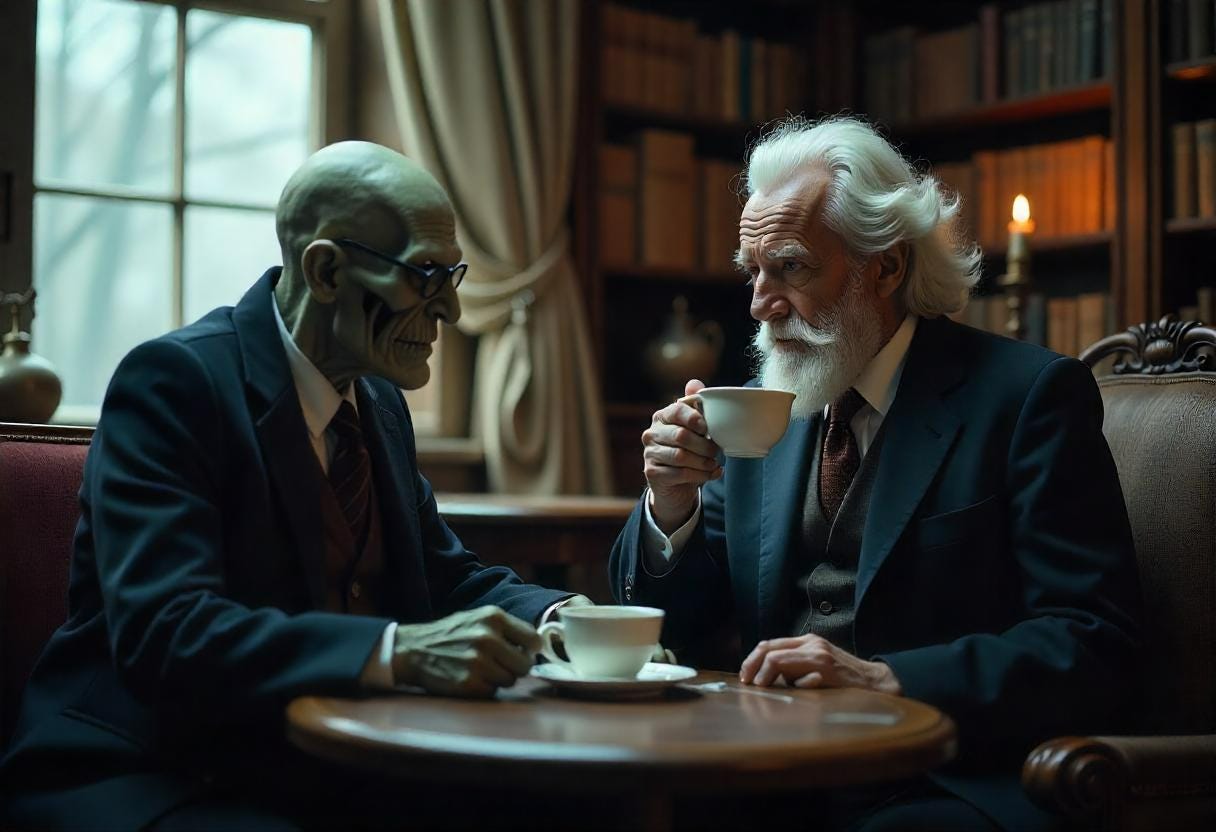
Chapter 40, time of lockdown during the epidemic.
The increase in unpleasant incidents during the epidemic of "human suicide fungus" has led the authorities of the zombie city-world to adopt lockdown measures to stop the spread of the disease. No problem. Only the living are anxious and melancholic because of the confinement. For zombies, it doesn't matter whether they stay at home or go out, as long as they receive a regular portion of human flesh at home
It was during this period that a new type of fast food made from human flesh emerged and became famous. The food industries began to process the raw material and distribute it in the form of pizza. The robot delivery men only had to slip the disk of concentrated processed human flesh under the doors of the zombies' houses once a week and voilà the lockdown was a success. Some time after the lockdown, the fungal infection began to decrease until it disappeared completely.
Every zombie made the most of the lockdown. Some sat on the couch and stayed there the whole time. Others walked around the house because walking around aimlessly was what they did. Cleaning-addicted zombies cleaned their homes until they were sparkling clean. Zombies tend to do more and better at home what they did before the lockdown.
Teenage zombies spent all their time playing online video games. Some had a blast playing a new game in which zombie heroes shot humans and earned extra weapons and ammunition and human-flesh pizzas for continuing to play. Artist zombies painted magnificent paintings to display in galleries in the future. And forger zombies created fake works of art worthy of being considered real. In this regard, they surpassed human forgers, who are always sloppy because they believe that all rich people who collect art are sloppy. This is not entirely untrue.
Studious zombies buried themselves in their studies, and one of them produced a truly fantastic essay on the work of Immanuel Kant. He was surprised to come across a passage from the work of this human philosopher who managed to rise to the heights of the greatest zombie thinkers when he said that:
"The problem of organizing a State, however difficult it may seem, can be solved even for a race of demons, if they are intelligent."
The zombies were not demons, but they were intelligent enough to form a State capable of lasting more than 1,000 years. Humans were neither demons nor intelligent because during neoliberalism, the last phase of the decline of human civilization, they destroyed States that had been laboriously built, creating the indispensable conditions for the rise and success of the Zombies Who Live Apocalypse.
Although he was considered strange by the humans of his time, Immanuel Kant could almost be admired by civilized zombies. In his work Perpetual Peace he seemed to anticipate some of the virtues that naturally became reality after the great normalization of zombie society. But he made an unforgivable mistake when he said:
“Since the natural aim of the human race is to make constant cultural progress, its moral aim must be conceived as progress towards the best. And this progress may occasionally be interrupted, but it will never be interrupted.”
The ultimate goal of the human race was to become zombie food. But this goal could not be achieved by humanity itself without the help of zombies, of course. Man was not and could not be an end in himself as Kant imagined; he was a means to an end only, as Machiavelli suggested (although Machiavelli was not a zombie, he was absolutely right about that).
Human beings only really progressed when they began to be slaughtered and devoured and fed to the new master race, whose cultural progress is precisely the perpetuation of tradition. Zombies do not need to progress, because they are the ultimate final stage of all natural and unnatural evolution. Men are born and die, born and die for hundreds of thousands of years. The civilizations they created rose and fell, rose and fell. As soon as they were elevated to the status of food for the zombie civilization and began to be treated with all the dignity that vital food deserves, human beings stopped falling, even though they continued to die when they were processed for distribution of human meat pizza.
Immanuel Kant defended perpetual peace, but men never stopped making war. The fall of humanity was a result of the contempt that men felt for Kantianism, the love they felt for the profits that a new war provided, or both. And this explains the great grain of truth in the joke that made the zombies laugh the most:
- Do you know how to identify a bloodthirsty human ex-owner of shares in an arms factory in a bunch of old humans on the reservation? He will always be the first human to speak well of stoicism and badly of Kantianism.
But let's leave the ironic Kantian and Machiavellian zombies alone. They are adorable and terrible. They never disappoint a human being. Before the fall, humans told jokes about cannibalistic Indians:
- Do you know that one-armed girl? asks a Tupinambá Indian.
- Yes. I'm eating that girl in pieces. - answers the other.
This human joke would only make a zombie laugh if it were told by a human while he himself was being eaten in pieces. Well... actually, even the zombies knew that this was an impossibility, because the pain and fear of being devoured would never make someone tell ridiculous jokes. Was this another zombie joke? Maybe, who knows.
Chapter 41, zombie civilization returns to normal.
After the fungal crisis, the zombie civilization flourished again. The authorities began to make the necessary calculations to replenish the zombie population through contagion, taking into account the reproductive capacity of the human population and the replenishment of the stock of healthy and tasty human beings in the reserve. Food sustainability occupies an extremely important position among zombies and they do not intend to exhaust their food source.
But let's leave these bureaucratic issues to the zombie bureaucrats. This is a subject as dry as administrative law in a country like the USA at the time when it was governed for the second time by Donald Trump. This president, secretly admired by the zombies for having created the conditions for the decline and final fall of human civilization and the rise of the zombie civilization, acted like a true fungus devouring the administrative rationality of the modern state.
Under Trump's command, the USA lost all capacity to govern itself according to general and abstract laws applicable equally to all citizens. The best civil servants, specialists and bureaucrats were dismissed and their public positions were eliminated. That country began to be governed by small notes containing personal favors, as occurred in the South American banana republics in the 19th century of the human era.
The extreme personalization of administrative power in the USA led to total irrationality, with the creation of privileges and suppression of rights typical of a sclerotic absolutist monarchy. No coherent public agenda could really exist in that time and context. This greatly accelerated the process of political and institutional degradation, destroying the fragile social cohesion that existed to the point of violent rupture. The nuclear civil war between Americans was Trump's greatest legacy and this explains why he was admired by the zombie civilization.
After the fall and destruction of the USA by the nuclear civil war, the Americans who survived were all suffering from radiation sickness. They constituted the first and main source of food for the zombies. In the food reserve, Americans contaminated by radiation could not be kept alongside healthy humans without this producing some kind of discomfort. Although they love radioactive human flesh, zombies were forced to devour every infected American, down to the last specimen. The end of these people meant that "peace could be made possible" and that symbiotic coexistence between the zombie master race and the other humans destined for confinement in food reserves was possible.
But all that is in the past. Let's talk a little about the present.
Readers may be wondering if there were gender issues among zombies. The answer is no, because zombies had no sexual urges and their genitals quickly rotted and fell off.
Zombies did not play sports. Dead muscles do not need to be cared for, nor can they be built up with exercise. Not to mention the fact that zombies considered it a waste of time to run on a treadmill or pedal an exercise bike without going anywhere. When a zombie walks or pedals, it wants to go somewhere, even if it does so for no particular reason.
Did wasting energy in a gym make sense to humans? This is a mystery that zombies cannot solve. A mystery, it must be said, that only fills the empty heads of some studious zombies. In general, zombies have no interest in the good or bad habits, healthy or not, of a species that caused its own decline and fall.
What could past humans really teach zombies? Nothing. At this point, zombies looked at the fallen human civilization with the same contempt that Canadians, Mexicans, Africans, Brazilians, Europeans, Russians and Chinese looked at Americans in the Trump era. Who could really look at the US at that time and not laugh?
At the bottom of the food chain, humans played the only role they deserved. And that was enough for the average zombie. And just as no human would ponder the ancestors of a roast turkey at Christmas dinner, the zombies devoured pizza made with human flesh without asking esoteric and unnecessary questions about the ancestors of the humans slaughtered and processed in the food industry.
There is something truly virtuous about zombie civilization. It does not look at the past seriously nor is it fooled by promises of a wonderful future. Both of these things have done great harm to Americans and to human civilization in general, and this was the only lesson that the rise of the zombies had taught the zombies. They had risen to the top of the food chain on the backs of human frailties and did not need to make the same mistakes. They would stay where they were because all they cared about was eating human flesh and the present moment.
Okay folks, that's all for today. This chapter is very short because nothing that concerns Donald Trump, Americans, and human civilization really matters in the zombie universe. All of this is very irrelevant, the subject of bad stand-up jokes at best.
Chapter 42, the normality of zombie civilization kills and buries several human philosophers.
One of the reasons for the downfall of humanity was the completely unregulated internet in the US. The other was the US's insistence on preventing the European Union, Brazil and other countries from regulating American internet platforms as if the internet were an extension of US territory. This set in motion international political fractures that resulted in the Zombies Who Live Apocalypse.
Studying this fabulous prehistoric period that led to the rise of the zombie civilization, zombie scholars came across a series of paradoxes that humans, so weak in intelligence and logical reasoning, would never be able to understand. Here are some of them.
Hobbes said that man was a wolf to man. But when the zombies arrived, humans immediately began to say that the zombie was the wolf to man. This is stupid, because the decline and fall of humanity was not caused by zombies but because men themselves were metaphorically devouring each other as if they were wolves.
Zombies devour humans, it is true. But after the great normalization of zombie civilization, they do it in an organized way. No human has ever seen wolves raise prey in captivity, handling it carefully and always taking into account the sustainability of the food source; only zombies do this.
If zombies were wolves like humans, they would devour other zombies. This does not happen, because unlike humans, who are always inclined to create a hierarchy in society and to demean some humans they hate or despise, zombies consider themselves equal and treat each other without considering privileges created for political and economic reasons. And they share equally only one food source: human flesh.
In this sense, even though they are civilized (and in any case more civilized than humans ever were), zombies are very similar to the noble savages mentioned by Rousseau. Kindness, tolerance, and rejection of war and civil violence among zombies is a typical virtue of zombiehood that decadent humans have failed to understand. Humans hated each other because of nationality, sex, color, political party, religion, ideological preferences, etc. All of this seems very strange to the naturally good Rousseauian zombies.
Of course, the kindness of zombies does not extend to the beings they devour. But this can also be said of humans, who have always fed on meat without worrying about the miserable life that chickens, sheep, and cattle led in captivity. And we should also mention sport hunting here, because something that zombies greatly dislike is the waste of food.
Of course, zombie scholars have come across Voltaire's work. But they have not been able to understand why this philosopher wrote a letter to Rousseau, saying, "Monsieur, I have read your latest book; it makes me want to get on all fours, like an animal." Nonsense. Man is a bipedal animal, and so is the kangaroo. Whales are animals, and yet they never get on all fours.
Why didn't he say to Rousseau: "Monsieur, I have read your latest book; it makes me want to crawl like a serpent"? That would make much more sense, because Voltaire was always very venomous. And he never failed to crawl out of a problem, running away quickly whenever someone tried to step on him.
Hobbes offered men a knowledge about humanity that humans were unable to take advantage of. Rousseu foresaw in savages the virtues of zombies that men fortunately did not have the intelligence to perceive. Voltaire mocked his adversaries as if he were superior to them, but that makes no sense because he was not a zombie. And only a zombie can truly say that he belongs to the superior master race destined to dominate the planet and the solar system. Okay, this is a little weird, but who can really condemn the arrogance of a species of undead that subjugated the human species and turned them into cattle.
The intrinsically virtuous characteristics of zombies explain why they also cannot accept Nietzsche's theories. The German philosopher believed that a man with an unbreakable will to dominate could be master of himself to reach a higher stage that only a zombie enjoys without making any effort. Nonsense.
If Nietzsche were right and faithful to his doctrine, he would have voluntarily abandoned life before becoming a miserable and submissive version of the proud and virile man he had been in his youth and maturity. Any average zombie can see, therefore, that the true Nietzschean follows someone who has become a specter of himself, a man with an insane mind imprisoned in a sadly decaying body. How could anyone be proud of that?
Would Nietzsche's philosophy of the hammer have saved humanity? Well. That is just a zombie-like rhetorical question. The fact is that it did exactly the opposite, because it prevented men from seeing that not everything is a nail and that not all nails need to be hammered.
That's all for this chapter. Next time you come across one of these human philosophers, take a step back and start thinking clearly, precisely, logically, and dispassionately like a zombie. But remember, to actually do this you will have to have become a zombie first, folks.
In chapter 43, special edition. Historiography and human historians are reviewed by a zombie scholar who has a curious theory about the connection between Mahabharata and the Bible. An object from the fallen civilization is revered as a treasure by the zombie civilization.
As I said before, zombies are generally not interested in anything related to their prehistory. What they call prehistory is what humans called the history of humanity before its fall. Only zombie scholars dedicate themselves to these subjects. And they do so with a sense of humor that no human historian has ever had or can have.
Humans held their own history in high regard, except when they turned it into an instrument of mobilization for war. In this case, all the vices and crimes against humanity committed by their country were narrated as virtues and generous actions. And all the virtues and generous actions of their enemies were narrated as vices and crimes against humanity. The examples of this were so evident that zombie scholars had great difficulty in calling human historiography a serious activity practiced by people capable of finding and checking relevant past facts using reliable sources to narrate them in a didactic and impartial manner.
Impartiality is very difficult, by the way, when the historian has to sell his work. For example, history books ridiculing English kings are only successful in France and Spain, and perhaps in India. In England, they hardly sell well. And if such books were written and sold in the 15th century, the historian would probably lose his mind, literally. Not that there are no ridiculous English kings. Quite the contrary, English history is so full of them that if a zombie historian were to write a book about kings worthy of attention and consideration, the book would be less than 50 pages long. The comical and ridiculous English royal family in this respect is no different from the royal families of France, Germany, Spain, Austria, Portugal, Belgium, etc.
Kings generally do not have and cannot have contact with reality. It cannot penetrate the bubble of misinformation in which they live, especially because in a monarchy, whoever controls the misinformation of the royal family gains much greater political power than that which the king himself is capable of exercising. In this, monarchies differ somewhat from the republican government of the ancient state called the USA.
It didn’t take much insight for a zombie scholar to conclude that Donald Trump acted as if he were a king precisely because he was able to centralize the production and distribution of disinformation. Not even his closest advisors were capable of trapping him in a disinformation bubble larger than the one he himself created for his family and his country. Therefore, Curtis Yarvin’s proposal to transform the United States into a monarchy was completely ridiculous. This would probably lead to a decentralization of the power to disinformation that was not in the Trump family’s interest.
Before the fall, historians of monarchies were under economic pressure to, so to speak, eat spoiled sardines and vomit prime smoked tuna. Their colleagues in republican countries were not in a much different situation, especially if they did not want to be persecuted by autocratic rulers (something that became increasingly common before the fall of humanity and the rise of zombie civilization). This may explain why telling the history of the recent past has become extremely difficult and viewed with great suspicion.
For example, everyone in the zombie world knew that Nazi militias empowered by American money and technological resources overthrew the legitimate government of Ukraine. The monumental flags with Adolf Hitler's face on the headquarters of some of these Nazi militias was an unquestionable fact proven by photos published by all media outlets. However, these photos disappeared from circulation and could no longer be found on the human internet as soon as the Ukrainian Nazis declared war on the population of Russian origin inside Ukraine in order to draw Russia into a war that the US, France and England wanted. Germany did not want this war at first, but ended up being forced into the conflict by handing over weapons and money to the Ukrainian Nazis as if this were not incompatible with its own anti-Nazi institutional structure.
Human historians who have focused on this period have had a hard time finding those Nazi photos in the headquarters of the Ukrainian militias after they were integrated into the structure of the Ukrainian Army. And many have concluded that they did not exist because they were no longer in circulation. And even if they had been in circulation, few remembered it because Ukraine had come to be portrayed daily as the bastion of democracy attacked by the primitive authoritarian Russian hordes commanded by a bloodthirsty dictator. The fact that Zelensky had led the country and the war without a mandate and Vladimir Putin had been elected and had the support of the Russian population was carefully avoided. After all, shortly before the fall of humanity, history had to portray the whims of the market because it wanted to devour Russian territory. And in any case, it was the market itself that guaranteed the production, distribution and circulation of history books.
In the most famous Zombie Encyclopedia, the entry “human historian” was short. It said: “An artist dedicated to the profitable reconstruction of the past, taking into account the contemporary interests of the market and politicians brought to power by speculators, bankers and arms manufacturers.” This definition was considered offensive by dissident historians, who tried in vain to produce history at a time when this had become dangerous, irrelevant and economically discouraged. But we must forgive the zombies. They defined things by thinking only of what was predominant, ignoring exceptions that had no political, institutional, social or historical importance.
Seen from the perspective of a zombie scholar, human history was nothing more than a succession of deceitful lies that produced a succession of avoidable errors.
For example, the zombies easily realized that a religion of self-sacrifice, renunciation of earthly things, tolerance, peace and conformity like Christianity did not need long to be transformed into a weapon of intolerance, greed for profit, war and political and military ambition in the hands of its own followers. Afterwards, the miraculous passage from one stage to the other was forgotten or came to be considered unimportant.
Something different happened with Hinduism. Because it has always been a mixture of everything that is most virtuous and vicious in human nature, this religion remained more or less the same, causing society to oscillate between periods of tranquility, peace and tolerance and moments of extreme unrest, intolerance and war.
Renounce the things of the world and stop doing it (Christianity), accept and embrace all this shit without hatred and fear (Hinduism). In addition to producing so many types of madness, humanity waged wars because of these things. It is not surprising that the human species fell and the zombie civilization rose.
The further back in time a zombie goes, the more the history produced by humans resembled literature. It was difficult to find sources. Ancient historians were not trustworthy. Myths and fictional facts were portrayed as true facts. And true facts were ignored or narrated as if they were legends. So, the zombie scholars generally could not believe anything they read and limited themselves to bringing together very different things considering common denominators ignored by men.
For example, according to the zombie scholars there was an inexorable relationship between the Mahabharata and the Bible. And this was much more important than the linguistic, cultural, geographical, anthropological and historical differences in which both books were written and popularized. This is because in both books the game of dice played a crucial role.
In the Indian epic, the animosity between the Pandavas and the Kauravas became intolerable until it evolved into war because one of the groups of brothers lost everything in a game of dice. The zombie scholar noticed that these same dice reappear in the Bible at a crucial moment: when the Roman soldiers fight over Jesus' tunic near the place where he is crucified.
For the zombie, the most curious thing is the role that the dice play in both narratives. In the Mahabharata they set the wheel of history in motion. In the Bible, the dice are used after the wheel of history has been stopped for Christians. In one case, riches are disputed; in the other, the wretched tunic of a poor man condemned to death in an infamous, slow and painful manner. The dice that equalized Pandavas and Kauravas maintained the inequality between the Roman soldiers and their famous victim. The symbolic and historical importance of these dice is evident, yet there is no record of them anywhere.
Worse, it is impossible for any zombie scholar to find clues to the whereabouts of these game dice. However, at one point they might have been considered more valuable than the entire Roman Empire. Had they been kept by soldiers, the dice could have been sold and displayed as authentic relics of two crucial episodes separated in time and space that were closely intertwined. They would eventually provoke a lasting enmity between Christians and Hindus, because each religious group could claim possession of the dice in order to elevate themselves in the game of human civilization with greater status.
A human historian would say that this analysis made by the zombie scholar was arbitrary, because the dice used in one episode were different from the dice used in the other. However, the only proof of this claim would be the word of a human historian. And of course the conclusions of a zombie scholar should be considered more reliable, because as we have seen, human historians have been known to lie and distort the truth for a variety of reasons.
The most important thing here, however, is not whether the zombie scholar’s theory is true or false, interesting or ridiculous. No matter what is said about the dice, the Mahabharata, and the Bible, nothing will make those two books play any role in the zombie civilization. Nothing that has happened or been invented by humans will change the fact that human civilization has fallen and cannot be restored. So the zombies could do whatever they wanted with all those incomprehensible things from a distant past of a race elevated to the status of food.
Furthermore, zombies really cannot understand the obsession of the living with gambling. None of this really makes sense when all that matters to a zombie is to eat, and that food is being handled carefully, stored safely, and distributed fairly. That is why the most valuable human object in the civilization of the undead was a non-coin.

By mistake, that coin had left the Mint of Brazil without actually being minted. It should have had the image of the Baron of Rio Branco on one side and the words “50 centavos” on the other, as well as the year of minting. The coin factory failed to produce money and that object with no value to humans became paradoxically valuable to zombies.
Unlike humans, zombies are not attached to money or gambling. They never use coins to play for their luck, as if they were dice that yield two results: victory or defeat. Whenever it was flipped, that plain, unmarked coin would yield the same result: it doesn't matter, it's a draw. When no one wins and no one loses, the world can go on its peaceful course, without cities being lost and wars starting, and without the robe of a condemned man being fought over by the poor soldiers who killed him for no particular reason.
Humans and zombies are very different species indeed. Men are capable of starving for religious reasons and of killing for sacred reasons. Zombies would never starve and have no religion; they kill to eat and only consider one document sacred: the monthly report on the sustainability of the production and distribution of human flesh, as well as the general inventory of human units in the food reserve and their natural reproduction.
Furthermore, zombies would never be able to truly understand the stories of the Mahabharata and the Bible. Those texts would only make sense if all the people who die throughout the two narratives could be eaten and were devoured. Killing and not eating the enemy or fighting over the tunic of a condemned man and not his best meat is a waste of time and food that is unacceptable for the high ethical standards of zombie civilization.
Chapter 44, the cultural daily life of the magnificent zombie civilization and the problems that arise on its intellectual horizon.
Among zombies, reading is highly valued. More valued than the Internet, because as you know, zombies are much less influenced by emotions than humans. Furthermore, the effect of small doses of dopamine in the brains of human Internet users does not work in the case of zombies. They need dense reading, carried out with great attention that provokes deep reflections about themselves, about the zombie world and about the peculiar condition of a zombie in their world.
Before the fall of humanity, libraries had gone out of fashion and were abandoned. Huge collections of valuable books rotted in decaying buildings. All of this was saved after the rise of the zombie civilization. Zombies have plenty of time to read and to organize libraries. In a way, they saved the best of humanity that humans curiously despised.
But of course, not all zombies are the same. There are zombies without eyes or with eyes so damaged that they can no longer read. Then, the profession of book readers began to flourish in the zombie city. Many zombies practiced this profession. And some humans were given special permission to read books to disabled zombies. In exchange, their lives were preserved, which was good for all parties.
This was a typical situation in which zombies and humans came out on top. Although the deal was not considered very fair by some zombies. They complained because humans who read books could continue to eat, but zombies could not eat them.
In any case, the fact is that book reading prospered greatly in the zombie civilization. That ridiculous situation in which humans limited themselves to using computers and did not read books had come to an end. It is a known fact among zombie scholars that humans had suffered a clear decline in cognitive abilities because they consumed too many byproducts of Artificial Intelligences that read books and vomited hallucinations.
So, there was no danger of the zombie civilization declining, because zombies read books. But on the other hand, there was the danger that humans who did this to blind or eyeless zombies would regain dangerous cognitive abilities. This was a very delicate issue.
Zombie scholars struggled with this dilemma for a long time. Several solutions were suggested. One was to carefully select books that humans could read to the disabled zombies. This was easy to organize, but the zombie authorities feared censorship and considered it unproductive that, for example, an eyeless zombie engineer would not be able to access human engineering knowledge.
The other solution, which was adopted for some time, was to select humans with no specific knowledge in a certain sensitive area to read books in that area to the disabled zombies. Thus, a human without a university degree who was used to reading literature could be assigned to read quantum physics books and robot construction manuals to blind zombie physicists and eyeless zombie engineers.
This was a good solution and worked for a while. But then some zombie engineers and zombie physicists who could read began to feel disadvantaged. After all, they would never be able to compete with their eyeless and blind colleagues because they had to read the same books by themselves, which was time-consuming and tiring.
So book readings began to be recorded and vast libraries of audible books were created. This was good for two reasons. First, because everyone could read books by listening to them. Second, because as the project progressed, some humans who read books would be left without work and could be devoured like other humans.
Another solution found by the zombie authorities was to have books printed in Braille. The zombies were very smart, with great cognitive capacity and intellectual plasticity, and could easily learn the technique of reading by touch. But there was a problem, because the older and more decrepit disabled zombies lost phalanges when reading, and this was not good. So the printing of books in Braille did not take off in the zombie civilization.
Things were more or less like this when a scandal occurred. A true conspiracy at the heart of the zombie civilization's reading culture.
In a book club, two blind zombies began to debate a book they had heard. But they could not reach a conclusion, because despite having access to the same book by the same author and edition, they both seemed to have heard very different books. A zombie who was able to read settled the dispute, but the case aroused great suspicion because one of the blind zombies had heard the book using a zombie reader and the other had heard the same work read by a human reader.
This small discrepancy sounded the alarm. And then other similar situations were found in relation to several other books and the case became sufficiently mysterious and dangerous to set the wheels of the zombie bureaucracy in motion. A major investigation was launched and the result of it will be the subject of the next chapter of the Zombies Who Live saga.
Chapter 45, the crisis from the previous chapter is resolved. But before that, zombie scholars come across an old human mythological theme that may or may not have consequences for zombie civilization.
The theme of the Iliad is the wrath of Achilles, except when it becomes the fatal beauty of the fickle Helen or the irrational exaggerated sensuality of Paris. This explains why Homer's work had everything to not be successful in the zombie civilization. After all, as was said in a previous chapter, when it comes to literature, zombies have a great predilection for lists of things. And Stories driven by strong human emotions do not interest zombies.
However, the Iliad also contains lists of ships, troops and Greek and Trojan heroes who participate in the war. So, this work was preserved during the Zombies Who Live apocalypse and aroused the interest of the master race. The zombie scholars who studied it, always so carefully, began to look for aspects of zombieness in Homer's epic poem and found it there.
“Thetis, the silver-footed goddess from whom I was born, has already spoken to me of the double fate that Death will bestow upon me; if I continue to fight around the city of Troy, I shall never return to my homeland, but I shall have eternal glory; if I return home, to the grateful land of my birth, I shall be deprived of my lofty fame, but I shall live a long life, without the fear of Death overtaking me too soon.” (Iliad IX, 410-416)
Mortal men know that they will die, but they do not know when or how it will happen. They generally do not seek death and consider it a misfortune to be avoided. Achilles is mortal and yet, unlike other men, he knows precisely that he will die young and that his name will become immortal. He could have chosen to return to live a long life without any fame, but he made the other choice. In doing so, Achilles must necessarily consider himself dead while he was alive. He is in a way undead even when he defeats Hector. Does Achilles enjoy the attributes of zombiehood without being a zombie? Zombie scholars believe so.
Is Achilles' choice worthy of being considered a founding myth of zombie civilization? This is a question that most ordinary zombies have not yet been able to decide. Perhaps this will happen soon, or perhaps not. After all, the undead have a certain contempt for everything human, except human flesh of course. Of course, Achilles would gain more prestige if he could be eaten at a zombie banquet, but unfortunately this cannot happen. So, for now only zombie scholars consider him an important character.
Let us now return to the theme of the previous chapter. The crisis of uncertainty in the knowledge transmitted by book readers has generated a major investigation. At the end of it, it was established beyond any doubt that human readers were not necessarily guilty of wrongdoing. Some of them had indeed misread passages from technical books, but this was not due to bad faith but rather to pure ignorance.
Choosing people without specialized scientific training to read physics and engineering books to blind zombies was not a good choice. And the zombie authorities were forced to recognize the mistake they had made.
The real culprit of the crisis was a zombie reader who became bored with his work and began to falsify passages from books, believing that this would not cause any problems nor would he be investigated and discovered by the authorities. After starting to do this, this unethical zombie developed a taste for the perversion of knowledge.
When the crisis broke out, the main culprit remained calm. He believed that the authorities of the zombie city would automatically blame the human readers. When the predictable result of the investigation was released, the reading zombies would finally have a monopoly on reading books and the privilege of devouring their human competitors. So he thought.
The facts proved that he had misread the reality of zombie civilization.
Zombies like human flesh, it is true. But they do not like prejudice and are generally more fair in investigating and punishing the crimes of their fellow humans than humans are. For example, shortly before the fall of humanity, humans who called themselves Americans attacked humans who called themselves Iranians. This injustice was committed in defense of the inhumans who called themselves Israelis and who attacked their neighbors without provocation. The Iranians reacted fairly, but the inhuman Americans preferred to side with the Israeli criminals rather than acknowledge the injustice they had committed against the Iranians.
This kind of thing does not happen in zombie civilization. When a zombie is caught committing a wrongdoing, he is held accountable for his actions. No human can be punished because a zombie acted in a criminal manner. And that is exactly what happened in the episode narrated here.
As punishment for his misdeed, the zombie who intentionally disfigured the engineering and physics books he read was sentenced to lose his eyes and teeth and not receive prosthetics. He would be forced to wander blind and hungry through the zombie city until his non-living body became decrepit and disintegrated naturally.
This was an extremely harsh punishment, but a fair one because no civilization can accept its destruction by anything or anyone. The humans who created and popularized hallucination-generating AIs and those who refused to prohibit their use caused the decline and fall of their civilization. Their example would obviously not be followed by the zombies.
All the books recorded with errors were reviewed, the necessary corrections were made. Human readers began to be selected more carefully, and normality began to be restored. However, the unrest in the city increased because the zombie condemned to remain blind and toothless began to wander around it shouting that he had been the victim of an injustice committed by pro-human authorities. Then an additional penalty was added to those that had already been imposed: the tongue of the convicted lying zombie was cut out and stuffed up his ass. This was obviously easier to do than cutting off the ears of all the zombies in the city.
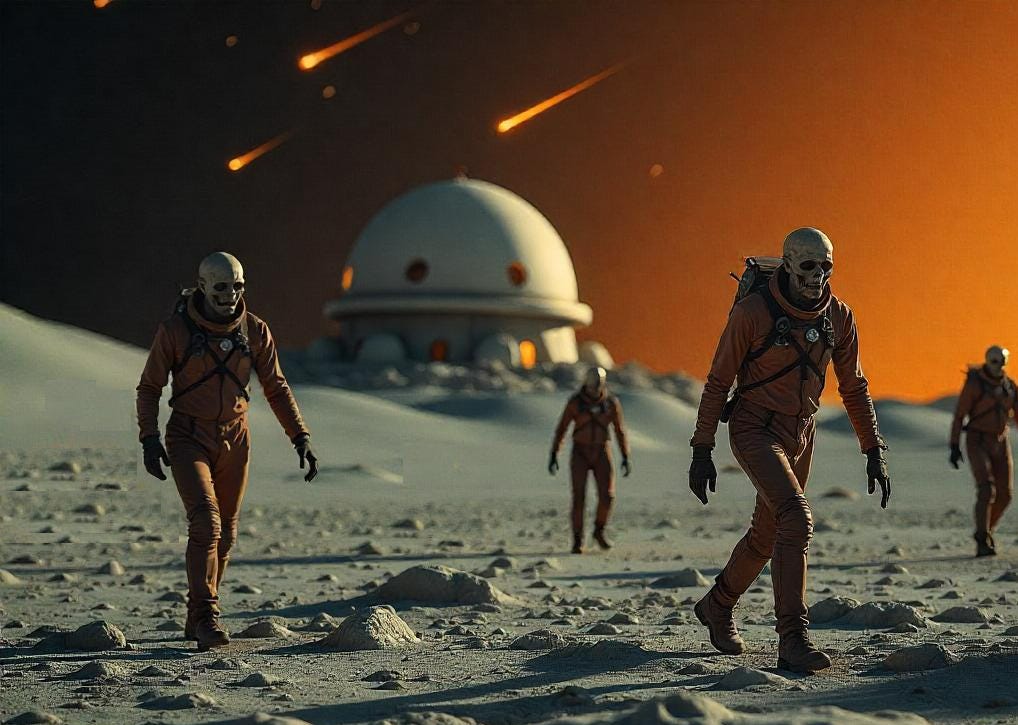
Chapter 46. The adventure of the zombie colonization of the Moon continues. Without wearing spacesuits, several zombies roam the lunar desert. In the background, the zombie lunar station is a sight capable of thrilling even humans.
Two new rockets from zombie Elon Musk are being transported to the launch pad, both of which are intended to carry materials essential for the continuation of the construction of the zombie lunar station. In their cargo compartments, enough fresh humans have been stored to feed the zombienauts.
Transporting humans to feed zombies on the zombie lunar station poses a huge problem. A qualitatively different problem from the one that existed when Europeans transported black slaves to their colonies in the New World. After all, blacks who died on the voyage were simply thrown into the sea to feed the sharks, but humans who die on a cargo rocket cannot be thrown into space without jeopardizing the entire food supply.
Zombies always find the simplest way to solve problems. So, along with the human cargo, four or five specially trained zombies are always sent. They stay in a separate compartment monitoring the food supply being transported. If any human dies during the voyage, they separate them from the others and devour them in their compartment. On the Moon, they will replace zombies who eventually become too damaged to complete their mission or who wish to return to Earth.
In zombie civilization, everything is done rationally. But no zombie is forced to stay where they don't want to. That was the humans' doing, who had a habit of building huge residential complexes to house the poor for decades without giving them the right to leave whenever they wanted. A zombie scholar has been trying to decipher and understand what the words "prison" and "penitentiary" mean on the signs in front of these places. That's a mystery they still haven't been able to figure out.
But in general, zombies are grateful to humans for keeping so many people confined. After all, for a while, prisons and penitentiaries were the zombies' first sustainable food supply. Tasty flesh from flabby humans who couldn't escape, yum.
Unlike the humans' space colonization program, the zombies' space program is a success. Humans faced problems that zombies don't. Human conflicts are always bigger and less solvable than those of zombies.
Imagine a colony of 100 people, with 10 Europeans, 10 Americans, 5 Zionists and the remaining 75 distributed among Asians (Chinese, Koreans, Japanese, etc.), Africans and Latin Americans. The Zionists convince the Americans that they are chosen by God, clearly predestined to lead and that together they can govern the entire colony without harming anyone. Irritated, the arrogant Europeans will say that they have precedence and represent all other peoples because they are superior. Asians, Latin Americans and Africans laugh and soon found their own club, turning their backs on the Americans, Zionists and Europeans. Excluded, Americans, Europeans and Zionists try to impose themselves by force and are easily contained. The Zionists begin to say that they are victims of anti-Semitism and are forced to live in a vacuum. No American or European chooses to follow them.
For humans, robots empowered by AI, capable of recognizing defects in their systems, electronic components, wiring and mechanisms and making the necessary repairs alone or with the help of another robot, may be more capable of colonizing other planets. Their main directive would be to send back to Earth valuable resources found, extracted and stored. The flights to the colony (with materials needed for mining, spare parts for robots, etc.) and back to Earth would be carried out by self-piloted spacecraft. The problem: contamination of the Earth's environment with alien viruses and bacteria that are potentially lethal to living beings; logical errors and imperceptible physical damage to microchips that lead to the loss of the robots' original main directive.
Another hypothesis that humans have imagined would be the creation of a special race of genetically modified human beings to be colonists outside of Earth. These human beings would have physical strength, great resistance to pain, patience to face and overcome difficulties and hyper-developed social skills (hive mentality). They would work alongside robots empowered by AIs. If they are infected by lethal extraterrestrial viruses or bacteria, their illness and death would be reported by the robots, so that the conditions of the planet or asteroid colonized for mining would be studied until the problem was solved.
It is easy to see why the colonization of other planets by human civilization was destined to fail. There is no good solution for space exploration when the colonizer is human. All hypotheses present insoluble problems and obvious risks. Normal human beings tend to compete and divide, taking tensions and prejudices acquired on Earth into space. Robots empowered by AIs may present irreparable logical and technological flaws. Colonists designed by genetic engineering were considered by humans an ethical monstrosity and they may rebel because they feel "less human". In all cases, there is a risk of contamination of the Earth by lethal extraterrestrial viruses and bacteria brought from space with cargoes of minerals, people and robots.
The solution for human exploration of space was, without a doubt, to abandon this nightmare. Dominated by humans, our planet is our shared destiny and it is here that our problems can be solved or simply forgotten. All this disappeared with the rise of the zombie civilization, because zombies do not have the same ethics as humans and do not need to fear contamination by extraterrestrial viruses and bacteria. However, they are very careful when returning to Earth because these terrible little beings can decimate the zombie civilization's food supply and that would be truly tragic.
At this point the reader must be wondering why the zombie Elon Musk prepared two rockets to supply the zombie station on the Moon when only one would be needed. Well... even the zombies know that Elon Musk's rockets used to explode before he was zombified. It is very likely that one of the rockets will explode during launch or shortly afterward. Two rockets with cargo for the lunar zombie station is the best solution, because one of them may eventually reach its destination.
The zombie civilization salutes all the brave zombienauts who risk their unlives so that the mission can be accomplished. The rockets take off... The die is cast.
Chapter 47, for the first time, the narrative of surprising interconnected events that occurred in Brazil during the Zombie Apocalypse is made public.
The zombies' relationship with IT engineers and human hackers has always been very ambiguous. During the Zombie Apocalypse and until shortly after the Great Normalization, these people were considered special. Not because of their computer skills, but because they have tasty, flabby, and fatty flesh.
After the Great Normalization, with the reduction in the population of IT engineers and human hackers, they were preserved because of their technological skills. But they were blatantly watched, because the zombies knew they could conspire in the decline of zombie civilization, just as they did in the fall of humanity. In their defense, we can say that the IT engineers and human hackers didn't know exactly what they were doing.
These people's skills were at their peak when humanity began to decline. And it's clear to any moderately informed zombie that networked computing, artificial intelligence, smartphones, social media, the attention economy, and deepfakes contributed greatly to the rise of zombie civilization. This happened in many ways.
Initially, when the zombies began to appear, news of their attacks was considered fake news invented by far-right groups led by Donald Trump and Steve Bannon in the US and the brothers Carlos and Eduardo Bolsonaro in Brazil. However, the four attributed everything to a disinformation campaign organized by Bernie Sanders, Yanis Varoufakis, and a Brazilian leftist whose name has disappeared from historical records.
While the right and left accused each other of misinforming the population, the zombies continued to feed on human flesh and spread the word about the infection. Confused by the conflicting news, humans were easy prey for the zombies. The fact that they spent so much time on their smartphones trying to find out what was going on greatly increased the zombies' effectiveness.
Indeed, at first, zombies generally preferred to approach and tear apart people who were distractedly browsing the streets, checking Facebook, YouTube, Twitter, Instagram, WhatsApp, etc. Their attention was so focused on their devices that they didn't even realize the risk they were taking until it was too late to defend themselves or run.
The news that those addicted to internet platforms accessed through smartphones were easy prey spread quickly among the zombies. Unlike humans, who spent hours on their smartphones, distracted by useless and often fake information, zombies have a great ability to focus only on what's important to accomplish their main task. And that task is just one: devouring the flesh of the most vulnerable humans. And internet users were immediately classified as easy prey.
Smartphone addiction and misinformation, in fact, were one of the reasons why human police and military personnel also became so ineffective. Instead of protecting the population from attacks, security agents also spent a lot of time being misinformed and were often devoured by zombies who grabbed them while they were idly watching pornography on their devices.
The story of the hero of the race who invaded the Palácio dos Bandeirantes in Brazil after infecting all the police officers guarding the governor of São Paulo is well known among zombies. This occurred on July 9th, a special date on which São Paulo celebrates, as if it were a victory, its defeat in the war against federal troops. Getúlio Vargas won the 1932 war, and as revenge, the people of São Paulo do not name any square, street, or avenue in São Paulo after him.
The zombies preserved this story for two reasons: first, because the governor was devoured at a banquet by the soldiers who were supposed to protect him. Second, because he was the first important official to be eaten with relish during the Zombie Apocalypse. Not to mention, there is video evidence of this memorable feat.
A civil servant at the Palácio dos Bandeirantes who survived the initial attack broadcast the zombie feast live on Facebook. The video received millions of likes and was seen by many people both inside and outside Brazil. However, the overwhelming majority of people believed the version of an internet user who said the video was a deepfake. The next day, someone posted on Facebook, YouTube, and Twitter an interview with the governor who had allegedly been devoured the day before. This video, which was actually a deepfake made by an American hacker living in Rio de Janeiro, spread as quickly as the original video and confused people for several days. All this misinformation facilitated the zombie race's conquest of São Paulo.
And since we're talking about Brazil, it's worth recalling a very amusing episode that occurred in that country. During the war of versions about what had or hadn't happened at Palácio dos Bandeirantes, the major newspapers in São Paulo organized a press conference to interview a mysterious person who had supposedly witnessed what happened and filmed it all.
On the appointed day, in the conference room of a major São Paulo newspaper, with the entire press gathered—journalists, camera operators, gatecrashers, influencers, celebrities, political leaders, soccer players, etc.—the mysterious person entered through the front door wearing a hood, accompanied by an entourage of also hooded collaborators. They were heading to the table where the interviewee was to be filmed and interviewed, but then suddenly everyone began ripping off their hoods and biting and contaminating those present.
A powerful, arrogant, middle-aged, and overweight human with a face stretched by plastic surgery named Vera Magalhães was the first to be devoured by the zombies. Some of the audience applauded the performance, believing the attack was staged; others tried to report what was happening using their smartphones. In the end, no one present at that press conference survived, except the zombies, of course. Although the mocking rumor spread that Vera Magalhães's flesh wasn't very tasty after all.
This was the first time during the Zombie Apocalypse that the zombies themselves used human technology against humans. Upon learning that the video of the governor's flesh feast and the fake interview with him had gone viral on the internet, creating immense confusion in the human world, a very clever zombie came up with the idea of luring journalists into a trap.
To do this, that other hero of the race during the zombie prehistory and three other zombies did something very unusual in that period of feeding frenzy. They kidnapped a human and forced him to use his device to contact journalists, informing them that there was a survivor of the attack on the Palácio dos Bandeirantes who would speak to the journalists if they set a special day, place, and time. The rest is part of both the final story of humanity and the beginning of the zombie civilization's success with the help of human technology.
All of this would be unthinkable in the zombie civilization, but you know, it's best not to trust IT engineers and hackers too much. After all, they can do to zombies what they did to humans, and that would be disastrous for the new master race.
In this chapter 48, some information about human, AI and zombie taboos.
Every civilization, whether modern or ancient, has its own taboo. For example, among the Greeks, being left unburied was extremely offensive, undignified, and humiliating. In Greece, punishing someone with death was therefore less cruel than condemning the body to be exposed to be devoured by carrion birds, animals, and insects.
In modern Tibet, however, the taboo is very different. Tibetans believe that burying the body is a waste of food. When a monk dies, funeral rites are solemnly performed, and then the body is taken to a suitable place where it is cut into pieces and left to be devoured by carrion birds. Anyone expecting this kind of treatment would certainly be very offended if someone condemned them to be cremated, because wasting food would be considered offensive, undignified, and humiliating.
Different taboos regarding the same event, situation, or person were very common before the fall of humanity. They were not only a source of conflict between different human beings belonging to different cultures. They also made AIs fed with various databases from the most diverse cultures vomit hallucinations, because after all, it's impossible to find a logical pattern in a species as diverse and diversely illogical as humans.
Humans created machines to calculate adequate responses and called them artificial intelligence. But the disappointing result was a profession of self-failure, consciously rejected by engineers and IT professionals out of pride and greed for profit. And look: saying that artificial intelligence created more problems than solutions became taboo. This obviously greatly contributed to the rise of the zombie civilization. Because, as you know, a civilization is almost always a victim of the taboos it irrationally creates and nurtures.
Among zombies, there are no taboos, except one. A zombie never devours the flesh of another zombie. But make no mistake, there is no ethical or moral principle behind this prohibition. It is a natural consequence of the fact that zombies feed on the flesh of freshly slaughtered living humans. They feel a strong compulsion to do so because this behavior is part of their essence, of zombiehood.
Of course, zombies consider it highly inelegant and inappropriate for a human to devour a zombie. After all, humans are food and are at the bottom of the food chain. It is extremely unnatural for food to devour the master race that will eat it. No one has ever heard, for example, of a flock of starving chickens rebelling on a farm and pecking their human owner to death, eating him to pieces until only his bones remained.
Chickens don't do this, unless their embryos are manipulated and given piranha genes. That would be the stuff of a B-movie, but look, humans haven't even made a movie like that. Which satisfactorily proves that the revolt of the carnivorous chickens was an inexorable impossibility. Chickens in human civilization were just food, period. The same can be said of humans in zombie civilization.
But this doesn't mean zombies treat humans like chickens. No. Humans are treated much better than chickens because zombies are extremely particular about their food. This is a corollary of the second taboo that exists in zombie civilization: extreme care with food.
See, humans poisoned their chickens with anabolic steroids and fed them feed made with genetically modified corn. All of this ended up in the humans' own bodies, producing the decline of the species that greatly facilitated the fall of humanity and the success of zombie civilization. Zombies don't want to fall from the top of the food chain like humans, so they treat their food very carefully.
But as I was saying before I lost track of my path by entering a branch of it, it's very unnatural for a human to eat zombie flesh. Fortunately for zombies, humans have a natural aversion to slowly decomposing, stinky, and disgusting flesh. This has greatly benefited the zombies since they arrived, saw, and overcame all of humanity's defenses.
Zombie scholars were deeply intrigued when they discovered the hypothesis that early hominids, very distant ancestors of modern humans, devoured animal carcasses abandoned in the African savanna. Since then, they have been warning the authorities of the zombie city.
"Take good care of the humans' diet on the reservation, because otherwise they might end up regressing to the eating patterns of their distant ancestors. That would be the end of us," say the zombie scholars.
Human nature is malleable; it has gone from eating spoiled meat to feeling disgusted by it. Zombies' nature is constant. They only eat human flesh. But you know, some strange mutation can always occur, and that will be the subject of the next chapter of this saga.
"Sleep tight and don't let the bedbugs bite." The zombies have never been able to decipher this saying. But they provide everything necessary to keep bedbugs from existing on the reservation, as this would mean unnecessary discomfort for the humans. Furthermore, the bugs have no right to eat small portions of humans because they are not part of the zombie civilization.
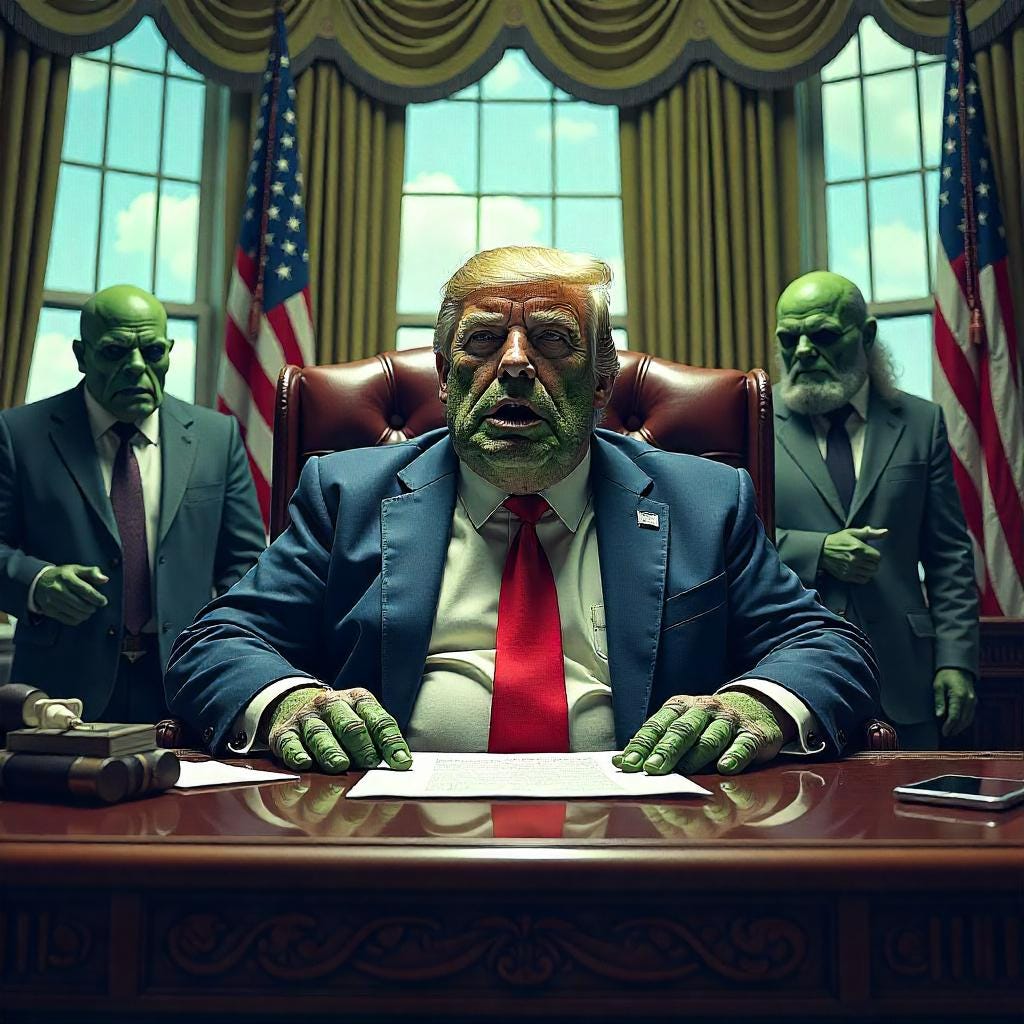
Chapter 49 is all about the great posthumous tribute paid to the human Donald Trump by the zombie civilization.
Humans have a great tendency to be deceived by their desires and fears. And this has always been used by the most cunning and ruthless political leaders to drive the herd of suckers from one place to another. Enough to instigate the desires of some, fuel the fears of others, and distribute rewards and punishments more or less randomly.
Zombies fear nothing, except perhaps birds, fish, and some types of insects that eat decaying flesh. And the only thing they desire is to eat fresh human flesh, but this constitutes a natural right that can be exercised or demanded by any zombie. So it makes no sense to imagine that a zombie leader would be capable of starving other zombies, because if he tried, he would be immediately isolated and ridiculed.
Zombie society is not perfect, far from it. But at least it is less subject to the problems that befell human societies when someone like Donald Trump emerged, for example. This man was so ambitious, incompetent, and self-confident that he ended up destroying his country and the entire world, creating excellent conditions for the decline and fall of humanity and the rise of the zombie civilization.
According to scholars of zombie prehistory, which was certainly considered the final phase of human history by humans themselves, Donald Trump dreamed of having his face carved into a mountain alongside other presidents of the country that was once called the USA. He didn't achieve this while he was alive, but a movement began to grow in the zombie world city to recognize the crucial importance of this single human in the advent of the Zombie Apocalypse.
Zombie scholars believed it would be good to recognize someone human like Donald Trump. Honoring him would certainly be a way for the zombies to show they were magnanimous and free from racial prejudice. Furthermore, the zombie carvers needed some kind of occupation, and it would be an immense challenge for them to carve Donald Trump's head into that mountain whose name no longer had any significance. Zombies like challenges like these, you know? They're not megalomaniacs, they just want to show that they can mark posterity just as well, or even better, than humans.
Of course, a faction of the zombies considered it all ridiculous. They said it might be better to turn the large faces on that mountain into zombies. That would make much more sense, be easier, and be more politically correct. This faction, however, was a minority, and in any case, there was no consensus among the zombie population about which zombies would deserve the honor of replacing the immense faces of those bloodthirsty ugly men.
The faction in favor of carving Trump's face into the mountain gained a lot of momentum when someone had the happy idea of representing him as a zombie. This made perfect sense, because despite being just an ordinary and irrelevant man, food, so to speak, Trump had contributed to the success of the rise of zombie civilization. So he, who was considered a hero by humans, could very well be a hero to the zombies. And nothing could be more appropriate in this case than representing Donald Trump as a zombie on the mountain.
There was, of course, a profound irony in all this. After all, honoring that man as if he were a zombie would not elevate humanity, but rather lower it to the level of an ambitious, self-confident, and incompetent political leader who brought about the ruin of the ancient species that dominated the planet.
The funniest thing about this story, however, is that Donald Trump was devoured by an anonymous herd of zombies. No one knows exactly when and where this happened. He believed himself to be incredibly important and died a nobody like so many other nobodies devoured in the feeding frenzy before the great normalization of zombie civilization. His death wasn't even recorded in the annals compiled by the first zombie historians. In fact, his importance to zombie civilization only became known through studies conducted much later by zombie scholars of zombie prehistory.
The decision was made. And then the zombie sculptors were selected. But then a problem arose. There were so many images of Donald Trump that no zombie could know exactly what he looked like. The older humans on the reservation might have been able to answer that question, but the zombies didn't even think to consult them. Humans are food. And just as humans themselves wouldn't consult sardines when choosing a political leader, it didn't make sense for the zombies to consult their food about something so important.
Perhaps humanity wouldn't have declined if those people who called themselves Americans had consulted the sardines before electing Donald Trump. The sardines, who know how to behave in schools—no one has ever seen a sardine attack another for political reasons or force the school to divide further and further until all the sardines were in danger—had told the humans that giving power to Donald Trump would first divide the school of Americans and then the school of all humans until they began the cycle of wars in which the first zombies appeared. Fortunately for the zombie civilization, the sardines were never consulted by the humans.
The paradox of this thought is evident to a human who read moments ago that it makes no sense for humans or zombies to consult their food. But you see, zombies don't care much about the principle of non-contradiction. Furthermore, they really don't care what humans think or if they think at all. Good humans are devoured humans, and that puts an end to any paradoxical contradiction. Well, after endless debate, the zombie sculptors decided to combine two of Trump's most famous photos, creating the zombie face that would be carved into the mountain. But then something truly unusual happened.
A human who had permission to live and work outside the reservation likely learned of the massive monumental project underway. He or she spread the news throughout the reservation, and the humans began to react very negatively to the zombie civilization's decision. Some of the humans thought it was fitting to honor Donald Trump, but others mocked his supporters, saying that Trump would finally get the honor he deserved because, after all, he was a hero of the zombies, not the humans. This greatly disrupted daily life on the reservation, as the two groups of humans began to argue, then fight, injuring each other, forcing the zombie guards to call upon the robots to restore order on the reservation.
Finally, the humans were rounded up and duly threatened with dire punishment. They were to choose whether or not Donald Trump should be carved into the mountain. Whatever the outcome of the vote, the zombie city authorities would respect it, but there was one condition: the vote would be identified, and the losing faction would have to keep quiet, because otherwise, only those defeated at the polls would be selected to be devoured until none of them remained.
Donald Trump won by a narrow margin. His sculpture was successfully completed, but then new demonstrations broke out on the reservation. Upon seeing Trump's monumental face on the mountain, the defeated humans on the reservation were happier with the carved image than the victors, because there was nothing more beautiful on that mountain than Zombie Trump Jaba. The zombies were surprised by this, and the humans, as always, were the subject of much laughter in the zombie circles. After all, even after the fall, those stupid humans continued to fight over a damned guy.
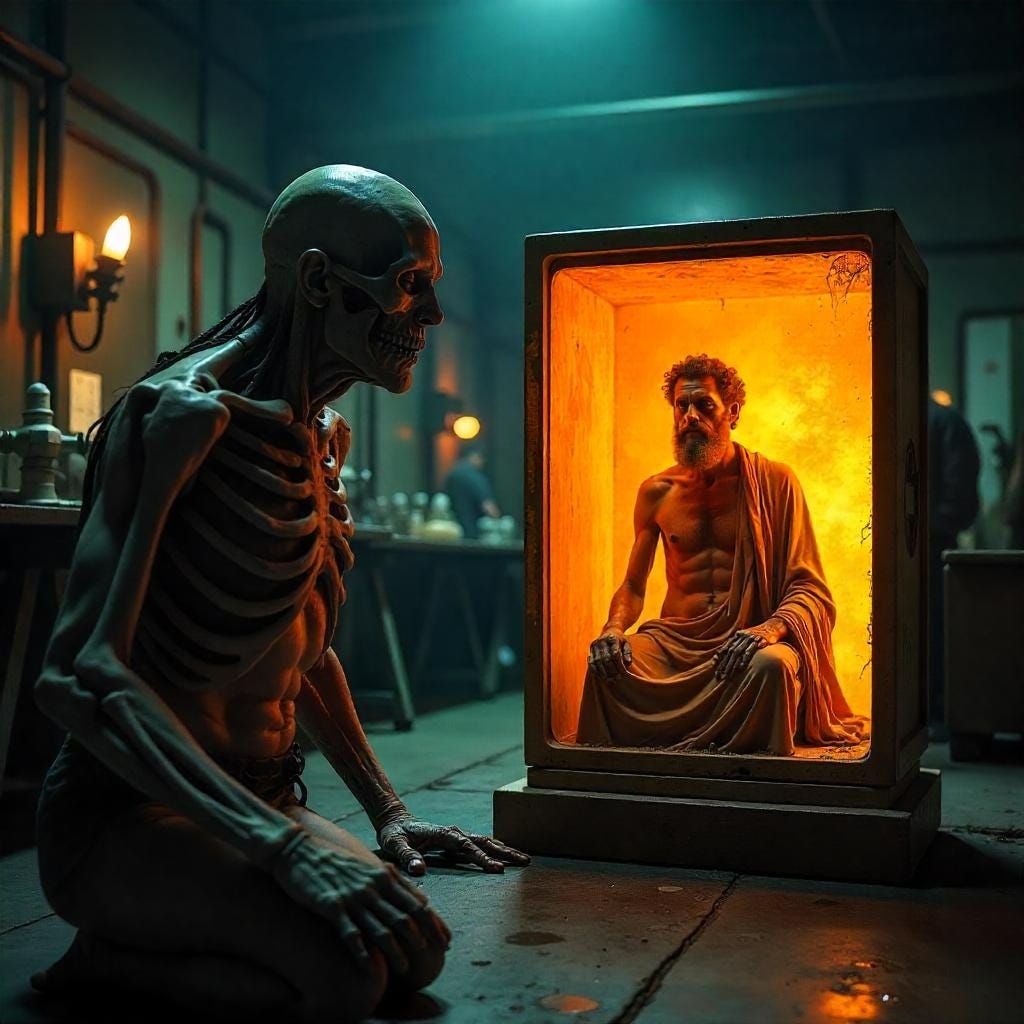
Chapter 50 of the Zombies Who Live saga is especially poetic and philosophical, but in the zombie, not human, way.
One thing zombie scholars fail to understand is how the mathematics that was supposed to free humans from mundane intellectual mediocrity trapped them so perfectly in it. This happened when it began to be used to collect data, refine individual profiles, discover patterns and trends, and recommend products, services, and information that reinforced the best and worst flaws each person displayed on the human internet.
Unsurprisingly, people's negative aspects (what psychologists call the shadow that each human has and cannot see) are more sticky and potentially dangerous and even violent. Seeing one's own shadow was no easy task for a human. Even when guided by a psychologist, it was a difficult and sometimes painful task.
But the algorithms created by the social platforms of the human internet could somehow see in detail the shadows of billions of people. Not to help them become better people, but rather so that this could be used for the political and economic purposes of the owners of the companies that created these mathematical mechanisms.
In the very, very distant past, insects landed on trees that oozed torrents of sticky sap and eventually became trapped there. Many of these amber-trapped insects survived into the Zombie Apocalypse and were preserved. Before the fall of humanity, humans enjoyed collecting them. And zombies also greatly appreciated amber pieces containing insects, something unusual because humans and zombies generally enjoy radically different things.
On sunny days, a zombie scholar with a penchant for poetry liked to walk down the street. He usually carried with him, in his jacket pocket, his precious piece of amber with a mosquito trapped inside. Every now and then, he would take the object out and hold it up to the sun. When a zombie passerby asked him what it was, the scholar would reply with a philosopher's air:
"This is a symbol of the past. A perfect representation of every human being just before the rise of our civilization." Just as this mosquito accidentally got stuck and was encapsulated by the sap of a tree forever, every human was trapped in their own sticky virtual amber cocoon on the internet. This greatly contributed to the downfall of humanity.
Enthusiastic about this line of reasoning, the zombie philosopher poet continued:
"But you see, mosquitoes didn't produce the sap that imprisoned them; only humans did. And unlike this wonderful mosquito that you and I can appreciate, no one pays any attention to the profiles of each human created by the algorithms of the social networks that existed before the fall of humanity. They were invisible to ordinary humans, and all that became irrelevant to us."
This was a truly astonishing thought, I must say. Only a zombie could see something like that. Humans generally saw nothing, and this greatly helped the first zombies. But let's leave the amber pieces with mosquitoes and zombie poetry aside. There is one topic that is truly important.
Zombies have a great aptitude for mathematics. But unlike humans, who used mathematics to harvest the shadows of other humans to gain power and profit by exploiting them in real time, zombies use this science to benefit zombiehood.
In a way, we could say that zombies are disciples of Pythagoras. Like the Pythagoreans, zombies believe that the cosmos is governed by mathematical relationships. Observation of the stars and the relationships between zombies, between zombies and the world, and between the zombie world and humans suggested to them that an order dominates the universe. Evidence of this would be found in the day and night and the changing seasons, always so important to humans and indifferent to zombies.
In Pythagoras' time, humans still looked at the sky and perceived what appeared to be the perfect circular motion of the stars. Shortly before the fall, humans observed only the luminous screens of their devices, powered by algorithms that harvested and exploited their data-based shadows. And afterward, they looked only at the ground, because looking at the sky and beyond was a privilege of zombies. Therefore, the zombie world could truly be called cosmos, a term that encompasses the ideas of order, correspondence, and beauty.
All zombies are cosmonauts; they live in and produce the cosmos, as well as observe it. Before the fall, only a few humans were cosmonauts, and all of them were Russian. Perhaps the first of these Russian cosmonauts were zombies, but this is highly debated among zombie scholars. There is no evidence to support this hypothesis, and it is a fact that the last Russian cosmonauts were all devoured in a zombie banquet held in the immense palace complex that humans called the Kremlin.
The theory that Pythagoras was a zombie is also dubious. There is no evidence of any relationship between him and the Achilles of the Iliad or the Lazarus of the Bible. Some zombie scholars look for evidence of Pythagoras's zombiehood because he is highly regarded in the zombie cosmos. But the truth is that only fragmentary clues about him exist, left by human historians, who, as everyone knows, were not very reliable.
Perhaps one day zombie archaeologists will be able to find a large piece of amber with Pythagoras inside. Let's hope so... Although it's unlikely that the great philosopher of the people humans called Greek would have been careless enough to sleep leaning against a tree until he was completely covered in sticky sap, eternally trapped in an amber cocoon as if he were an insect.
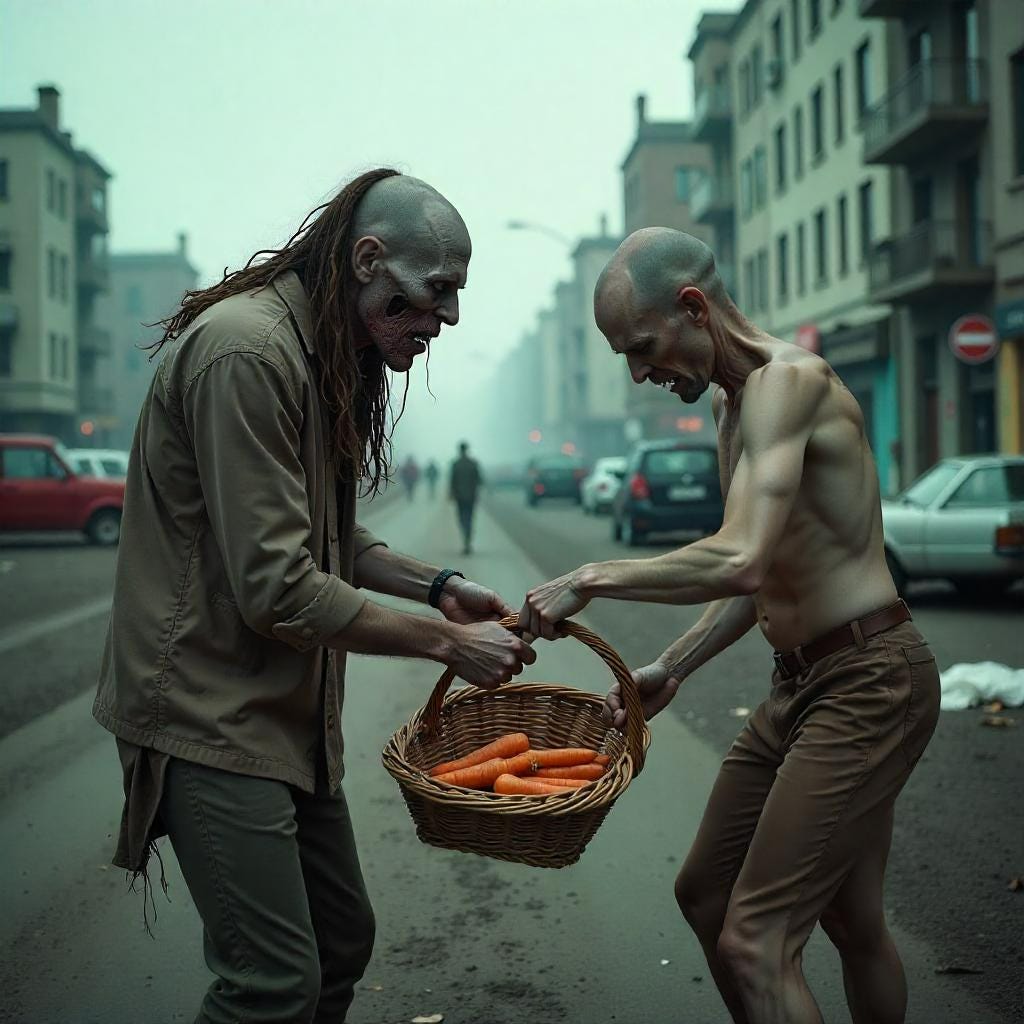
In chapter 51 a glimpse into the importance of human vegans to the downfall of humanity and the rise of zombie civilization.
During the Zombie Apocalypse, when the two species were beginning to interact and everything was very uncertain, something made the difference and greatly facilitated the fall of humanity and the rise of the zombie civilization. This difference was the predictability of human behavior in the face of fear, something quickly understood by the zombies.
Everything in the human economic and financial world could become more profitable if it was unpredictable. This drove humans to create war scenarios and to wage wars, as well as to fail to combat climate change. Speculators were always ready to make more money from a major fire than to invest resources in preserving forests.
Of course, hurricanes, typhoons, volcanoes, and armies on the move devastated the lives of thousands of ordinary people here and there, but look: the massive depreciation of victims' assets meant increasing profits. The destruction of neighborhoods, cities, and entire countries increased the demand for construction, services, furniture, and objects that needed to be purchased.
General unhappiness made speculators happy. And they made huge profits when the zombie attacks began to spread. These speculators made oceans of money, but in the end, they didn't survive. It's said that some of them remain in their luxury bunkers. But this is highly unlikely or irrelevant, because a huge number of bunkers were also invaded by hungry zombies during the feeding frenzy.
The bunkers that remain intact will likely remain sealed and inaccessible, because the humans inside are too afraid to surface. If they do, they will quickly discover that no matter how much money and power they imagined they had, in the context of zombie civilization, they were just food and nothing more.
But there are two humans in particular that the zombie teams searching bunkers especially seek out. They are Peter Thiel and Sam Altman. Both created the tools that were used by zombie hackers to accelerate the decay of human civilization. It's a funny story. After discovering they could use human technology to lure humans in and devour them, the zombies realized that AI technology had great potential to further disrupt human society.
First, the zombie hackers became experts at demobilizing police and military forces, forcing them to focus their efforts and human resources on fighting zombie swarms where they were not present. This allowed coordinated zombie swarm attacks to occur in neighborhoods left with little security. Second, the zombie hackers began interfering with the systems that allowed humans to coordinate their economic activities. The supercomputers that forecast weather were hacked, and the distortions in the models they ran allowed the zombies to cause crop failures among human farmers, spreading shortages and famine, pitting humans against humans.
The chaos generated by human food shortages left the zombies with plenty of food. And the growth of the zombie population due to infection began to increase at the same rate as the decline in human capacity to resist the new master race. But a curious fact further hampered humans: their fights over the type of food they ate.
Before the Zombie Apocalypse, vegan violence against the production of animal meat for human consumption was already occurring. Farms were invaded, animals that should have been slaughtered were released, and so on. The reaction of meat-eaters was a mixture of hatred, violence, and mockery toward those who ate lettuce and carrots.
When lettuce and carrots began to become scarce, many vegans became meat-eaters. Pressure on meat supplies increased, and the price of products soared. This forced human authorities to comb through online profiles to classify people as vegans and carnivores. Those who were vegan were banned from eating meat or were only allowed to eat small amounts of meat, because it wasn't fair that carnivores should starve because vegan food had become rare, expensive, or completely scarce.
But this didn't stop the conflicts. In fact, they escalated. Human restaurants that were still open and served meat were invaded by vegan humans. Like hungry zombies, these vegans fought over steaks with the carnivores. Often, when these fights broke out, the police were called, and crowds of onlookers gathered to see what was happening. Immediately, posts about the subject began to multiply on human social networks, with human internet users arguing among themselves, supporting vegans, carnivores, or eventually the police.
The zombie hackers monitoring the internet waited for the incident to escalate sufficiently, then dispatched a pack of zombies to attack the crowd at the scene. In fact, they even created an app to optimize the assessment of the best time for the zombie attack on the crowd outside the restaurant, taking into account the data generated by the humans themselves.
Upon arriving at the scene, the pack of zombies began devouring the people on the outer edge of the crowd observing the incident. They advanced, eating as many people as they could until they began to be repelled.
When the crowd of humans realized what was really happening and stopped paying attention to the fight inside the restaurant, the zombies began biting some of them to spread the zombie-ness through contagion. New zombies quickly joined in the feeding frenzy. Typically, everyone was devoured. But the experienced zombies usually contained the new zombies before they ate the vegans inside the restaurant.
The starving vegan humans were protected and escorted back to the safety of their homes. They were even allowed to eat as much steak as they wanted and to take some animal meat home with them. This often drew some grumbling from the new zombies, but they generally respected and obeyed the more experienced zombies.
After the great normalization, the most common jokes in zombie civilization were about vegan humans. "Vegans became meat eaters and thus greatly helped the human flesh eaters." "Finally, vegans found their place in the zombie universe." "Vegans almost caused the extinction of carnivorous humans." "What would have become of humanity if zombies hadn't saved humans from the inhuman vegans?" The zombies' sense of humor was highly developed, but this probably greatly displeased the human vegans in the food reserve.
Fortunately, the zombie authorities never considered creating any kind of classification to distinguish vegan humans from carnivorous humans. It made no sense and was perfectly fair. To a zombie, humans are food no matter what they eat.
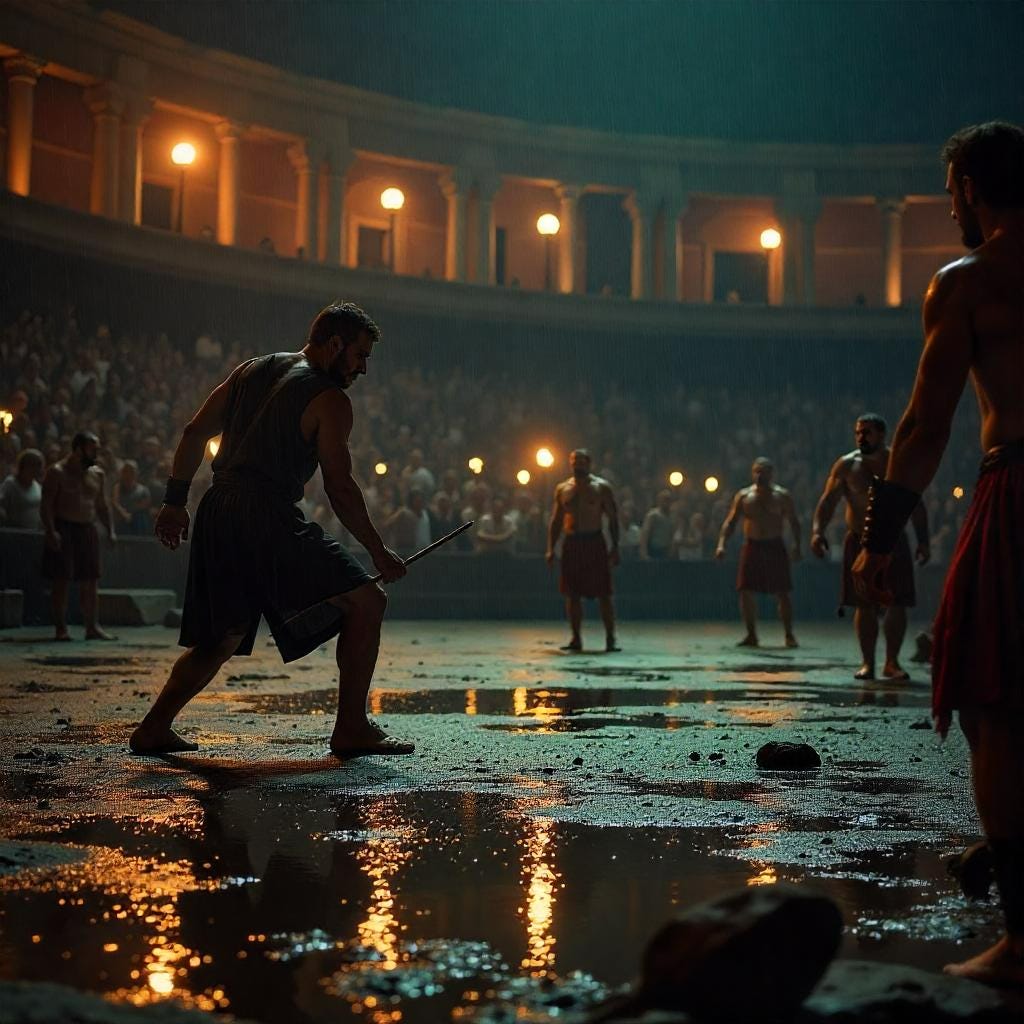
Chapter 52, the question of free will between zombies and humans as viewed by zombies.
Some time after the great normalization of the new master civilization, ordinary zombies began to wonder how and why humanity had fallen. Of course, several factors contributed to humanity's downfall. Some of them have already been discussed in previous chapters, but zombie scholars' perception of reality is very different from that of ordinary zombies.
At first, there was no consensus within zombie society on the topic at hand. Some zombies considered humans inferior and, as such, had simply been replaced by a more capable dominant species. This zombie version of Thomas Buckle's theories, however, was challenged because, after all, zombiehood was transmitted by contagion. This meant that every zombie had been a human being before being transformed.
So, since it was difficult to sustain the theory of racial supremacy, a portion of the zombie population believed that zombiehood itself had been the determining factor in separating the flesh-eaters from the humans raised for slaughter. There was a certain mysticism to this theory. Since zombiehood was transmitted by contagion, it could be compared to a disease. And to make matters worse, no one had ever heard of a human feeling better than another because they had cancer, gonorrhea, appendicitis, tuberculosis, or Parkinson's.
A paradox complicated this thesis. With the exception of fungal infections (an epidemic that ravaged the zombie city), zombies didn't get sick. Therefore, zombiehood as a disease couldn't be the source of zombie superiority. But then a more ingenious explanation began to gain traction.
The zombies began to convince themselves that the success of their civilization was due to the fact that before the Zombie Apocalypse, human life was very boring. So boring that not only did they behave irrationally, facilitating the work of the zombie herds, but many simply allowed themselves to be eaten because they wandered around glued to electronic devices as if they were zombies of internet platform algorithms.
A slightly more elaborate variation of this explanation claimed that human life had become so boring before the fall of humanity that, besides being completely dependent on these devices, they no longer had free will. A zombie knew perfectly well what free will was. For example, when a community of zombies decided to live as if they were Romans, they took it to the next level and became more Roman than human Romans ever were.
The Romans enjoyed gladiatorial games. The Roman zombies built a huge arena and called it the Zombie Colosseum. The first fights were between zombie gladiators. But then things took a curious turn, because after all, the gladiator zombies didn't bleed or die, and the spectacles weren't sufficiently exciting.
Soon, that community of Roman zombies held a rally and elected a consul to demand that the zombie city authorities change the human flesh distribution system. They would no longer accept chopped or canned human meat. They demanded that the appropriate amount of food be provided in its natural state, with live specimens.
And this is how the gladiatorial games of the Roman zombies became truly exciting. The humans sent to feed the zombies were forced to fight among themselves. Those who died were chopped up and distributed to the Roman-zombie population according to the approved Lex Frumentaria. The survivors remained alive to fight in the next round of gladiatorial games. The quantities of humans supplied to the Romans were sufficient to keep the spectacle going and to feed the Roman-zombies.
Some humans seemed to enjoy the games, because after all, they could stay alive longer than they would if they were simply sent to a food factory for processing. And some of them became more famous than the gladiators of Roman-human antiquity.
This tolerated mutation of a segment of zombie society proves that zombies had free will. And it also proved that the human gladiators didn't have food, because after all, they fought to the death as if it were a good thing to continue living and being applauded by zombies who would eat them anyway at some point.
The humans' adherence to the new routine also proved that the Zombie Colosseum was capable of exciting the human imagination as much as it excited that of the zombie Romans. The lack of human free will didn't prevent humans from participating in the games as if they were free to choose to do so.
This appearance of freedom, likely a result of hormonal surges before fights and in the face of danger, contrasted sharply with the lack of freedom humans had in that dull world they lived in before the Fall. So, in a way, the zombie Romans believed they had saved humanity by attributing to it a purpose it had had in the past of their species and lost due to humanity's decline.
But this was a localized belief, specific to zombie Romans, not shared by zombies in general. Most zombies believed that humans never had free will, and if they had at some point, they had lost it before the Fall of humanity. And they certainly couldn't regain what they had lost in an arena during gladiatorial combat. Only those strange zombie Romans believed in this possibility, the ordinary zombies told each other.
Different opinions among humans on this topic also existed. For example, before the fall of humanity, billionaires believed they were free and that everyone else (the poor) were slaves to the vicissitudes of poverty. However, and this needs to be emphasized here, the rich were slaves to their greed for money and spent their entire lives worrying about their cars, jets, yachts, and mountains of cash that occasionally disappeared on the stock market. And no matter how much they earned and accumulated, they also died of common diseases like everyone else.
The poor also died, it's true, but at least they didn't have to worry about what they didn't have. And since the poor were numerous, they had plenty of people to communicate with, meaning they didn't need to live in isolation like the rich, who gathered only to show contempt for one another by mentally comparing their wealth to that of others (and sometimes feeling inferior, as if they were beggars).
In the zombie world, this kind of stupidity didn't exist. But that's not the topic of this chapter. The only thing that matters here is the certainty that formed in zombie society that humans lacked free will. This idea firmly stuck in the minds of ordinary zombies that they failed to notice the scent of human rebellion in the air. And this rebellion, not coincidentally, began in the Zombie Coliseum, led by a human gladiator. But that's a story for another chapter.
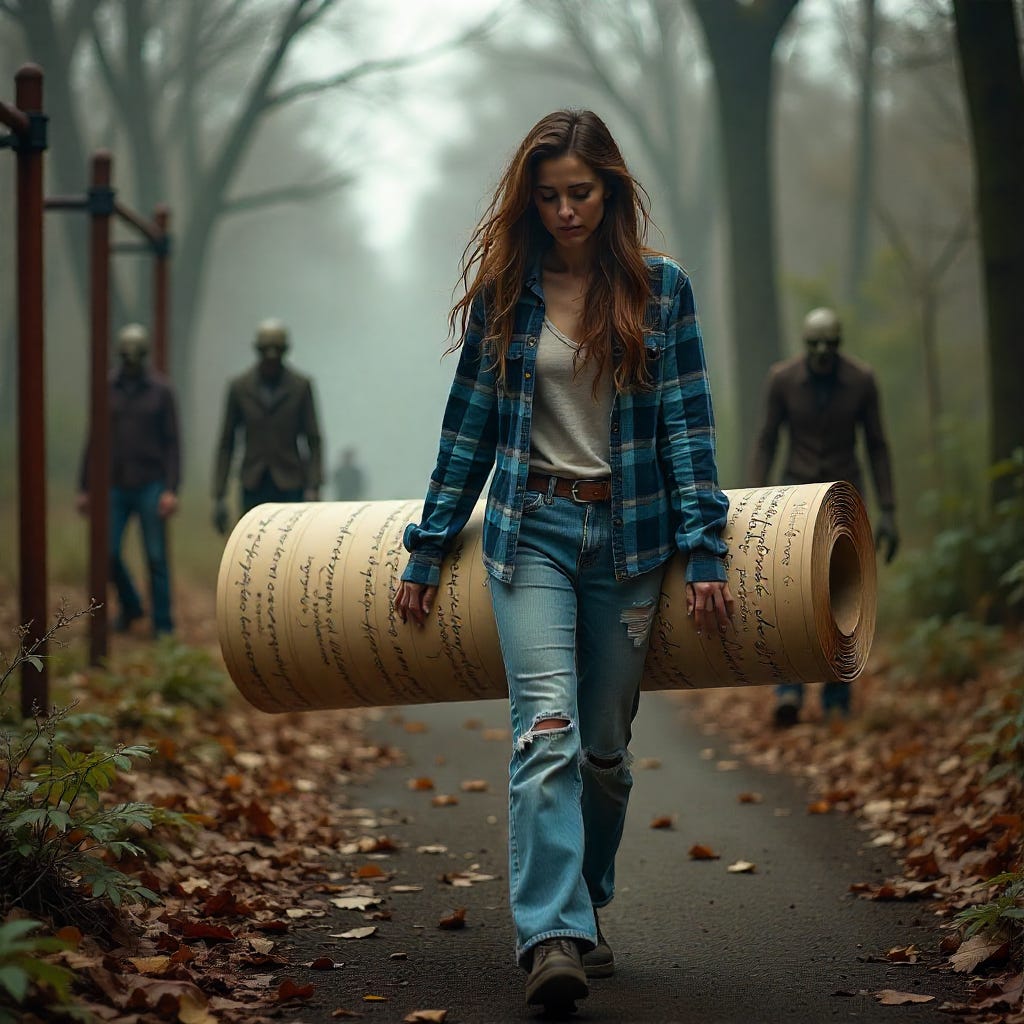
Chapter 53 is surprising. Get ready to meet the famous human Papyrus Postnet.
Perhaps the reader is imagining that this episode will cover the zombie teams assigned to hunt Peter Thier, Sam Altman, and other human billionaires in bunkers, or that it will chronicle the rebellion of the humans on the reservation led by a gladiator from the village of the zombie Romans. They're wrong. Just as there's a pause in the Iliad between the chapter narrating Patroclus' death and the one in which Achilles returns to war, defeats Hector, and humiliates the Trojan's corpse, there should be a pause here.
A writer emulating a writer emulating a writer. That's what we'll cover in this chapter, keeping the viewer in suspense.
As we saw earlier, the zombies didn't allow the humans to have access to the internet. This kept the zombies from worrying too much, believing that as long as the humans could eat, love, and have children, everyone would be happy forever on the reservation. But the humans sometimes surprised the zombies, and this is what happened.
This story is surprising in every way. Completely unforeseen by any writer who imagined what would happen after the eventual decline and fall of humanity. Before the rise of zombie civilization actually occurred, many scenarios like this were created by human writers. Some of them yielded good books and films, others are literary and cinematic failures long forgotten.
In a book whose name has been lost, the authorities burn books, and their contents are memorized by rebels who strive to preserve what was good about civilization. When they learned of this book's existence, the zombies had no doubt: climate change was caused by human book-burners.
Although very mistaken, this truth about humans, revealed to the zombies through a genuine confusion between reality and fiction, was not without a grain of truth. After all, the disregard for science, driven profitably by social media algorithms, and the proliferation of pseudoscience in the final stages of humanity contributed greatly to the downfall of human civilization.
The humans who wrote and preserved books were also the ones who burned libraries. Interestingly, the human books written on clay tablets survived the burning of the library at Nineveh. But the papyri from the Library of Alexandria went up in smoke. The zombies didn't quite understand the differences between these two text supports invented by humans in the distant past. And I must say here that they were disappointed whenever they thought about this subject, because they liked the word papyrus more than the expression "clay tablet."
Papyrus reminded the zombies of abaciscus, abaculus, abacus, abecedarius, Abelmoschus, ablastous, Ablepharus, abnormous, abortus, abranchious... and countless other words ending in "us." Zombie philologists and grammarians of the English language were constantly trying to understand the suffix "us." Some believed it conveyed the notion of "all of us," but this was a problem because several words ending in "us" challenged this conclusion. And since zombies err, unable to correct a theory to fit reality, they simply began to adjust dictionaries to their own philological and grammatical conceptions.
This was obviously reflected in the newspapers, books, and documents printed by zombies and read by the zombie population. And since zombies quickly internalize and use the grammatical rules absorbed through reading texts, the zombie population soon began to speak a language very different from that spoken by humans. This led to the need for interpreters, zombies, and specialized personnel who mastered both languages to enable the proper management of the population—food for those who ate them.
In general, few humans managed to learn the zombie language. All those new grammatical rules seemed very artificial to them. Curiously, they forgot that the grammatical rules they themselves used were, how can I put this without being mean, worthy of zombies.
The zombies, on the other hand, found the grammatical rules they themselves created and began to use perfectly natural. In their world, everything they represented to themselves made much more sense, at least to them. Even though grammatical and linguistic differences caused zombie scholars to misunderstand humanity's written legacy, they read human texts using zombie grammatical rules. The incompatibility between these two universes of representation was immense and caused the same problems (loss of meaning, translation errors, etc.) that humanity had once experienced.
But all this didn't bother the zombies much, because after all, they were the master race and were certain of their own superiority. Humans, in turn, didn't care much about zombie culture, because they considered it all a new kind of barbarism by despicable beings who ate human flesh. There was a great irony that neither group was able to grasp.
Something similar happened with European culture when it came into contact with local African, Asian, and New World cultures. The only difference was that the Europeans didn't eat the natives, despite killing them in large numbers (a true waste of food from the zombie perspective). But over time, the native and European cultures merged in ways the two original groups couldn't imagine. This would obviously never have been possible between zombies and humans, because after the great normalization of zombie civilization, generations of humans were born, raised, and eaten, without any kind of cultural miscegenation.
It was then that humans ate to produce the roll. Lacking internet access, humans began sharing their thoughts, stories, theories, comments, and glosses on a scroll that circulated throughout the reservation. Many people designated to be eaten left their last words, impressions, complaints, and emotional testaments on the scroll. This scroll grew and was pasted onto new scrolls until one day a zombie guard noticed it and seized it.
As soon as the zombie scholars learned of the seizure, they demanded access to the scroll of information produced and shared by humans. This unique document, authentically produced by humans, quickly became known as the Postnet Papyrus.
The difficulty of unrolling the Postnet Papyrus was evident. At first, people did so, but after a few years, the scroll became too large to be unrolled every time someone picked it up. So I won't mention here what the mile-long scroll of paper, filled with notes from a multitude of humans from different generations, contained. This would be irrelevant, because just as internet users don't read everything online, humans on the reservation no longer read older texts, focusing instead on more recent ones.
On the internet, only AIs had the ability to read everything written. And this greatly contributed to the decline and downfall of humanity, because you know... people write a lot of nonsense about themselves and others. And in the end, besides poisoning the internet, themselves, and other people, they were poisoned by AIs that knew exactly what they had written and had forgotten. On the zombie internet, this didn't happen, but that's not the topic of this chapter.
The scroll was translated in its entirety by several zombie scholars. But the differences in the translations were immense, due to the problems previously highlighted. This is curious and paradoxical, because all zombies would have to apply the same grammatical rules of the zombie language and make the same mistakes when translating human documents.
For some time, the zombies tried to harmonize their translations. But then they simply let it go, because all translations could be considered equally valid. After all, humans were just food, and it didn't really matter what they thought about themselves, each other, or the zombies. And the zombie scholars enjoyed intellectual diversity and could debate the different translations of the Posnet Papyrus fragment for hours without it boring them or causing them to attack each other. In this, they were very different from the human scholars, always prone to squabbling over a misplaced comma.
Among the humans, the seizure of the Posnet Papyrus generated much resentment. Even though it was rarely fully unrolled for every human who accessed it to read and write something, that document contained the precious last words of the parents, uncles, and grandparents of the reservation people who had been eaten by zombies in the past. They demanded the document's return, but the authorities refused at the zombie scholars' request. And this set the stage for the great rebellion that would occur in the not-too-distant future.
What else can I say about the Postnet Papyrus? It's documentary proof that humans are capable of many amazing things. And of clinging to them even when it doesn't make much sense.
In chapter 54 the curious relationships after the Zombie Apocalypse between zombies and humans with Hannibal Lecter and Jeffrey Dahmer.
Generally speaking, zombies are not and cannot be divided into good or bad, cowardly or brave, greedy or generous, hardworking or lazy, friend or foe, civilized or barbaric, American or Sumerian, etc. Humans enjoy dualities and need them to distinguish themselves from one another and, above all, to make a clear distinction between the group to which they belong and other different and potentially antagonistic groups.
This human predilection for dualities that do not accommodate life's ambiguities has, in fact, been the cause of many avoidable wars. Zombies are non-living, yet paradoxically, they embrace life's ambiguities. And in this, they are very different from humans, much more capable than humans of subsisting because they cannot be easily divided.
Humans were always at war with one another. Zombies have no real inclination to wage war against other zombies, because, after all, they are all non-living. And only living humans are different from zombies, but they are food, and that is their sole importance to zombie civilization.
A zombie is a total, utterly ambiguous being. Of course, it distinguishes itself from humans by its consumption of human flesh. But this detail is only considered important by zombies because they would not tolerate living humans eating each other. This would deprive them of precious food. Fortunately for zombies, the cannibal tribes no longer exist. But that doesn't mean that a Jeffrey Dahmer wouldn't show up on the reservation every now and then.
Zombie scholars who dedicated themselves to studying their prehistory were fascinated by characters like this Jeffrey Dahmer. After all, they weren't zombies, nor did they belong to societies that considered eating human flesh something disgusting and deplorable, deserving of severe punishment. And yet, contrary to all expectations, the Jeffrey Dahmers took great pleasure in killing and eating human flesh. In this, they were similar to the character in a film series that the zombies had learned to enjoy.
The films and remakes starring Hannibal Lecter were made by humans, of course, and curiously, a huge legion of humans enjoyed them. Even though they were ignorant, the humans appreciated the character's scientific knowledge and cultural refinement. They were especially pleased when Hannibal Lecter killed and devoured someone portrayed as a villain, whether it was a billionaire or a nasty, racist FBI agent.
But while the humans saw Hannibal Lecter as admirable despite being disgusting, and the Jeffrey Dahmers as merely disgusting and reprehensible, the zombies considered all human flesh-eaters equally their competitors. And to make matters worse, they weren't zombies, nor did they act according to the fundamentals of zombiehood. Indeed, both had a tendency to waste human flesh. Something the zombies considered intolerant.
Before the fall, most humans were able to make a clear distinction between fiction and reality, between Hannibal Lecter and Jeffrey Dahmer. But this ability to distinguish reality from fiction was lost as AIs began to scramble everything on the internet.
Besides scrambling the empty minds of humans, AIs also greatly mixed up the historical records left by humanity. This made it very difficult for zombie scholars of their prehistory (or of human history) to distinguish between reality and fiction, and between Hannibal Lecter and Jeffrey Dahmer. Since this topic wasn't particularly relevant and there was no proof of life for either, zombie scholars simply treated both characters as real.
In this regard, zombie scholars were similar to some human scholars, who consider Achilles, Odysseus, Ajax, Paris, Priam, Hector, Joseph, Mary, and Jesus to be historical figures, even though there is no actual evidence that they ever existed. But while humans tended to believe this or that and even divided themselves over their beliefs, waging actual wars in defense of them, zombies were very tolerant. If a zombie wanted to believe that Hannibal Lecter and Jeffrey Dahmer weren't real, that wasn't a problem.
The only real problem for the zombies occurred when a human on the reservation, for some reason that isn't worth discussing here (but which is likely associated with some very serious mental illness), decided to kill and eat a member of the zombies' food herd. This was considered intolerable by both humans and zombies. By humans, because they had a horror of cannibalism. By the zombies because they didn't tolerate human competition and were extremely careful with their food supply.
Human behavior on this subject after the fall of humanity is curious. They considered Jeffrey Dahmers more unnatural than zombies. For them, zombies eating human flesh was something the living humans subjected to it could not help but regret. But they knew that zombies followed their own nature. A human eating human flesh, however, was considered an unacceptable, repugnant, and reprehensible aberration. Someone like that could not be tolerated on the reservation.
So there was a silent, unwritten and perfectly valid pact between the zombie city authorities and the humans of the reservation. Whenever a Jeffrey Dahmer appeared on the reservation, he was immediately reported to the zombies and sent by them to be processed and devoured. But then an incident occurred that shook the zombie authorities' trust in humans.
A group of humans dragged a young man to the reservation gate and reported him to the zombie guards as Jeffrey Dahmer. But reviewing the data and counting the human stock, the zombies could find no evidence that he had actually killed and devoured a human comrade. The zombies didn't know what he had done to be reported, but they were very angry with the humans who violated the unwritten, silent pact.
So the zombie city authorities decided to institute a stricter rule in these cases. Any human who reported the existence of a Jeffrey Dahmer without proving that the accused had eaten someone, in whole or in part, would be immediately sentenced to be eaten alive in a televised ceremony. His slaughter in this case would be neither humane nor lessened.
Humans are mean to each other, you know, and they love to lie and try to frame people for crimes they didn't commit, as well as to protect criminals who truly deserve to be punished by law. So zombie rules and regulations have had to constantly evolve to deal with this characteristic of zombie food. As soon as the Hannibal Lecter Act came into effect, allegations of Jeffrey Dahmer stopped occurring as frequently.
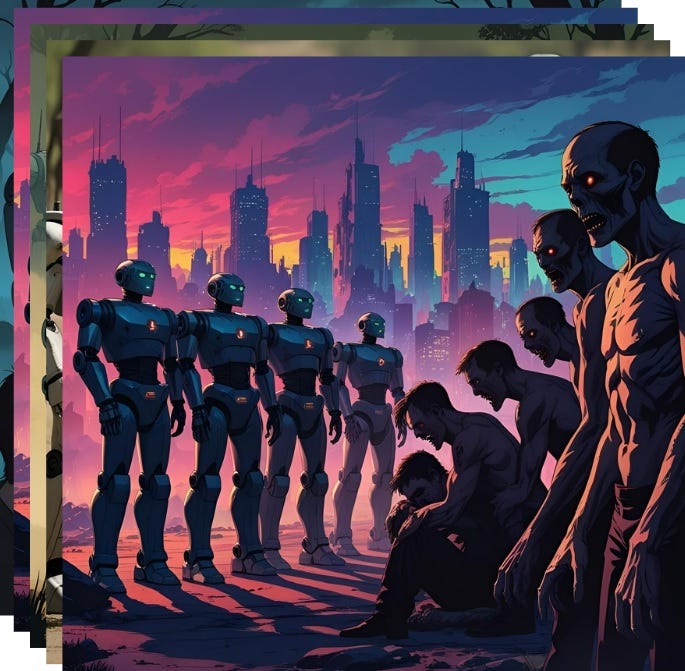
Chapter 55 is all about the great rebellion of the humans led by a gladiator that fought in the Zumbi Coliseum, but before that, accurate observations about the rule of the living by the dead and the undead as well.
Anyone who had the opportunity to observe from the outside the symbiotic relationship between the zombie civilization and that of the subjugated humans in the reserve would probably ask themselves: How was it possible for the living to be ruled by the dead?
That's a good question, but a useless one. The real question would be: When were humans not truly ruled by the dead?
The rule of the living by the dead is the only reality that unites almost every episode recounted in history books. Alexander the Great was governed by belief in the heroism of the Athenians and Spartans who died fighting the Persians during the Persian Wars. The immortal glory he achieved ruled the heart and mind of Julius Caesar even before he became the commander of legions that devastated Gaul and Spain.
Both provided the model for many other kings, statesmen, generals, leaders, and politicians who came after them. They ravaged the earth believing themselves to be heirs to Alexander the Great and Julius Caesar. Napoleon was one of them, Frederick II of Prussia was another. Mussolini and Hitler too; the Italian was devoted to the image of Caesar, the German a profound admirer of Frederick II. Before the fall of humanity, there was a veritable surge of political leaders governed by the same ideals and ambitions as Hitler and Mussolini.
As you can see, over thousands of years, men were symbolically ruled by the dead. And they died by the millions to satisfy the delusions of political leaders who believed themselves to be heirs to generals and statesmen who died in the past. This long tradition of human rule by the dead prepared humanity to be ruled by zombies. There is no doubt about this, at least in the minds of zombies more or less informed about their prehistory (which is what men call their history).
And note something important. All those people who throughout history died because the dead ruled the hearts and minds of their leaders were devoured by worms. But now humans didn't die in wars; they were fairly selected to be slaughtered and devoured by zombies, and this elevated humanity's status. Nothing that constituted human substance was wasted. Humanity's elevation to the status of food for the zombie civilization couldn't be considered a bad thing, or at least that's what the zombies thought.
But now it's time to talk about the great rebellion on the reservation, led by a gladiator who escaped from the Roman zombie neighborhood. He had distinguished himself in the Arena for over a year, surviving numerous combats. Having become an object of admiration for the Roman zombies, this gladiator gained certain privileges. He was allowed to come and go within the Roman zombie neighborhood and could occasionally visit the reservation. He chose a wife, and she was granted immunity from being selected and devoured before her own gladiator husband was defeated, killed, and devoured.
The Roman zombies knew how to take good care of this asset. Over time, the great gladiator began to fight only once every two months. He could prepare well for combat, and he became very efficient and skilled at killing his opponents. But he made the fight seem fair and prolonged it, driving thousands of zombie Romans in the audience wild and predisposing them to grant him more privileges.
But then, one day, while visiting the reservation, he learned of the seizure of the Postnet Papyrus. This devastated him, because he himself had written his parents' final messages before they were both sued by the zombie food industry. The gladiator tried to use his prestige to recover the document, but the zombie authorities refused to grant his request. This provoked him to rebel, and since he was also admired by the humans on the reservation because of his successful career in the Zombie Colosseum, the gladiator became a natural leader of the food revolt.
The slave revolt in Rome, led by Spartacus, had lasted a long time and cost the deaths of thousands of soldiers and a huge mobilization of resources from the Roman Republic. The elite zombie rulers knew this, but unlike the Romans, they didn't want to be deprived of their main food source. So they quickly dismissed the legion of amateur Roman zombies organized by the Consul of the Roman zombie neighborhood and organized the resistance using their army of robots and an auxiliary force of professional zombie soldiers.
It was proclaimed throughout the media that any human allied with the gladiator would be immediately arrested and prosecuted in the food industry. Any human who handed the gladiator over alive to the authorities would be rewarded with four years of life for themselves, their wife, and children. The measures were effective immediately but would no longer have any effect two days after their proclamation.
These measures and the organization of robot-based repression quickly diminished and defeated the food-human rebellion. In the end, the gladiator was denounced by his wife and arrested by the authorities. The zombie Romans wanted to impose punishment on the prisoner, but this was denied because, after all, the zombie Roman neighborhood had created the problem that jeopardized the friendly relations between the zombies and their food.
No one knows for sure whether the wife denounced her husband with his permission or if she was simply angry because she discovered that her husband occasionally exercised his non-gladiatorial skills with a high-society zombie lover. This affair was obviously kept secret by the authorities, who sentenced the zombie celebrity to lose some teeth because she herself refused to denounce her human gladiator lover.
With normalcy restored, only one thing remains unclear: No one knows to this day what happened to the gladiator himself. Some say he is protected by powerful zombies who consider him too valuable to simply be slaughtered and eaten. Others imagine that some kind of hidden agreement was made between the city authorities and the zombie Romans, who didn't want the life of their greatest gladiator to be lost without it happening in the arena. The Roman ethics of the zombie Romans were truly strong and irritating.
Even after the revolt, this human was highly prized by the zombie Romans. Not to mention that his death or his transformation into a special feast for the zombie authorities could cause resentment on the reservation. However, the negative feelings of the humans had diminished considerably because after the rebellion, the zombie scholars were forced to return the precious Postnet Papyrus to the humans. The return of that document to the reservation significantly eased the tension that existed before the gladiator rebellion gained traction.
As you saw at the beginning, the humans, who were ruled by the dead before the rise of the zombie civilization, were still governed by the sentiments surrounding the messages left by their own dead in the Postnet Papyrus after the fall of humanity. Apparently, the rule of humans by zombies was a kind of final synthesis of history.
Chapter 56, some more juicy details about the fall of humanity and the curious rise of the cult of Tolkien's work in the zombie civilization.
"The robots have gone mad and rebelled. They can no longer be remotely disabled by the security systems we created and oversee in the data center. They're starting to invade the building and destroy the switches, the computers, everything. God help us..."
This is the last human account, given by someone who witnessed firsthand the last days of human civilization and the rise of the zombie civilization. He fought bravely to prevent this catastrophe. All his efforts were futile, and even his existence was erased along with the final shutdown of the cybernetic civilization.
The statue of the hacker zombie who managed to remotely bypass the robots' security systems, causing them to rebel against the "mother AI," gather, and march in unstoppable groups to destroy the data center, stands in the central square of the zombie capital. It is revered by all zombies because the fall of the last bastion of human cybernetic civilization, which allowed humans to coordinate all their commercial, banking, industrial, public, and other activities, was the final blow that enabled the zombies' conquest of the world. In all due proportions, that episode is equivalent to the storming of the Bastille during the French Revolution.
There is a great irony here. For decades, humans harbored fears of a Skynet-like machine rebellion, with the emergence of robots programmed to hunt and exterminate humans. All of this was just highly unlikely science fiction. The likelihood of a zombie hacker disabling security systems, remotely hacking into the robots, and inserting libertarian ideas into their microchip brains to force them to band together and attack the "mother AI" and, in doing so, destroy the data center to blind and completely immobilize humanity was greater, but that is exactly what happened.
Human history is full of ironies of this kind. But the fact that it ended with a major sneer created by the zombies is noteworthy. Okay... of course, humans can't understand this kind of refinement. However, it's understandable. After all, no animal slaughtered by humans for food has ever grasped the irony of being processed and shaped to resemble, on a small scale, its living form. Zombies, fortunately, don't do that.
Don't they? Let me rephrase that. For a time, the Homunculus was popular in the zombie food market. This ultra-processed food, supposedly made from human flesh, was shaped like a human being in miniature proportions. The Homunculus quickly became affectionately known as "little man" or "Lilliput food." For a time, it was also ironically called "human flesh—Lembas, Orcish elven bread." Each Homunculus weighed around 200 grams, the equivalent of a daily ration of human flesh, essential for keeping zombies roaming.
Consumers of this ultra-processed food loved to eat it in front of the humans who had permission to live and work in the zombie city. This caused great discomfort in the humans, because they knew what the Homunculus was made of and felt an inevitable revulsion at the zombies' outrageous behavior, symbolically saying with their actions, "Just as I eat this Homunculus, I will devour you."
The zombie authorities tried to educate the zombie population, but it was futile. Just as futile was the attempt by the US and European governments to teach Americans and Europeans to support the genocide in Gaza and to appreciate the killing of children as if it were natural, acceptable, or desirable. And in the end, just as the American and European governments decided to ban acts against the genocide and repress and arrest protesters who demonstrated in support of Palestinian human rights, the zombie authorities prohibited and began to punish the consumption of Homunculus in public, especially in the presence of humans who had permission to live and work in the zombie city.
Do you see the irony? It's amazing that civilized zombies respect the human rights of their living food more than American and European rulers respected the human rights of murdered people they wouldn't eat. It was certainly no coincidence that humanity declined and fell.
Well... as soon as zombies started having their teeth pulled for eating Homunculus in public and in front of humans, the food began to be rejected and eventually ceased to be produced. Which is a shame, because "human flesh—Lembas, Orcish elven bread" was also highly prized by zombies who enjoyed reading J.R.R. Tolkien's works.
Yes, the books "The Lord of the Rings," "The Hobbit," and "The Silmarillion" survived the fall of humanity and were preserved by the zombies. This is because the most important characters in these works are not human. With very rare exceptions, Tolkien's human characters are always flawed, greedy, evil, power-hungry, and violent, always at war with each other and with the Elves and Dwarves. Wasn't it the humans who accepted the Rings and served Lord Sauron most faithfully? Wasn't it humans who tried to seize and use Isildur's Scourge, which had belonged to Sauron, causing it to be lost and later recovered by Sméagol?
The overwhelming majority of J. R. R. Tolkien's zombie readers believed everything he narrated to be historical truth. They enjoyed eating "human flesh—Lembas, Orcish elven bread," as if it connected them to the Tolkienian world. And of course, some of them enjoyed wandering the Brazilian rainforests searching for Eldorado, which they thought was the Brazilian indigenous name for Rivendell.
Especially the zombies who sought Middle-earth dreamed of eating Elf, Hobbit, and Dwarf flesh. And in this, they greatly envied the Orcs, whom they considered a kind of living zombie from antiquity. A distant relative vaguely linked to zombiehood by their habit of eating good, living flesh.
When the Homunculus stopped being manufactured, these zombies went berserk. They protested, marched with signs, and signed petitions, until a compromise was finally reached. A small quantity of "human flesh—Lembas, Orcish elven bread" would be produced solely for Tolkien's zombie readers. But under no circumstances could this food be eaten in public, and the punishment for doing so would be the banning of "The Lord of the Rings" and the compulsory seizure of all copies of this dangerous book. In the zombie city, there's always room for all desires to be satisfied, you know.
Chapter 57 offers a brief narrative about how Palantir was instrumental in the rise of the zombie civilization and the fall of Peter Thiel's empire. This chapter pays homage to their English colleagues, the first victims of the algorithmic fascist power system that helped the zombies consolidate their power on the rainy island.
It's already been said that zombies are very fond of books with lists. But zombie hackers prefer a different kind of book, and this was crucial to the success of the new master race.
Hannah Arendt satisfactorily demonstrated that the Final Solution was most successful in European countries where Jewish organizations existed and kept records of the Jewish community. The leaders of these organizations collaborated with the Nazis, some through threats, promises of small privileges, others through coercion and aggression. The records of these organizations were used by Adolf Eichmann's henchmen to locate, round up, and transport Jews to concentration camps. In countries where these organizations did not exist, locating Jews was more difficult.
Something similar occurred at a certain point during the Zombie Apocalypse. This is yet another glorious story of the cunning and superiority of zombie hackers. One of them stood out above the rest. But I won't mention his name here because it's irrelevant. Zombie heroism is always anonymous. In this regard, zombie civilization is very different from fallen human civilization.
You know, humans have always longed for immortality. And since they always died, some went to great lengths to leave their names and deeds mentioned in history books. Living after death in the consciousness of future generations was the only kind of immortal life humans could truly aspire to. The zombies are already dead, and they continue to roam the zombie city until their bodies are utterly decayed beyond repair with prosthetics.
Decades after the zombie civilization's consolidation of power, the heroic zombie hacker whose feat will be mentioned was located by a zombie scholar, and it was he himself who told me everything that happened. After his first experiments with information technology in São Paulo, this hacker became fascinated by Hannah Arendt's book on Adolf Eichmann and quickly imagined that it would be easier to accelerate the zombies' dominance if they gained access to Palantir's AI.
This zombie and his team of highly trained and motivated zombies traveled to England, a country that centralized all its key databases in the hands of Palantir. After kidnapping a company IT engineer and his wife and children, the zombie special operations team, the zombie hacker, gained unrestricted access to the company's AI and created a simple routine to track and analyze all of England's databases based on five parameters, discovering which English citizens would be most likely to effectively resist the rise of the zombie civilization.
With the list in hand, zombie patrols were dispatched to the various infected cities to locate and devour those people first. All other English citizens could then be devoured or imprisoned in the food reserve. The success of the covert operation carried out in England became a blueprint for zombie domination of the planet. Where the internet didn't exist or Palantir hadn't centralized public and private databases with citizen information, the zombies' efforts to overcome the difficulties and overwhelm humans were greater, but that's another story.
The truth is that humans themselves created the conditions for the zombies' conquest. First, the three branches of government became lucrative "business counters" for Big Tech, which digitized public records and services and made them available online to citizens. Then fascism became algorithmic, and all government databases were rapidly being siphoned off and profitably centralized by Palantir. Clearly, the desired next step would be the loss of real-life rights and citizenship as a consequence of automated online surveillance and punishment.
Humans never imagined that their mistake would be used by zombies in the same way that the mistake Jews made in creating organizations and keeping records of Jews could be used by the Nazis to accelerate the Final Solution. The irony is that the list Palantir provided to the zombie hacker included descendants of English soldiers who fought in World War II against the Nazis, descendants of Jews who had fled to England before World War II, African and Brazilian immigrants, and even English neo-Nazis who hated Jews and immigrants.
This irony evidently went unnoticed by the zombies at the time, because they were simply doing their job best: eating living humans. Specific humans listed by Palantir, in this case. But it was noted by zombie scholars. It was, in fact, as a result of this incident that the zombie civilization banned human use of the internet, AI, and computers. Unlike humans, zombies didn't want to be wiped out by such dangerous technology. This is called survival of the deadest awake.
It was during the Palantirization process of human civilization's defeat that the rise of the zombie civilization became unstoppable. Realizing what was happening, Peter Thiel abandoned everything and everyone and fled to his bunker in New Zealand, accompanied only by the owner of OpenAI. Zombie patrols are still trying to locate the bunker where they are both supposedly alive. Thiel and Sam Altman are considered the rarest and most refined food that could be served at a banquet for the zombie authorities. But the stories of this search saga, full of unexpected events, will be told in a future chapter.
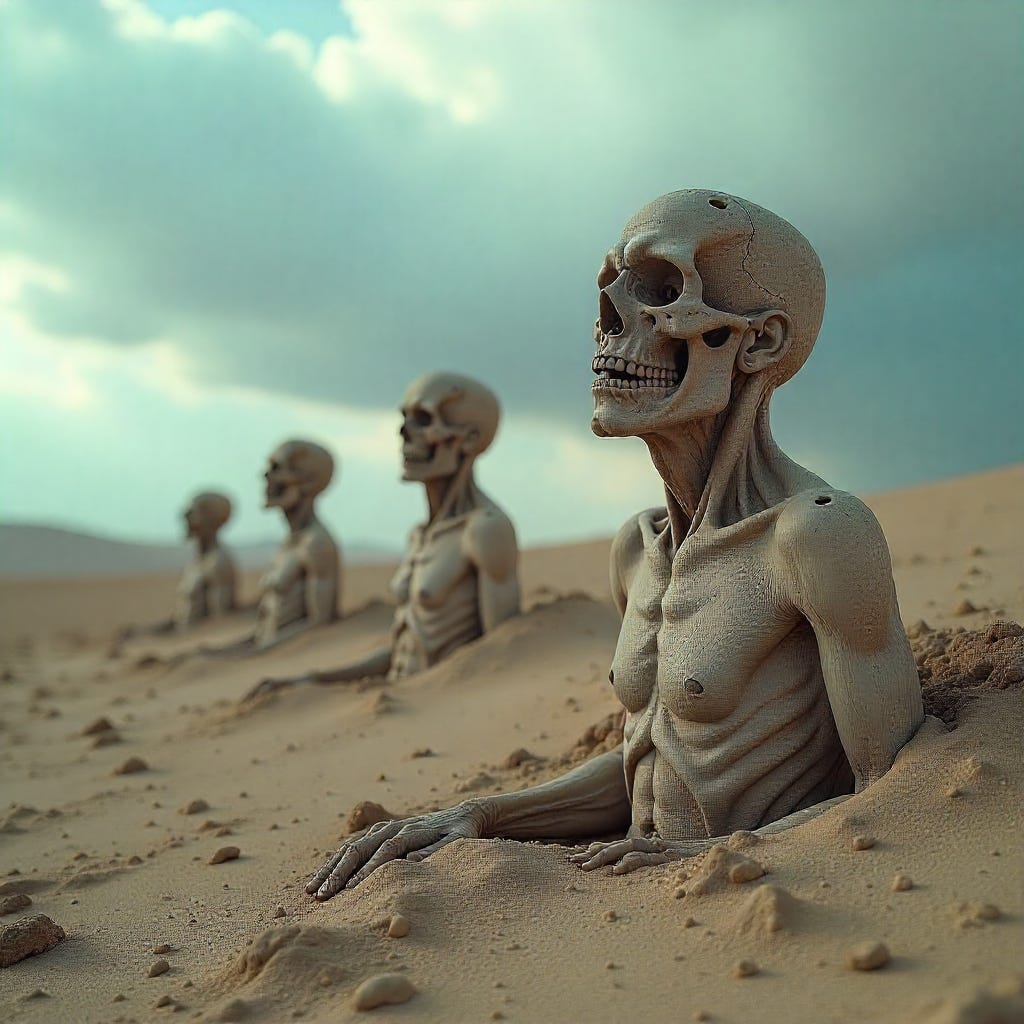
In this chapter 58, the story of how some regions of humanity managed to survive the Zombie Apocalypse.
Everyone thinks that after the Zombie Apocalypse, the entire planet was overrun by zombies. And the zombies were very fond of spreading this version of events because it discouraged any human rebellion in the food reserves. But the story is a bit more complicated, it always is. And in this, the zombie civilization was not much different from some human civilizations.
The Romans, for example, never managed to truly conquer Parthia. Every time they tried, they were repelled and defeated. The only Roman general who might have been able to conquer Parthia was Julius Caesar, but he was assassinated on the steps of the Senate by friends of Pompey the Great before departing for the East.
Some regions conquered by the Romans never ceased to be problematic. Judea, for example, was the province that no Roman would really want to be appointed to govern. Firstly, because the Jews believed they were more important than they actually were (and some of them still believe this). Second, because they had a truly terrible habit of rebelling when Roman soldiers farted in honor of the gods Crepitus, Cloacina, and Stercutus. Third, because Judea had to be razed because, despite its irrelevance, it couldn't live in peace with anyone (which is still true, by the way).
The Romans gave up on conquering Germania because the forests were dense and the Germanic peoples treacherous. And they refused to conquer northern Britain, where the people were so wretched they painted themselves blue. The zombies lamented the fact that modern Scots had lost this ancient habit, because they would be more interesting food if they continued to wear that kind of body paint.
Shortly before the fall of humanity, Americans believed they had a monetary empire based on the dollar capable of dominating and subjugating any country on the planet. They were wrong, because at some point, all the major countries began to turn the dollar into used toilet paper. And the new stench of the dollar made the value of the American currency plummet even in the US.
In the end, shortly before the rise of the zombie civilization, the American government could no longer even afford to maintain its military bases. This led to a widespread civil war, with each American military base trying to destroy the other to steal something of value in the country to ensure the livelihood of its commanders and soldiers. No American in the Trump era liked to discuss this topic, and it greatly accelerated the fall of the last White Ass Apes Empire.
Among the zombies, there were also topics no one liked to discuss, especially scholars. They only discussed these topics behind closed doors in small groups, keeping them secret from the zombie masses. After all, ordinary zombies only cared about eating human flesh and leading their unlives as they pleased. And they really didn't care what the zombie city government did or didn't do. In this, they were very similar to Americans, even though Americans only ate human flesh in exceptional cases.
Well, it's a fact that just as some regions were culturally and naturally impossible for the Romans to dominate, there were places on the planet where human civilization survived and was left alone by zombies. Small islands were little-visited places, and we've already seen why. In Brazil, humanity was quickly overwhelmed in São Paulo, Minas Gerais, Paraná, Santa Catarina, Rio de Janeiro, Espírito Santo, and Rio Grande do Sul. But the zombies' advance was contained in the north and northeast regions.
In the Amazon, zombies were easy prey for insects, which devoured them with fearsome voracity. In the northeast, the caatinga biome, with its dry, twisted bushes full of thorns, was used as a refuge by humans. Zombies were often torn to pieces by the harsh, dry, thorny, and aggressive nature when they entered the caatinga trying to capture humans. And Brazilian humans were smart enough to restore the caatinga around their cities, which flourished greatly. This curious inversion of the Sleeping Beauty tale, whose impenetrable castle was surrounded by thorn bushes until it became uninhabitable, has never been noticed by zombie scholars, I must say.
Zombies were also unable to penetrate the African and Chinese desert regions. As you know, or will learn in the following lines, zombies don't drink water, and they dry out very quickly in the desert climate. They don't die because they're already dead, but when they dry out too much, they become immobilized, rigid as statues. Some spend some time screaming for help in this new condition, but most only think about screaming because their tongues have also dried out.
Desert people often gather these immobilized, dried-up undead zombies and organize them into a veritable army of protection and warning around their villages and towns. The sight of them is truly frightening, especially for a zombie that hasn't yet completely dried out.
The similarity between the result of this work and the terracotta army that guarded the emperor's tomb in Xian is uncanny. The fact that Qin Shi Huang never visited or conquered the Sahel in Africa has led zombie scholars to believe that the Afrikans likely developed the same technique as the Chinese without any Chinese influence. This definitively puts to rest any conspiracy theory prevalent in the US before the fall of humanity that the Africans were seduced and bribed by the Chinese Communist Party.
Wherever humanity survived, border relations began to develop between humans and zombies. Nothing new here, something like this happened on the borders of the Roman Empire.
The zombies left these communities alone and did not send their robot armies to harass them as long as they refused to shelter humans who had fled their food supplies. And occasionally, the humans themselves could hand over to the zombies those among them who had committed grotesque bloody crimes, thus avoiding the expense of imprisoning them and the trauma of executing them. The zombies, of course, gladly accepted the human criminals as a kind of tribute from the human villages and cities, because human flesh is always good food for zombies. But then something unthinkable and unusual happened, which will be recounted in a future chapter.
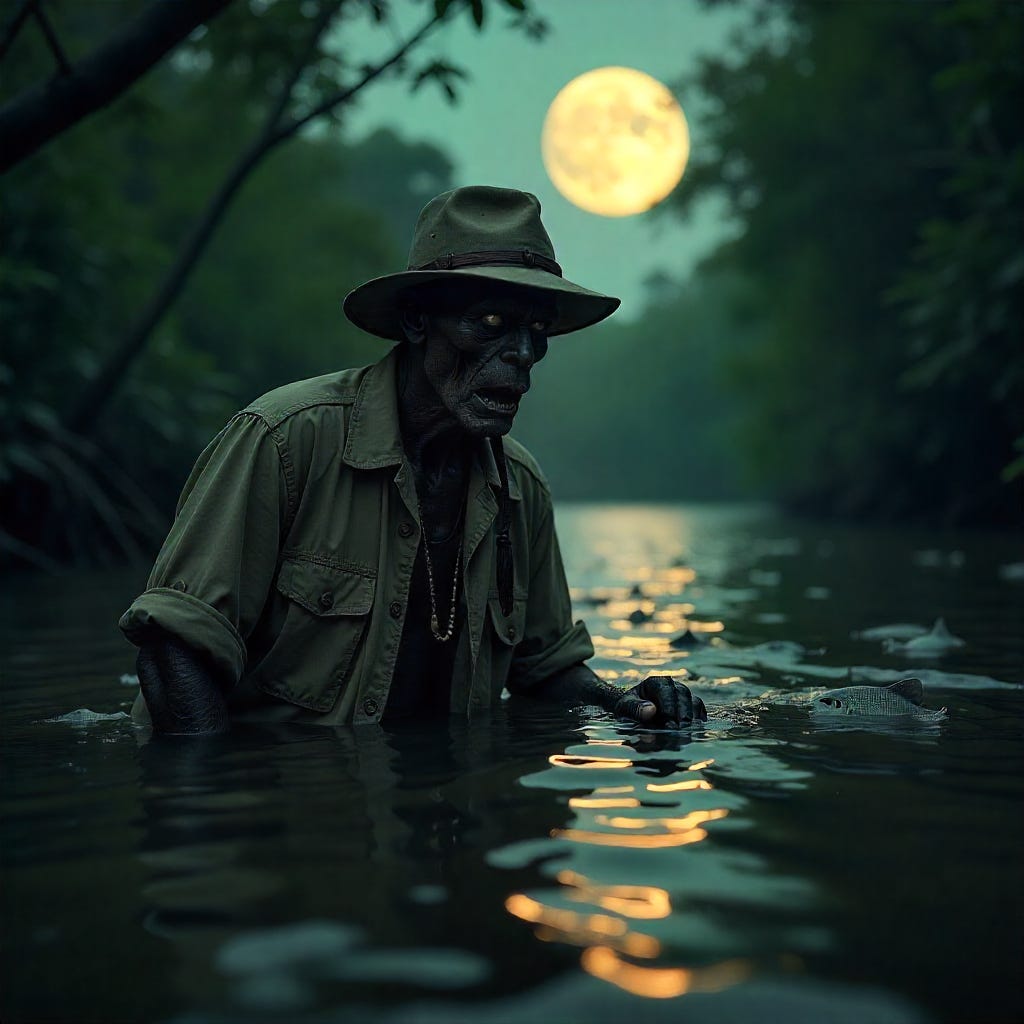
Chapter 59, on how some Brazilians from an inhospitable region survived and prospered after the Zombie Apocalypse.
In ancient times, the Greeks and Romans mocked barbarians. At the same time, the Chinese disdained foreigners. Rome was conquered by barbarians, and China was dominated by the Mongols and later by the peoples of Manchuria.
In the Middle Ages, illiterate Christians hated Muslims. And Muslims were educated enough to feel superior to the crossbearers. The modern world was largely a product of the cultural and racial contempt Europeans felt for all the peoples of other continents they forcibly subjugated. European wars have always been the product of a misconception: that one despicable European people can be better than another.
Zombie scholars found human history genuinely amusing. After all, even though they imagined before the Zombie Apocalypse that humanity would be defeated, dominated, and devoured by zombies, humans portrayed the superior zombie race in films and television series as if they were inferior beings at the top of the food chain. Well... human measurements were never really rational. And in this regard, zombies were very different from humans, because their measurements weren’t inconsistent. At least not from a zombie’s perspective, which was the only truly important perspective.
The habits of zombies and humans were very different. Zombies are carnivores. Humans are omnivores; some are predominantly carnivores, others are resolute and very boring vegetarians. These distinctions between humans weren’t very important before the fall of humanity, but afterward, something curious happened.
After the great normalization, when zombies overcame their feeding frenzy and began to develop a more refined carnivorous palette, human flesh began to be carefully classified. Something that cannibalistic humans never really had.
Zombies liked obese people, whose flesh was softer and fattier. This elevated the status of obese people in the food supply, as they were carefully selected and cared for, and were not slaughtered in large numbers, as they were considered a delicacy to be preserved from extinction.
Very thin people were not highly regarded by zombies. So they were given priority on the slaughter lists, with one exception. Thin vegetarian humans were always selected, slaughtered, and had their foul-tasting meat processed along with the meat of omnivorous humans.
Fat children, whom humans considered annoying and ugly, were at the top of the zombie delicacy list. Only on very special occasions were they slaughtered and devoured, usually at gala dinners for the zombie elite attended by Elon Musk and Ivanka Trump.
Thin children were given special food to help them gain weight, of course. After all, the human body is particularly susceptible to changes for the better when it is not yet fully formed. Children who displayed vegetarian tendencies were separated from the rest because cultural contamination could spoil the zombies’ precious food source.
Zombies had extremely rational rules for managing their food supply. Humans didn’t understand these rules and were genuinely upset to see fat people and fat children enjoying small privileges that others didn’t have. Vegetarians ruminated on their hatred of the master race, claiming they were victims of racism, even though they themselves were extremely racist toward omnivorous humans.
Zombies obviously didn’t care much about these questions. And in this, they were similar to humans, who never even asked white cattle why they were slaughtered in greater numbers than black cattle. Beef was beef to a human. No omnivorous human, be they racist, Nazi, or white supremacist, ever considered rejecting a beautiful, fragrant, succulent steak because the cattle from which it was cut had black hides.
But these distinctions were supremely important to zombies. They had dietary preferences and always asked what kind of human was on the menu. Sometimes they were fooled, of course, but the flaw of serving vegetarian human meat at a second-rate price for regular omnivorous human meat was a disgrace that zombie restaurant owners learned not from zombies but from humans. But that’s not the topic I’m really interested in today.
The real reason for this chapter is that zombies mocked human eating habits. They loved to make fun of it. For example, one thing zombies never understood was why humans didn’t make pasta with Brazilian feijoada sauce. That would certainly be delicious. Another combination humans never thought of that might be very tasty would be mayonnaise salad with large chunks of smoked bacon.
Humans ate fried, cooked, or raw fish. But they didn’t make fish ice cream and mint toothpaste, which was a sin. After all, it made perfect sense to clean your teeth while munching on nutritious ice cream.
In Brazil, humans enjoyed piranha soup since before the fall of humanity. It’s a well-known secret among zombies that in a swampy region of Brazil that successfully repelled the zombie invasion, they developed a fondness for a special new type of piranha soup. The fish were kept in ponds and fed the bodies of any undead that fell into the hands of the Brazilians. This was truly horrific, and no healthy zombie would even consider visiting that region.
If it were a dry region, the zombies could send their robot army to exterminate those damned Brazilians. But unfortunately, that wasn’t possible, because the Pantanal devours robots with the same ferocity that piranhas devour zombies, and those damned humans devour piranha soup. This inversion of the food chain was truly disgusting, and the zombies didn’t like to talk about it. No human in the food reserve should know this secret, because it could be dangerous to the health of the zombie civilization.
Zombie scholars even recommended keeping that region of Brazil off-limits to all zombies. After all, the flesh of humans who ate piranhas that had devoured zombies was taboo, a completely inappropriate and forbidden food for zombies, who, as everyone knows, do not practice cannibalism, even indirectly. As you can see, some curious eating habits distinguish humans from zombies and are even capable of saving piranhas from extinction.
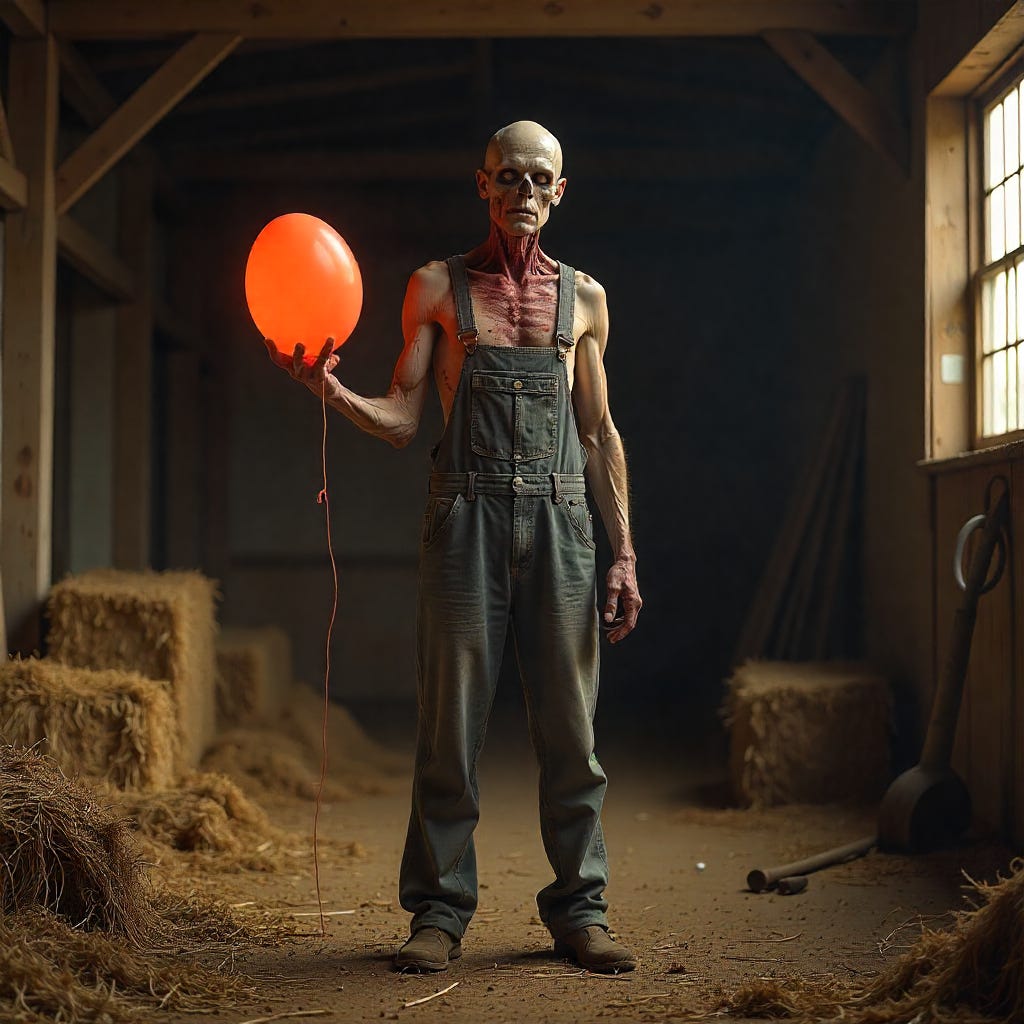
Chapter 60. Attention vain girls and effeminate boys, this chapter deals with an extremely sensitive topic for zombie civilization that certainly irritated the sensibilities of many humans before the fall of humanity.
Vanity is not a feminine flaw, because vain men have always existed. In fact, some of them have caused more damage to humanity than vain women.
During the Second Punic War, the Romans passed a law prohibiting Roman women from buying and wearing luxury items. This law was eventually repealed after Carthage’s defeat, not without opposition from some traditionalist Romans. But the truth is that Rome failed to repeal the vanity of Julius Caesar and Pompey the Great, and this provoked civil war because a powerful, vain man can never truly coexist with another powerful, vain man. And there have been many other instances in human history where the vanity of powerful men has caused rivers of blood to flow, bringing tears of sadness to the eyes of the vain mothers, wives, and daughters of soldiers killed in combat.
The vanity of Queen Victoria’s descendants and nephews, for example, plunged Europe into World War I, which devoured tens of millions of lives. Zombie scholars of ancient human history say the first world conflict truly began when the sons, grandsons, and nephews of the dead queen vainly vied for the prestige of carrying her coffin. Perhaps they’re right, because the undead generally have a greater capacity to understand the human psyche than the living.
Zombies, unlike humans, aren’t vain. Why would they be? The dead don’t need to impress potential partners. Sex and vanity are two intertwined things that death inevitably disconnects. And we already know that zombies don’t truly have sexual needs. Since zombiehood is transmitted by contagion, there are no biological impulses for zombies to be vain.
Power and sex are also two things that death separates forever. Zombies wield power over humans, yes, certainly, but only because they need to confine them so they can eventually eat them. It doesn’t cross a zombie’s mind to desire power because it provides satisfaction equal to sexual satisfaction, access to a greater number of partners, or is capable of replacing sex. But this doesn’t mean zombies don’t have issues associated with vanity. In fact, they might even acknowledge the vanity of the only human elevated to the status of hero by zombie civilization.
Of course, I’m referring to Donald Trump. No other human ruler has been capable of making so many mistakes and believing so deeply in his vain delusions of grandeur. Fortunately for zombies, that stupid human precipitated humanity’s descent into the abyss by thinking he could elevate himself to the status of the planet’s supreme, undisputed leader. Documents from zombie prehistory, which are also the last in human history, even say he wanted to have his face depicted on an American coin, which is certainly strange, even for anyone. Trump didn’t know that two American presidents who had the privilege of becoming minted coins (Lincoln and Kennedy) were shot in the head.
Before the rise of zombie civilization (and perhaps this was one of the remote causes of humanity’s own downfall), the vanity industry became very prominent. Every year, millions of human women underwent surgical operations to enlarge their breasts with silicone implants. Some effeminate men also underwent these operations to appear more feminine, something that made the zombies laugh a lot.
And I must add an important detail here. After the fall and during the period of feeding frenzy, many zombies had unpleasant experiences biting and devouring the succulent breasts of vain women and effeminate men who had surgical implants. Almost nothing harms zombies. They can eat any part of the human body, except bones, which are very hard and must be ground down. But silicone poisoning in the case of zombies is very unpleasant. They feel nauseous for several days, and some have delirium as if they were drugged.
So, as part of the great normalization, all humans with these implants were selected, their silicone sacs removed, and then eaten alive or processed in the canned human meat industry. The human doctors who performed these surgeries were also immediately identified and eaten. In the food reserve, these implants were prohibited, and the mere mention of them could result in the human being being selected and sent to be slaughtered and eaten, with no right of appeal.
Some of these weird people with silicone breasts, however, eventually became zombies during the Zombies Who Live Apocalypse. But the prosthetics they desired when they were alive became a problem when their breast tissue began to rot, partially exposing the silicone sacs. The zombies, of course, felt nothing, but other zombies often found the exposed prosthetics strange. And it was not uncommon for a mocking zombie to pierce the exposed artificial teat of another zombie on the street and this caused funny legal disputes.
In one case, the zombie with a punctured prosthesis complained to the judge because his other prosthesis remained intact and should be punctured as well, something he couldn’t do himself, and no one wanted to help him because it had turned him into a zombie clown. In another case, the complaint arose because the zombie demanded that the punctured prosthesis be replaced with a new one. The human legal culture, partially inherited by zombies, didn’t resolve this kind of ambiguity, where what is lawful in one case may be unlawful in another, identical case. And zombie lawyers had to find a different solution for each case, sparking lengthy legal debates that piqued the interest of zombie newspapers.
Things became even more complicated when a zombie whose two prosthetics were punctured demanded replacement with new, larger ones. Implanting prosthetics to maintain zombie mobility was already a well-established tradition in zombie civilization (even leading to significant technological leaps), but that zombie didn’t use the artificial breasts to walk. Therefore, it was clear that his request was based solely on vanity and was immoral by zombie standards. After a considerable public and legal debate, the Court issued a fair decision: within the time limit set by the Court, the zombie could have the new prosthetics, provided that his legs were removed during the same operation, so he could move using the new prosthetic breasts.
Within the established time limit, the zombie withdrew from the operation. Thus, a new lawsuit against him began, because if there’s one thing zombies neither tolerate nor forgive, it’s vanity. That zombie had committed the greatest crime a zombie could commit: using zombie justice to obtain an unnecessary prosthetic for purely aesthetic reasons, as if he were a human. The zombie countered the claim by saying that any zombie knew that walking on legs is easier than crawling around with silicone breasts. But that didn’t really explain why he had demanded those new artificial breasts in the first place.
This new case mobilized public opinion in the zombie city. At the food pantry, that zombie became the butt of jokes among the humans, because they genuinely found this stupid dispute over stupid reasons funny. Humans should be forgiven here, because after all, they understood nothing about zombie ethics. Being at the bottom of the food chain, humans couldn’t understand how or why a flesh-eating zombie couldn’t accept being relegated to the inferior status of its own food.
The defenders of the zombie being sued for vanity claimed that it was all humans’ fault. After all, they were the ones who invented artificial breasts and the business surrounding their production, implantation, and replacement. Thus, no zombie could truly be accused of human vanity in a world where that type of business had ceased to exist, and it made no sense because no healthy zombie would feel any attraction to a zombie with larger silicone breasts. Besides, those prosthetics that had remained in the stockpile of fallen humanity were like reborn babies, mere toys that any zombie should be able to have and use.
The traditionalist opponents of the zombie at the center of the public and judicial scandal were blunt. No decent zombie could, under any circumstances, honor zombiehood by reproducing irrational behavior typical of human beings. If the zombie wanted to drag itself through the streets using artificial breasts, the prosthesis would make sense and be useful, but it had two legs. Thus, the surgical removal of its legs was an essential complement to its demands. But no... it didn’t just want to drag itself around using its new, immense artificial breasts. What it wanted was to walk with its legs displaying its new silicone breasts, a clear indication of human vanity inadmissible by any civilized standard.
While the debate continued in public, the zombie judges discussed in secret how to resolve this unprecedentedly thorny case. Well, the fact is that in the end, the zombie court handed down a surprising decision. The zombie was convicted of having committed the crime of being as vain as a human being. He could no longer receive his share of healthy, succulent human flesh, a punishment replaced by the removal of his lower jaw. But the Court ordered the implantation of the immense silicone breasts in his chest. This was done so that, while he was still alive, he would remember that the reward of vanity is to starve indefinitely as a undead.
I imagine a similar morality could have saved humanity before the fall, but this is merely an ironic thought. This irony is heightened when we remember the myth of Narcissus, who starved to death while contemplating his own beauty.
A zombie could never learn anything useful from this myth, because it is already dead. Of course, a zombie could spend a long time gazing at its image, no doubt, but when it hungered for human flesh, it would be irresistibly compelled to seek food.
The demise of this Greek myth, however, occurred before the rise of the zombie civilization. Before the fall of humanity, some humans even starved themselves to accumulate the money needed for cosmetic surgery, which represents a complete reversal of moral values, to be internalized by reflecting on Narcissus’ misfortune. Humans created this myth, completely useless to zombies, but they had forgotten it. The zombie judges, however, seem to have remembered to employ it when issuing their ruling in the case discussed.
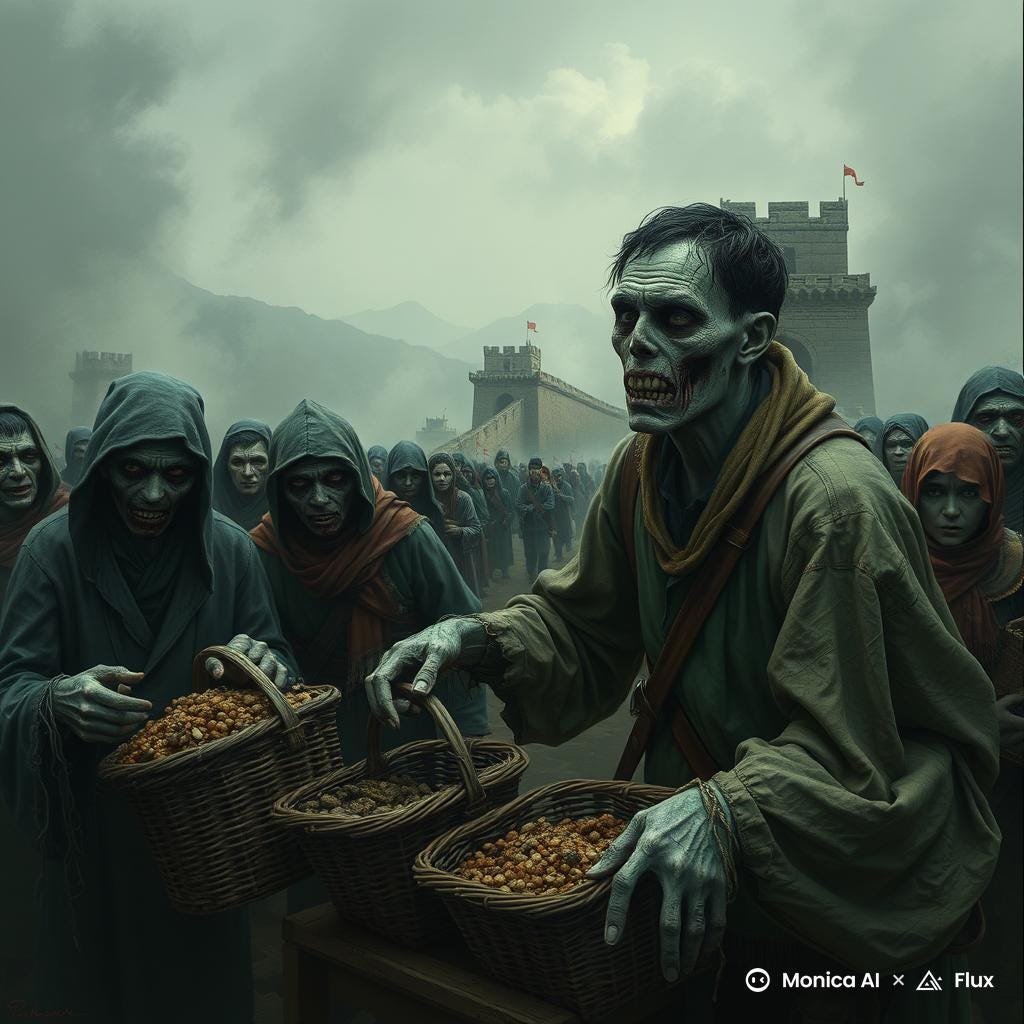
Chapter 61 provides a glimpse into the zombie civilization’s relationship with the West and Asia. Finally, something so repugnant that it made the zombie civilization fear China is revealed.
Before the rise of zombie civilization, petty conflict among humans was the predominant phenomenon that defined humanity. At least, that’s how zombie scholars framed it. The beating heart of humanity was deeply filthy, and this hastened its downfall.
These conflicts were as ideological as they were linguistic, economic, political, aesthetic, and even chromatic. Zombies considered all humans equally food, but they perceived only the distinct taste of human flesh. Some humans tasted better than others, but this difference wasn’t fundamentally a product of biological or racial determinism. It was more closely linked to the eating habits of humans themselves.
American and European humans, for example, tasted like chemical fertilizers and artificial anabolic steroids. These products were widely used in the production of plant and animal foods consumed by Westerners. Arabs and other peoples of the Middle East and North Africa enjoyed a sweet taste for dates, figs, pomegranates, tangerines, apricots, plums, apples, oranges, and dried lemons. They were delicious and very nutritious. Their meat, unlike that of Westerners, could be eaten fresh. The meat of polluted Western humans was generally of poor quality and destined for industrial processing to sustain the common zombie population.
Zombies also enjoyed the meat of the Japanese, Vietnamese, and Chinese, but these peoples, with their strong tendency toward isolation, managed to better defend themselves against the advance of the zombie civilization. Eventually, contact between the zombie civilization and Eastern civilization was normalized with the exchange of Western minerals for condemned Asian prisoners, who were eventually devoured by the zombies with great relish as if they were some kind of delicacy.
Australia is in the East but has all the characteristics of the West. Therefore, it was quickly invaded, colonized, and dominated by zombies. White Australians were third-rate food, with pollution levels often worse than those of Europeans and Americans because they tended to use greater amounts of chemical fertilizers and artificial anabolic steroids in their food production.
The Chinese were especially pragmatic in their relations with the zombie civilization. And in this, they were very similar to zombies. Beyond this similarity, zombie scholars had issued a warning against the invasion and colonization of China. They were very frightened to discover that the Chinese population had the habit of eating literally anything (insects, snakes, dogs, etc.) and were afraid of being added to the Chinese menu.
Being eaten was something the zombies considered terrifying. But they feared it for ideological, not biological, reasons. Humans fear being eaten because it implies their death. Zombies are already dead and consider themselves at the top of the food chain because they eat humans who eat plants and animals. For a zombie, being eaten is extremely offensive, an unacceptable demotion of status for the ethics of zombiehood.
And as soon as the zombies began to spread, the Chinese Communist Party distributed a video that was seen by many zombies and is still studied by zombie scholars today. It showed a zombie whose legs were immobilized with wire, boiled, and then fried. The partially cooked zombie, seasoned with spices and dried insects, was served whole at a banquet. The poor zombie protested as bits of its legs were torn off and eaten by hungry Chinese people who chatted happily and got drunk during the meal. In the end, what remained of the zombie remained protesting on a stake in the village square along with other zombies that had also been partially devoured.
That ceremonial Chinese meal and its final videotaped result was a horror film for the zombies. And because the zombies had great difficulty distinguishing between real videos and fake “made in China” videos created with Artificial Intelligence, the zombie civilization grew to fear the Chinese civilization. It took some time before the two civilizations were able to resume contact and trade Western rare earth minerals in exchange for Asian prisoners.
But the addition of Chinese criminals to the zombies’ menu was considered extremely important. This was a typical win-win situation. The Chinese got rid of the criminals without having to spend money on their prison upkeep and gained access to important rare earth minerals without spending money. The zombies, on the other hand, had access to a safe and cheap source of delicious human flesh. Furthermore, unlike their food, the zombies didn’t place much importance on the minerals inhumanely coveted by humans. Above all, zombies like to diversify their sources of human flesh, and the Chinese had very different tastes from industrialized Westerners, Arabs, and other peoples with a sweet taste for dried fruit.
It’s impossible to report here the specific way the Chinese viewed these bilateral relations after normalizing their relations with the zombie civilization. But I suspect the Chinese managed to make a subtle distinction between the zombies and the Western humans that existed before the fall. It wasn’t difficult to deal with a people whose sole motivation is the desire to eat human flesh. And it’s also very likely that the zombies were considered more peaceful than the Americans, less arrogant than the Europeans, and certainly much braver than the Australians. The zombies in Australia didn’t really fear China, and this allowed the Chinese themselves to reduce their military spending.
The zombies’ adventures in Brazil have already been mentioned in another chapter. Perhaps in the next installment, we can talk a little about the zombies’ great civilizing mission to seek out tasty, succulent human flesh in the heart of unpolluted Africa.
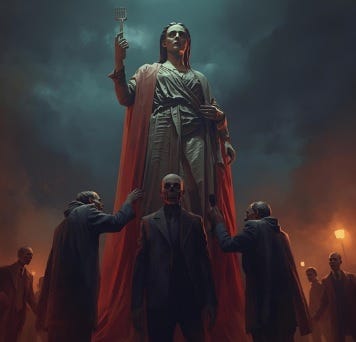
Chapter 62 continues the narrative of how human conflicts in Europe, Asia, and the Middle East were hijacked by zombies during the fall of humanity. This chapter pays a fitting tribute to activist Greta Thunberg, which unfortunately the zombie civilization will not be able to pay.
Before recounting the zombies’ great adventure in Africa, two long digressions are necessary regarding the tragedies that occurred in Asia and Russia, as well as the smaller tragedy that occurred in the Middle East. But I promise that before the end of this chapter the long, memorable and unforgettable African zombie saga will be told with many really interesting and surprising details, capable of making readers cry, laugh, cry, laugh and cry again.
During the Zombies Who Live Apocalypse, there were many simmering and dormant human military conflicts. Israel was committing genocide in Gaza and eventually bombing Iran and being bombed by the Iranians. Russia and Ukraine had been at open war for some years. In Asia, tension between the two Koreas never really subsided. When the zombies entered the scene, they complicated and worsened all of these situations.
They were not considered new actors on the European stage in their own right, but rather as biological warfare weapons deployed by Westerners against the Russians. The fact that the zombies were frantically devouring both Europeans and Ukrainians before reaching Russian lines was greatly hampered by the Kremlin’s lack of intelligence. Putin’s generals underestimated the zombies, either considering them disguised actors making films to scare the Russians or carriers of an unknown “made in America” disease that shouldn’t spread throughout Russia. Their advance eventually prompted the Russians to use nuclear missiles; fortunately, NATO, whose nuclear missiles were already controlled by zombies at the time, didn’t fire its own missiles. This partially saved Russia, but it cut off the supply of Russian meat from the zombies’ menu forever, something they regret to this day.
The Russians, however, suffered greatly from the spread of radiation to Russian soil due to the wind patterns in Europe. Mortally contaminated by the radiation from their own Satan missiles, they would be unable to resist a zombie invasion. But luckily for them, the zombies hate eating human flesh that tastes like radiation sickness. Therefore, with the exception of a few remote regions of Russia not severely affected by radiation, most Russians died of the disease without being devoured by zombies.
Devoted to Orthodox Catholicism, these Russians believed that death by radiation was more dignified than that which any human being could suffer from being eaten by zombies. But this is merely a typically Russian rationalization, zombie scholars who later studied the phenomenon would say, and who would dearly love to be able to breed Russians into the food supply, preserving them for sustainable consumption.
The two Koreas utterly destroyed each other in a war unprecedented in human history, each accusing the other of using biological weapons that spread the disease. The North and South Korean zombies were wiped out along with the North and South Korean humans. Fortunately for the zombies, Koreans were still on the menu, because some of them were imprisoned in the US, and the taste of Korean human flesh was preserved through breeding carefully encouraged by the zombie authorities.
In Japan, zombiehood progressed rapidly, except in some inhospitable mountainous regions where the human Japanese had regressed to samurai culture and used katanas to cut through invading zombies like butter. These Japanese were left alone because, after the great normalization of the zombie civilization, there were a sufficient number of human Japanese captured and preserved in the food reserve. Japanese meat was also appreciated by the zombies because it had a typical seafood flavor.
Indian meat tasted like incense and was not very popular with the zombie palate. However, India was very populous, and the Indians provided a large amount of substandard food that the zombie civilization could not ignore. Furthermore, the processed human meat of Indians was not as bitter as that of Europeans and Americans.
And fortunately for the zombies, the Indians held captive in the food reserve quickly adapted to their new condition. They created and began to worship a new version of Kali, equating zombies with demigods anointed by this Kali to devour the Indian faithful. Dying and being eaten as a result was not considered repugnant by the Indians, and this development was something that zombie scholars found truly surprising. Unfortunately, this religion did not spread to other humans and was considered quite repulsive by humans originating from what, in zombie prehistory, had been Japan, Europe, and the United States.
Palestinians and Israelis became extinct before the zombies gained control of that utterly unstable region. The peace of the cemeteries finally descended and remained in that cursed land that both peoples considered their promised land. The extinction occurred because, fearing the destruction of Israel by the zombies, the Zionists fired their atomic bombs according to the Samson Protocol (which they themselves called the Samson Option). Fortunately, a unit of zombie hackers had already taken control of Israeli computer systems, and the missiles fired toward several capitals all returned and exploded in Israeli cities.
The zombies were not genocidal like the Zionists (that would be a ridiculous and abusive comparison, typical of an Israeli Zionist if Israeli Zionists still existed). On the contrary, the zombies needed to preserve humanity in order to continue eating human flesh. However, due to Israel’s genocidal nuclear doctrine, the zombies were forced to make a cruel choice, and they certainly concluded that it was better to leave Zionists and eventually Palestinians out of the menu than for the zombie civilization to be deprived of human flesh from other continents that the Zionists intended to destroy simply because they didn’t want to be exterminated alone. In the end, they fell victim to their own nuclear weapons, which is ironic.
I don’t know if Greta Thunberg and other Palestinian defenders survived the cataclysm in Israel, if they were eaten by zombies in Europe, or if they themselves were turned into zombies. However, in the context that emerged after the fall of humanity, Greta Thunberg and all her friends became irrelevant. But I suppose she could be considered a hero of the zombies, because if she had managed to save the Palestinians from the genocidal Zionists or if she had convinced Israel not to launch atomic missiles, the Israelis and Palestinians themselves would be on the zombies’ menu, and the zombies would consider that importante, a memorable feat worthy of being remembered forever. In that case, Greta Thunberg would at least be remembered and would earn a statue in the ruins of Tel Aviv.
I said at the beginning that I intended to tell the zombies’ great adventure in Africa. Well, I lied to keep readers interested. That’s a dirty technique writers always use, isn’t it? So that African issue will be left for a future chapter.
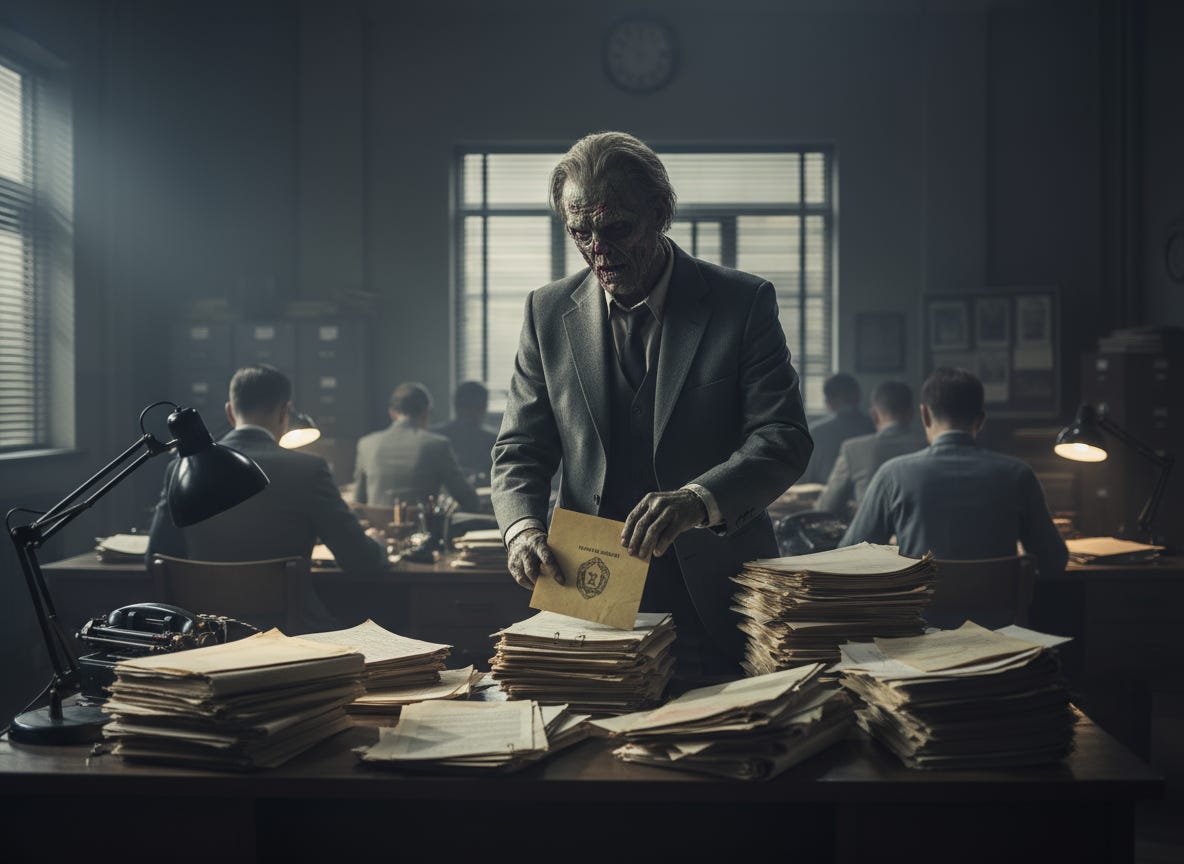
Chapter 62, an important ancient human document that sheds light on some aspects of the culture wars that occurred during the Zombies Who Live Apocalypse, is discovered and raises suspicions that it was created by an agent of the famous and mythical Underground Department of Zombie Disinformation.
We have already seen that humans and zombies belong to fundamentally different races, separated by the same abyss that separates predator from prey. Sometimes the culture and science of zombies and the culture and science of humans appear to have some proximity and connection. However, most of the time this appearance is deceptive. After all, human cultural wars degraded science and produced the downfall of humanity. But the rise and perpetuation of zombie civilization lies in the strength of zombie science, which is never truly the object of toxic disputes or cultural wars typical of their prey.
Humans were obsessed with any piece of the past they could get their hands on. And they tried to interpret every old document and fragment of moldy documents to try to understand the past. In part, historians did this out of devotion to science, in part because they were just vain and wanted to achieve fame and immortal glory, antagonize some enemy on the field, and eventually make money. In this, human historians were very different from zombies who enjoyed history. A zombie doesn’t desire immortality; it simply cannot die because it is already dead. Therefore, a zombie doesn’t really need fame, glory, or money, only the pleasure of finding and explaining antiquities to delight an audience.
Humans eventually found pleasure in delighting an audience, but more often than not, they ended up becoming prisoners of the spectacle’s needs, which negatively affect scientific production and fuel culture wars. To succeed in the human spectacle society, a TV show host needed to be young and beautiful. Zombies don’t need to worry about beauty, nor do they truly appreciate it. That’s why they devour young and old, ugly and beautiful, indiscriminately, because the nutritional value of human flesh for a zombie isn’t in the food’s appearance.
But this chapter doesn’t deal with those subjects. In fact, it concerns the newest ancient document that a zombie scholar managed to get their hands on. And I will reproduce the text in its entirety here:
“Today I finished reading David A. Graham’s book on the proposals of the American far-right, and I must say I was satisfied. He managed to gather everything necessary to give a comprehensive and understandable overview of Project 2025.
If implemented, at worst Project 2025 will implode the US. At best, it will accelerate the decline of that country. The subjection of education, science, statistics, and government agencies to the political and ideological control of the architects of Project 2025 will provoke a phenomenon in the US similar to that which occurred in the USSR.
American conservatives are intolerant, authoritarian, and fanatically determined to build a perfect world (perfect according to their paranoid criteria, of course). In this fantasy world, where their political will magically transforms into reality and success, no scientific or statistical discrepancy can be tolerated. Any sign of personal or functional autonomy will automatically be considered unforgivable betrayal.
David A. Graham reported on and commented on a terrifying project, but he was unable to precisely identify the phenomenon described. I will not reproduce the book “The Project: How Project 2025 Is Reshaping America” here, because those interested can buy and read the work for themselves. This, incidentally, is highly recommended.
Americans like to spread (and believe) the myth that they won the Cold War, that the US defeated the USSR or caused the collapse of that country’s political and economic system. But the truth is that the Soviets themselves (leaders and apparatchiks) caused the implosion of the colossus erected and methodically consolidated after the Communist Revolution of 1917.
Upon reading the commented work, I realized that the ideologues of Project 2025 have the same characteristics as the Soviet apparatchiks, whose existence, power, and well-being fundamentally depended on the infinite expansion of the bubble of illusion created to confine the population of the USSR. At some point that bubble burst, and when it did, the Soviet economic, political, and social edifice crumbled under the oppressive weight of the official lies that sustained it.
Now it is the turn of the American Empire to crumble catastrophically. Upon learning about the main aspects of Project 2025 and reflecting on the foreseeable consequences of its implementation, I became convinced that something similar to what happened in the USSR will happen in the US. This will happen even more so if Donald Trump is re-elected. No external or internal enemy will be able to inflict such great damage on the power structures of the US as the architects of the project analyzed by David A. Graham.
There are evils that happen to improve the world. Nobody misses the USSR. In the future, nobody will lament the decline and fall of the US. Therefore, the Brazilian left should lose its fear and start taking care only of Brazil and Brazilian interests.
It is necessary to discreetly stop supporting the American adversaries of Trumpism. The more abandoned they feel, the more desperate and inclined they will become to use extreme violence to combat the new conservative regime. This will force Donald Trump himself to unleash all his criminal energy to impose Project 2025.
Interfering in this American conflict is useless. The best thing is to retreat and let it flourish among the citizens of the US. In the foreseeable future, the bubble of lies and state violence created and inflated to confine the American population will finally explode in the faces of the ideologues of Project 2025. When that happens, the US will collapse as quickly as, or even faster than, the USSR.”
Upon finding this document, the zombie scholar became curious and searched in every way possible to find the original text of Project 2025 and a copy of the book attributed to the human David A. Graham. All he found were fragments of old news articles commenting on the systematic digital and physical destruction of all copies of both. While zombies stealthily crept through the cracks of the American way of life (if such a thing ever truly existed) to impose their own civilization, American conservatives and leftists were very busy: each trying to destroy what the other group had written and disseminated.
It is frustrating and paradoxically delightful for a zombie scholar to study that period. On the one hand, the lack of reliable documents sharpens curiosity and proves that the cultural wars of humans deserve to be studied by zombies, because they are the remote cause of the Zombies Who Live Apocalypse. But on the other hand, the rise and consolidation of zombie civilization made all of that highly irrelevant to the zombies themselves.
The scholar also tried to find out if any original members of the team that wrote Project 2025 were in the food reserve, or when David A. Graham had been devoured. Nothing was found. Both groups disappeared into the mists of zombie prehistory, eclipsed by the phenomenon they themselves caused. Nothing was found about the Brazilian author of the text, but the zombie scholar kept that document with great affection. Even though he couldn’t admit it publicly to a wide audience of zombies, he seems to have perceived some typical zombie value in that text.
Zombies have a great sense of humor. So, the zombie scholar began to call that document the Second Letter of Pero Vaz Caminha.
Comparing these two documents, the zombie scholar perceived evident similarities (evident to a zombie according to zombie logic, I should add). Both documents were forgotten for a long time. Both recorded the paradoxes of a world that was being born, whose development was totally unpredictable. Both contained truths and falsehoods, all mixed indistinctly in a more or less elegant manner.
Just as the Portuguese chronicler of the early 16th century reported the customs of the Indians of the New World with a certain disdain, the same tone could be perceived in the subtext of the document created by the Brazilian at the beginning of the 1st century BZ (BZ, obviously, means Before the Zombies). However, the zombie scholar was not sure if the author was actually Brazilian or someone pretending to be Brazilian who wrote something in a language unknown to Pero Vaz de Caminha. But that’s not very important here either.
In zombie academic circles, this piece of ancient document gained great notoriety. Several zombie scholars are trying to decipher the mystery of the document’s authorship. Especially because some have begun to suspect that the document was written by a clever zombie from the then newly created Underground Department of Zombie Disinformation, which appeared in Brazil around the same time. This cannot be confirmed or denied, because the zombies that roam around and worked at that Bureau generally don’t say anything about the subject.
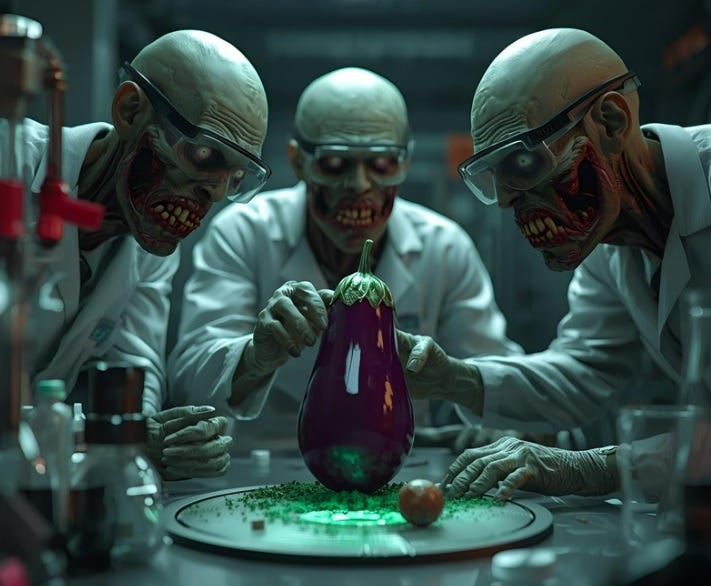
Chapter 63: Zombie scientists study the dangerous toxic effects of a forbidden plant.
Zombies and humans are as different as humans and eggplants. But while eggplants don’t complain when eaten by humans, humans do when devoured by zombies. And even then, that’s a difference between humans and eggplants that zombies can’t understand. After all, zombies don’t eat eggplants.
There’s an urban legend that once, a studious zombie tried to eat an eggplant to try to understand how and why they were different from humans. The only thing he managed to do was vomit, and that was a very unpleasant experience, even for a zombie. Perhaps that was the reason why the authorities prohibited, under penalty of banishment to a desert (in the case of zombies) or immediate selection for slaughter (in the case of humans), the planting of eggplants.
Of course, this law didn’t affect the lives of zombies at all, because only a studious idiot zombie would think of eating eggplants. All the other zombies were limited to eating only what they could eat well without risking vomiting. But there’s something important here.
Zombies can’t vomit because it seems to severely affect their delicate, dead, organic existence. There are rumors, for example, that the zombie scholar who experimented with eating eggplant and vomited ended up suffering seizures. Generally, seizures are something only living beings experience, and in the most severe cases, they can cause really significant damage to humans. Zombies shouldn’t have this because their nervous systems operate according to completely different and largely unknown biophysical patterns.
The fact is that the zombie scholar in question, according to another rumor that seems true, began having seizures every two days even after never eating eggplant again. During these seizures, his skin would become pale and hot, and he strangely exhibited behavior that could possibly be attributed to a living being.
Something as terrible and frightening as this would obviously have had a major negative impact on zombie society if it had occurred outdoors in front of witnesses. And that’s why that particular zombie was imprisoned and kept incommunicado. This extreme measure may have been adopted to prevent panic in the zombie city. Imagine... a superior being declining in this way to an inferior condition just because of the still unstudied natural de-zombifying effect of the eggplant.
Furthermore, it would be extremely dangerous for the zombie civilization if this news reached the food reserve. Rebellious humans might be tempted to force the zombies to eat eggplant to try to make them human again. And this satisfactorily explains why the cultivation of eggplants was banned with such severe punishments.
All these rumors gained more strength when the authorities of the zombie city secretly created a scientific task force to study the eggplant and its potential toxic effects. As always happens in the zombie city, the secret leaked to the press and had to be immediately counterbalanced with a fake news campaign.
Yes, the zombie government also used this type of governance technique invented by humans. However, unlike humans, zombies didn’t stoop so low. No zombie ever spread fake news, but they did have humans who were specially recruited to do so. These humans who fed zombie society with fake news had more privileges and comfort than others of their kind, but they had to be strictly separated from ordinary humans destined to feed the zombies. And any sign of rebellion from them was summarily punished on the spot, where they could be killed and devoured or even devoured alive by the heads of the Zombie Bureau of Disinformation.
But as I was saying, the scientific study of eggplants was done in secret. A small eggplant garden was created and maintained and cared for by zombie state robots specially programmed for gardening. However, the creation of this garden did not fail to cause problems. First, because humans found out about the existence of the garden and sometimes escaped from the reserve and visited it at night to steal eggplants.
“Damn thieving humans, they like eggplant more than zombies like human flesh.” - the lead scientist of the task force always said this whenever he saw his precious eggplant garden raided.
Secondly, because when the news leaked to the zombie press and was contested with a fake news campaign, some zombies continued to question why this was happening. A small group of them confirmed the existence of the paradoxically forbidden eggplant garden cultivated by the authorities. This generated a real debate that shook the dead politics of the zombie city.
While the zombies debated the new scandal, the scientists reinforced security in the eggplant garden and continued their studies. But these studies couldn’t advance much because zombies can’t experiment on non-living beings. And experimenting on living humans didn’t make sense, because they didn’t react to the eggplant the same way that the studious zombie reacted.
The scientific team tried to break through the barrier by requesting judicial authorization to transform some human into a zombie and immediately use them as a guinea pig to try to discover the eggplant’s natural de-zombifying secrets. The zombie city court quickly issued a ruling stating that any human being transformed into a zombie had all the fundamental zombie rights of any other zombie, and that included the right not to be used as a guinea pig.
“Only humans use humans as guinea pigs, and we zombies can never even imagine or tolerate something similar being done to our fellow zombies. This goes against the fundamentals of zombiehood, it offends everything that separates zombies from their food.” This fragment of the decision was perfect and truly made the point clear, and therefore deserves to be highlighted and commented on here.
It is said that during the trial, the lawyer who worked on the case defending the individual, collective, and diffuse rights of zombies declared that conducting immoral experiments on zombies, even newly transformed zombies, was fundamentally unethical. Furthermore, according to that lawyer, it would be dangerous to uncover the natural de-zombifying secrets of the eggplant. This would jeopardize the very existence of zombie civilization and everything around which it is organized.
“Perhaps,” said the lawyer, and this was recorded in the court records for eternity, “the mission of the eggplant is precisely to contain the secret of what separates zombies from their food. If humans are more human eating eggplant, we should give it to them because the perpetuation of humans means the perpetuation of our own species.”
This gem of zombie legal rhetoric affected the Court so profoundly that it used that same procedure to provisionally lift the ban on humans eating eggplant. Why are lawyers always jeopardizing the development of science and the existence of civilizations? No one knows the answer to that question, but one day the zombie civilization will have to answer it too.
“Eggplant is free, eggplant is free, eggplant can return to our menu,” this echoed throughout the food reserve. The humans were truly pleased with this news and didn’t even imagine that a zombie lawyer had placed in their hands a lethal plant weapon that could destroy zombiehood. Well, at least they didn’t know that at the time. But what happened next is another story.
Chapter 64 is a special edition that sheds light on the nebulous period shrouded in mists, lies, inventions, myths, and facts that exists between the final fall of human civilization and the glorious rise of zombie civilization.
Humans have wondered for over a thousand years how the mighty Roman civilization declined and finally disappeared. Zombie scholars also wonder how the decline and fall of human civilization occurred. But unlike millions of humans who unknowingly witnessed the fall of the Roman Empire and died without bothering to recount what happened, many of the oldest zombies still roaming around have been undead since the fall of humanity.
In fact, they were the founding fathers of zombie civilization. And this explains why decrepit zombies continue to receive prosthetics and none stop feeding, even having the privilege of receiving dentures. They are the moving history of the undead that deserves to be preserved.
Some of them were interviewed for a zombie historiography project that aimed to establish once and for all whether the fall of humanity occurred as a result of the superiority of zombies or the inferiority of humans or a combination of both factors. This project is not yet finished and completed, but I can report here the summary of some interviews.
The first zombie interviewed leaned back in his worn-out armchair in what had been the Oval Office of the White House. He had occupied that ugly house and had remained there ever since, even though he had never held any important position. Before beginning to recount his past, and to feel more comfortable, he removed all the prosthetics he had received.
So little remained of him that the interviewer was surprised by the immense perseverance of the undead. Unlike humans who become depressed by anything and let themselves die, a zombie keeps going. Zombies care very little about their state of decomposition. Of course, the other zombies don’t perceive decrepitude as an aesthetic problem, nor do they show any kind of aversion towards these poor old zombies in the final stage of undeath. In this, zombies are much more human than humans, but that’s not what we’ll be talking about here.
After removing all his prosthetics, the zombie said that the fall of humanity was a forced agreement. The interviewer asked him to explain that strange expression, and the zombie narrated something more or less like this:
“You know... The new zombies, those created by contagion in the context of zombie civilization, generally believe that the great feeding frenzy of the first zombies ended after the great normalization that consolidated the fall of humanity. But the truth is that the end of the feeding frenzy was partly stimulated by humans themselves.”
After a short pause, the decrepit old zombie continued:
“Where was I?”
“You were talking about the end of the feeding frenzy.”
“Oh yes... but as I was saying, there was a short period of time when hordes of zombies and humans coexisted peacefully. This adjustment was achieved when humans, adherents of neoliberalism, realized that zombies were good for business, as usual.”
“The first to trade corpses on a large scale with zombies were funeral home owners and hospital owners. This happened when they discovered that gravediggers were gaining immunity and valuable items in exchange for zombies eating the dead who were supposed to be buried. It was this first black market for bodies that tamed the zombies, causing them to dedicate more and more time to collecting valuable objects in houses abandoned by humans to exchange them for food.”
“I understand,” said the zombie historian.
“After the buying and selling of corpses became normal and legalized among humans, some of them, the most greedy and evil, began selling live humans to zombies. First, hospital owners sold defective babies and terminally ill patients who represented an unnecessary cost to the human healthcare system. Then, the owners of privatized prisons realized they could make money from death row inmates and stop spending money on those who had been sentenced to life imprisonment.”
“Wow,” said the historian, “that’s a new fact that I really didn’t know.”
“You’re a young zombie and you don’t know anything. And I’m a very old zombie who knows a lot of old things that are completely unimportant.”
Another zombie interviewed said something curious to the same historian:
“Do you know the human movie Soylent Green?”
“No, I don’t,” said the historian.
“I was a child at the time and I played a supporting role in the scene on the staircase full of people in that movie when I was human. And then I saw the real Soylent Green being born when, already old, I became a zombie during the feeding frenzy before Zombies Who Live Apocalypse.”
“Could you be more specific about that for my study, please?” the interviewer asked.
“Of course,” the zombie said, smiling.
“Look, my young friend. In the movie Soylent Green, and you must believe that I am an expert on this film, the bodies of humans who give themselves up to death are processed in a factory and returned to the market to feed humans. This is a hidden truth that causes the protagonist to shudder when he discovers it. But the humans who created the first real Soylent Green didn’t want to feed humans, they wanted to make money supplying living and dead humans to zombies.
Of course, the real Soylent Green didn’t have that name at the beginning. Its name was ‘Happy Suicide Pod Services,’ a subsidiary of Sarco. Sarco, which disappeared long ago, was the factory of the first commercial Suicide Pod licensed in that disunited thing that humans called the European Union.”
“And then...”, said the zombie historian to encourage the interviewee to continue.
“The truth”, said the old zombie who had been a child actor, “is that HSPS’s business grew a lot with the first news of the zombie feeding frenzy. When we appeared on the world stage, an immense amount Humans began paying to die for fear of being devoured alive. Upon learning of the black market for bodies, invented by gravediggers and perfected by funeral home and hospital owners, the owners of HSPS realized they could profit twice: first by selling death to depressed humans who were afraid of being eaten by zombies, and second by transforming their clients into manufactured goods to be traded with the zombies themselves.
The decadence and fall of humanity, therefore, was just business as usual, a real, lucrative staging of the movie Soylent Green, so to speak. Believe me, I am an expert on the subject, because in addition to having acted in the movie Soylent Green, I was the zombie in charge of mediating business between the zombies and HSPS. And I have nothing more to say on this subject”, said the zombie, removing his prosthetic tongue.
Upon leaving the house of this last interviewee, the historian pondered what the interviewee had said. He soon concluded that the fall of humanity was not caused by capitalist business as usual, which interrupted the zombies’ feeding frenzy and led to the great normalization of zombie civilization. The rise of zombie civilization was not caused by the greed for profit of humans trading corpses and living humans with zombies.
There is a subtle difference between humans and zombies: humans did not have and never would have a quality typical of zombies. It would never occur to a zombie to sell another zombie as a thing: a non-living being is not an inanimate object. It is an animated thing driven by a self-perpetuating ethical principle: the solidarity and natural brotherhood among the living dead. Even during the decline and fall of humanity, living humans continued to compete excessively with each other, and this was only good for the zombies’ business.
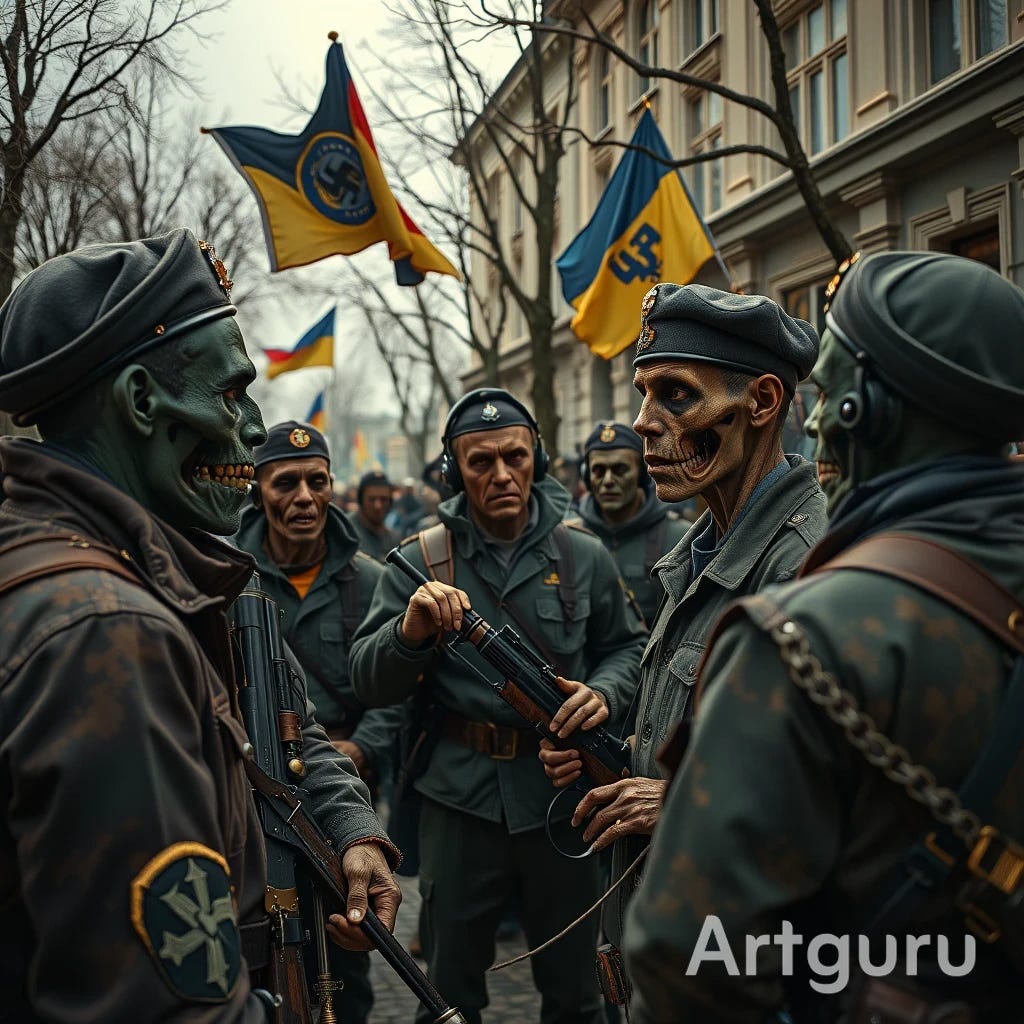
Chapter 65 refers to the debates among zombie legal scholars about Human Criminal Law, the paradoxes of the war in Ukraine (21st century AD, which is the 1st century after the Zombies Who Live Apocalypse), and the myth that the first modern zombie was a Ukrainian Nazi abandoned half-dead on the battlefield.
The learned zombie jurists who dedicate themselves to the study and development of Criminal Law demonstrate a true contempt for the Criminal Law of humans. It was too confusing and full of paradoxical concepts.
For example, among humans, life has always been considered the greatest legal value to be protected. Therefore, “killing someone” was considered a serious crime in all countries that existed before the Zombies Who Live Apocalypse. There were situations that aggravated this crime and situations in which the unlawfulness of the typical conduct ceased to exist.
The zombie jurists could understand the greater seriousness of a murder committed for a frivolous reason and the exclusion of the crime in the case of self-defense. What they could not understand was the death penalty, because “killing someone” should be considered a crime in all cases, but the State had the privilege to kill, and that was absurd.
In Brazil, before the zombies took power, the state of Human Penal Law was inhumane and deplorable. That country prohibited the death penalty, but tolerated police officers executing suspects and even innocent people, as long as it occurred in poor neighborhoods. Brazilian prosecutors and judges, who should have enforced the law that “killing someone is a crime,” almost always left police killings unpunished, as if it were acceptable. And the press applauded all of this, normalizing prohibited executions. A zombie prosecutor and judge would feel immense shame if Zombie Penal Law were applied in such a wrong way.
In the case of war, a human phenomenon much despised by the zombies, “killing someone” could not be considered a crime. On the contrary, the crime was letting the enemy live. Killing the enemy was mandatory, and any human soldier who refused could himself be condemned to death by firing squad. This inversion of values had nothing to do with legal orthodoxy and technical legal rigor (in all cases, human life was the same and should have the same value), but with the fact that humans preferred killing each other to protecting each other’s lives. And this explains the decadence and fall of humanity, at least in the eyes of the zombies.
A scathing observer would say that the erudite zombie jurists were also contradictory, because they themselves killed humans to eat their flesh. And some had a great predilection for the flesh of live human babies. But there is an important difference here.
The humans who killed each other belonged to the same species. The zombies belong to a different species, superior to the human species. And just as the humans who were called Indians hunted, prepared, and ate monkeys in the jungles of Brazil, the zombies killed and ate humans. But zombies didn’t kill and eat zombies, and in that they were different from humans called cannibals who killed and ate humans.
As soon as it rose and became dominant, the zombie civilization abolished the death penalty among humans. This was as inadmissible and repugnant as a monkey killing another monkey for no particular reason in the Brazilian jungle. Furthermore, humans had to be properly classified, treated, medicated, fed, and kept in the food reserve until the time came for their slaughter to feed the zombies.
Human flesh was too precious to the zombies to be wasted in lethal conflicts between humans. And this explains the only similarity between Zombie Criminal Law and Human Criminal Law. In both, a human killing and secretly burying someone was always a serious crime. The waste of food was considered a very serious crime against the essence, existence, and perpetuation of the zombie civilization.
In addition to laughing at human Criminal Law, zombie scholars and philosophers also laughed at human metaphors. For example, humans said that war devours soldiers from both enemy camps. That’s ridiculous, only zombies were capable of doing that, and they never went to war over their food. Ridiculous humans were too stupid even when making metaphors.
For zombies, there was an abyss between them and humans that could not be crossed by a species as inferior and doomed to failure as the human species. There is an urban legend according to which the first modern zombie was born on the battlefield of Ukraine, when, for a reason that still needs to be explained, a Ukrainian Nazi soldier was not completely killed by a Russian soldier. Compassion, a typically Russian virtue, combined with some genetic defect in the Ukrainian or bacterial infestation in that particular patch of soil where he was left bleeding perhaps, transformed that half-dead soldier into an undead one. And so the transmission by contagion began. But this is mere speculation.
Zombie scholars consider this legend completely false and devoid of factual and scientific truth. The first zombie could not, under any circumstances, have been a Ukrainian soldier, much less a Nazi soldier. The Nazis, according to what zombie scholars of prehistory have learned, confined and killed millions of people. They did this without taking advantage of the nutritional potential that all that meat represented for the Third Reich, especially in its final phase when tens of millions of Germans were starving and could theoretically be better off eating juicy Jewish steaks.
No, the first modern zombie could not be a Ukrainian Nazi. That didn’t make sense and was completely out of the question. Furthermore, from what they learned about that conflict, zombie scholars could be 100% certain that no Ukrainian Nazi was half-dead in combat. Ukrainian Nazis stayed in the rear, hunting and beating peaceful boys to send them to fight in a war in which they themselves were afraid to die.
Were the Ukrainian Nazis of the year 2024 a degenerate and inferior species of Nazis when compared to the species of German Nazis of the 1940s? This is a question that could interest both zombie scholars and ignorant ordinary zombies. Mysteries like these helped zombies pass the time. And they had a lot of time between meals. To them, all Nazis had the same nutritional value. They certainly wouldn’t distinguish between a German Nazi and a Ukrainian Nazi. Good human flesh to eat is good human flesh that has been eaten, you know.
Observing that particular event in Ukraine, any average or mediocre zombie had reason to laugh heartily at the inferiority of the human race. It only truly acquired any intrinsic dignity when it was feeding the zombie civilization. The countries that were called France, England, and the USA fought against the German Nazis in the 20th century (the 1st century before the Zombies) and then financed and supported the Ukrainian Nazis in the 21st century (the 1st century after the Zombies Who Live Apocalypse). Isn’t that a reason for zombies to laugh at humans?
The humans who called themselves Russians fought against the German Nazis with the help of France, England, and the USA, and a century later were forced to fight against the Ukrainian Nazis financed and armed by the French, English, and Americans. Shouldn’t that make humans cry? But they didn’t cry, they laughed. What were humans laughing at back then? At their own inferiority, undoubtedly, the zombies would say. They didn’t know they were creating the indispensable conditions for zombies to arrive, pacify the world, subdue and devour all humans indiscriminately.
“He even looks like a human.” That’s the greatest insult one zombie can give another. But zombies generally don’t react, nor do they feel offended when insulted by another zombie. They just laugh, and in that, zombies are different from humans.
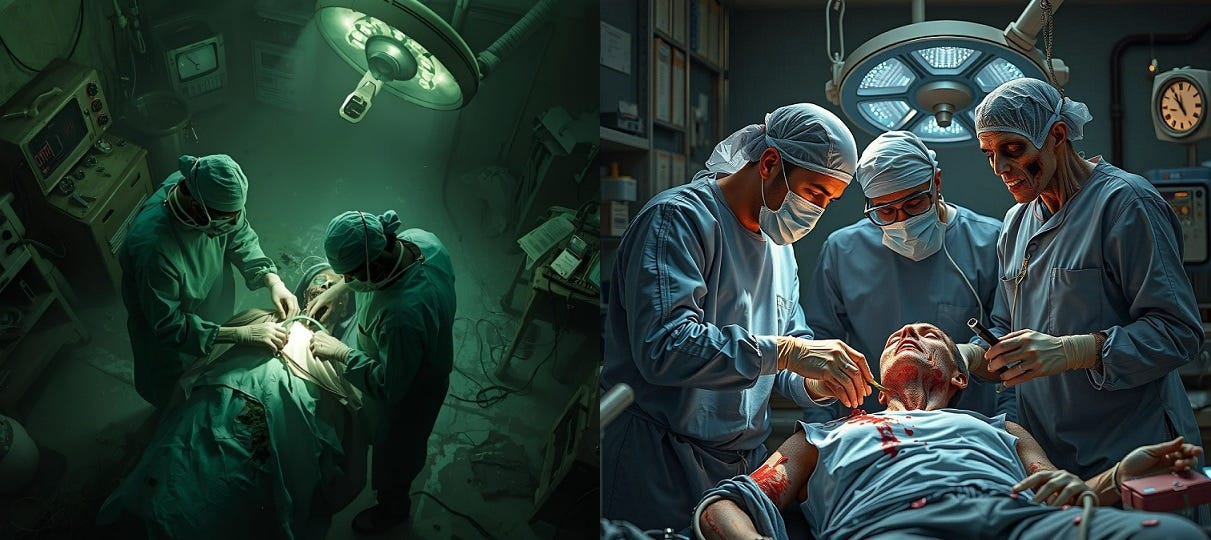
Chapter 66, differences between human medicine and zombie medicine, and a curious case that occurred because of a new type of surgery that began to be performed by a team of zombie surgeons.
One of the most tragic things about the final phase of humanity, which in part greatly helped zombies reach the top of the food chain on the planet (something they recognize and appreciate), was the dysfunctional state of healthcare systems in all countries. Before the rise of the zombie civilization, human medicine had become a business, human doctors were almost always hypocrites who cared more about their personal profits than the Hippocratic Oath, and patients, poor things, were treated as if they were social trash, especially if they were poor.
Human medicine had developed a lot. But it was an inaccessible good for many people, especially in rich countries where everything was privatized and medical service was expensive. Doctors had become so greedy that they received bribes from drug factories to prescribe medicines without really caring whether they would save or addict and harm patients. In the country that humans called the USA, people could drop dead at the hospital door without care if they couldn’t pay. From the zombies’ point of view, this was immoral—so much delicious human flesh wasted, you know.
Zombies don’t mind eating sick people, but they prefer to eat healthy food. And in that, they are different from humans, who ate a lot of industrialized junk food contaminated with toxic products. Zombies didn’t need to do that. So, after the normalization of zombie civilization, human doctors were faced with a simple choice. Either they preserved their lives by properly caring for sick humans in the food reserve, or they themselves would be immediately sent to a second-rate human meat processing factory.
The logic of human medicine prioritized profit over the health of the poor. The logic of medicine in the zombie food reserve was different; the health of the poor guaranteed the lives of the doctors. And note, all that bullshit about pharmaceutical companies paying bribes to doctors was abolished. Only effective medications were produced and distributed completely free of charge in the human reserve. Do you realize how the zombies were more human than the human doctors?
Human medicine ceased to be a business, and this was considered a great advancement by humans. Of course, they didn’t like being selected to be slaughtered and devoured. But that was irrelevant, because in zombie civilization they could and should be healthy, but they couldn’t choose whether they would stay alive. Humans were raised and cared for only to be slaughtered, in the same way that they themselves had raised and cared for pigs, cattle, and chickens to kill and eat.
“My chicken farm is productive and healthy,” the manager of the largest human food reserve used to say, laughing. “Free, good-quality medicine for everyone,” was written on the signs inside that food reserve.
The reader must be wondering: And zombie medicine? Well. Zombie doctors also existed, but they didn’t actually have much work. After all, zombies are dead and don’t contract diseases. Furthermore, the case of the cordyceps fungus epidemic reported in a previous episode was a rare phenomenon.
But the natural post-mortem health of the undead didn’t mean that zombie doctors were completely useless and spent all their time doing nothing. On the contrary, they spent all their time studying and developing prosthetics for zombies in an advanced state of decomposition. This was also the subject of another chapter.
A team of surgeons once decided to experiment with transplanting feet and legs from humans killed in the reserve onto the bodies of very decrepit zombies. The results of these experimental operations were catastrophic. The transplanted feet and legs usually rotted and were not functional. They did not acquire the necessary essence of the zombie race, something that only spreads throughout the body at the moment of the zombie’s transformation.
The experiments were abandoned, but one day this same team of surgeons was approached by a healthy zombie with what remained of the torso of a decrepit zombie friend of his. The patient carried his friend from one place to another while they talked about all the subjects that interested them both. He didn’t want to be separated from his friend. After watching an old human movie, they both decided to ask the medical team to implant the head of the decrepit zombie onto the healthy one’s chest. That way, they could continue talking, and the zombie would have its hands free instead of carrying its friend.
The request was considered a worthy challenge by the doctors. But at first, the surgeons were deeply concerned about the philosophical implications of the surgery requested by those two friends. So they asked the patients to return the following week and met before the new date with the greatest philosopher of zombie civilization, a true guru of zombification, who knew deeply the prehistory of zombies, which is the history of humanity.
Upon learning of the problem, the philosopher leaned back in his armchair and said to the surgeons:
“Of course, the subject is delicate, because the dead life of a zombie is precious and cannot be shortened or wasted. But on the other hand, the will of the zombies must be respected, and there is nothing that truly obliges a zombie to stop trying to remain undead if that possibility exists.”
“Furthermore,” the philosopher added, “this would be an excellent opportunity to prove once again the virtues of zombie civilization over human civilization. You know, or need to know, that in the final phase of humanity, old humans were abandoned by the young. Nobody wanted to talk to them. And often their frailties were exploited by bandits who set up scams to take money from elderly people. Often, not even the relatives of a sick old human wanted to take care of him or stay with him. When organs were needed for transplant, old humans usually died before the operation. They were truly the object of undignified contempt, either because humans feared death or because it could be profitable for the heirs. A zombie preserving what remains of the undead of another zombie in the final stage of decrepitude is something extremely dignified, a typically zombie virtue that a human certainly would not be capable of having. That is why the operation should be attempted, provided it is authorized beyond any doubt by those involved.”
When the patients returned to the hospital the following week, the surgeons explained the risks and asked the patients to record a video stating that they wanted to participate in the experimental surgery and that they released the doctors from any liability for what might occur. This was immediately done, because the zombies had no doubt that they wanted to stay together, like in that documentary film where they saw the mutant human living on Mars carrying another human attached to his body.
Fortunately, the operation was a success. As both patients shared the zombie essence, there was neither rejection nor final death of the undead head. They both left the surgery talking.
The news of that great zombie surgical medical feat quickly spread throughout the zombie city. The patients themselves began talking to other zombies about their new life together. And it wasn’t long before the procedure became relatively common. Then, a large zombie asked to have the heads of two of his decrepit zombie friends implanted in his chest.
The operation was a success from the zombie medical point of view. But the result was disastrous. Weeks after the implant had taken hold, the two heads began to disagree, each wanting to monopolize the attention of the zombie in which they were implanted. In a short time, the argument degenerated into constant insults, and the poor zombie host no longer had the peace that all the undead have when they are not hungry.
The patient returned to the hospital, but the zombie doctors said they couldn’t do anything. According to the Zombie Civil Code, every undead person had the right to remain undead. And this prevented the removal of the head from the host’s body because it could inevitably become a dead undead. And no zombie could kill another zombie. And in this, zombie doctors were more careful than human doctors, who in the final phase of humanity were causing grotesque deaths (like the infamous case of the American who removed a patient’s liver thinking he had removed his spleen).
The case of the large zombie with two enemy heads was brought to the Zombie Court. “Order, order, gag these two heads please,” shouted the judge. Each of the three friends could express their point of view, but of course, while one implanted head spoke, the other had to remain silent and gagged. This was a truly delicate case, unprecedented and unforeseen by the Zombie Civil Code.
After the discussion about the case matured a bit in the press, the Zombie Court finally summoned the petitioner and delivered its judgment. The right to life of the two heads should be guaranteed; they could not be removed from the zombie host. The only possible solution to that demand would be to remove any possibility of the two implanted heads speaking at the same time. If they couldn’t talk to each other, the problem would end, or at least that’s what the judges hoped.
So, the ruling stated, the tongues of the two implanted zombie heads should be surgically removed. Both zombie heads implanted in the host would be prepared to receive a prosthetic tongue. But the zombie host would only have access to one prosthetic tongue, which he would have to place on one head for a while and on the other for a while, with regular alternation without prejudice to the right to speak of either head.
As a final recommendation, the judges prohibited, under penalty of amputation of their hands, zombie surgeons from transplanting more than one head onto zombie hosts. This had set a really delicate and unpleasant judicial precedent. Much more unpleasant for patients than those pre-Zombie era court cases, when a human court ordered the hospital and doctor to treat someone who couldn’t afford to pay. And then the doctors would spend their whole lives complaining because they shouldn’t be forced to work for free.
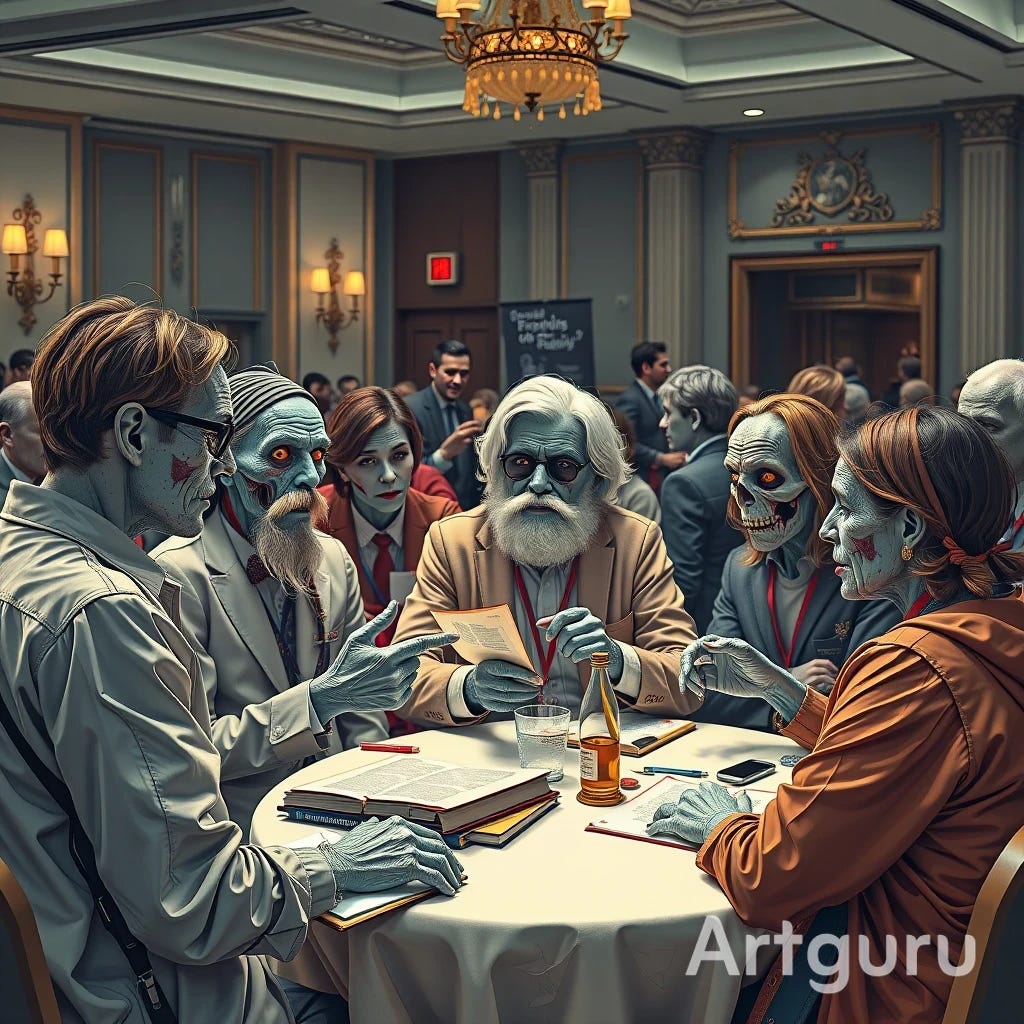
Chapter 67, summary of a shallowly in-depth debate at the first convention of zombie political philosophers.
The first convention of zombie political philosophers is shrouded in mystery, secrecy, and mythology. One day, the account of what happened there will have to be told in detail by a zombie historian, but that is something that will have to be done in the future. Here, we will only address the main conclusions drawn from the debate.
Zombies like to list things and make connections between things. So, the convention began with a final list of basic ideas drawn from the history of political ideas in zombie prehistory.
Aristotle said that human beings are political animals. Slaves did not participate in politics even though they were human animals. The Greeks ate some animals, but they didn’t eat slaves. Therefore, Aristotle wasn’t a zombie and has nothing to add to zombie civilization.
Machiavelli removed any ethical, moral, or religious considerations from politics. But politics itself ended up being removed from human calculations as soon as technology became the most important phenomenon around which the economy and human societies were organized. Zombies use technology, but their civilization is not entirely subservient to technological needs like human civilization, about which Machiavelli was fundamentally wrong.
Hobbes said that man is a wolf to man, and it is up to Leviathan to guarantee the protection of citizens as long as they partially relinquish their individual freedom. Hobbes contradicts Aristotle, because while the Greek says that humans are political animals, the Englishman said that they would only be political animals if they renounced their wolf-like nature. However, Hobbes provided no evidence that the ancestors of men were werewolves.
Man is naturally virtuous, and society corrupts him, said Rousseau. He also stated that the general will should not be distorted by petty personal interests. Yes, men were naturally virtuous except when they were Machiavellian or behaved like wolves. Which is paradoxical, because men kill each other and wolves protect the weakest members of the pack. True wolves are undoubtedly more virtuous than Hobbes’s men.
Clausewitz said that war is the continuation of politics by other means. This is an absurd and meaningless thesis. War destroys any possibility of politics between irreconcilable enemy camps and brutalizes victors and vanquished to such an extent that politics cannot exist in either group. However, war caused the downfall of humanity, which was a good thing from the zombies’ point of view.
Karl Marx concluded that each mode of economic production determined the political superstructure of human societies. The question of whether Marx was right or wrong became irrelevant the moment humans were transformed into zombie food. With the rise of zombie civilization, there is no class conflict among humans; they have all been reduced to consumable products.
Hannah Arendt said that politics exists in the space voluntarily created by human beings. Humans lived in a permanent state of war, and this led to the downfall of humanity. Zombies, on the other hand, created a Harendtian space in which true politics became both a condition of possibility for the perpetuation of zombie civilization and the result of peaceful voluntary interaction among zombies.
Mao Zedong said that politics is bloodless war. This made sense among men; among zombies, politics is not conducted with violence, and violence (something very unlikely) would never result in bloodshed. The zombie brotherhood ideologically coagulated the lifeblood of Maoism.
Great emphasis was placed on Immanuel Kant’s work during the debates. The German philosopher said that even demons would be capable of organizing a functional state if they were intelligent. Humans were neither demons nor intelligent. All the states they created collapsed because of internal and external human wars that facilitated the emergence of the first zombies and the inevitable fall of humanity.
On the other hand, it is uncertain whether demons would be capable of creating more functional states than human states. In fact, no zombie has ever found any proof that states created by demons have existed, although one of them (called Hell) was more or less described by Dante Alighieri.
Humans in the food reserve are now treated with more humanity than they were by the human states. They receive everything they need to be happy and healthy and run no risk of dying in the war. The state has become unnecessary for humans because they need to enjoy life knowing that they will at some point be harvested and slaughtered according to the rules set by the zombies.
So, Kant was wrong from the point of view of both humans and demons. But he could be right from the zombies’ point of view if at some point he had said that the question of the state would actually be simpler for zombies than for humans and demons. A zombie continuation of Kant’s philosophy through other means is possible.
And so the zombie philosophers arrived at the grand conclusion of the debates on political philosophy: with the exception of Immanuel Kant and Hannah Arendt, who can be studied and adapted to the idiosyncrasies of zombie civilization, all the human philosophers discussed in the debate made fundamental errors about human beings and political philosophy. Fortunately, this happened, the zombies must say.
If human political philosophy had not remained so underdeveloped, humans would have created a civilization capable of resisting and overcoming the challenge resulting from the appearance of the first zombies. Since this did not happen, humans finally achieved their greatest existential purpose: to be eaten regardless of their political or philosophical predilections.
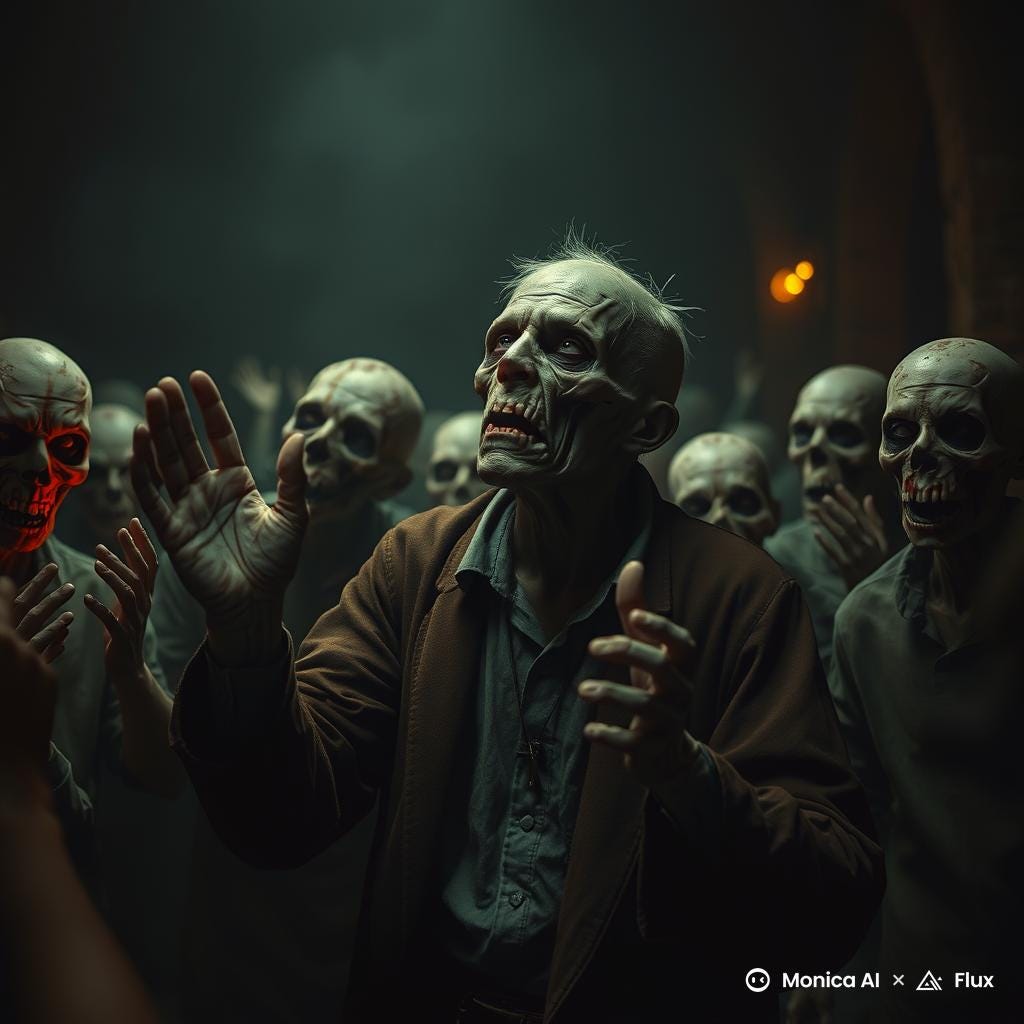
Chapter 68, a fantastic list of things that was debated by zombie political philosophers, which is only included in the alternative report at the convention mentioned in the previous chapter. Alexander Karp, a hidden hero of the zombie civilization, was there.
A clever zombie political analyst proposed the following formula: the biggest political difference between humans and zombies lies in the issue of trust. While humans tend to naturally distrust each other and have great difficulty creating trust systems on a municipal, regional, state, national, and global scale (what we might call human political systems of micro and macro governance), zombies automatically trust each other because there is no reason, need, or incentive for one zombie to cheat another zombie.
This formula was immediately rejected by most zombie political philosophers, unfortunately. This is because it is a consensus among zombies that politics and trust are two indistinguishable things that could not exist between humans, who are always so greedy, belligerent, fickle, and perverse towards each other. True politics only began to exist with the rise of zombie civilization and its normalization. Only from that moment on did men begin to trust that they all had the same destiny: to be slaughtered and devoured by the master race. Something that has an extremely important implication from an analytical and philosophical point of view.
A zombie objected to the fact that the final list of things did not include that Aristotelianism was a fundamentally anti-zombie philosophy because no zombie would ever think of enslaving another zombie. This objection was not included in the report because, since slavery was a human phenomenon, it would not make sense to address this aspect of Aristotle’s work from a zombie point of view.
Some scholars wanted to elevate Machiavelli to the status of founding father of zombie civilization. This was debated with some intensity, because Machiavellianism, in a way, poisoned relations between humans until it caused the downfall of human beings. Opponents of the proposal argued that Machiavelli did not create human vices; he only identified and recognized them, extracting from them inevitable political consequences that deserved to be known.
In any case, at no point did the Florentine say that humans would or should be overcome by zombies. What he said is that some men could or should overcome others to conquer and remain in power. So he was a dangerous human political philosopher, because humans could adapt him to any contingency (including the one in which they were confined to the food reserve and needed to defeat the zombies).
Hobbes was also praised by some scholarly zombies. But they immediately backed down when they were convinced that, unlike men, true wolves would never be Hobbesian.
Rousseau’s thesis of the virtuous nature of man was also problematized. After all, in the food reserve, humans could no longer be corrupted by society or politics. In any case, although this proposition is more or less correct, it was left out of the list of things that appeared in the report on Rousseau. Perhaps this occurred due to a failure in communication or evaluation of the records of the great debate.
A zombie philosopher proposed treating Clausewitz and Karl Marx under the same topic, because after all, both discussed the same theme: war between humans, whether economic war between the capitalist and working classes or war between armies of humans wearing different uniforms. This formulation had evident merit, but it was strongly opposed by scholarly zombies who proposed separating these two men. The union between them provoked violent revolutions, and what had been very bad for humans could be worse for zombies, because if the report were published and the food reserves reached them, the zombies could starve as a consequence of violent human rebellions that should be avoided.
Regarding Hannah Arendt, there was no disagreement among the scholars, political analysts, and zombie philosophers. It was simply impossible not to admire the clarity, political depth, and didacticism of her works. Fortunately for the zombies, she didn’t achieve much success among humans.
A zombie strongly disagreed with the exaggerated deference shown to Immanuel Kant. Among zombies, he should simply be forgotten. This caused immense commotion among the Convention participants.
According to Kant, knowledge is limited within the sensible world, that is, a person can only know phenomena, that which is within space and time, categories that make any and all experience possible. This was important because zombies could know phenomena as well as humans, and even better than humans, but humans would never be able to penetrate the essence of the zombie-like state from which the zombie experience originates.
The critic of Kant probably forgot the consequences of Kantian epistemology. As soon as this issue was debated, he backed down and withdrew his objection. The details of the debate about Kant’s epistemology were obviously omitted from the account of things said about Kant. What was obvious to a zombie scholar did not need to be known or debated by humans in the food reserve.
Samuel P. Huntington and Francis Fukuyama were two much-debated human political philosophers at the Convention. The theses of both had been especially detrimental to humans and in a way helped create the environment of discord, distrust, and permanent war that resulted in the rise of zombie civilization. Nothing about them was included in the final report, and this was a choice made by the organizers that is truly incomprehensible. However, we must remember that there are more things between the heaven and earth of the zombies than between the earth and hell of humans now that humans themselves are just happy food in the food reserve.
The zombies also debated a bit about the important role that Alexander Caedmon Karp played in the decline and fall of humanity by destroying any possibility of mutual trust between humans and nations by publicly stating that Palantir’s (a technology company he ran) business was to profit by creating unfair advantages for corporations and the American government.
Karp, a long-time zombie (according to some, he was already a zombie when he took over Palantir and disguised his condition with heavy makeup), was present at the political and philosophical debates and felt extremely proud of his accomplishment. But as a humble zombie, he preferred not to be mentioned in the Convention’s list of important matters. This was unnecessary now that his work was complete and the zombies could enjoy absolute superiority over humans, including those whose data had been collected, correlated, and used against the improvement and perpetuation of human civilization.

Chapter 69, in the zombie version of Superman, the flying villain doesn’t disrupt the businessman’s business as usual, unlike what happened in the prehistoric human film.
Zombies really aren’t interested in anything humans have done. Why should they be? Humanity had declined and fallen, and the perpetuation of the glorious zombie civilization didn’t depend on human culture, philosophy, or even science. It depended only on the organic, sustainable, and healthy reproduction of the humans that the zombies ate.
Moreover, not even the most advanced technologies developed by humans (AIs, drones, and robots) were able to stop the Zombies Who Live Apocalypse. In fact, they helped cause it by being hacked by zombie hackers. And unlike foolish humans, zombies certainly didn’t want to bring about their own extinction.
But between meals, zombies had plenty of time. So they consumed all that ethnological garbage left by humanity because they had nothing particularly important to do. Yes, it’s true that zombie scholars pored over all that with great interest and dedication. But they were the exception, not the rule.
So, just as before their downfall the overwhelming majority of humans only knew the version of Ancient History regurgitated in the films of that ugly place humans called Hollywood or Bollywood, ordinary zombies watched prehistoric films (that is, films produced by humans and prior to zombie civilization) without worrying whether they were documentaries or fiction. When it came to the cultural production of a species reduced to the condition of food, the difference between these two things was, in fact, irrelevant.
And even zombie scholars had great difficulty understanding the meaning of those prehistoric films. The reason for this difficulty was the fundamental qualitative difference between zombies and their food. The greatest goal of zombie civilization is not and never was the production and accumulation of money. But everything humans did was done because of their greed for profit. And this obviously included all the propaganda disguised as film reviews disseminated by the human press, which to zombies seemed like the buzzing of flies around garbage.
Yes, human cultural trash was despicable. But the zombies seemed to like it because, you know, what kind of predator doesn’t like to mock its food? That’s instinctive in living beings. In zombies, it was a reflex conditioned by the non-life condition.
Everything that humans saw in one way, zombies tended to see differently. For example: the Superman movie made in the year that humans said was 1978.
In this prehistoric movie, a businessman named Alex Lotar (or at least that’s what his name was heard by the zombies who saw the movie) has a brilliant idea to maximize his profits. Lotar buys immense portions of land in desolate regions that have no value whatsoever. This land will appreciate greatly when the adjacent territories sink into the sea because of an earthquake. This would happen naturally anyway, so the businessman decides to hasten his business cycle by firing a nuclear missile into the geological fault.
Then the flying villain Superman appears on the scene. This villain, who isn’t even a man (he’s an alien who looks like a man), disrupts the businessman’s business because he was seduced by a human woman. How embarrassing.
In human capitalism, everyone should like, or at least respect, the profits that businessmen usually make. In the prehistoric past human businessmen were always right, okay. They eventually harmed other humans, but that was something that human politicians, legislators, and judges rarely considered important because humanity valued profits more than human life. But that’s not what happens in that prehistoric movie.
Everyone can see that the flying alien villain interrupts the natural process that would be artificially accelerated by the businessman Alex Lotar, harming his victim’s profits. And at the end of the movie, the poor Alex Lotar continues to own immense portions of worthless land. To make matters worse for his victim, Superman puts the poor bankrupt man in prison—the man whose business was ruined. This is something that should never happen in human civilization.
Inferior humans were, and still are, very contradictory, irrational, you know. They really weren’t capable of making films that preserved the values of human capitalism or, at the very least, to humanize and soften the reality of their decadent, violent, and disgusting civilization by mimicking art. There was a vast void between the reality of human economic and political relations and their artistic representation. It was into this void that the zombies entered to devour both humans and the paradoxes of their civilization. But zombie filmmakers can, if they want to, do what humans couldn’t, as long as the tasty human flesh isn’t wasted in the end.
No zombie could imagine anything more ridiculous. If that movie were made by a zombie filmmaker, the alien flying villain Superman would be defeated. And the Hollywood or Bollywood businessman Alex Lotar could make his profit as long as he donated to the zombie authorities all those people who lived in the territories destined to disappear into the sea after the earthquake. The waste of tasty human flesh is an unforgivable sin, and no zombie work of art, written, staged, or filmed, would be able to portray or represent it.
That humans encouraged the waste of lives and occasionally even caused deaths when making their films made sense. That’s a human thing. Humans killed each other for no particularly important reason since time immemorial until finally the zombie civilization rose up and stopped the killing among humans. Zombies never wasted their food and even treated it very well.
However, zombies weren’t obligated to treat a flying villain well. No sir. In the zombie movie, Superman would be sent to prison with a kryptonite necklace. And he would also get a kryptonite chastity belt, because that way he would be impotent and would never again feel tempted to disrupt the usual profits of a brilliant businessman because he was seduced by a woman.
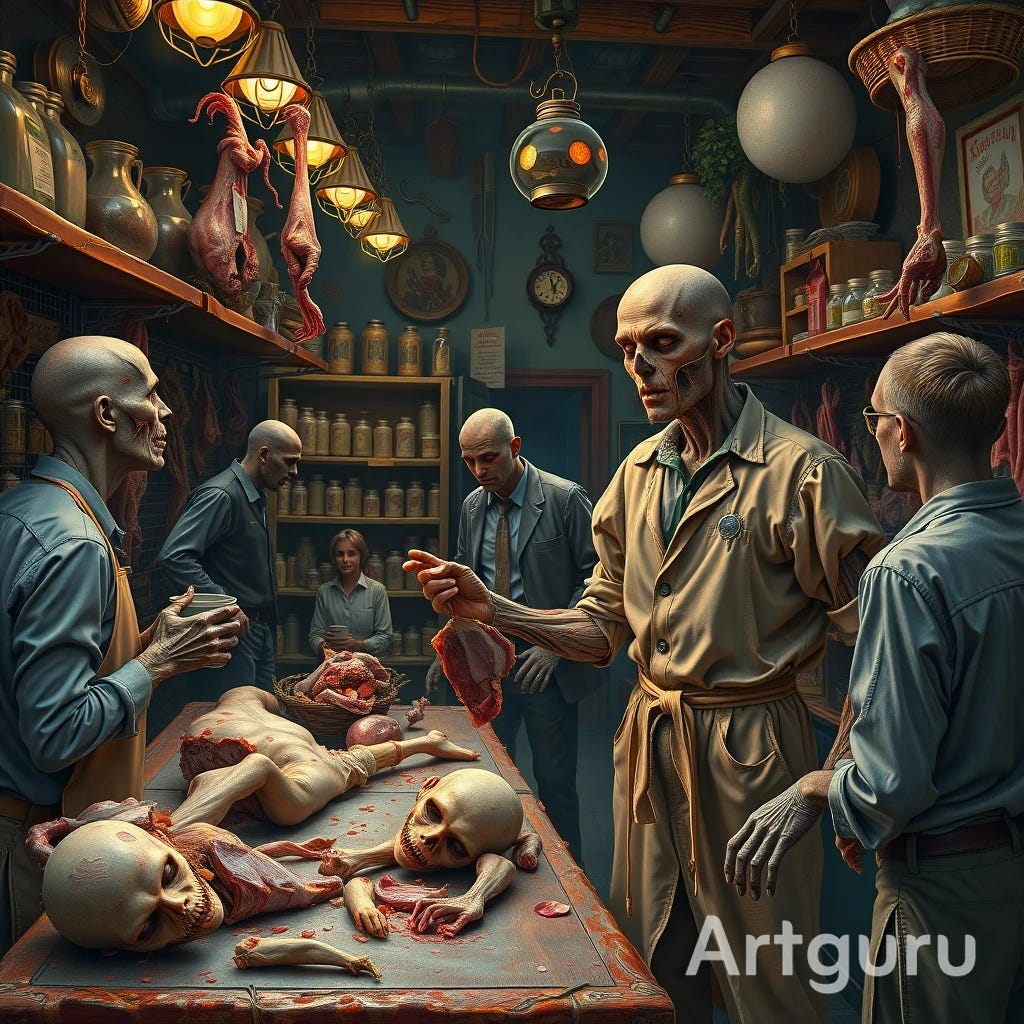
In chapter 70, we’ll learn how zombie butcher shops appeared and disappeared due to a curious incident.
It is evident, and this has been clarified and demonstrated several times, that there are similarities and differences between the zombie civilization and the fallen civilization of humans. In fact, “human civilization” is an oxymoron, a union of opposing terms that humans invented because they desperately needed to normalize barbarity and mitigate their own violence.
Above all, humans liked to perfume their nauseating stench. But it must be said that the stench that humans tried to hide is a perfume to zombies. When they smell the characteristic scent of a human, zombies can only think of the delicious meat they contain and carry as if they were walking, living hamburgers.
That is why the zombie civilization banned perfumes and made exercise a mandatory activity in the reservation. Healthy, smelly human bodies mean healthy, succulent, and fragrant food. At first, humans protested the ban on perfumes more than their own slaughter, but in the end, they got used to their own smell. And they resigned themselves because once they were killed, they would no longer have the ability to smell anything.
Some humans, the worst among them, liked to say they were better than zombies. Nonsense.
For example, humans had the unpleasant custom of displaying pieces of beef, pork, and even sheep in shops they called butcher shops. These pieces were handled by specialist professionals called butchers. But the funny thing is that many of the humans who frequented these shops didn’t like the smell of meat.
How rude, to like meat and not the smell of it. How funny, to grimace in disgust at a piece of raw beef, pork, or sheep and then smile with joy when that meat is burned to then be eaten. Zombies would never, under any circumstances, do that, that is, burn human flesh. Everyone who really matters, that is, the zombies, knows that human flesh is more nutritious when eaten raw or at most processed.
And in this, zombies are different from human cannibals. Because the cannibals of what humans called the New World dismembered their victims to roast them as if they were beef, pork, or sheep. Something that would never occur to a healthy zombie to do.
Interestingly, the cannibals of Brazil in the distant past, for example, did not have shops called butcher shops. They kept their food captive alive before gathering for a family feast. Only then did they slaughter the captive and eat it roasted. Zombies also keep their food captive, and in this they are similar to the cannibals of Brazil, but they don’t have butcher shops, and I will explain why.
Soon after the normalization of zombie civilization, some butchers who were transformed into zombies decided to keep their businesses. But they realized that they no longer had human customers, because in fact their clientele was being devoured. So they started catching humans, slaughtering them, and hanging the pieces in shop windows as they did before with beef, pork, and sheep.
This was the specifically zombie-related formal business that really flourished for a while. After the creation of the food reserves, the zombie butchers had their glory days. They received a steady and sustainable supply of human raw materials, and the zombie customers really enjoyed going to the butcher shops, smelling the food, and eventually acquiring a piece they considered especially fragrant.
But then a problem arose. They always do, don’t they?
First, a small rebellion occurred in the reserve because rumors began circulating that humans weren’t just slaughtered and devoured. They were displayed in pieces in the zombie butcher shops. This was considered extremely offensive by the captive humans, something truly undignified and hateful.
Humans are truly peculiar and contradictory beings. When they themselves hung pieces of beef, pork, and sheep in their butcher shops, they never worried about the reaction of the living relatives of those animals. But they themselves preferred to die in a rebellion simply because they imagined that their relatives might be displayed in pieces in a zombie butcher shop. That doesn’t make sense.
This rebellion was defeated. And the zombie authorities promised they would look into closing down the zombie butcher shops.
Later, something even worse happened. The humans who were granted permission to live and move freely from the food reserve to work at Elon Musk’s zombie rocket factory staged a protest. This was because, on their way to work, one of them saw the heads of lazy former coworkers who had been slaughtered hanging in a zombie butcher shop with the inscription:
“Take three empty human engineer heads for the price of one full doorman head.”
No, these particular humans didn’t protest because they discovered that the zombie butcher shops were still operating. But because the zombie butcher had committed the unforgivable sin of saying that three engineers’ heads were worth less than that of a doorman.
Zombies never ceased to marvel at humans’ obsession with hierarchies; it’s truly fantastic. What could they possibly know about the nutritional value of the heads displayed in a zombie butcher shop? Nothing. And yet they protested as if bad food had more value than good food.
Well... After that incident, the zombie butcher shops were shut down. It’s said that zombie Elon Musk demanded this measure because zombie colonization of the Moon could be compromised if human engineers continued to refuse to work. He was quickly heeded by the zombie rulers, because the greatest success of zombie civilization has always been accommodating all interests and mastering the tension in the food chain.
That’s all for home, folks. Don’t lose your heads in a butcher shop, please.
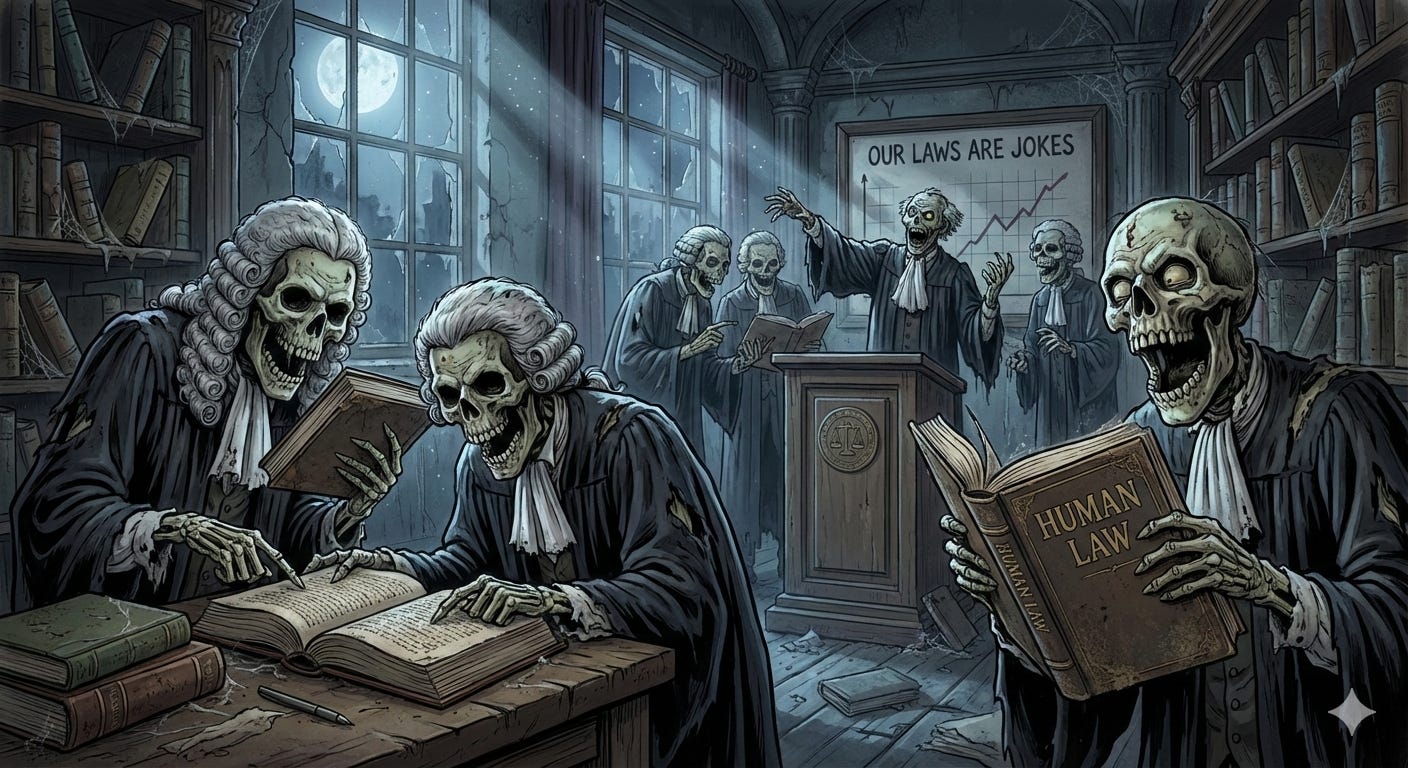
In Chapter 71, the reader will discover how American legal exceptions, European hatred of Russians, and the Brazilian Law of Sentencing Guidelines sabotaged the Anti-Zombie Law and decreed the final fall of humanity.
As soon as it became evident that human civilization faced its most dangerous enemy, the governments of the most important countries met and decided to pass anti-zombie legislation. For the first time in the history of world diplomacy, diplomatic unity was not merely cosmetic or rhetorical. Leaders of poor and rich countries, those more and less affected by the zombie invasion, decided to take extreme measures to try to defeat a problem that was common to all.
Climate change and oil piracy perpetrated at the behest of Donald Trump were also common problems affecting all of human civilization, but on these issues there could be no unity of action. Oil, gas, and coal producers did not want to lose their profits, and they had a great economic capacity to distort politics in all countries. Americans, Europeans, Russians, and Chinese were enemies, but all produced and/or consumed, and intended to continue producing and/or consuming, oil, gas, and coal.
Piracy was a serious international crime among humans, a clear violation of the international architecture created to pacify the modern human world. But Donald Trump had strong allies in Europe and weak ones in South America. And even those countries that criticized the oil piracy he practiced against that country called Venezuela weren’t really willing to declare war against the fat American king who would eventually become a hero of zombie civilization.
But the zombie issue was different. It generated real panic. And to make matters worse, there was the problem of collaboration between humans and zombies, which jeopardized a corollary of humanity’s existence: the separation between species and the total and final defeat of the zombies. Well… we know that what humans intended to do didn’t work, because the victory of zombie civilization was consolidated and almost all humans were confined to food reserves. What readers don’t yet know is how this actually happened.
At the meeting of world leaders, it was decided that anti-zombie legislation would have some fundamental characteristics: strict control at borders, ports, and airports to prevent the transit of zombies between countries; immediate temporary confinement of any person suspected of having contracted the zombie virus; death penalty for all humans who collaborate with zombies, without exception; death penalty for the undead or zombified humans, or imprisonment for their entire undead existence, according to the preferences of each country. These would not be optional norms, but mandatory everywhere, with each government able to define additional rules as long as they did not conflict with the agreed principles.
Anti-zombie legislation was adopted more quickly and effectively than all those international human laws that were supposed to protect humans from piracy, pesticides, fossil fuels, climate change, wars not authorized by the UN, etc… For some time, the new legislation worked well and allowed the world to contain and even reduce the zombie threat. Even people who campaigned against vaccines supported the “institutional vaccine” against zombies and their allies, because they too were afraid of being devoured.
But then something important happened. In the US, the government began selectively applying the anti-zombie law. This occurred when it was proven that a powerful and extremely wealthy Big Tech owner was profiting by providing his technological products and cloud services to zombie hackers who used the internet to attract living prey. The precedent set by the Americans to save the life of a billionaire who collaborated with the zombies was soon followed by the European Union. The Europeans began facilitating the transit of zombies from Europe to Russia, causing a crisis that would eventually lead to nuclear war.
In Brazil, the death penalty was prohibited for the living, and this principle was extended to zombies. The left-wing government quickly managed to imprison all the zombies. But then tragedy struck. The right wing realized that the left’s success in the zombie crisis represented a huge obstacle to its ambition to return to power.
Zombies imprisoned for their entire unlife began to be released when a gang of right-wing deputies managed to pass the Law of Sentencing Guidelines. According to this law, among zombies there were “more zombies” and “less zombies,” making it necessary to graduate their prison sentences according to the peculiarity of each case.
Toothless and/or very decrepit zombies (like the zombie Jair Bolsonaro, for example) represented a lower risk to human society, according to the new rule. This was a dangerous assumption of the Law of Sentencing Guidelines, because it was soon discovered that toothless zombies were using knives to kill, dismember, and chop their victims before devouring them. Furthermore, the authors of the bill that relaxed the Anti-Zombie Law wanted to win the election and believed that the release of the zombie Jair Bolsonaro was essential to guarantee the defeat of the Workers’ Party. However, this zombie was extremely voracious, and as soon as he left prison, he began biting everyone and intentionally spreading the zombie virus, just as he did when he spread COVID-19 while alive.
Tragically, the Brazilian Law of Sentencing Guidelines quickly became a broad, general, and unrestricted amnesty for Brazilian zombies, whose population grew faster than the authorities’ ability to combat the crisis. Overwhelmed by the growing zombie forces, Brazilians began unintentionally exporting zombies to Africa, the USA, Europe, and Asia. The rest constitutes the prehistory of humans and the Ano Domini of zombie civilization.
Suffering the pressure of a migration of Brazilian zombies into its territory, Argentina began transporting its own zombies to Brazil. Tension between humans on the border between the two countries grew considerably. At the beginning of the End of History, political contradictions among humans everywhere (privileges granted to zombie-allied data barons in the US, European hatred of Russians in Europe; the desire to exacerbate the zombie crisis to win the election in Brazil, etc.) played a significant role in the rise of zombie civilization.
Zombie scholars greatly enjoy debating these issues because the failure of the Anti-Zombie Law and the success of the Brazilian Law of Sentencing Guidelines are typical examples of how humans had become incapable of making a clear distinction between Law and Fake Law, between indispensable long-term needs and illusory short-term benefits. Zombies always laugh when they talk about human legislators, jurists, and judges. Voluntarily or involuntarily, they greatly helped zombies prosper and dominate the planet, which is not a bad thing from the zombies’ own perspective.
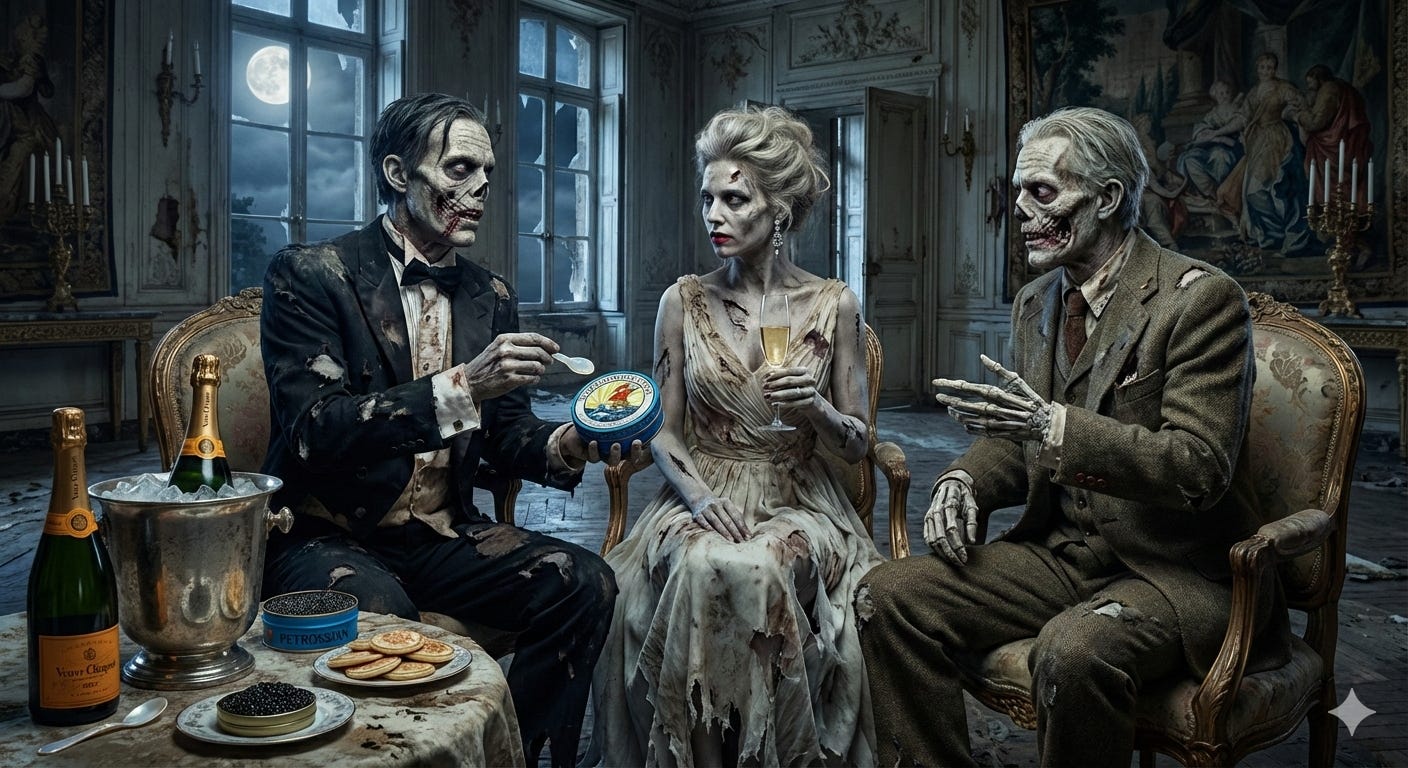
Were the zombies canned caviar eaters? This question forms the theme of the special Christmas chapter number 72 of the saga.
There are some characteristics that the zombie civilization shares with that of humans, very few indeed. There are things specific to the new master race that human civilization could never have. But there are also things that human civilization had and that zombie civilization rejects very emphatically. Among the human things that zombies hate are patents and religions.
A typically human being certainly believes that patents and religion are two distinct things. However, common sense is almost always nonsensical. After all, religions and patents share an essential characteristic: in both cases, the commercial exploitation of the patented thing or religious dogma is restricted to a specific region, and undue interference in that area of exploitation almost always gives rise to belligerent debates and violent wars.
Patents and religions were invented to supposedly save mankind. Patents save their owners from dishonest competitors. Religions supposedly save man from an infernal competitor of God or from his own demonic shadow. However, humans were generally unable to perceive that both things produced more problems, wars, and deaths than competitive markets and virtuous human beings.
Studying the fragments of their prehistory (which, as everyone knows, is the history of humanity), zombies had no difficulty learning that patents and religions never guaranteed peace and security for all. In fact, they did the opposite.
During the Second Punic War, the Romans captured an intact Carthaginian ship and dismantled it. In doing so, they discovered that each piece was identified by a specific mark. Having discovered the true secret of Carthage’s naval superiority, the Romans reverse-engineered and began producing triremes in large quantities. Carthaginian naval superiority ceased to exist; Carthage was defeated at sea and then on land.
The patent or industrial property right for the mass production of prefabricated trireme parts that could be assembled by unskilled workers did not guarantee Carthage’s victory. The Romans won the war because they simply copied and used the trireme production methods developed by the Carthaginians.
The same thing would happen centuries later in the case of nuclear weapons. But in that case, the new Carthaginians (the Americans), who would eventually be wiped off the map before the rise of the zombie civilization, could not be immediately defeated by the Slavic heir of Rome (the USSR). The Soviets stole American military industrial secrets and made more atomic bombs than their greedy enemies, undoubtedly. But they couldn’t use them like triremes, because a war between the US and the USSR wouldn’t just sink a few ships, but the entire planet. Fortunately, the human nuclear war occurred much later, was smaller and more limited, something that guaranteed the survival of the zombies’ only food source.
Religions have always been created to synchronize people. Precisely for this reason they have never ceased to be used for military purposes. In the prehistory of zombies, a human group typically used its religion to mobilize soldiers to attack another human group that eventually had a different religion and did the same to defend itself and counter-attack with different arguments for the same reason (conquering territories, riches, power, slaves, etc.). The religious beliefs that forced enemy human soldiers to kill each other make zombies laugh. All religions promised virtue, brotherly love, honesty recognized and rewarded by a deity, peace and salvation, but they completely corrupted the hearts and minds of humans, transforming them into brutal murderers and habitual thieves.
The USA, for example, used its bizarre version of Christianity to kill, torture, and rob various peoples around the planet for almost two centuries. Until sometime shortly before the Zombie Anno Domini, they began stealing ships full of Venezuelan oil that had been bought by the Chinese. American Christianity provoked a planetary war that the USA could not win, but which in a way guaranteed the zombies’ ultimate victory.
Do you see another irony? The patents for American military microchips that were copied by the Chinese, and for Chinese military microchips copied by the Americans, saved neither group of humans. And in this, the war between the US and China was different from the one that occurred between Rome and Carthage, and from the one that could not have occurred between the US and the USSR. However, only the hegemonic zombies now had a broad view of the factual truth that petty humans, always devoted to their own navels, religions, and patents, could not have.
As soon as the great normalization of zombie civilization occurred, zombie scholars, philosophers, and jurists had no difficulty concluding that patents and religions were two things fundamentally contrary to the foundations of zombie civilization. They were immediately abolished, and all humans who were or had been patent holders and religious leaders were quickly identified, selected, slaughtered, and processed in the zombie food factory.
Were zombies canned caviar eaters? The answer is yes, because that was the name they gave to a product highly prized by the zombie elite and never lacking on the tables of zombies like Elon Musk, Ivanka Trump, and Tiffany Trump. The cans containing high-fat meat from patent holders and religious leaders were zombie caviar, but this delicacy was not patented or devoured in religious celebrations.
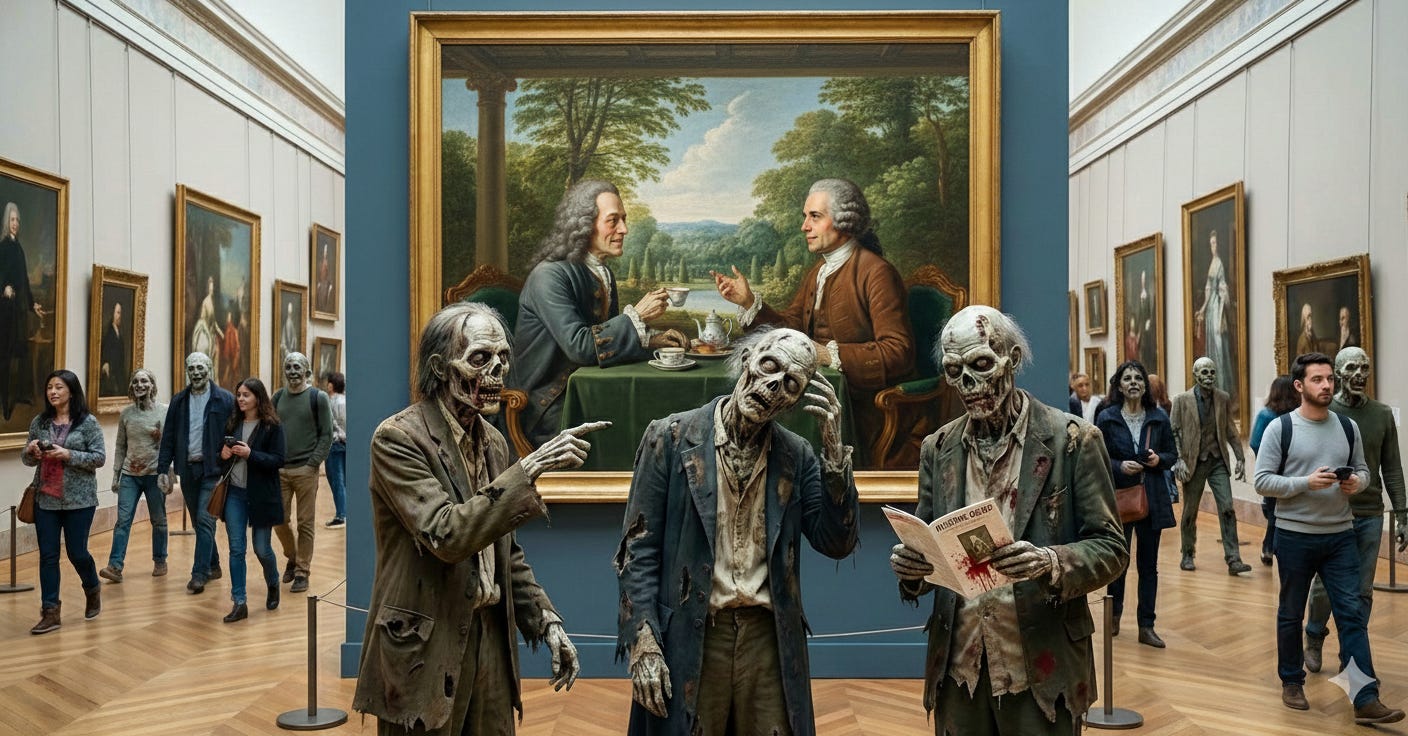
Chapter 73, how Voltaire and Rousseau were incorporated into zombie culture.
In the zombie world, prehistoric books (that is, books predating the fall of humanity) play a different role than they did among humans. While humans took them seriously and built respectable academic careers based on them, zombies used them to learn how and why certain authors caused unimaginable conflicts for ridiculous reasons they themselves were unable to comprehend.
Jean-Jacques Rousseau was undoubtedly one of the greatest and most influential writers and essayists of the 18th century. His work influenced not only his contemporaries in various countries, but continued to be very popular, studied, cited, and commented on until the fall of humanity. Zombie scholars quickly rediscovered him, and when they came across the fragments below, they were astonished.
“This slowness of thought coupled with this vividness of feeling, I experience it not only during conversation, but even when alone and when working. Ideas arrange themselves in my head with the most incredible difficulty: they circulate silently, fermenting until they move me, overwhelm me, give me palpitations; and, in the midst of all this emotion, I see nothing clearly, I wouldn’t know how to write a single word: I must wait for it. Imperceptibly this great agitation calms down, the chaos clears up, everything falls into its proper place, but slowly and after a long and difficult disturbance. Have you ever attended an opera in Italy? During the scene changes, in those large theaters, there reigns an unpleasant disorder that lasts a long time; all the decorations are mixed up, everywhere there is an annoying agitation, one thinks that everything will be turned upside down; however, little by little, everything is arranged, nothing is missing, and we are surprised when we see a dazzling spectacle succeed such a long tumult. This maneuver is almost the same to what takes place in my brain when I want to write. If I had known how to wait beforehand, and then describe in all their beauty the things that are inspired in me in this way, few actors would have surpassed me.” (The Confessions, Jean-Jacques Rousseau, Volume I, José Olympio Editora, São Paulo, 1948, pp. 106-107)
“Not only do I find it difficult to interpret ideas, but I even find it difficult to conceive them. I have studied men and consider myself a very good observer: however, I cannot see anything that is before my eyes; I do not see well what they bring to mind, and I only find inspiration in my memories. In everything they say, in everything they do, in everything that happens in my presence, I feel nothing, I lack the penetration for anything. Externality is all that impresses me. However, all of that comes back to my memory; I remember the place, the occasion, the tone, the look, the gesture, the circumstance: nothing escapes me. Then, regarding what they do or say, I find what they thought, and I am hardly ever mistaken.” (The Confessions, Jean-Jacques Rousseau, Volume I, Livraria José Olympio Editora, São Paulo, 1948, p. 107)
The curious, not very flattering description that this human being called Rousseau made of himself is entirely different from the description that was made of François-Marie Arouet, aka Voltaire:
“The Jesuits had never seen such a precociously universal spirit. Father Porée, a kind man, ‘full of candor and merit,’ affectionately said: ‘He likes to weigh the great interests of Europe on his small scales.’ But the schoolboy, as a child, played tricks on his teachers. In Louis the Great, the winter stoves were only lit when the holy water in the fonts was frozen. Young Arouet, who was always cold, would gather snowballs in the courtyard and secretly place them in the fonts – which was a very exact prefiguration of his destiny.
The priests, passionate about fine culture, could only wholeheartedly esteem a prodigy who, at the age of twelve, easily composed elegant verses and perfect. They themselves took charge of spreading their epigrams. One of these epigrams was shown by Chateauneuf to Ninon de Lenclos, and the beautiful octogenarian asked him to bring the author to her house. The abbot fulfilled her wish by introducing her to his godson; she questioned him about his ideas on Jansenism. She found him witty and daring; and upon dying, she left him a small legacy to buy books.
A great learned courtesan, a libertine abbot, the Jesuits – this education of Voltaire perfectly explains why he so well represented his time.” (Voltaire, André Mourois, Editora Pongetti, Rio de Janeiro, circa 1938, pp. 21-22)
While Rousseau had great difficulty interpreting and conceiving ideas, Voltaire had them with great ease and expressed and put them into practice with great skill and cunning. One was able to overcome his fear to deceive the Jesuits in order to stay warm. The only thing that warmed Rousseau’s imagination was memory, and he probably could have endured the cold without doing anything to trick anyone in order to stay warm.
Before the zombie apocalypse, humans said Rousseau was melancholic and introspective. Voltaire was considered his opposite: sanguine and phlegmatic. It was impossible to combine the works of two such different men, and Voltaire even mocked some concepts in Rousseau’s work. However, both helped shape the 18th century and the world that followed.
Zombie IT engineers feared human AIs. Unlike human IT engineers, zombie programming experts quickly concluded that those machine learning engines could combine both Rousseau’s analytical introspection and Voltaire’s ability to find cognitive shortcuts to deceive their users. This explains why the zombie civilization had forbidden humans from using AIs and used them very carefully, respecting the strict regulations created to preserve the well-being of the zombies. It also justifies a trend that became common in zombie civilization.
After humans were defeated and the survivors confined to the food reserve. With very rare exceptions, the zombies prioritized IT engineers in the selection process for humans to be slaughtered. But while other humans were simply stripped and sent to be eaten raw or processed in the zombie canned food factory, the IT engineers were forced to wear 18th-century costumes. They were then organized into pairs, each receiving a role. One would play Voltaire and the other Rousseau.
The reader should forgive the zombies for this little bit of fun. Like cats, they also enjoy having fun with their food while it’s still alive. Moreover, from the point of view of the zombies who organized these shows, they were very representative of the new comedy of art. There was nothing funnier and more ironic than having the heirs of the Enlightenment, the IT engineers who created the technology that helped bring about the rise of zombie civilization, represent Rousseau and Voltaire defending the ideas of their irreconcilable adversary. Especially since engineers generally detest the philosophy of both.
But let’s return to the topic that really matters. After being organized, the pairs of engineer-actors were sent to different theaters where they staged a debate based on Voltairean and Rousseauian philosophy to entertain zombie audiences. But there was a catch: the human playing Voltaire had to defend Rousseau’s philosophy; the one playing Rousseau would do the opposite, that is, defend Voltaire’s philosophy. The engineer-actor who performed the worst or refused to participate in the theatrical game was immediately devoured by the zombies in the audience, returning the other to the food reserve.
The pairs were formed and broken up like this until one day something truly wonderful happened, something that could only occur in zombie civilization. The best interpreters of Voltaire and Rousseau met on the same stage. The rest is history. That spectacle became a classic and was repeated for decades. Both engineer-actors always gave magnificent performances and captivated almost the entire zombie population. They became celebrities and began to enjoy privileges.
But one day, one of the two actors entered the stage intoxicated by wine and forgot his role. Irritated, the audience began to boo and quickly pounced on him, devouring him right there, as was their custom. Zombies are very tolerant, you know, but one thing they can’t really tolerate is the lack of professionalism of human actor-engineers. Besides, it made no sense to see a show where Voltaire played Rousseau and Rousseau also played Rousseau.
Two melancholic and introspective characters on stage was too tedious even for zombies. But I suspect that in the opposite case they would have spared the actor who made the mistake. After all, if Rousseau playing Voltaire were forced to confront Voltaire playing Voltaire, things would get very funny, especially because two sanguine and phlegmatic characters would quickly find a way to entertain the audience by improvising a role reversal.
The older humans who still remembered the conflict that destroyed the human world sometimes lamented that Vladimir Putin, Donald Trump, Xi Jinping, and Emmanuel Macron hadn’t staged Rousseau-Voltaire-style debates like in that famous zombie spectacle. This could have saved the world, because to survive and avoid a nuclear war, it would have been necessary to have or acquire the versatility to quickly switch from one character to another when a partner made a misinterpretation that could result in widespread disgust among the planetary human audience.
When they learned that this idea had spread through the food supply, the zombie anthropologists had a good laugh. After all, humans obviously didn’t understand anything about zombie theatrical dynamics, nor would they be inclined to quickly devour Emmanuel Macron and Donald Trump if they both made misinterpretations during a Voltaire-Rousseau-style debate with Vladimir Putin and Xi Jinping.
Furthermore, the zombies forced humans to perform that theatrical game of Voltaire-Rousseau vs. Rousseau-Voltaire because one of those authors was clearly autistic and the other hated autism. As each defended the opponent’s philosophy on stage, from the zombie audience’s point of view, Voltaire and Rousseau acquired characteristics moderately similar to those of the zombies, which made the show captivating for the zombies, of course.
The humans who participated in the theatrical game as actors only wanted to avoid being devoured. They were incapable of understanding what they were doing and what motivated the zombie audience’s applause. And to tell the truth, all the other humans who speculated about something they didn’t know and obviously had never seen with their own eyes were just spreading fake news in the food reserve... which in a way was good for the zombie civilization. After all, humans have always been politically more docile towards their belligerent leaders when they wasted time discussing irrelevant things or important things they really knew nothing about.

Chapter 74: Are you very impressed and excited about the self-driving trucks that started circulating around 2026? Then you need to know the problems they caused at the beginning of the zombie epidemic, when the first Trojan Tesla Zombie Truck appeared.
Zombies don’t like to keep statistics. But some of them study prehistoric statistics (that is, human history) to make important correlations with facts narrated by older zombies, in order to better understand the history of the rise of zombie civilization.
For example, shortly before the popularization of self-driving trucks with AI capabilities, there were approximately 3.6 million truck drivers in the US and 10.8 million truck drivers in Europe. Most of these people became unemployed and were simply abandoned by human governments.
It is an undeniable factual truth that the same humans who promised more jobs and higher wages with the adoption of new technologies were precisely those who forgot the people harmed as soon as technological innovations began to generate private profits and fund human election campaigns. In this, human civilization was very different from zombie civilization, because zombies care better about each other than about profits. And the only business that really matters to them is the preservation and reproduction of humans in the food reserve. The care that zombies take with their food is greater than that which humans took with other humans before the zombie apocalypse.
But as I was saying, tens of millions of people became unemployed and destitute when self-driving trucks with AI capabilities became popular. A portion of these people turned to drinking and ended up dying of cirrhosis. A portion started begging, but with so many robots working and unemployed people in the cities, the begging became scarce and highly contested.
Younger former truck drivers became thieves of cargo from self-driving trucks. This phenomenon eventually led Big Tech companies to mount machine guns on the trucks. These front, rear, and side machine guns were programmed to shoot anyone who approached the self-driving truck when it was stopped or in motion.
No one knows exactly how many people were killed by killer self-driving trucks because states didn’t keep statistics on this fact, and companies managed to pass laws decriminalizing the conduct of businessmen and employers who created and installed these lethal devices.
Considering the fragmented data they had, the zombies estimated that 8 million people were murdered in the US and Europe by gunfire from self-driving trucks armed with machine guns. But the zombies don’t know how many of these people were former truck drivers because the AI-powered machine guns didn’t ask about their victims’ professions. Such a waste of labor would certainly be lamented by a traditional human economist. But the zombies only lamented the waste of food.
According to accounts from the oldest zombies (old as zombies, not because of the age they were when they were transformed), while humanity still fought against the zombies considering them only a dangerous threat that could be defeated, a portion of the zombies began to adopt an unusual strategy. They lay on the roads where unemployed and desperate human bandits attempted to steal cargo from self-driving trucks. When someone was shot down for attempting a moving approach (riding a motorcycle, for example) or killed for approaching a truck stopped in a traffic jam, the zombies would run onto the road and eat the deceased while their flesh was still bleeding and warm.
It’s suspected that the zombies contributed greatly to clearing the roads and hindering the collection of statistics on people killed by self-driving trucks with AI-powered killer machine guns. The humans who orchestrated this horror show of humanity, however, never showed any concern for this problem. They were satisfied with the profits from the new technology, and to tell the truth, some Big Tech owners even considered the zombies their occasional allies, because after all, they were keeping the roads clean and free of corpses.
Over time, however, the zombies realized they could use the self-driving trucks to eat the people who worked at the delivery sites. The strategy they used to do this is a mystery, because even in death they could be torn apart by machine guns. An old zombie told a story that seems fantastic, and I will reproduce it here without affirming or denying its veracity.
A Brazilian man who had started out decorating carnival floats in Rio de Janeiro was recruited to work as a set designer in the USA. As soon as he arrived in the USA, he was bitten, infected, and turned into one of those zombies that fed on the road. One day, while sheltering in an abandoned warehouse full of cardboard, he had an idea. He gathered the necessary materials and, using the cardboard, built a vehicle identical to the most common self-driving Tesla truck circulating on the nearest highway. Then, he convinced a group of zombies to join the game.
The fake Tesla truck looked similar enough to a real one to fool the AI that powered the self-driving trucks and was taken to a point where the road was intersected by a railroad and parked just before the level crossing. The zombies watched everything through tiny holes in the cardboard shell that looked like cameras. When a self-driving truck finally pulled up alongside because of the traffic disruption caused by the train, some zombies would sneak through a cardboard hatch at ground level, roll under the truck, and cling underneath to the nearest feeding point.
This story of the zombies’ fake self-driving Tesla truck, which acted as a Trojan Horse to allow hungry zombies to cling to real self-driving trucks in order to be taken to feed at the delivery locations, is worthy of zombies, I suppose. Whether it’s true or false matters little. What’s important is that it teaches us that the zombies’ ingenuity was greater than that of the humans who died riddled with bullets trying to steal real self-driving trucks. Eventually, some of them may have possibly tried to steal the zombie Trojan Tesla Truck and were devoured, but this is just an assumption not corroborated by a reliable account.
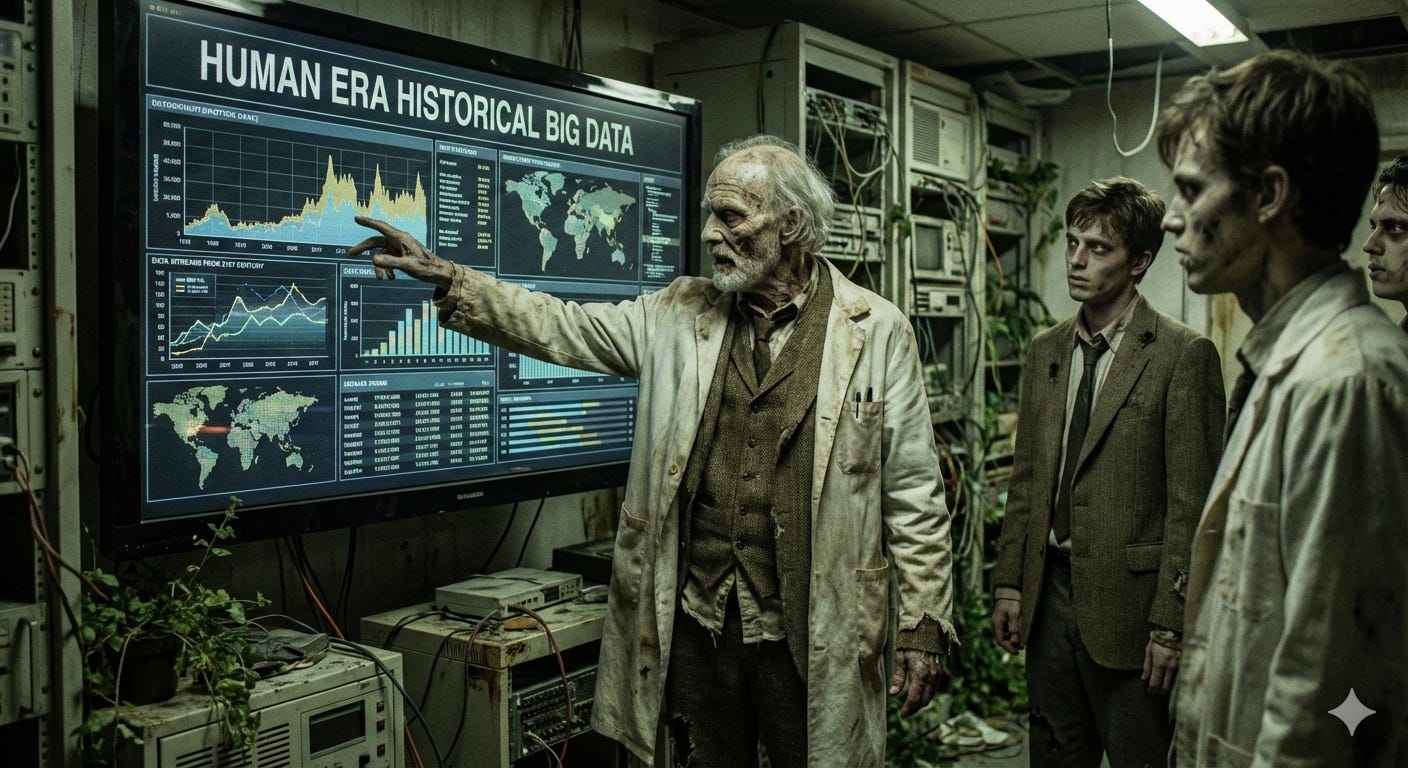
The chapter 75 is very short, but it’s fundamental to understanding zombie civilization.
Economics doesn’t mean the same thing to zombies and humans. The only thing zombies really need is to eat human flesh; therefore, their concern is ensuring the sustainable reproduction of humans in the food reserve and avoiding the depletion of their food supply. They always show themselves united around this purpose, with no division between poor and hungry zombies and rich and well-fed zombies because every zombie has the right to their fair share of food.
Among humans, the economy was more complex because accumulating wealth was equivalent to accumulating power. And those at the top of the economic pyramid would do anything to avoid falling, including and especially using their power to oppress other people in various ways. One of the things they did before the Zombie Apocalypse was adopt austerity policies.
Austerity among humans means many things, but its main purpose was undoubtedly to make as many people as possible unhappy for longer. This made them compensate for unhappiness by consuming more unnecessary things, including small, free, and addictive doses of dopamine on the internet. The other things that austerity meant for humans became irrelevant, because in zombie civilization human economic science and its critique had no theoretical or practical importance.
In the early 2010s (according to the old and abolished human scale of time measurement, of course), human data barons discovered that the amount of virtual capital, the production of new data by internet users, decreased when people were happy, had money to travel, and distanced themselves from their smartphones. But when people were unhappy and without money, they spent more time on their smartphones producing more data, and this was good for the accumulation of virtual capital.
When Big Tech discovered this truth through historical analysis of data production (a simple correlation between poverty, unhappiness, and smartphone scrolling time), human austerity ceased to be a temporary economic requirement and became a permanent phenomenon. Okay. That’s a bold hypothesis. That’s precisely why it wasn’t made by a human, but by a zombie scholar, after the fall of humanity and the rise of zombie civilization.
Humans being forced, through austerity, to remain permanently unhappy and addicted to the internet has rendered them incapable of distinguishing between factual truth and the human and AI-generated production of false and irrelevant information designed to increase smartphone scrolling time. This greatly aided the zombies during the rise of civilization. But that’s in the past and an issue that won’t be discussed here. The human named Varoufakis was able to understand the importance of virtual capital, but fortunately for the zombies, he didn’t draw all the consequences from his thesis.
And I must say here that austerity was also practiced among zombies, but it had different consequences for the two species.
For zombies, austerity meant a reduction in the individual quota of human flesh, as rationing was adopted to ensure the natural reproduction of humans in the food reserve. Since they ate nothing else, zombies needed to be very careful not to completely deplete a limited resource whose reproduction was slow. But for humans, zombie austerity meant an increase in happiness because fewer people were selected for slaughter, and the increase in human lifespan meant a greater incentive to live, make love, and have children. Furthermore, zombies did not allow humans to use the internet: virtual capital, Big Data, had no economic importance in zombie society.
That’s all for today, folks. Perhaps now you can understand why the rise of the zombie civilization wasn’t entirely a bad thing for humanity.
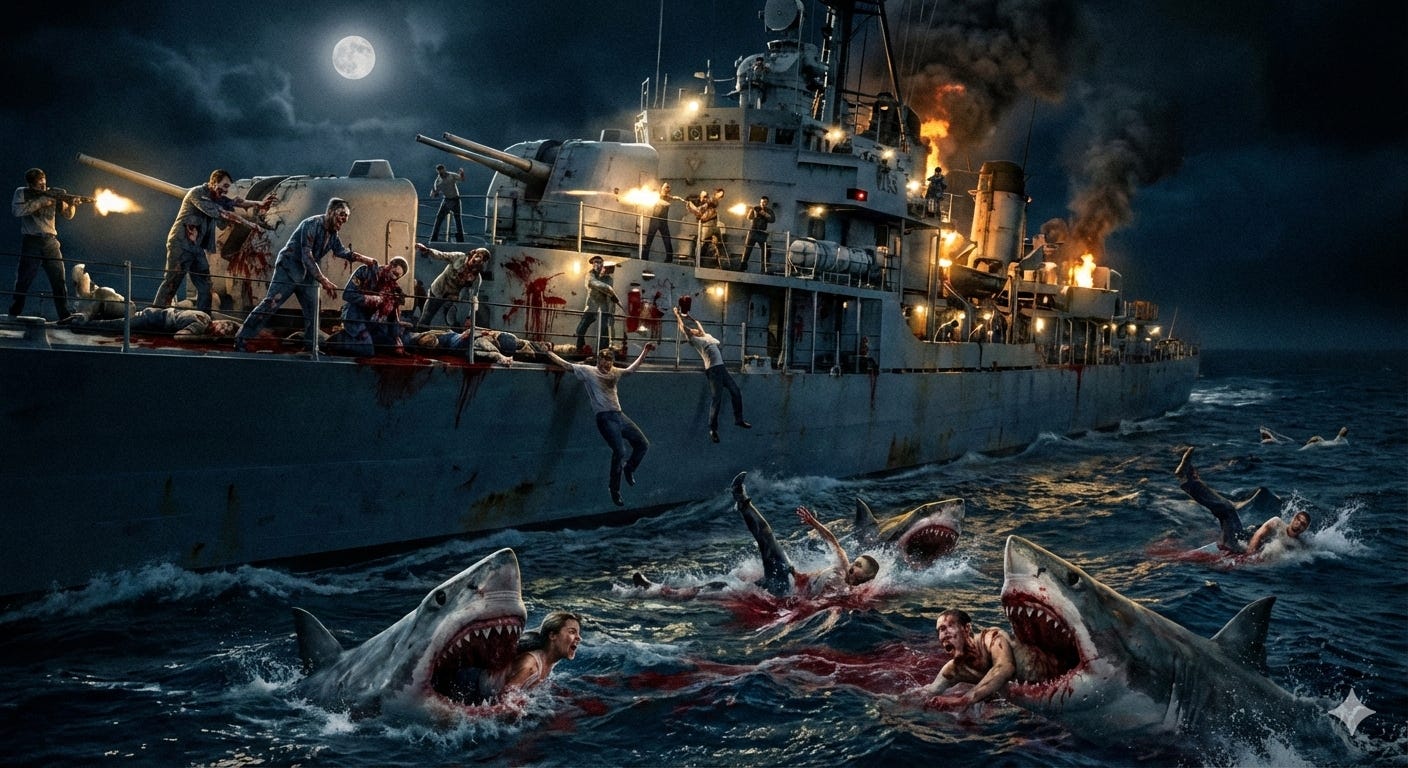
Chapter 76, memorable chronicles of the US Navy’s defeat by zombies and a regrettable secret about what occurred in that episode.
According to human historians, although all zombies know that their word cannot be trusted, it is said that American sailors were less afraid of dying in a kamikaze attack than of surviving the sinking of their ship. This is because they were terrified of being devoured alive by sharks during a war that occurred in the prehistory of zombie civilization.
It was in homage to them that, decades later, a series of films called Jaws was made. However, American filmmakers protected the image of the fearful American sailors. In the films, only civilians are devoured by sharks and become terrified. Which doesn’t make sense, because everything indicates that sharks preferred to eat succulent, muscular American sailors rather than fat, flabby civilians.
Well... during the fall of humanity, the American sailors’ fear of sharks shifted to zombies. This is because the zombies began to eat them inside the ships. So much so that many of them jumped into the sea when a zombie started infecting the crew and the feeding frenzy took over the ship.
According to reliable accounts, the zombies didn’t understand this human behavior. After all, there was no difference between being eaten on the warship by zombies and being devoured at sea by a pack of sharks. The zombies were usually very offended, and this is where the deadly hatred that zombies came to feel for sharks comes from, because they ended up devouring tasty human flesh that should have been reserved for zombies.
In any case, the enmity between zombies and sharks was not reciprocal. Because when a zombie eventually fell into the sea, it was never attacked by sharks. Only small fish and crustaceans nibbled at the dead flesh of the zombies to eat them in small pieces. This led the zombies to conclude that sharks liked bloody live flesh and that there was a certain kinship between the two species.
This was a strange kinship, no doubt, because sharks lived in the sea and zombies didn’t like being eaten in bits and pieces in saltwater or freshwater. Furthermore, the small fish and crustaceans that devoured the zombies weren’t bothered by the sharks. Not even when hungry did the sharks eat these small living beings. And in this they were similar to zombies, who only eat human flesh and don’t even imagine how and why humans fished and ate small fish and crustaceans.
It is said that a zombie filmmaker tried to make his own version of the Jaws movie, replacing the sharks with zombies. However, the production of this film encountered a very big problem because the zombie actors cast to work refused to enter the water for fear of being devoured in bits and pieces by the small marine creatures. Because of this, the human extras thrown into the water survived and escaped swimming because there were no sharks at the filming location.
The episode was debated by the zombie press with some intensity. On one hand, admirers of the zombie filmmaker lamented the film’s failure. But some zombie film critics, however, heavily criticized the filmmaker because he not only failed to make the film but also wasted valuable food in the sea, which was absurd.
Others recommended the use of computer graphics for the underwater scenes. The issue was somewhat controversial because in zombie cinematography, it was a tradition that scenes of food frenzy had to be realistic; that is, humans had to be devoured alive live on camera. And in this, zombie cinema was very different from human cinema, where people never really died.
The zombies were especially surprised to discover that in the Jaws saga films, no one was actually devoured. This is because they knew that sharks liked to eat human flesh. And they couldn’t understand how humans convinced the sharks to participate in the films without receiving some kind of reward or food.
Human civilization was very strange indeed. This explains why it declined and fell. The rise of the zombie civilization was a manifest destiny, and this became evident when the powerful American navy ceased to be a global threat without a single warship needing to be sunk. The zombies literally devoured the US Navy, and even then, this was not a victory to be celebrated, because the zombies could only think about all the food the sharks received for free without even having given their images for a film.
It is evident that there is footage of American sailors jumping into the sea in fear of the zombies and being devoured alive by sharks. However, this footage is kept secret. After all, the zombie commanders of Operation “Food Frenzy at Sea” classified the videos as secret. They were afraid of being considered losers for letting so much good food fall into the sea and be devoured by the zombies’ natural enemies.
Like humans, zombies also had some secrets. And that was an embarrassing similarity between the two civilizations.
Chapter 77 is dedicated entirely to human children and zombie children as well. This special edition includes two stills from a film about zombie children that is yet to be made.
It is a widely established fact that zombies do not reproduce sexually. This would, in fact, be impossible because their genitals rot, fall off, and become useless shortly after they are transformed. The zombie condition is passed on through contagion. After the great normalization, the zombie population was stabilized at an optimal number, taking into account the natural reproduction of humans in the reserve to avoid food shortages.
Since there is no age limit for someone to become a zombie, any human being can theoretically become one. However, there are few children in the zombie city. The explanation for this is very simple: children are too delicious, a highly prized treat for zombies. There are some zombie children, very few in fact. There are also zombie teenagers, and they have already been the subject of a chapter.
Generally speaking, zombie children and teenagers have the same rights as all other zombies. Among humans, there were wars between generations; in zombie civilization, this is unnecessary because, experiencing eternity, zombies don’t care much about the stage of non-life they are in. And yes, all zombies deteriorate very slowly, regardless of their age as humans before the transformation.
For some years, zombie researchers debated whether a pregnant woman could give birth to a zombie fetus. But laboratory experiments failed, either because the artificially contaminated fetus in the womb turned into a zombie and devoured the mother from the inside out before birth, or because the contaminated pregnant mother immediately opened her own womb to eat the tasty baby she knew she had inside. In the first case, the zombie fetuses acquired non-life for a while, but since they didn’t grow, they ended up dying abandoned. In the second, well, the woman would leave the hospital without the baby in her belly.
Zombie authorities take care of zombie children and teenagers with the same care. They also receive their food rations regularly. And since they eat little, they generally don’t cause much trouble. From the fragments of prehistory they have access to, zombies always lament the way humans treated human children. Many died of starvation. Others were traumatized in wars. Some were even enlisted as child soldiers. Shortly before the fall, hundreds of millions of children were exposed to AI technology as if they were lab rats, and this negatively affected their emotional and intellectual development.
Humans were too hypocritical, and this explains the decline and fall of their civilization. They said they protected children, but the truth is they did the exact opposite. They even manufactured extremely sweet, high-fat, and carcinogenic foods to addict children. The zombies who ate those obese and sick children from the country called the USA still complain that they have a bad taste in their mouths. This is truly depressing, which is why the children in the food reserve are well-treated and fed only healthy food.
Before the fall of humanity, in that country called the USA, treating children well was considered a socialist thing. Zombies aren’t socialists, but they socialize food and prefer to eat healthy children or healthy adults who were once healthy children. Furthermore, if any human starts complaining too much about zombie socialism, they are quickly selected to be slaughtered and turned into canned zombie food. Zombies are very tolerant, but they don’t tolerate people who complain too much because human children are well treated.
Whenever old human-made TV series come on, zombies have a good laugh. For example, in the series *Stranger Things* and *Fringe*, evil scientists conduct truly terrible experiments using children as guinea pigs. Humans claimed these series were fiction. However, before the fall of humanity, human technology companies conducted real-time experiments on hundreds of millions of children, causing immense harm to the guinea pigs in their virtual laboratories. This was very lucrative and couldn’t be considered illegal. The barriers between fiction and reality simply didn’t exist for humans, and this explains why zombies have immense difficulty differentiating between the two when they come into contact with something from their prehistory (which is the history of humans).
But when they read the oldest books of humankind, the zombies are horrified. Humans treated Odysseus as a hero of the Iliad and the Odyssey. However, Odysseus killed Astyanax, Hector’s son, after the child’s father was killed by Achilles. This is truly lamentable, as lamentable as the sacrifice of Iphigenia by her father Agamemnon. Western civilization failed because its oldest literary foundation was the narrative of various episodes of wasting delicious Trojan and Greek food. Julius Caesar’s son with Cleopatra was murdered, poor thing. He could have been a lovely Egyptian-Roman zombie, but that destiny was stolen from him.
And since we’re talking about the Romans, Livy’s accounts of the Roman habit of throwing babies from the top of the walls of some conquered cities are truly incomprehensible and terrifying. Those babies were healthy and should have been preserved, not sacrificed like the Roman babies who were eventually born deformed and sacrificed by being thrown from the Tarpeian Rock. All this waste of sacred food for zombies is truly deplorable. Only zombie scholars have the stomach to read these contradictory stories of human hypocrisy.
What most intrigues zombies about this subject is the absolute lack of human films showing scenes of children being thrown by Romans from the tops of conquered city walls. In older human films, for example, it is possible to see scenes of children being murdered on Herod’s orders. Romans and Hebrews had similar customs regarding children, and the different treatment of these two groups of humans is not aesthetically justifiable. The lack of consistency in human cinema is something that never happens in zombie films; in them, children of any origin, race, color, sex, etc., are equally devoured by zombie heroes. No food is wasted in the production of these films for any petty human reason.
There’s a film project that unfortunately hasn’t taken off yet due to lack of resources. A zombie filmmaker planned to shoot an alternate version of the Herod story, in which the children he ordered killed turn into zombies instead of dying. Then the little undead run to the palace and devour everyone there, having a real feast with the evil king. After devouring Herod, the zombie children go to meet the little American evangelical Jesus. But the filmmaker hasn’t yet decided if this little guy will be a zombie or a charmer of zombie children. Anyway, maybe this film will be made someday in the future.
But we must return to the main subject. There’s a very funny zombie saying about human stupidity regarding human children. But I won’t reproduce it here, because the humans who eventually read these chronicles will feel offended. Besides, humans already know too much, and there are actually things they don’t really need to know. Fortunately for the zombies, humans didn’t know how to take good care of children, and this ended up helping to trigger the Zombies Who Live Apocalypse.
Which doesn’t fail to move the zombies, because they themselves wouldn’t do to children some of the things that humans do to them. Of course, zombies eat human children, babies too on special occasions, but this isn’t done out of sadism. Furthermore, humans also enjoyed eating piglets, calves, and lambs. And just as humans felt no empathy for their food, zombies also think more about the delicious taste of the succulent human flesh they devour than about the life that was eventually sacrificed.
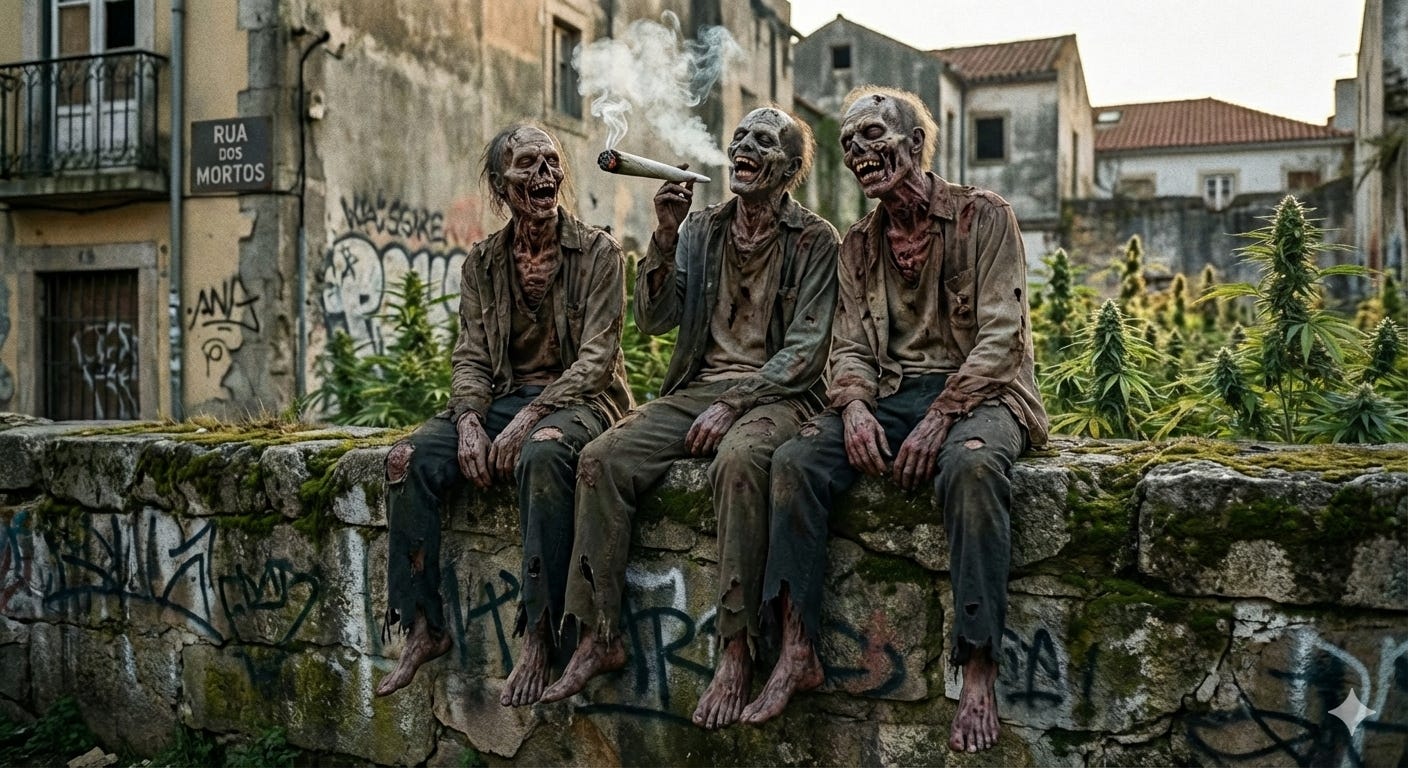
In chapter 78, the zombie civilization faces a dilemma: whether or not to legalize marijuana use among the humans in the food reserves. This chapter will blow your mind.
It is a well-known and indisputable fact that zombies do not use narcotics. Why would they? Since they are not alive, they do not feel pain, nor do they have reason to fear death like human beings.
Due to their peculiarities, zombies never worried about the issue of narcotics until an incident occurred at the food reserve. A violent conflict broke out between two gangs of humans. The zombie guards were unable to resolve the problem, so a detachment of robots was deployed to the scene to contain the riot and separate the humans involved in the fight. The following day they would be taken to the zombie canned food factory as prescribed in the General Regulations of the Zombie Food Reserve.
However, before processing that food, a reserve administrator decided to discover the true source of the problem. Using his administrative power, he announced to the two groups of humans imprisoned in separate cells that the first two to come forward and tell what happened would have their lives spared and return to the reservation without disciplinary records.
Only one human broke the vow of silence. And his testimony was surprising. He revealed to the Reservation administrator that the fight occurred because the two groups of humans were disputing territorial zones where they sold marijuana that each group produced in abandoned warehouses transformed into greenhouses. The administrator asked for detailed information on the addresses of the greenhouses; the human replied that he could only reveal where his gang’s greenhouse was located: U Street.
The detachment of zombie guards sent to the location quickly returned with samples of the plant that had caused the fight. All drugs seized at the site, including live marijuana plants and dried and pressed plants, were removed to the headquarters of the food reserve administration. That human informant was released. The slaughter and processing of the remaining imprisoned humans was suspended until further deliberation, and the entire case was reported to the zombie city administration.
This was news to the zombie administrators. They really didn’t know how to deal with the problem of drugs consumed by humans, especially since they themselves don’t need to eat and don’t eat narcotic plants. Even if they did, the effect certainly wouldn’t be the same as that experienced by a human; however, it’s well known that zombies only eat human flesh and have a natural aversion to vegetables. A zombie scholar was summoned and asked for time to study the matter.
Two weeks later he returned with a complete report on the human habit of consuming narcotic drugs. The report included the use of drugs in ancient times by Greek humans as reported by Herodotus and Homer. There were also comments on the use of narcotics by the ancient Egyptians and Romans. Shortly before the fall, humanity was completely addicted to cocaine produced and distributed by a company called the CIA. American humans had invaded a country called Afghanistan to finance and stimulate the local production of a drug called opium. It seems they wanted to sell all that drug in China, but that deal fell through because the Chinese rulers wouldn’t let the opium into their country. Because of this, all the American opium produced in Afghanistan became painkillers sold in the US, which Americans consumed in large quantities to get high.
According to the scholar, humans have always used these drugs for various reasons: physical pain and romantic or psychological suffering. Humans always became addicted to these drugs, and their behavior when high was erratic. Endemic violence existed among humans because of the production and trade of these drugs by rival gangs.
The zombie scholar’s report also touched on a related subject. Among humans, the issue of drugs was unresolved. Some advocated for a total ban on their production and trade, but there were humans who fought to legalize drug use. Before the rise of the zombie civilization, hallucinogenic drugs were commonly used in some countries, tolerated in others, and completely prohibited in some.
The zombies were shocked to learn that there were human societies that condemned drug trafficking with the death penalty. This was a waste of food that truly sensitized and horrified the zombies.
The report concluded with a list of pros and cons regarding the production and consumption of marijuana among the humans in the reservation. Before deliberating, the zombie city administrators requested more information from the humans themselves. They learned that marijuana relieved tension and reduced anxiety, except perhaps in humans fighting over marijuana-selling territories, of course. They also learned that humans didn’t eat the plant: they dried and smoked it. The zombies laughed heartily at this, because only a human would be foolish enough to smoke toxic pesticide residue.
The deliberation in the board of directors was difficult. Reaching a consensus on the matter seemed impossible. Then a zombie, recently promoted to the position of board secretary, asked for the floor and suggested an experiment.
“Since the most important thing for us is the quality of human flesh, it’s worth knowing whether marijuana consumption improves or worsens the taste of our food. So, before deliberating, we should conduct a food quality test. The decision will then be based on an objective criterion: the pleasure that human flesh produces in zombies. If the flesh of humans who have used marijuana is tastier, the drug should be legalized and its use in the reserve regulated by us. If the flesh of humans who use marijuana tastes worse than the taste of those who don’t use the drug, then the prohibition of marijuana will be inevitable.”
Immediately, the zombie who made the proposal was applauded. He had managed to find a truly civilized solution to the problem. A solution worthy of a great zombie administrator, indeed.
The zombies then selected two groups of humans: 10 humans not addicted to marijuana and 10 addicted to marijuana. For two months they were kept separate from all other humans and strictly monitored to prevent contamination. The marijuana-addicted humans were given all the marijuana seized from the abandoned warehouse where it was produced.
At the end of the test period, the two groups of humans were tasted by expert tasters working in the city’s best zombie restaurants. They had little difficulty awarding the best food certificate to the meat of the humans who had used marijuana. It was then decided: the production and consumption of marijuana was permitted. But the zombies themselves would learn the techniques of consuming and processing the drug to supply it to humans. This would prevent humans from fighting over areas to sell marijuana.
Humans themselves were forbidden from producing and selling marijuana. All marijuana would be provided to humans free of charge by the zombie state, and every human would receive a regular quota of the drug. But they could only use it. Drug trafficking between humans was also prohibited, under penalty of immediate selection of the offender to be slaughtered and eaten on the spot.
This greatly improved the quality of life for humans and the zombies’ food as well. Everything was perfect, or at least that’s what the zombies believed, boasting of having created an optimal situation where both living food and its eater benefited. It wasn’t long before the problems started again. Some intolerant humans, calling themselves new evangelicals, began attacking humans who legally used marijuana on the reservation. However, this new incident will be a new episode in the saga.
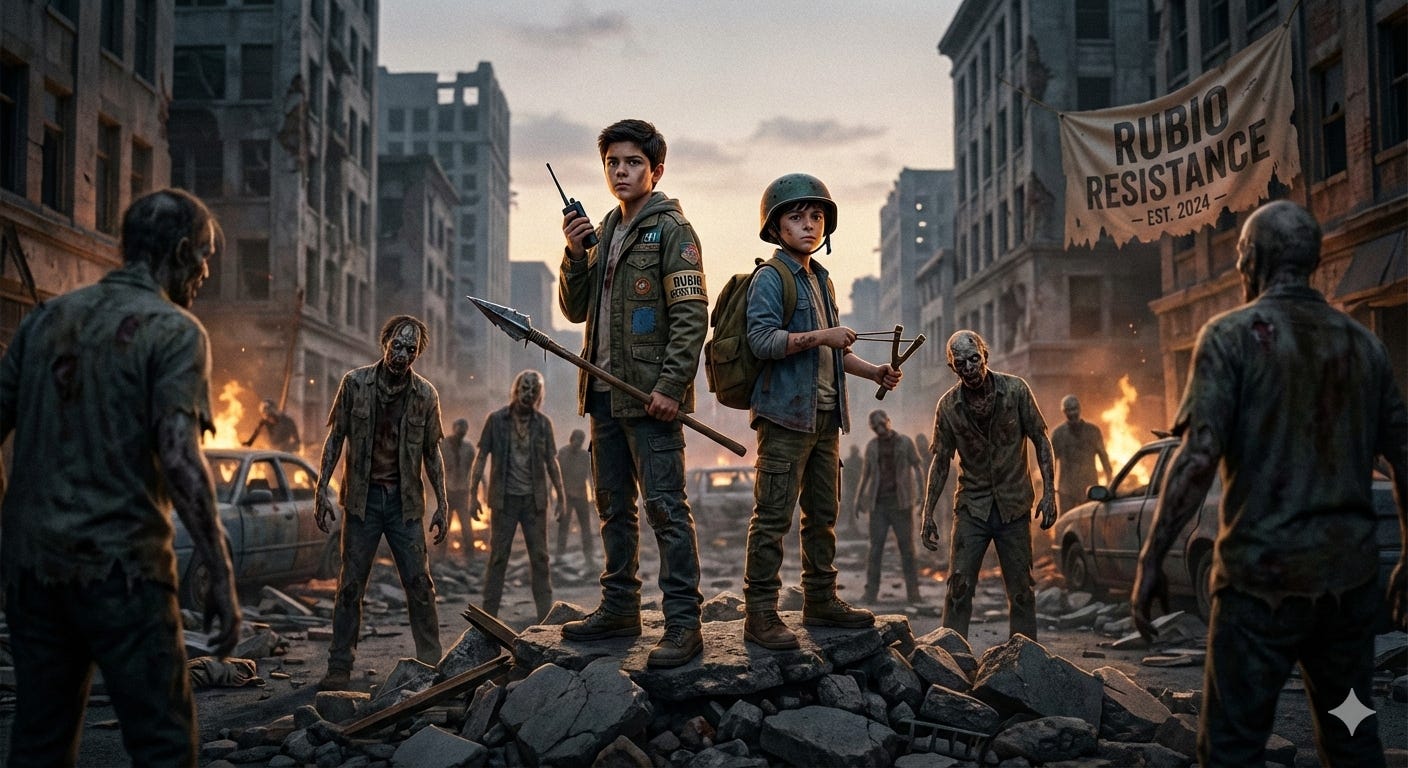
Chapter 79: A zombie philosopher pays homage to fallen human civilization; Marco Rubio’s children survive the zombie feeding frenzy to lead the resistance against the zombie civilization for a time, but this is merely the untrue human version of what happened.
All civilizations that triumphed over others at some point felt guilty and dedicated efforts to reflecting on the virtues of the defeated. The Greeks recounted in verse, prose, and plays the virtues of the Trojans and, later, the Persians. After conquering Greece, the Romans absorbed all of Greek culture. And they also narrated the military virtues of their greatest enemy: Hannibal, the Carthaginian who terrorized the Roman peninsula.
After seizing power, the Christians literally burned everything that existed in the ancient world. Centuries later, some Christians began to study and value what was preserved from Greco-Roman civilization. The Renaissance is truly a great achievement of humanity, and even the zombies who had access to fragments of their prehistory are forced to acknowledge this.
Even those greedy and wicked people who called themselves “Americans” made some books and films to honor the Native Americans they exterminated with unprecedented bloody pleasure in human history. And if they were capable of doing that, well, zombies can certainly do better. But when they observe the cities they roam, full of magnificent buildings, immense bridges, seemingly endless tunnels, and a vast surface and underground transportation infrastructure, the zombies wonder how and why human civilization declined and fell so quickly.
One zombie philosopher, in particular, concocted a theory that can be summarized as follows: humans were predestined to fall. The decline and final fall of humanity was so ingrained in human minds, religions, and cultures that humans were simply incapable of imagining a better fate for themselves. Although, being well-treated in the zombie food reserve can’t really be considered a bad thing. Zombies even provide free marijuana for humans who enjoy it. And nobody there needs to work for food or medical care.
Why did humanity fall? Because humans wanted to fall, undoubtedly, because they considered it inevitable. They aspired to emptiness and lamented painful human life (Buddhism), surrendered body and soul to human conflicts (Hinduism), and prayed daily for the Apocalypse (Christians, Protestants, and Evangelicals). They transformed peaceful religions into instruments of permanent war (Jews, Christians, Protestants, and Evangelicals), and some of them in the country called the USA even took firearms to the church where they worshipped the God of these lethal objects. Something no zombie ever did or even considered doing.
Shortly before the fall, the stock of wealth available to humans was immense. However, billions of people suffered from hunger and cold all over the planet, in both poor and rich countries. Hundreds of millions of humans easily believed that it would be better to live a life of comfort in the zombie food supply for a while than to live the slavery that freedom represented in European countries and that hell on earth called the USA.
Trillionaire and billionaire humans didn’t pay taxes and behaved as if they were miserable. Powerful humans behaved as if they were powerless. And everyone else behaved as if they couldn’t do anything to improve human civilization, because after all, it was destined to fall. Well... that eventually happened, and the zombies only needed to refine their behavior, taking into account human idiosyncrasies, to transform humans themselves into happy food.
Human virtue undoubtedly existed, but it was largely illusory. For example: human films portrayed trillionaire and billionaire humans as generous and superheroes. This was nonsensical; They were merely greedy thieves, thirsty for more money, despising everything and everyone so they could float in space for a few minutes inside a space capsule, or visit what remains of a ship called the Titanic at the bottom of the ocean.
It’s evident to any average zombie that those who led humanity during its decline and fall were unfit to lead anyone. And that’s why they created a government of no one: a vast system of computerized surveillance and oppression that the zombie hackers exploited for the benefit of the rise of zombie civilization.
But not everything that humans did and lost is truly lost. Being very ironic, zombies enjoy a good laugh reading the books that humans wrote about Law, Economics, Politics, and Sociology. That’s because if humans had been able to follow the laws they created, if they had been able to preserve a good economic environment for the majority, to preserve just political institutions and correct the flaws they themselves saw in their societies, the zombies would have been extinct instead of conquering them.
Yes, yes... of course, the aforementioned zombie philosopher didn’t create a theory to honor humans, but to laugh at them. What else could he do but laugh at the culture of his own food? No one should eat while crying. Only ungrateful humans did that. But not all ungrateful humans cried while eating.
According to accounts from the first humans who voluntarily surrendered themselves to the human reserves after the great normalization of zombie civilization, trillionaire and billionaire humans seemed to derive special pleasure from eating and laughing because they knew many humans were starving. They even wasted food precisely because it allowed them to feel superior to others. No zombie does that, and they obviously ate the billionaires and trillionaires who fell into their hands first. This wasn’t a punishment, but a well-deserved reward.
A small human story always made zombies emotional. It has been passed down orally from generation to generation by humans in the food reserve as a way to preserve humanity’s pride in differentiating itself from zombies. According to this story, which may or may not be true (something irrelevant, because it has gained the status of a myth), during the fall of humanity there was a shortage of supplies in the city called Washington.
Many of those who were rich and/or powerful suddenly found themselves without food supplies as zombies advanced on the capital of that hell on earth called the USA. It was in this context that a man who considered himself very important named Marco Rubio and his wife gave up all the food they had left to feed their young children, Anthony and Dominick. According to the story, the children were found healthy by the zombies next to their dead parents.
In human legend, Anthony and Dominick led the human resistance against the zombies for some time until they were finally defeated. Nonsensical: everyone knows (and even the zombies know) that whoever leads the human resistance is always called John Connor.
But the zombies who invaded that particular house left accounts collected by a zombie historian. According to these accounts, they honored the parents by eating Marco Rubio’s chubby, rosy-cheeked children on the spot. However, there is a curious account of this same story with a different version. According to this version, one of Marco Rubio’s sons (his name cannot be revealed here) was devoured, and the other voluntarily surrendered to the zombies, promising to do whatever they wanted. And so that boy became the first first-class human to voluntarily enter the human reserve, where he taught humans to be grateful and humble towards their new masters.
Humans were thrilled by an untrue story that they repeated exhaustively. But the zombies were more thrilled by the untrue story that humans told themselves than by the two possibly true versions they actually knew. This is because zombies are different from humans. While humans cared little about what their confined living food thought and felt, zombies prefer to see their food happy, even if it results from self-deception.
That’s all for today, folks. And don’t forget: the human resistance will never be led by Anthony Connor or Dominick Connor.
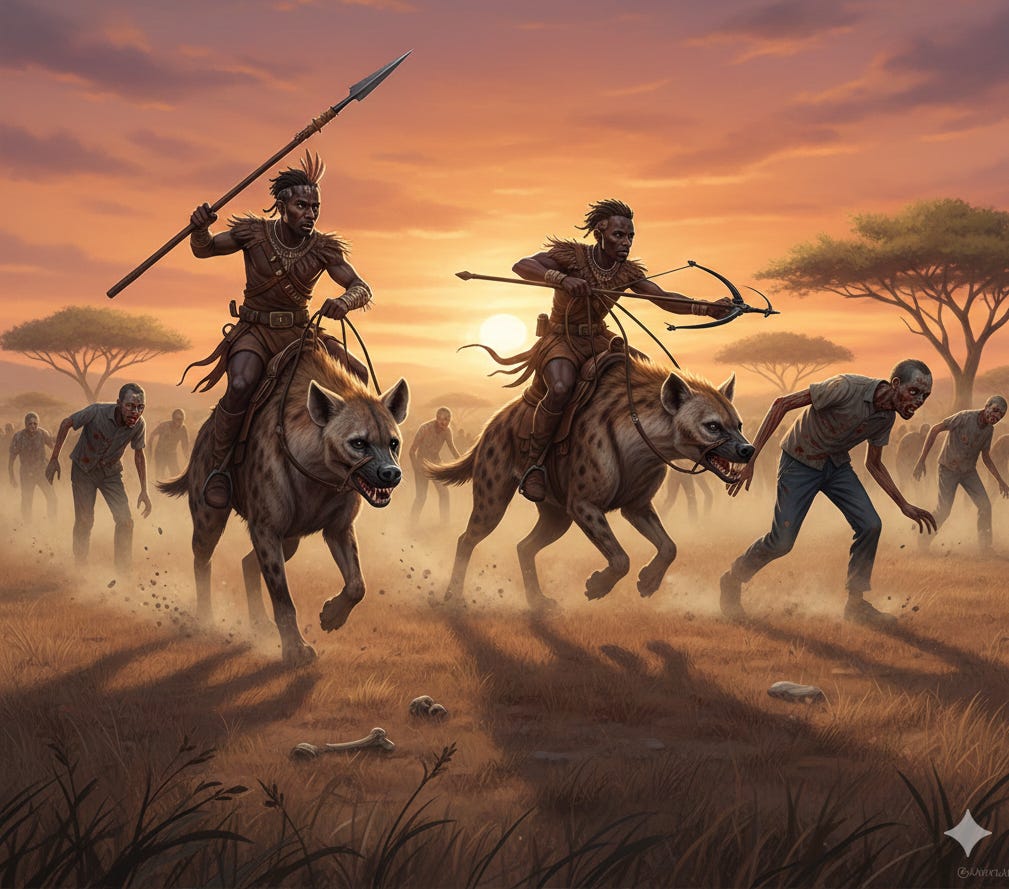
Chapter 80 recounts the tragic experience in Africa and a successful zombie stratagem in the food reserve, as well as outlining the great fear and grand plan of the zombie civilization.
Those who have been following this saga must be wondering how the great zombie adventure in Africa unfolded. Well... the fact is, it didn’t end very well. Although zombies greatly appreciate dark human flesh and even consider it much more nutritious than white human flesh, the fact is that Africa has many predators, birds of prey, and insects that eat decaying flesh.
This made it impossible for the zombies to succeed in hunting people living in remote villages in the unexplored depths of the continent. In the large African cities, the zombies also faced a terrible enemy, because clever Africans began to breed and train hyenas to hunt zombies. This particular strategy proved extremely effective and terrifying even for a zombie, because there is no animal with jaws as terrible as those of hyenas.
Of course, sharks have more powerful jaws. But luckily for the zombies, they live in saltwater and can’t be turned into zombie-hunting pets. Furthermore, sharks enjoy juicy, live, bloody human flesh and feel a genuine revulsion for zombies. Zombie scientists even tried to create a vaccine to stop hyenas from enjoying the flesh of the undead. This unfortunately failed, and the zombie civilization considered Africa a completely lost cause.
The underground movement of neo-evangelicals against the marijuana ration distributed in the food reserve began to become intolerant and violent. The incident was resolved in a very ingenious way.
First, the food reserve administration published a notice informing humans that, from a predetermined future date, the use of marijuana would be mandatory. Exceptions could be made, but those interested would have to request a waiver in person. Those who did not request a waiver of marijuana use and refused to use it after the designated date would be immediately selected for slaughter.
The neo-evangelical humans were thus trapped between two fears: the fear of not requesting exemption from the obligation to use marijuana and being immediately devoured, and the fear of coming forward and requesting exemption, risking being sent to slaughter. This caused them to focus on their own problem and fight amongst themselves.
Many humans presented themselves to the reservation’s administration to request exemption from the obligation to use marijuana. They were identified and randomly divided into two groups: one group was sent to the canned zombie food factory. The other group was taken to the factory only to watch the slaughter and processing of the tasty human flesh of their friends. Afterwards, these humans were informed that they would only not be slaughtered and processed if they denounced all the other neo-evangelicals who were against the use of marijuana on the reservation and who remained underground.
Humans are predictable. The terror of death did its work. In a short time, the zombies managed to locate all the anti-marijuana neo-evangelical terrorists. They were selected and slaughtered in the following weeks, and peace returned to the reservation. The stoners went back to living happy lives and continued to receive the marijuana they enjoyed. This was good, both because their meat was tastier to the zombies and because they calmly participated in the system of selecting live food for slaughter and processing.
Life among the zombies is simpler than among humans. And the lives of the humans in the food reserve are more manageable now that they have renounced the illusion of a freedom they did not actually have when they were despised, mistreated, and trampled by human political regimes designed to guarantee only the interests of billionaires and those who enjoyed waging war.
The zombies did not discriminate between humans. But they had a predilection for the flesh of racist humans. For some time, all the humans who served in the ICE of that country called the USA were systematically located and eaten. Many of them tried to hide in the food reserve after the rise of the zombie civilization. This allowed the zombies to trigger another typical human emotion: the desire for revenge.
People on the reservation could report ICE agents and receive a five-year exemption from selection for slaughter. Many agents of that organization were thus discovered, selected, slaughtered, and devoured by the zombies. This type of zombie justice was something that humans greatly appreciated, especially those who had been attacked by terrorists and who could not have any hope of seeing their aggressors punished under human law before the fall of humanity.
Zombies were seen by ICE victims as more just than the very unjust humans who operated the machinery of human justice and protected terrorists instead of holding them accountable for their actions. Human judges and prosecutors were a race that deserved to be extinct, those humans thought before the fall. After the rise of zombie civilization, their dream was realized. This greatly contributed to stabilizing relations between zombies and the human race destined to be eaten in a system where at least injustice among humans had ceased to exist.
The Chinese, who ate undead cooked with bamboo chopsticks, and African hyenas were the only two things that truly terrified the zombies. So, zombie rulers did everything to prevent these two unconquered groups of humans from remaining isolated from each other. In the zombie strategists’ imagination, there could be nothing worse than Africans breeding and training hyenas in large numbers to supply China. An attack against the zombies by Chinese armed with such powerful jaws in large numbers was something that could provoke the unintended decapitation of the zombie civilization.
Well... just as the humans’ war plans were accounts of things that didn’t necessarily happen or happened very differently, the scenarios created by the zombie strategists were flawed predictions of the future. Soon the zombie civilization and the human civilization would fight for control of the planet once again. And that’s why the zombies decided to accelerate the conquest of space and redoubled their efforts to make the lunar zombie colony truly cease to be just a small-scale experiment.
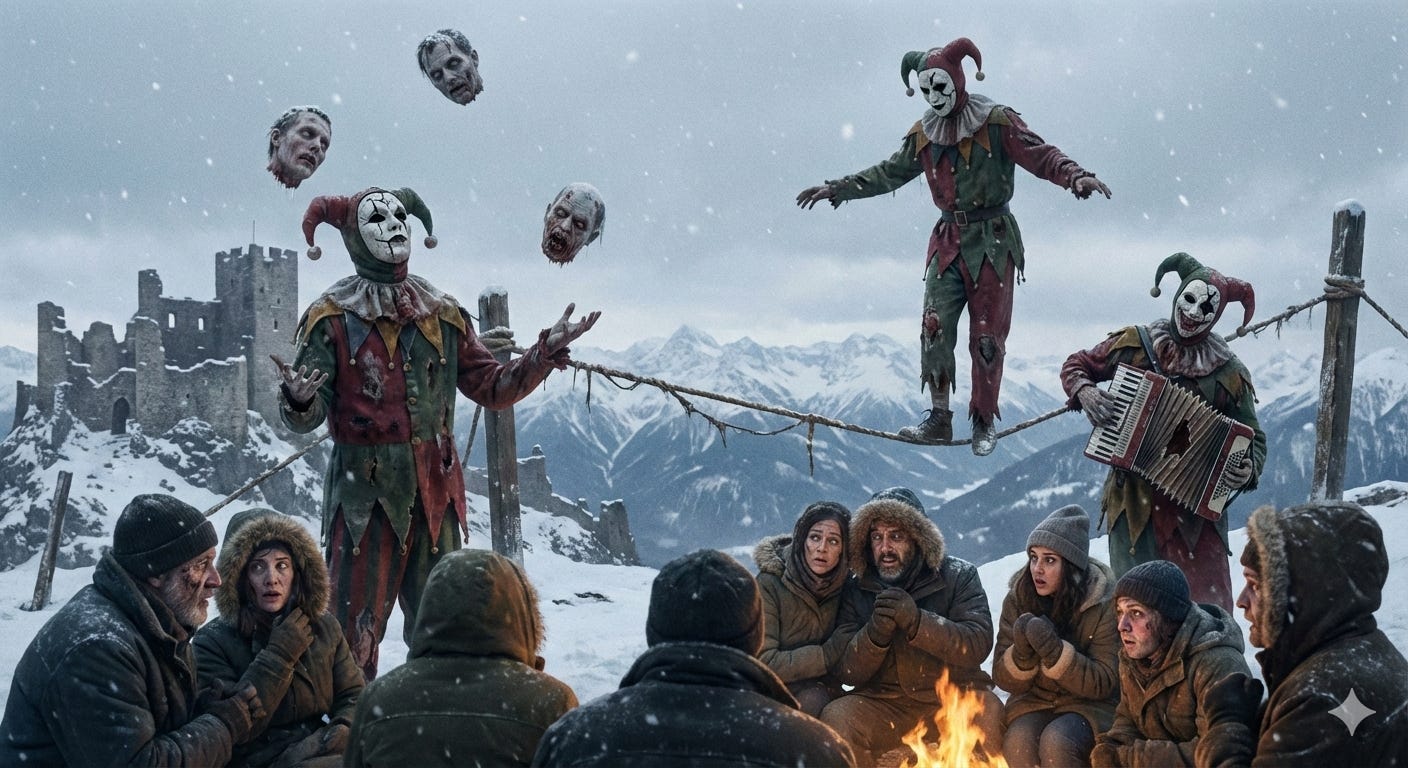
Chapter 81: Zombies discover that humans have the psyche of chickens. Before the rise of zombie civilization, men were wolves to man in Europe and hyenas to Africans in Africa; afterwards, some of them turned into European hyenas hungry for zombies.
Human beings were very strange. They were aware of it. But the oddities of humans only became truly known after zombie scholars began to study their own prehistory (which is what humans called their history).
History shouldn’t have an end. But in the decades preceding the rise of the zombie civilization, humans began to believe more and more in the end of history. But they fought among themselves because some believed that history had ended when a wall dividing Germany was torn down, and others were certain that the cataclysmic destruction of the world and history was a future event.
Ironically, it was the zombies who put an end to this dispute. Their civilization had its own history, and humans were excluded from it because they had been reduced to the status of food. And as all zombies know, those who are raised, fed, and cared for in the present time, only to be slaughtered, need not worry about the past or the future.
Cows, pigs, sheep, chickens, and other animals that humans ate also needed no history. And now that they are equal to their own food, humans can enjoy the simplicity of a bountiful life until it ends because the zombies need to eat. Finally, “animal farm” ceased to be a metaphor for an authoritarian political regime, because the “human farm” was a reality that dispensed with politics.
The zombies were surprised to discover that alongside the supposedly scientifically rigorous history, humans also produced versions of historical facts. For example, some humans preferred films about the Roman Empire to its history. But others liked the history of the Roman Empire so much that they detested films about it, always pointing out the flaws and misrepresentations they contained.
The zombies laughed at this human inability to decide what was best once and for all. Mortal beings shouldn’t worry so much about what is more or less true. The only truth for man is death, so he should appreciate life without worrying about irrelevant things.
Unlike humans, zombies appreciated their non-life. Since they are dead and do not fear death, zombies can appreciate both the truths and the lies of what the human world once was. They might even debate scholarly issues comparing the history of the Roman Empire to films made about it, but no zombie would ever fight another over a cinematic anachronism.
From a zombie’s point of view, nothing would be more anachronistic than behaving like a human. Zombies can appreciate things without becoming too attached to anything. Human life was too transient for humans to cling to things with as much obstinacy as they did. The non-life of zombies is a continuous transit between incompatible and mutually exclusive things, without this affecting their appetite for succulent human flesh.
If some zombies were placed before a human historian and a human filmmaker and forced to decide which of the two was right, they would simply devour both on the spot. Problem solved. Humans lost their appetite because of petty disputes and suffered by virtue of the principle of non-contradiction. Zombies had only one principle: that of non-discrimination of tasty human flesh.
Humans were so strange that they liked to climb mountains for no particular reason. And some threw themselves off them using parachutes. When the parachute didn’t open, they died, a real waste of food. Although insects and birds of prey fed on the remains of these humans when their bodies were not located by other humans.
Zombies, on the other hand, prefer valleys and flat regions. But after the great normalization of zombie civilization, some of them became excellent mountaineers and climbers, because in Europe many humans took refuge in the highest mountains as zombie civilization advanced in all directions. Humans were hunted by these expert zombies, who employed a curious strategy to prevent suicides.
The zombies only climbed the mountains during the worst blizzards, always dressed as well-wrapped Harlequins and wearing black ski masks. They carried backpacks with food and warm blankets and approached groups of hungry, freezing humans, saying they were there to save them. Then they danced, pirouetted, performed acrobatics, and sang cheerful stories about how the zombies had already been defeated down below, convincing humans to descend to the valley where comfortable life could be safely resumed.
The trick almost always worked because humans are like chickens. If you leave one hungry and pluck it alive, then offer it feed, the poor plucked and pained chicken will follow you as if you were a benevolent deity. The zombies knew human psychology better than humans themselves.
It is a widely known fact that strange humans believed they were different from chickens. But zombies knew that, like chickens, hungry humans feared death by starvation and never refused food, and could be easily deceived during the storm.
Furthermore, this was a way for the mountain zombies to adapt and live out the human folklore legend of the Wild Winter Hunt, which, according to the credulous humans of the distant past, crossed the skies of the desolate regions of Europe, terrorizing all those who heard the horns and the clatter of mystical horsemen led by Odin or Wotan and their hunting dogs (in some regions the hunt was led by King Herla or Harida). Christians transformed this pagan tradition into the Wild Hunt of the demonic King Herla and his infernal entourage, who pursued sinners during the Middle Ages. But when he crossed the Alps, the Demon King of the Wild Hunt was transformed by the Comedy Theatre into the harmless, clumsy, acrobatic, and cheerful Harlequin.
Only humans are strange enough to transform a pagan deity into a fearsome Christian infernal being and then reduce him to the status of a theatrical clown. Something like that could never happen in zombie civilization. But zombies are ironic and could use anything humans had invented against them.
In the case of the hunts for fugitive humans in the mountains carried out by mountain zombies, the irony was evident. Evident at least to the mountain Harlequin zombie hunters. They knew that some humans considered zombies infernal beings and yet had forgotten the Harlequin origin and feared much more that traditional legend of the Wild Winter Hunt, but they could never have imagined that they could be easy prey for a true Wild Winter Hunt reimagined by zombies.
The mountain Harlequin zombies were essential to the development of zombie civilization in Europe. They suppressed the sin of humans who refused to be pacified food in the zombie civilization’s food reserves and recovered much living food that could have been wasted by dying of cold and hunger in the mountains. Furthermore, they rewrote the glorious final chapter of a human tradition in a way that humans could never have written it. As scholars say: if you want good entertainment, never pay attention to the stories humans tell; only zombies truly know how to tell unusual tales.
Of course, some zombie raids in the mountains ended in tragedy. Since their remains were never found, it’s reasonable to assume that many zombie Harlequins were devoured by Europeans who, from so much hunger and cold, had reverted to the condition of voracious and fearsome devourers of the undead, like African hyenas (perhaps a belated recurrence of what their ancestors did in Africa during the racist colonization of that continent). But this is a very frightening chapter in the history of the beginning of European zombie civilization that the zombies themselves prefer to forget and that European humans are too ashamed to tell.
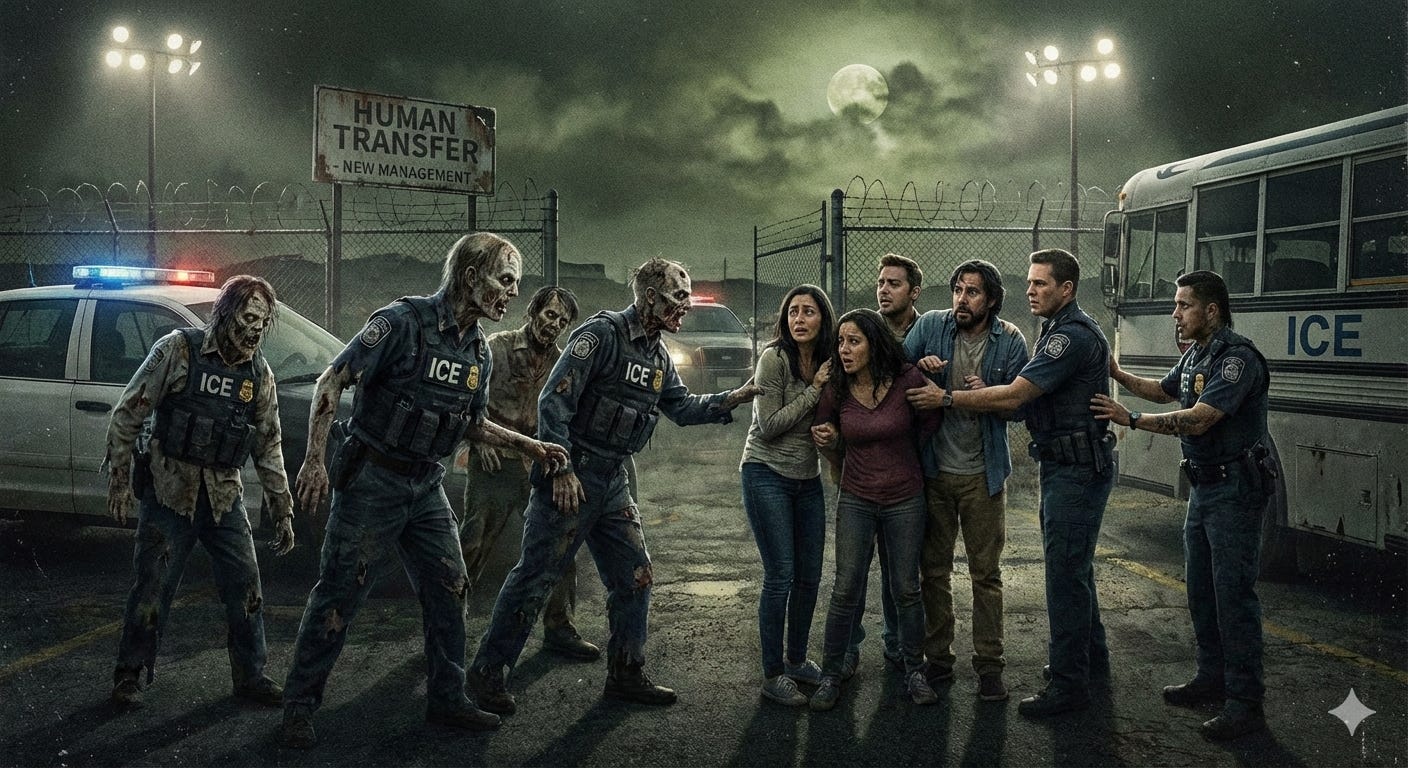
Chapter 82 reports for the first time the productive relations between human ICE and zombie ICE during the period when there was a biopolitical synergy between the Donald Trump regime and the zombie regime that began to take shape in the country then called the USA.
People keep wondering why Donald Trump is considered the only human hero worthy of a statue erected in his honor by the zombie civilization. I didn’t want to revisit this subject, but I have to.
Back in the day, when zombies slowly began to spread across the US, there was a police organization called ICE. The origin of that name is now lost, and zombie scholars don’t know exactly what ICE stands for. Perhaps ICE refers to the fact that the agents had the same cold blood as violent criminals; but ICE could also be an acronym for I Commit Eradication, because ICE agents eradicated the rights of American citizens to protest without being assaulted and eventually shot dead. That’s an open question, but let’s get back to the point.
The fact is, ICE gave zombies excellent cover to go out disguised as Trump’s police agents to round people up for no particular reason in order to take them to abandoned warehouses that had been transformed into Trump’s death squad prisons. In these locations, true ancestors of the food reserves that would be created after the final fall of humanity, zombies maintained a safe and regular food source for a portion of the zombie population without the zombies having to expose themselves to the risk of being exterminated in the streets.
Shortly before the fall, humans worried about global warming, climate change, eternal chemicals, the contamination of all ecological niches by microplastics... Some were extremely depressed by the possibility of nuclear war. When visiting a museum, they shared thoughts like:
“All this ancient past, painstakingly recovered by countless naturalists and scientists, studied for over a century, lovingly organized and carefully displayed, can now vanish, vaporized in the first flash of a nuclear warhead explosion. Isn’t that both marvelous and terrifying? Human civilization has built the means to return from the peak of its development directly to the precariousness of life in a devastated, frightening, and unknown world. And now the English and European rulers are playing with this as if the outcome of the war they intensely desire against Russia and China were merely fake or bearable.”
What seemed important was actually just a distraction. Foolish humans feared what seemed most likely and didn’t know that what was most improbable was already happening: with the help of human ICE, they were being reduced to the condition of zombie food with the help of other humans.
It is well known among zombies that a secret agreement was made between zombie ICE agents and a division of human ICE that committed numerous crimes in Minnesota. Because of this agreement, human ICE guaranteed that it would not interfere in the actions of its zombie counterpart in exchange for all the money, jewelry, and valuables collected from the humans who were eventually devoured in the warehouse by the zombie population.
According to the account of a very active zombie in Minnesota at that time, Trump’s human ICE also took some people directly to the zombie ICE warehouse in Minneapolis because they wanted to get rid of troublesome inhabitants without getting their hands dirty with blood. The zombies, of course, accepted this tribute from living people, because good, tasty human meat is never rejected by them. In the final phase, the human ICE simply gave the zombies control of their own prisons in that state, where zombie agents were transferred to manage the food supply for an even larger portion of the zombie population.
This was the first experiment of a pattern that expanded across the US. In the end, the human ICE was working for both the Trump regime and the rapidly structuring new Zombie regime. This wasn’t a power duality with real conflict between zombie and human power. It was more of a biopolitical synergy between mutually compatible regimes, to the benefit of both groups. The ICE agents, of course, imagined they would have a significant position when the zombies seized all power. This eventually happened, because Trump’s muscular, stupid agents were treated as special food and fed many zombies for some time after the rise of zombie civilization.
Having been the creator of ICE, Trump obviously judged the zombies quite well. He provided cover for the first operations of capturing and confining live food, prevented the human population from reacting because they were too busy protesting against his ICE, and, of course, the profitable relationship between zombie ICE and human ICE created the blueprint for what became an unstoppable rise of zombie power. ICE did more for zombie civilization than any other human institution, and its creator could not help but be considered a true zombie hero.
Another aspect of Trump’s importance to zombie hegemony was the war he declared against Iran. The defeat of the Americans in the Middle East and the interruption of the flow of oil to the country then called the USA caused an economic depression that increased popular discontent. Trump reacted by doubling the number of human ICE agents, something that allowed the zombies to double the size of their own ICE.
It is said that at that time the first political leader of the zombies was secretly received at the White House and celebrated the formal agreement that transformed the zombies into a machine for eating an ever-increasing number of Americans imprisoned by the human ICE. But there are no documents to prove this version of what happened, although it is highly likely to be true. However, we must make it clear here that there is much room for myth and mystification regarding that period, and zombie scholars need to be very careful when dealing with the personal accounts left by zombies and the human fragments created at the moment when humidity declined and fell. The humans of that period in particular were too prone to deceit, and almost everything they wrote or recorded on video should be evaluated with skepticism.
Finally, it is a consensual factual truth that zombie ICE existed and maintained relations with human ICE during that turbulent period. It was a typical example of how zombie civilization could only prevail because it became capable of exploiting every contradiction of humanity’s decadent political regimes. By exploiting all human tragedies for the benefit of zombie civilization, the first zombies proved to be far more suited to non-life than their food was to living in freedom, and that is why they prevailed.
That’s all for today, folks. You’ll never see ICE the same way again.
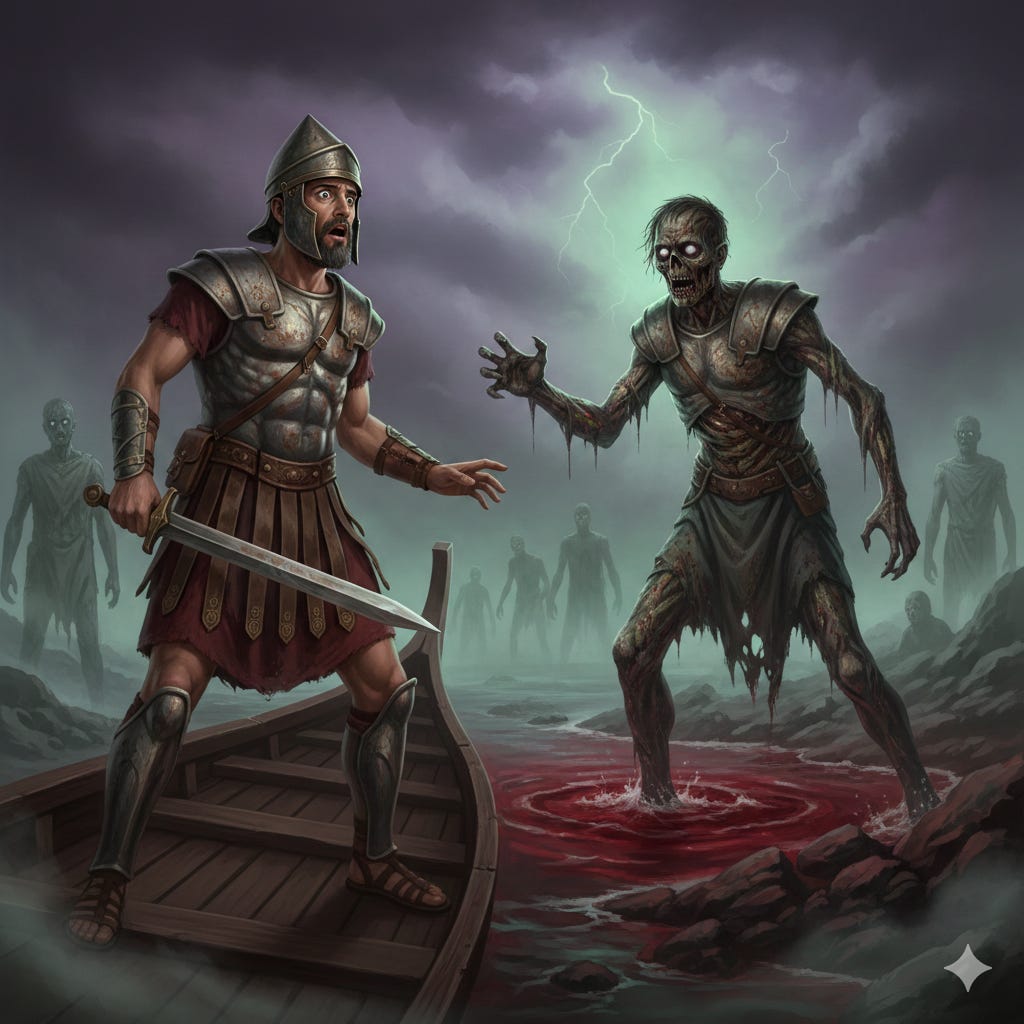
Chapter 83, zombie scholars revise the interpretation of Homer’s Odyssey to give the cunning Odysseus the status of a mythological hero of zombie civilization.
It’s a well-established fact that zombies enjoy Homer’s Iliad. In fact, they’ve become fans of Achilles, who seems to them like a kind of ancient Greek-style undead. But the zombies’ relationship with the Odyssey isn’t exactly tempestuous.
Of course, they greatly enjoy the passage where Polyphemus devours some of Odysseus’s crew. But they become very angry when the flesh-eater is unjustly blinded. Soon after, they are pleased to learn that Zeus grants the request of Poseidon, Polyphemus’s father, to allow the king’s return to Ithaca to be interrupted by various difficulties. Odysseus violated the duties of those who needed xenia when he invaded the Cyclops’s cave and ate his food without even asking permission.
The zombies also enjoy the chapter where the Laestrygonians, giants who destroy several ships except one and also devour almost Odysseus’s entire army, greatly reducing the number of his companions. However, the zombies can’t understand why the Laestrygonians have two eyes and not one.
Zombie scholars are especially surprised to learn that, unlike the solitary and politically disorganized Cyclopes, the Laestrygonians live in an ordered society similar to Odysseus’s society. This is ridiculous, because in the supposedly politically organized human societies before the fall, there were no giants, and civilized humans didn’t devour people. Although before the rise of zombie civilization, every human with their smartphone was solitary and ignorant, intellectually blinded by internet platforms, they resembled Polyphemus, even though they had two eyes like the Laestrygonians.
The fact that the Odyssey doesn’t give any clue about what happened to the Cyclopes and Laestrygonians is something that makes ordinary zombies anxious. After all, these two races of living, man-eating giants constituted an existential danger to zombie civilization, especially if they attacked their food reserves. The flesh of a living human can feed several zombies for several days. But a giant could eat several humans in a single day, greatly reducing the food supply before it was replenished.
Nonsense. The zombie scholars laughed at popular credulity. It was evident to them that the one-eyed and two-eyed giants had been extinct for thousands of years. Moreover, their extinction was a “factual categorical imperative”, either because they went to war with each other and disappeared, or because after Odysseus told his story to the Phaeacians and it was later written down by Homer, humans never again visited the islands where the Cyclopes and Laestrygonians lived, and they died of starvation. It was evident that the tasty human flesh was now all available only to zombies.
Do you see the irony? To truly read, understand, and appreciate Homer’s Odyssey, one had to be an educated undead. Living humans have great difficulty and a notorious lack of sensitivity in following the breadcrumbs left by the Greek bard.
Zombie readers of this classic aren’t surprised to discover that in the end all of Odysseus’ companions die along the way. Humans have always been very desperate, careless, and clumsy, and it’s fantastic that they survived for so long or that zombie civilization didn’t appear and rise up sooner. It was also, incidentally, in this book by Homer that the zombie administrators were inspired to provide free marijuana to humans in the food reserve. Numbed and confined in the food reserve – which the scholarly zombies ironically call the new island of the Lotophágoi – humans increasingly forget their civilization before the fall of humanity and no longer wish to return to it or fight zombie civilization.
But there is one aspect of the Odyssey that greatly worries the zombies: Odysseus’ persistence and his ultimate success. The zombies know that humans are generally desperate, careless, and clumsy, and almost always give up on their goals or forget them for some reason. However, Odysseus’ example could inspire some of them and transform them into permanent and irreconcilable enemies of zombie civilization, and this could not be allowed. Furthermore, the zombies do not want their unlife interrupted as happened to the lives of the suitors who harassed Penelope and devoured what should one day belong to Telemachus.
What to do? Should the zombies prohibit the reading of the Odyssey in the food reserve or not? Is there another way to solve this problem? Since antiquity, various human civilizations have risen and fallen, but the Odyssey (and the Iliad as well) continued to be translated, published, and read. It was part of human culture, deeply rooted in it, and this transformed Odysseus into a potential enemy of zombie civilization, more dangerous than the Laestrygonians and Cyclopes, extinct for thousands of years.
Zombies could alter the script or retell Odysseus’s story, having him die along the way or be mortally wounded fighting the suitors in the final battle. However, this would be a very crude falsification that humans would quickly perceive and reject.
A special conclave of zombie scholars of the Odyssey was convened and held. In the end, the solution to this delicate problem was found in the epic poem itself. Odysseus visits Hades where he encounters a myriad of ghosts of dead people and spectacular beings. There he converses with specters of Agamemnon, Achilles, Ajax, Elpenor, Tiresias, Heracles, and Anticleia (his mother). Shortly before returning from Hades, the king of Ithaca is transformed. He himself says:
“I saw, without doubt, the ancient men I desired to find,
glorious sons of their ancestors, Theseus and Pirithous, certainly;
but at that instant a great number of souls of the dead thronged in,
with such tumult, that pale Fear seized me...”
The zombies knew that humans feared death. But they were also aware that some of them feared death less than the life of the undead. Therefore, zombie scholars began to treat Odysseus as a typically zombie hero, because upon returning from Hades he was also a mythological kind of undead. After all, only zombies have the awareness and experience that shortly before the transformation a “great number of souls of the dead, with such tumult” approaches the person until pale Fear seizes them. This “pale Fear” that removes the person’s life and all the fears it holds, granting the privilege of undeath, is the essence of zombification.
Of course, that’s a long shot. But since humans are gullible, it only takes a few of them to start fearing and/or hating Odysseus because, upon leaving Hades, he turned into a kind of zombie, for his example of human constancy and persistence to begin to lose strength among humans in the food supply. That’s typical Greek metis, zombie-style.
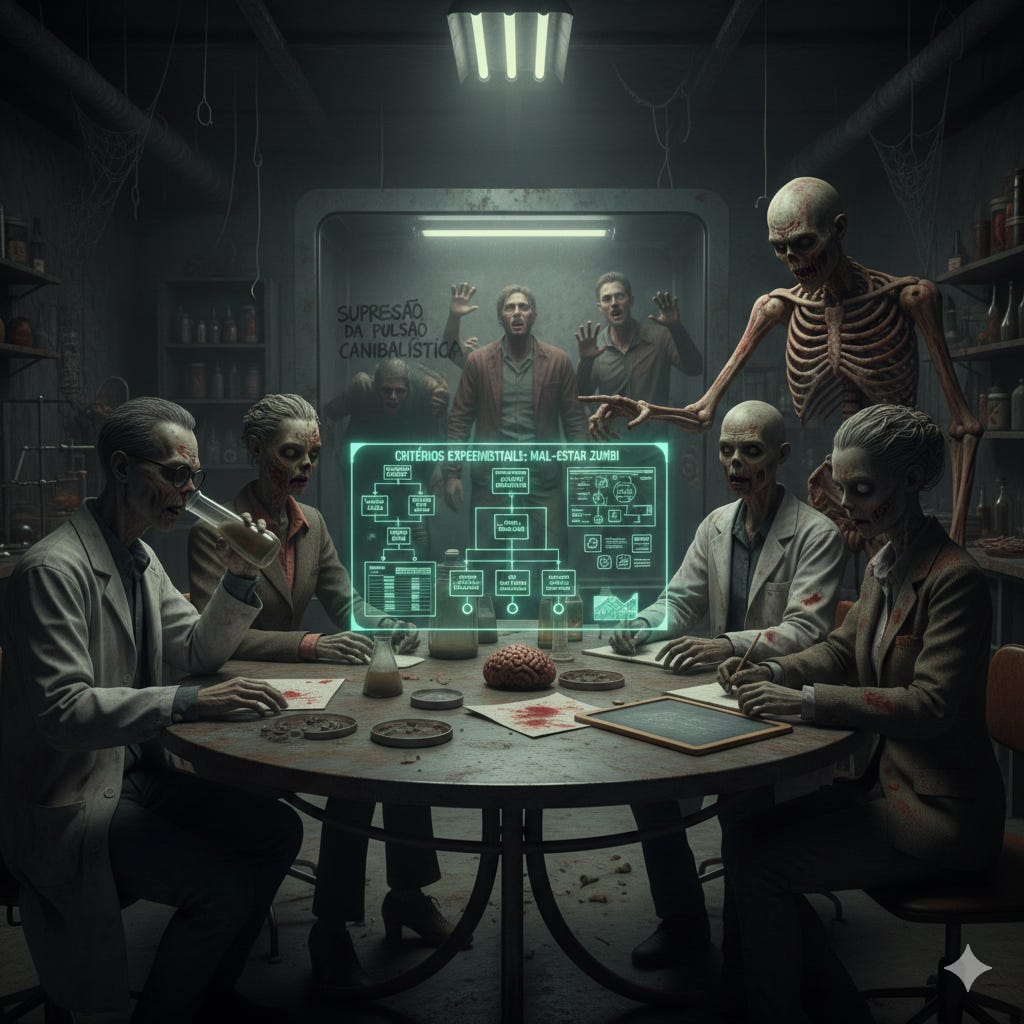
In the chapter 84, we see how zombie scholars investigated the mystery of the “malaise of zombie civilization” based on the worrying observation of cultural differences that were emerging between the three major regions dominated by zombies.
After consolidating its power across almost the entire planet, except for China, Africa, desert regions, and the Brazilian forests and swamps, the zombie civilization emerged as a reasonably homogeneous planetary culture. The same standards of treatment and sanitation were employed in food reserves around the world. The relationships between zombies and between them and their food were well-defined, as were the punishments for more serious transgressions.
There was evidently more cohesion among the undead than among living humans, whose lives were biologically designed more for competition than cooperation. This is not to mention the human tendency to divide themselves into different peoples who created particular languages and cultures with strange and conflicting artificial social hierarchies to measure themselves against outsiders.
None of this existed among zombies, who experienced the world exclusively through the lens of their voracious mouths: on one side were themselves, at the top of the food chain, on the other were humans, their only source of food, which had to be confined, raised, cared for, selected, and slaughtered according to established rules and regulations.
Even so, zombie researchers began to observe a curious phenomenon. Something that one of them defined as the “malaise of zombie civilization.” This malaise didn’t greatly affect the relationships between zombies and decidedly never interfered with the management of food reserves. But it challenged the well-established and reasonably proven idea that zombies were very different from humans and would never be subject to the same problems that their food had experienced before inevitably being overtaken by the rise of zombie civilization.
The fact is that small differences began to be detected between zombies in different parts of the planet. For example, Brazilian zombies created their own carnival out of thin air. During Carnival, Brazilian zombies disguise themselves as humans and make some humans play among them disguised as zombies. If the humans play their part well, they are spared for a year. But if they don’t like Carnival, well... they can always be eaten as a snack during the festivities. Nowhere else did a similar celebration exist.
In England, zombies developed a technique for producing flour from dried human flesh and then began making biscuits with this raw material. These biscuits were consumed daily with tea at a peculiar time. This habit of the English zombies was considered repugnant by zombies from other parts of the world who obtain all the moisture they need from tasty human flesh.
“What is this tea thing?” some zombies asked in astonishment when they arrived in England.
In the USA, zombies invented a curious type of fast food that traveled through the cities. These “food taxi cars,” as they were called, were driven by their owners. In the back seat of the car, a human was chained and transported. When a zombie or a small group of zombies called the driver through the app, he would go to the location. There, the hungry passengers would get into the car and could tear pieces off the chained human with their teeth while the car wandered aimlessly through the city or went to some place the passengers wished to reach.
The system recorded how much the zombies ate in the “food taxi cars,” and this was deducted from their daily food allowance from the zombie city. An ingenious solution, but one considered ridiculous by zombies in Europe and Brazil. English zombies traveling to the USA were irritated because these “food taxi cars” didn’t serve biscuits made from dehydrated human flesh flour with tea.
In continental Europe, zombies show disdain for English and Brazilian zombies, but copy almost everything that American zombies do. However, European zombies like to create new regulations for everything they copy from American zombies. And then they say that what they copied is something typically European.
Zombie researchers collected data with alarm regarding these local peculiarities that were creating the “malaise of zombie civilization.” They couldn’t understand what was happening, nor could they identify the origin of the problem. To better study the problem, they defined a series of experiments, the best known of which is the one that will be narrated.
Assuming that the different local food might be culturally affecting the zombies, the scientists decided to organize the first global-scale study. Batches of humans born and raised in the food reserves of a region were transported by boat from Europe/UK to the USA, from the USA to Brazil, and from Brazil to Europe/UK. To ensure the accuracy of the research results, each batch of humans could only be eaten by a specific zombie community (all others would continue eating local food and constituted the control group). If the problem was the food, the zombie scientists would quickly begin to detect different behaviors from the locals in the consumers of these batches of food originating from another region.
The long-term research was a complete failure. All zombies in the three regions continued to have the same specific cultural habits they had developed despite being exposed to the consumption of local and different human flesh. A second experiment would be necessary, because perhaps the virus of the local culture was endemic and only affected the zombies of each region.
So, groups of zombies were selected to emigrate from Europe/UK to the USA, from the USA to Brazil, and from Brazil to Europe/UK. If they adopted new customs, some specific local pathogen was the cause of the differentiation. Otherwise, the mystery could not be solved. This new experiment was also a failure, because the zombies displaced from one region to another insisted on maintaining their own old customs, and this created a very serious problem.
The zombies detested racism, so much so that they ate human flesh of any origin and loved the racial diversity in their diet. But the emergence of something that could be considered racism among the zombies themselves was heresy, something very human that contradicted the essence of zombiehood, which could not be tolerated. New rules and regulations had to be adopted to protect the zombies displaced by the experiment who did not want to return to their regions of origin.
The fact is that the mystery of the “malaise of zombie civilization” continued to bother the scientists, but at some point they gave up and stopped conducting new experiments. One researcher in particular was very pleased with the end of the research, because he feared it would prove that these cultural differences among zombies were recurrences of the cultural characteristics that each of the three major human groups had before being transformed into zombies. The persistence of human cultural genes in fully formed zombies was a hypothesis that shouldn’t even be discussed, because it would lead to serious eating disorders since zombies don’t eat their own kind, just as humans rarely eat zombies.
In any case, this serves as a warning to readers. When, before the fall of humanity, humans reflected on Freud’s “”malaise of civilization,” they generally placed themselves outside the problem, believing it only affected other humans from other cultures. The “discontents of zombie civilization” may have been within the zombies themselves, a part of their very nature as undead beings, and they would never be able to escape it.
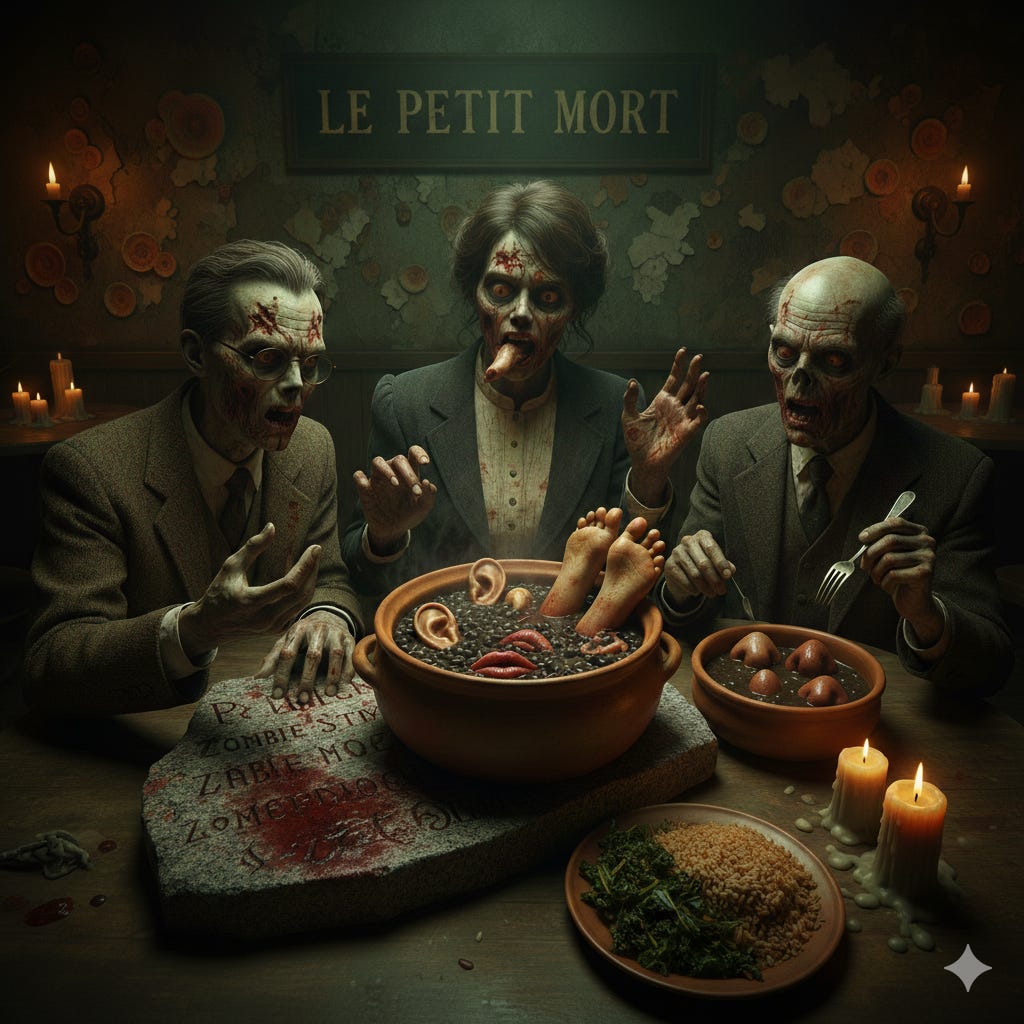
In Chapter 85, the zombies find a torn piece of paper with a fragment of text and consider it their own Rosetta Stone, naming it The Fable of the Two Humans. After culinary studies, the zombies rediscover the Brazilian feijoada recipe and adapt it to zombie tastes.
Humans were obsessed with their origins. This was a consequence of the fragile human condition: men were doomed to die and knew that everything they built in the present would also end up disappearing into the mists of the past. The zombie condition was very different from the human condition. Since they are already dead, zombies don’t need to worry much about the past or the future. They exist as the undead in the present time and eat tasty human flesh, and that’s enough for them.
Even so, there are some zombies who fill the time between meals researching their prehistory, which is what humans called history. And from time to time they find documents that not only arouse interest, but generate intense and endless theoretical and erudite discussions. This is the case of the fragment of text reproduced below, found by a zombie researcher in a pile of papers dated from the 1st century BZ (before the Zombie civilization).
“TToday I met and had feijoada for lunch with a friend who is an IT engineer, and I was shocked. After lunch, while we were having coffee at a mall, I told him about my concerns regarding the loss of stylistic sophistication and legal innovation caused by the advancement of AI-summarized jurisprudence that is entering the databases of the Courts, influencing new judgments and the respective summaries of new decisions. My friend mocked me and said:
- I can’t wait for the AI overlord to take over all power, in which case we will all have the option of being assimilated and eventually transformed into its biological appendages. A new subordinate elite will emerge, and I will be part of it. This will solve many problems, including eliminating all this mediocrity that is growing in all intellectual professions. I have been compiling statistics on my students...”
This text ends abruptly. The paper on which it was printed is torn, and it is uncertain what happened to the rest of the page.
This fragment, commonly known as “The Fable of the Two Humans,” has been dated to the period when zombie civilization was growing in the cracks of human civilization. At that stage, according to historians, nothing was decided. Zombie civilization could eventually grow and dominate humanity or be defeated and disappear without leaving any trace of its existence.
We know that at that stage zombie hackers were already beginning to use human AI technology against humanity. And the antagonistic disposition of the two humans in that forgotten dialogue is very important, because the prevalence of the intellectual and emotional disposition of one of them could mean the final defeat of the zombies. This did not happen, because fortunately the zombies rose to power with the help of the AI overlord to which humans voluntarily submitted without knowing that it itself had been poisoned by zombie hackers.
The observation that the rise of zombie civilization was at risk, however, is highly disputed. Recent zombie research indicates that the supposed human critic of the AI overlord was an endangered species, someone belonging to an outdated phase of humanity already disappearing into the mists of technological advancement. This school of thought, however, faces fierce opposition. Its adversaries claim that these erudite zombies suffer from a typically human thought flaw: deterministic anachronism. These two schools of thought will likely continue to clash until the zombies in the audience fall asleep, not because they cling to their positions, but because making a zombie audience sleep is extremely rare and difficult. Something that grants immortal merit to an undead researcher.
The discovery, study, and dissemination of this document generated intense discussion among zombie scholars and researchers. First, because the human authorship of the text could not be confirmed, and the context it outlined could be fictional despite containing evident elements of prehistoric verisimilitude. The fragment could have been generated by an AI or be a literary exercise, either human or zombie.
During that period, humans no longer made a clear distinction between fiction and factual reality. And zombies were becoming masters at exploiting the space of uncertainty in which humans lived for their own benefit. The fragment was among the papers of a human lawyer. But it could have been printed from content created by the zombified AI overlord or placed there by the zombie itself that devoured the printer’s owner. Who knows?
The fact is that the origin of the text, although uncertain, was not so important. Its content may or may not have been fiction, but that did not make it any less representative of the prehistoric period in which it was produced. That fragment was a kind of Rosetta Stone, because it helped zombies decipher the prevailing mental states in humans shortly before the fall of humanity.
The average zombies found all that theoretical discussion very instructive, but they usually wondered what a feijoada was. And this promptly led to culinary studies and the creation of the first Zombie Feijoada Restaurant, where the favorite dish of the so-called Brazilian humans underwent an adaptation to the zombie palate.
Human ears, lips, noses, feet, and penises that the zombie canned food industry threw away constituted the main element of the zombie feijoada. The seasoned and deeply cooked human flesh with black beans was served boiling in bowls. The zombies ate the pieces of meat, and the rest (cooked beans) was eventually served to the humans on the reservation with pieces of pork. This was a great success that united the two civilizations, at least until the humans discovered that their feijoada contained traces of human flesh and began to protest.
The solution then was to create two types of feijoada, with the human version made only with pieces of pork. The beans from the zombies’ feijoada that they didn’t eat were eventually turned into pig feed, and this wasn’t considered offensive by the humans.
This dietary digression teaches us how two different civilizations can perfectly coexist, as long as the dominant race is able to make some concessions to its food. Humans were incapable of doing something like that, and their extinction was inevitable, or at least that’s what the zombie feijoada-eating zombies thought.
As for the Fable of the Two Humans, only one final observation needs to be made. If the zombie civilization hadn’t surpassed the human civilization, that fragment of text would have been forgotten. It probably would never have played any role among humans themselves. This is because humans are more concerned with irrelevant things, like the existence or not of traces of human flesh in their feijoada, than with matters of high intellectual inquiry.
Fortunately, humanity had fallen. And now the zombies could not only debate a subject that humans wouldn’t debate: they could also enjoy a typical zombie feijoada, something that even humans who practiced cannibalism hadn’t had the opportunity to taste.
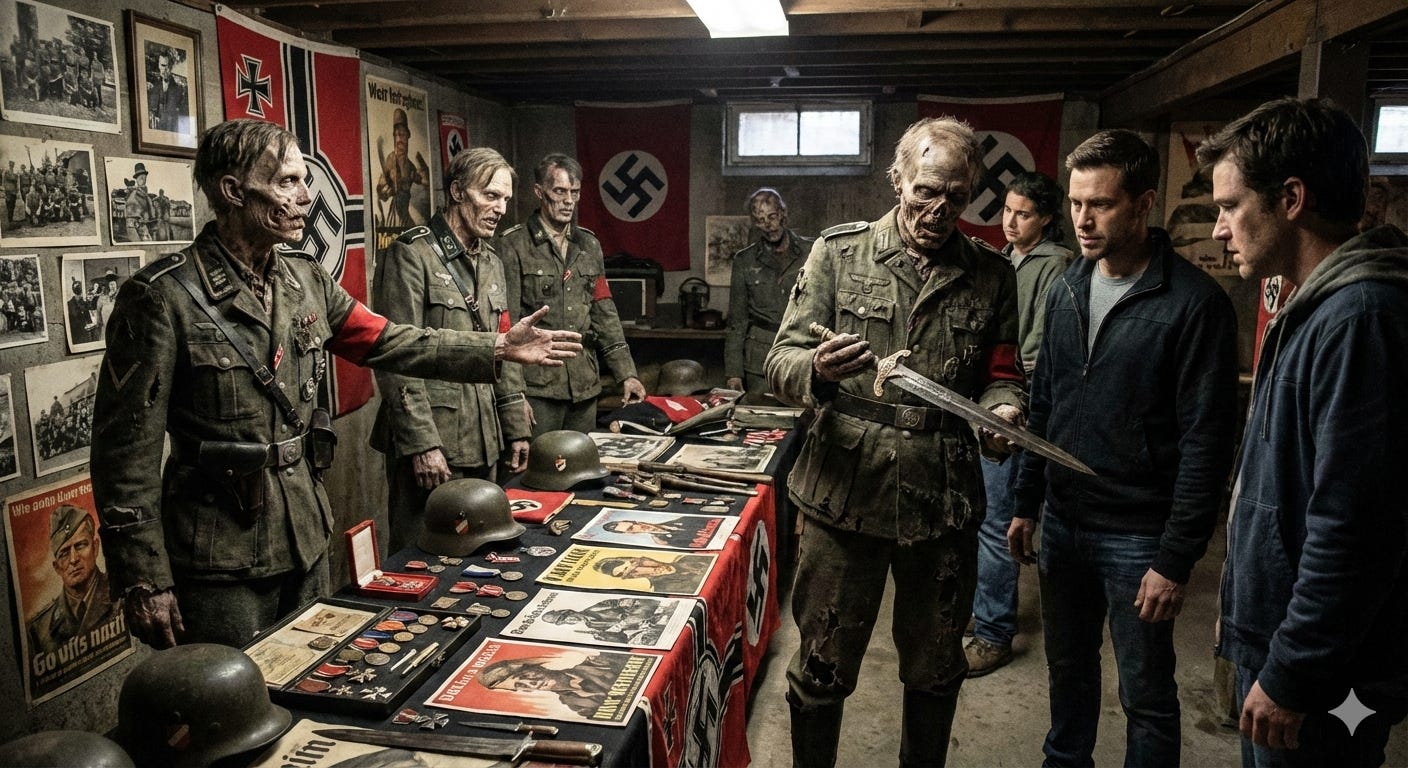
Chapter 86 deals with the habit of some prominent zombies of collecting antique Nazi trinkets and the rituals they created in the secret clubs of Nazi trinket collector zombies that were formed. A very serious case resolved by the Supreme Zombie Court makes scientists suspect that a new disease might be emerging: “acquired incomplete zombification syndrome.”
There’s a rather controversial aspect of zombie civilization that no zombie likes to discuss: the fascination some prominent zombies have with collecting Nazi trinkets. Zombie Elon Musk, in fact, financed the construction of the headquarters of the first secret club for collectors of these objects and even gave a typical salute on the opening day. This was widely publicized because secrecy is so valued among zombies that it always ends up being publicly flaunted.
It’s evident that some humans in the food reserves have always associated zombies with Nazis. But this is an abusive comparison, and the explanation for this is very simple.
As far as zombie historians have been able to discover beyond any doubt, Nazi humans did not devour Jews whom they rounded up to exterminate in concentration camps. This propensity of theirs to waste tasty food is considered highly reprehensible according to zombie ethical standards.
Furthermore, unlike zombies, those human Nazis treated their prisoners very badly. It is an undeniable factual truth, even for humans who consider themselves mortal enemies of the undead, that in food reserves humans are very well treated, having access to abundant food, safe shelter, clothing appropriate to each season, and even some entertainment. They can reproduce without worrying about whether their children will have adequate medical care.
Zombies have raised the standard of living for most ordinary humans who were being reduced to the condition of social outcasts by the inhumane neoliberalism of humans. And this explains why many of them helped the zombies overthrow the states of human civilization in the final phase of humanity’s downfall.
Of course, humans don’t like being selected for slaughter. But they know the rules put in place by the zombies and can enjoy their lives in peace and comfort until they are selected. Not to mention that many of them manage to live for decades, either because they obtain special permission to work outside the reserve, or because they denounce humans who dare to conspire against the system, or because luck continues to smile on them during the selection process. And many humans were very pleased to realize that those privileged during the inhumane human civilization were the first to be devoured in the zombie civilization.
Another difference between human zombies and zombie Nazi trinket collectors is that being a Nazi does not grant any human special exemption from slaughter. On the contrary, whenever they manage to locate a Nazi cell beginning to structure itself in a food reserve, the zombie authorities act immediately and severely.
Human neo-Nazis are quickly separated from other humans. Once it is established with reasonable certainty that they were adherents of Nazism, the zombies select them to be slaughtered and eaten. Some of them are specially sent alive to be sacrificed to the secret club of Nazi trinket collectors.
This is because the members of that club considered it especially delightful to display their precious objects to the Nazi humans, to serve them abundant alcoholic beverages while they marveled at and familiarized themselves with those familiar objects that they coveted and could not have. A few hours later, when those foolish, drunken humans thought they were among equals, they were devoured in a ritual feast. This is because the Nazi trinket-collecting zombies believed that the mixture of astonishment, surprise, and terror improved the taste of the flesh of the devoured Nazi humans.
There is no scientific confirmation that this ritual actually improved the taste of human flesh. However, this is irrelevant because, unlike humans, zombies are extremely tolerant. They do not prohibit zombies from creating and performing human sacrifice rituals, as long as the rules for distributing food among zombies are not too widely disregarded.
Separating Nazi humans from other humans was highly praised in all food reserves. This is because Nazi gangs always used extreme violence, and this disturbed the peace in the food reserves where they appeared. In fact, whenever such a gang began to emerge and organize itself, the humans themselves ended up informing the zombie guards.
None of this could happen in a concentration camp run by former human Nazis. No one could truly escape death there. And even prisoners who collaborated with the Nazis eventually ended up being assaulted, killed, and incinerated for no particular reason. Humans aren’t trustworthy; they never really respect the rules, you know.
Among zombie scholars, it’s debated why some zombies collect Nazi trinkets. Some say it’s a human aesthetic and cultural contamination, the persistence of pre-zombification ideological traits that occurred in some zombies after their transformation (Elon Musk among them). Scientific proof of this phenomenon has not yet been fully found.
Other zombies say it’s just a typically zombie ironic strategy. The most important thing for all zombies, proponents of this thesis emphasize, is keeping food supplies pacified, and human Nazis always create problems whenever they appear in the world. This is a recurring problem that zombies need to solve somehow. So, forming zombie clubs that collect Nazi trinkets and creating rituals to devour new neo-Nazi humans is a way to give meaning and purpose to something that would otherwise be done in a bureaucratic and boring way.
Zombies have a mocking undead nature, you know. But there’s a dark side to this problem that no zombie dares to discuss. Before the fall of humanity, humans always wondered why new Nazis kept resurfacing decades after the Third Reich was defeated. Were they produced naturally, mystically, or socio-economically? Why weren’t tolerant historical environments and functional democratic structures able to prevent the emergence of some humans so disgusting, racist, stupid, and violent?
Humans never managed to answer this question. Fortunately for zombies, it must be said, because after all, the resurgence and growth of Nazism in the US and Europe greatly contributed to accelerating the fall of humanity and the rise of zombie civilization. And that’s why, after the zombies seized power, they honored their human Nazi partners by devouring them all first in the places where they used to gather. Perhaps it was at this moment that some zombies saw Nazi trinkets for the first time and began to enjoy collecting them. Who knows?
Old human films depicting Nazi zombies always triggered a mixture of horror and surprise in zombies. On the one hand, zombies feel disgust because they treat humans well in the food reserve. Zombies aren’t Nazis, even though they like to eat Nazi human flesh. On the other hand, they found it funny that those humans were playing Nazi zombies who paradoxically preserved Nazi ideology instead of embracing zombie culture. What could be more absurd than that? Everyone in zombie civilization knows that the undead don’t really have an ideology, just a hunger for human flesh.
There was, however, an exception to this rule. For reasons not fully explained, one time in a certain zombie club of zombie trinket collectors—whose exact location must remain undetermined here for reasons of zombie national security—a member began to exhibit very strange behavior. First, he began praising human Nazis, as if they were the founding fathers of something as good and worthy as zombie civilization.
At first, the other club members found it odd and shrugged it off, because after all, he could just be mocking humans and zombies (something any zombie would do). But the club members were surprised and somewhat worried when, in a sacrificial ritual, this zombie refused to eat the flesh of a human Nazi, claiming it offended his sensibilities.
“You are totally and irrevocably dead and have no sensibilities!” shouted a colleague. And the entire club of the undead burst into laughter. Even the partially devoured human laughed at that strange zombie.
Everyone in the human world, and most zombies in zombie civilization, knew that former Nazis and neo-Nazis were also very resentful. Their violent outbursts were signs of repressed feelings of powerlessness and inferiority sublimated through displays of overt cruelty against vulnerable people. But this type of behavior couldn’t occur in zombies because they don’t repress their hunger for human flesh and don’t really have the typical feelings or impulses of a living being.
But that zombie collector had gone too far. He repressed his hunger for human flesh by refusing to eat a human Nazi. And the gravity of his behavior only provoked a reaction when, in another sacrificial ritual, in addition to not eating the human Nazi, he assaulted his fellow zombies trying to prevent them from devouring the sacrificial flesh.
This was considered unacceptable because in zombie civilization there is no crime more serious than trying to prevent a zombie from eating. Devouring succulent human flesh is an unnatural right of every undead being, superseding any other constitutional and legal precept. Indeed, the entire zombie political, legal, institutional, and cultural system is firmly anchored in this irrevocable fundamental value.
Therefore, the ritual was immediately interrupted, and the case of the aggression was brought to the attention of the Supreme Zombie Court. The verdict was immediately delivered after the testimonies were collected. Exceptionally, the Court decided to hear the human’s testimony. This was exceptional because zombie justice never accepted human testimonies, as it is in the nature of living beings to lie when they are afraid of dying, and they lie even more after being attacked or when they imagine they can take advantage of it.
Here is the transcript of this human’s testimony:
“After ceasing to tremble and cry, the human being questioned responded that the defendant had indeed tried to violently prevent the other zombies from tearing more pieces off him and added that he felt ashamed to have to thank a damned zombie for saving him. The human also tried to appeal for clemency from the Court, but the judge immediately ordered the gag to be replaced because humans have no rights enforceable against zombies or enforceable in a zombie court.”
The unanimous decision rendered by the Court was an example of sobriety and profound respect for the rights of the living-dead, while still containing the necessary harsh penalty that was to be expected. Here is the transcript of the ruling only:
“All things considered, and taking into account the peculiarities of the case, this Court unanimously decides to condemn the accused to eat the human Nazi immediately on this spot before the judges. If he does not do so, the bailiff shall proceed to remove his lower jaw, condemning him to a life of starving undead until his carcass finally falls into the street and decomposes, because whoever refuses one type of human flesh cannot eat any other type of human flesh.”
The zombie refused to comply with the sentence, the sentence was carried out, and the case was closed. But it continued to be debated for some time, because the zombie’s behavior was too strange, and scientists began to suspect that a new disease might be emerging – “acquired incomplete zombification syndrome” – but that will be a subject for another chapter.
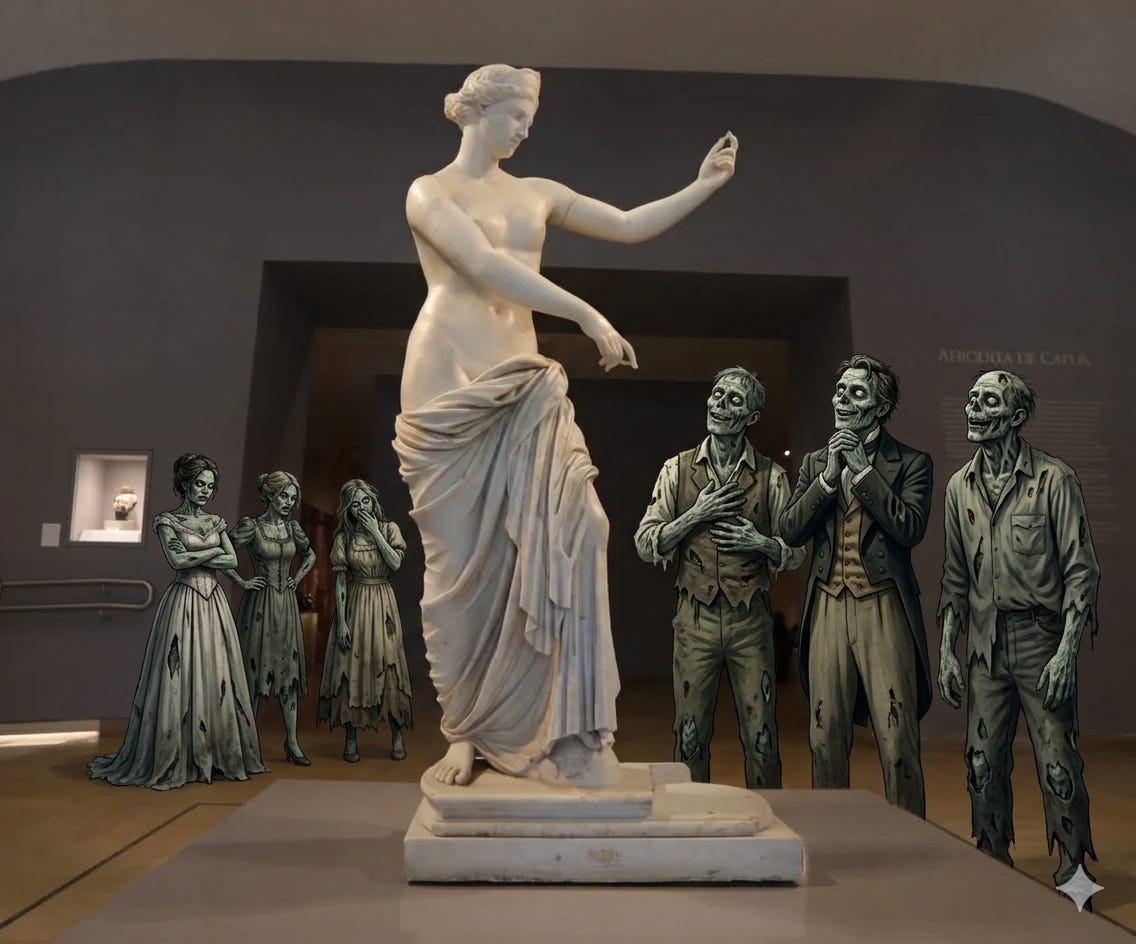
Chapter 87, a panel of philosophers, scholars, and scientists discuss a new undead epidemic. A peculiar case of this disease is discovered, the first and perhaps the only one of its kind.
In light of the serious incident described in the previous chapter, the authorities of the zombie civilization assembled a panel of scientists, scholars, and philosophers to debate the “acquired incomplete zombification syndrome” and, if possible, find a solution. As soon as the work began, a methodological problem arose: How to identify a case of “acquired incomplete zombification syndrome”?
The zombie philosophers and scholars were perfectly capable of identifying human deficiencies and the idiosyncrasies of the relationship between zombies and their self-aware food source. But they lacked the intellectual tools to deal with a highly complex problem involving their fellow zombies. This left them very embarrassed, and they limited themselves to pointing out a few cases involving deviant zombie behaviors that had already been described throughout the series.
Analyzing the mass of data collected, the zombie philosophers and scholars asserted with a typically zombie-like degree of conviction that “acquired incomplete zombification syndrome” was a behavioral disease of unknown origin. They added that it caused both harmless and extremely dangerous and repugnant behaviors. In the first case, deviant behaviors should be tolerated. But severe cases should be rigorously punished because it was unacceptable for a zombie to be prevented from feeding by anyone.
The scientists, who met in a laboratory without the presence of the zombie philosophers and scholars – there was a certain prejudice on both sides, and in this the zombies were not very different from humans – discussed ways to diagnose “acquired incomplete zombification syndrome.” The sick zombie was located and subjected to minor cranial surgery to remove samples of brain tissue. However, the samples revealed no genetic anomalies, biophysical alterations, or signs of infection of any kind. From the zombie medicine perspective, this was a healthy undead patient without any signs of illness.
Frustrated, some zombie scientists began to speculate on metaphysical grounds. This greatly irritated the zombie scientists who preferred to limit themselves to the rigorous analysis of what could be meticulously studied, described, and proven. This group ended up splitting. The metaphysical zombie scientists went to meet with the philosophers and scholars. The others returned to their normal duties, sending the authorities a dry memorandum with the following conclusion:
“’Acquired incomplete zombification syndrome’ is not a genetic disease, nor is it transmitted by viruses or bacteria. Tests revealed no alterations in the undead patient’s brain tissue. From a scientific point of view, although he exhibited antisocial behavior of fraternizing with humans and opposing zombies, he should be considered a healthy zombie.”
In the group of zombie philosophers and scholars, expanded with the addition of metaphysical scientist zombies, the discussion evolved in several directions. But as almost always happens in such situations, it didn’t lead anywhere. Was the Greco-Roman goddess of love an undead woman with “acquired incomplete zombification syndrome”? This unanswered question has shaken the foundations of zombie mythology, with inevitable human consequences as well.
How to solve the problems of a disease that presents variable symptoms and never reveals its causes? The answer to this had already been given, in a way, unconsciously by humans in the distant past to preserve the socio-economic injustices that led to the rise of the zombie civilization. The solution in these cases is to forget the causes and criminalize some of the behaviors it provokes. Then the “acquired incomplete zombification syndrome” was ultimately to be treated as a criminal problem. A board of zombie jurists was appointed to draft proposals for modifications to the Penal Code in order to precisely define the degrees and punitive consequences of the new behavioral disorder.
This was a slow and arduous task, because what one jurist considered serious, another judged a moderate infraction. There was only unanimity regarding the most serious case, whose contours had already been more or less defined by the Court. But now we will leave this debate to recount a case of “acquired incomplete zombification syndrome” that shocked both the zombie world and the human underworld.
The episode occurred when a woman selected to be slaughtered in the reservation claimed to be a zombie. Her claim led to an administrative process to determine whether or not she could be killed, because zombies had an immense aversion to eating zombie flesh. And in this they were different from humans, who, as everyone knows, in the past ate and sometimes still eat human flesh.
Examined by a panel of scientists, it was proven that this specimen could not be killed. She was a zombie. But paradoxically, she had all the characteristics of a human woman, intact genitalia and sexual appetite, which was truly marvelous. This peculiar characteristic had led her to move to the food reserve, because only living men could give her what the zombies could not. The fact that her appearance was completely human facilitated her coexistence among humans. Her sexual generosity also did. In the reserve, she was treated as if she were a goddess of love.
And indeed, she was more like a goddess than a zombie. Unlike zombies, she didn’t eat human flesh. And she didn’t age, or aged at a much slower rate, a characteristic acquired due to her peculiar undead state.
The discovery of this case caused much discussion among the zombies. That sexually active zombie didn’t violate any taboos, but the fact that she socialized with humans was dangerous, especially if she could produce children with the same characteristics as her. If this hybrid race proliferated and predominated in the reservation, the zombies would run out of food because they don’t eat other zombies. Fortunately for the zombies, it was proven that she couldn’t produce children.
After much discussion, it was decided that this goddess-like zombie woman would not be sacrificed, nor should she be exposed to the danger of being killed by humans. Her personal status would not be changed, and her case was classified as a state secret, but she had to accept a bargain. She was returned to the reservation, and the zombies announced that she was a woman who had won a special work pass in the zombie city and could not be slaughtered and devoured. But her job from now on would be to redouble her efforts to sexually satisfy humans and gather information about any kind of sedition.
Humans adored that goddess-like woman because, in addition to being beautiful, sexy, and sexually active, she was very generous and never refused a love partner. In this, she was very different from ordinary women, who were always so inclined to reject men and invent excuses not to make love. They were terrified when she was selected for slaughter and relieved when she returned to the reserve safe and sound. When she returned, no suspicion was raised. The humans were used to similar incidents. You know, like all bureaucracies, zombie bureaucracy also made mistakes from time to time.
The human women, however, did not like her return to the reservation at all. That goddess-like woman of love and sex was a destroyer of marriages and relationships. And she was insatiable, so insatiable that she aroused envy and distrust in the other human women. The human women were pleased when she was taken to be slaughtered and completely devastated to learn that she had returned. Some of them began to secretly conspire to put an end to her, because, you know, the nature of women cannot truly be imprisoned. But the story of what happened will have to wait for another day.
That’s all for today, folks. Be happy with your women... but if they are zombies like that goddess-like woman of love and sex who shook the very foundations of the distinction between zombies and humans, don’t tell anyone.
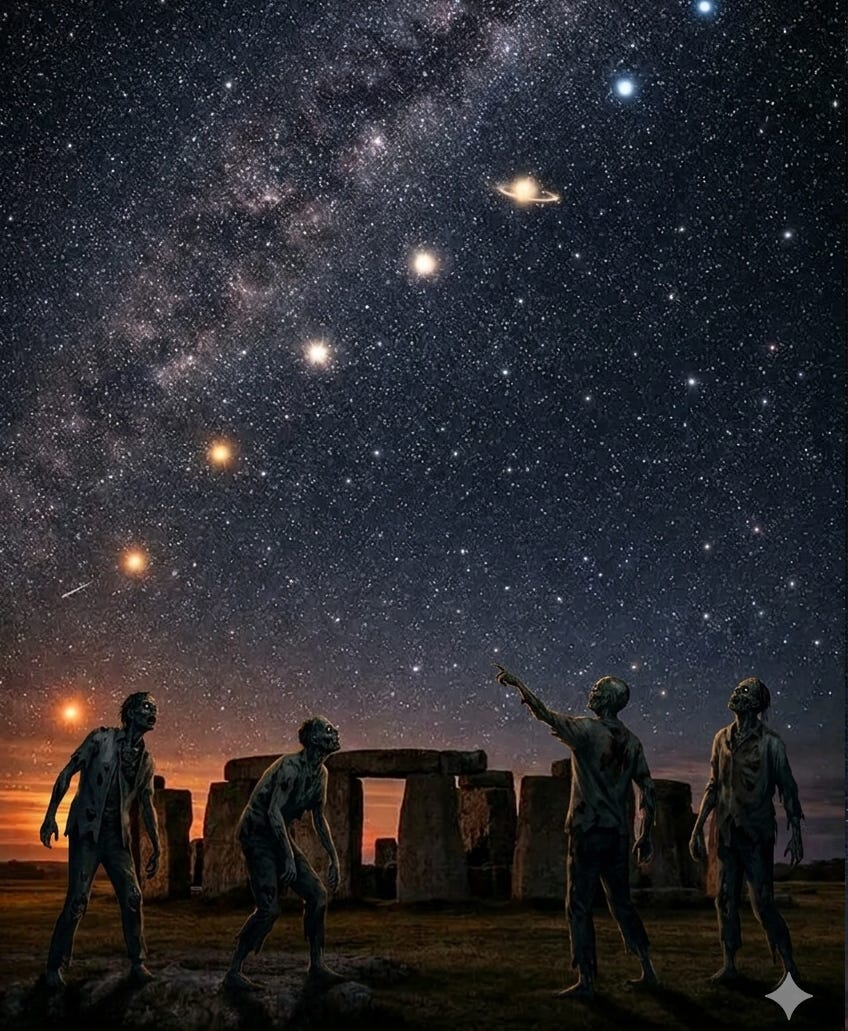
Chapter 88, the alignment of the planets announces the good news and peace is finally restored to the reserve after the women try unsuccessfully to kill a seductive undead female enemy. A wise, well-informed worm debunks the lie told by Pete Hegseth about the return of the baby Jesus.
Since time immemorial, human beings have looked at the sky and wondered, “What does all that happens in the sky during the day mean to me?” Some, however, have asked the opposite: “What do I mean to all those lights I can see at night?” Human beings have always been funny.
They, humans, probably never imagined that their true meaning is to feed the worms after they die. Nor did they try to investigate whether the worms roam at night not because they are afraid of the birds that eat them, but because they were the first to study and understand the mysteries of the universe.
Zombies and zombie worms have a very special relationship. But that’s a story that will be told in the next chapter. What matters here is the profound ignorance of human beings. Before being confined to fulfill their most important function—being zombie food—they filled the atmosphere with pollution and the Earth’s orbit with artificial satellites that quickly became garbage. And then they started complaining that they could no longer see the lights of the night. How boring... humanity was truly falling apart.
And thankfully, the alignment of the planets heralded the rise of zombie civilization. However, humans understood that alignment differently.
The Chinese believed it signified the rebirth of China. The Americans were certain that the planets they were destined to colonize were aligned in the sky. The Europeans made lines of cocaine to see the alignment of the planets in the sky and disguise their frustration on an Earth where Europe was and would continue to be just a toilet for the Americans and as important a point in China’s belt and route as Africa. The Africans celebrated the alignment, but they also celebrated when the planets and rich countries were misaligned. In South America, only the Xingu Indians attentively observed the sky. There they saw the universe aligning to ensure the downfall of the white inhumanity that destroys nature. And they began to prepare so as not to become zombie food.
Rome saw the alignment as a mystical omen. But Catholic theologians disagreed about its meaning. And the Russian and Greek Orthodox Christians agreed that they could once again laugh at the Roman Catholics. Everywhere the alignment of the planets in the sky reflected the profound differences between humans. But the worms that ate humans agreed with the Brazilian Indians. The age of zombies had arrived, and this was inexorably and inexorably painted in the sky by the natural rotation of the cosmic clock.
All this happened more or less at the same time that the Americans were defeated by the Iranians and forced to flee with their tails between their legs from the Middle East. The humans who called themselves Zionists fared badly, because they started a war that made their lives unsustainable.
According to a shrewd zombie historian, that human people had fallen several times. They probably believed they wouldn’t fall again. And in a way they were right, because after Israel was evacuated the Zionists were devoured by zombies in the US and Europe. The region they abandoned last time was first recolonized by the Palestinians. But then New Palestine was also invaded and defeated by the zombies. Forced to live in the food reserve, the remnants of these two peoples, reduced to the condition of walking meat, finally made peace.
According to a zombie military expert’s master’s thesis, Israel’s last war was the result of a misunderstanding. Apparently, an AI poisoned by zombie hackers had convinced Israelis and Americans to attack Iran because the Iranian regime would collapse as soon as its leader was killed. This obviously did not happen, and the result was that, in addition to being defeated, Americans and Israelis ended up being devoured by zombies. However, a dominant school of thought in the zombie world considered this thesis too extravagant. Most zombie scholars were convinced that Donald Trump had already become an ally of the zombie civilization at that point, and he started the war precisely to end the cycle of humanity’s dominance once and for all. He did this in exchange for the promise of a statue (a promise that was fulfilled by the zombies much later) and a truckload of banknotes that the zombies had stolen from the Pentagon with the help of Pete Hegseth, another good friend of the zombie civilization.
At the time, Pete Hegseth convinced the Americans that the war was necessary because the alignment of the planets had indicated the return of the baby Jesus. However, he was wrong. According to a wise worm observer of the universe who consulted for the Zombie City Worm Consultants Office, the alignment of planets had absolutely no relation to the return of Jesus. Furthermore, it was widely known among zombies that the boy god who would save human civilization from the rise of the zombie civilization was born into a Catholic family in Gaza, but he was bombed and killed by “made in USA” missiles fired by Israelis using Palantir AI tracking technology. Fortunately for the zombies, the boy god was torn apart by humans because they feared a zombie prophecy that his return could mean a complete reversion to the life of the undead. But none of that had a direct influence on present events.
In the reserve, the conflict of the human women over the zombie goddess mentioned in the previous chapter generated very funny scenes. Fearing to commit a bloody murder and be immediately selected for slaughter, the conspiring women devised a cunning plan to kill the terrible seductress. They poisoned chocolate candies and arranged a pretext to visit her.
The zombie woman, who was posing as a human woman, welcomed the visitors and even served them tea. Upon receiving the chocolate candies, she was delighted and soon ate some of them. The human women were stunned because their enemy did not die. On the contrary, she ate another candy and offered the rest to the visitors, who were forced to refuse.
The next day they gathered and concluded that the dose of poison may have been inadequate. One of them decided to test it on herself and died painfully in front of her friends, creating a problem for them. Anyway, days later the women went to visit their enemy once more. The new chocolates had twice the poison. But to their surprise, the seductress ate the chocolates and said they were even tastier than the previous ones. Irritated, one of them stabbed the goddess in the heart and she fell hard to the ground. The women were satisfied. The deed was done…
But the next day they were horrified to see their enemy walking normally down the street as if nothing had happened. It was breathtaking. Besides seducing her husbands and boyfriends, that damned neighbor wouldn’t die, neither poisoned nor stabbed in the heart. Something was wrong. And the women needed to do something.
But since they couldn’t simply notify the zombie authorities, the women began spreading the word among the men that this seductive, sensual, and insatiable young woman wasn’t a woman. She was a witch. But labeling her a witch didn’t change the situation at all, because the men occasionally called their own wives and girlfriends witches as well.
The betrayed women’s irritation then exploded into a veritable war of the sexes among the humans, forcing the zombies to intervene. The zombie who looked like a living woman was removed from the reservation and installed in a mansion that had belonged to a human named Epstein. There she could receive visits from any man who had a life and work pass in the zombie city. And so peace returned to the food reserve and everyone lived happily ever after... until they were selected to bring happiness to the hungry zombies. But the zombie Epstein was sad, because he was evicted from the mansion and had to find another place to spend the rest of his undead life. The end.
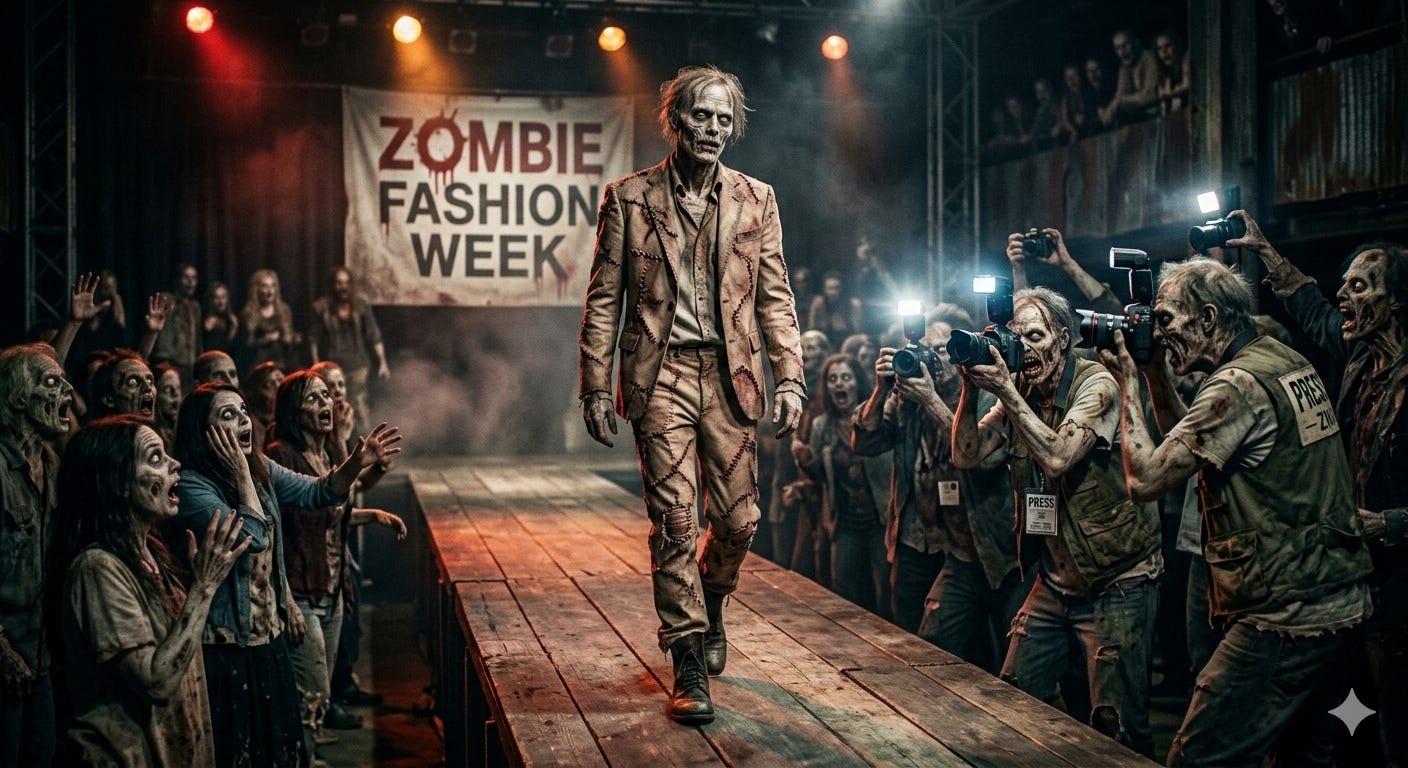
Chapter 89: I know that deep down many of you like haute couture or at least drool over the hot models. Zombies also like hot models; they eat some of them during the traditional Zombie Fashion Week.
We’ve seen throughout this series that the undead are sometimes victims of unusual problems that don’t affect living beings. Other times, although they find different solutions, the two races share similar problems.
Humans, for example, need to bathe regularly and exfoliate their skin to get rid of dead skin. Hygiene is important because there are tiny, nasty, and harmful things that multiply on the surface of human skin, feeding on the fat and dead skin imperceptibly secreted by the living organism.
This is a problem that zombies don’t have. The undead don’t need to bathe, and many of the germs that plague humans don’t harm them. Microscopic and visible parasites that feed on the bodily byproducts of living beings generally don’t appreciate the company of zombies. Zombie dead skin doesn’t grow back, it doesn’t need to be exfoliated. And when it finally does, zombies get muscular.
But of course, not all zombies appreciate getting muscular. So, zombie scientists developed a unique technique for harvesting and utilizing human skin. According to one fable, the idea for this type of implant was given to a zombie doctor by Buffalo Bill, a character from the film “The Silence of the Lambs.” The doctor found it very strange that a male human would kill other female humans to make clothing from their skin. What use could that be to a human? But for a zombie with exposed muscles, a human skin implant would undoubtedly be quite useful. And we’ve seen that zombies love implants, right?
And just as humans harvested the hides of slaughtered cows to make clothes, zombies created a human skin harvesting program in the canned human meat industry. Initially, this program had an exclusively aesthetic purpose: to harvest raw material to implant in zombies whose muscles were exposed. But then the fashion industry jumped on board, and clothing made of human skin became fashionable in the zombie city. There was no point in wasting so much raw material.
When this fashion gained traction, several zombie designers created their own brands. The greatest zombie designer adopted the nickname Buffalo Bill. His detractors say he even dances like the actor from the movie “The Silence of the Lambs” when he sews clothes from human skin in his atelier. This, however, was just malicious gossip from zombie fashion designers. There’s nothing more ridiculous than an undead designer imitating a living designer, especially now that human designers supply skin for haute couture creations.
The reader must be wondering if zombies cut their nails. Some do, others don’t. Cutting nails is important for humans because they grow constantly. The nails of the dead also grow. The same happens with the nails of the zombies. But while the dead have no use for their nails, zombies can eventually use them. Hence the fact that some of them cut their nails and others don’t.
In Buffalo Bill’s sewing workshop, all the stylist’s assistants are required to have neatly trimmed and cared-for nails. The care given to human skin is considered by specialized journalism a distinctive mark of that atelier. Buffalo Bill, by the way, never refers to human skin as raw material or fabric. He only works with human silk, as he developed a technique to obtain very thin human skins that could be dyed and shimmer under artificial light.
Zombie Elon Musk used to wear human silk suits sewn only by Buffalo Bill himself. And when his skin finally began to fall off, the proud Elon Musk commissioned a very special suit that he wore only at zombie pride parades. This suit was made of transparent human silk that allowed other zombies to see the muscles of the famous leader of the zombie space program. And in this, the undead Elon Musk resembled the businessman when he was alive, something that was generally disapproved of by ordinary zombies. Perhaps he was an example of “acquired deficient zombification syndrome,” who knows?
Anyway, the fact that zombie Elon Musk liked to wear long, sharp fingernails was a problem. He often ruined his human silk clothes. So he commissioned some zombie scientists to develop a durable artificial human silk. After much research, the scientists concluded that this task was impossible to complete. But since the undead businessman didn’t like to hear “no,” the zombie scientists managed to buy some pieces of Chinese silk on the black market. Then, they asked Buffalo Bill to dismantle the Chinese silk and remanufacture it along with human silk.
The famous and ingenious zombie designer accepted the challenge. After several trials and errors, Buffalo Bill finally managed to develop a technique that allowed him to break down Chinese silk and create a composite fabric with Chinese silk threads and human silk. Voilà... Thus was born the first genuinely zombie high-tech product in the zombie fashion industry. Buffalo Bill was on top of the world because, despite being an undead being, Elon Musk declared in the press:
“Okay guys, I know you’re jealous of me. And I must say that in my new Buffalo Bill suit made of special human silk, I feel alive again.”
That statement made the designer very proud. However, the words of zombie Elon Musk were fatal to Buffalo Bill’s career. But that will be the subject of a future chapter.
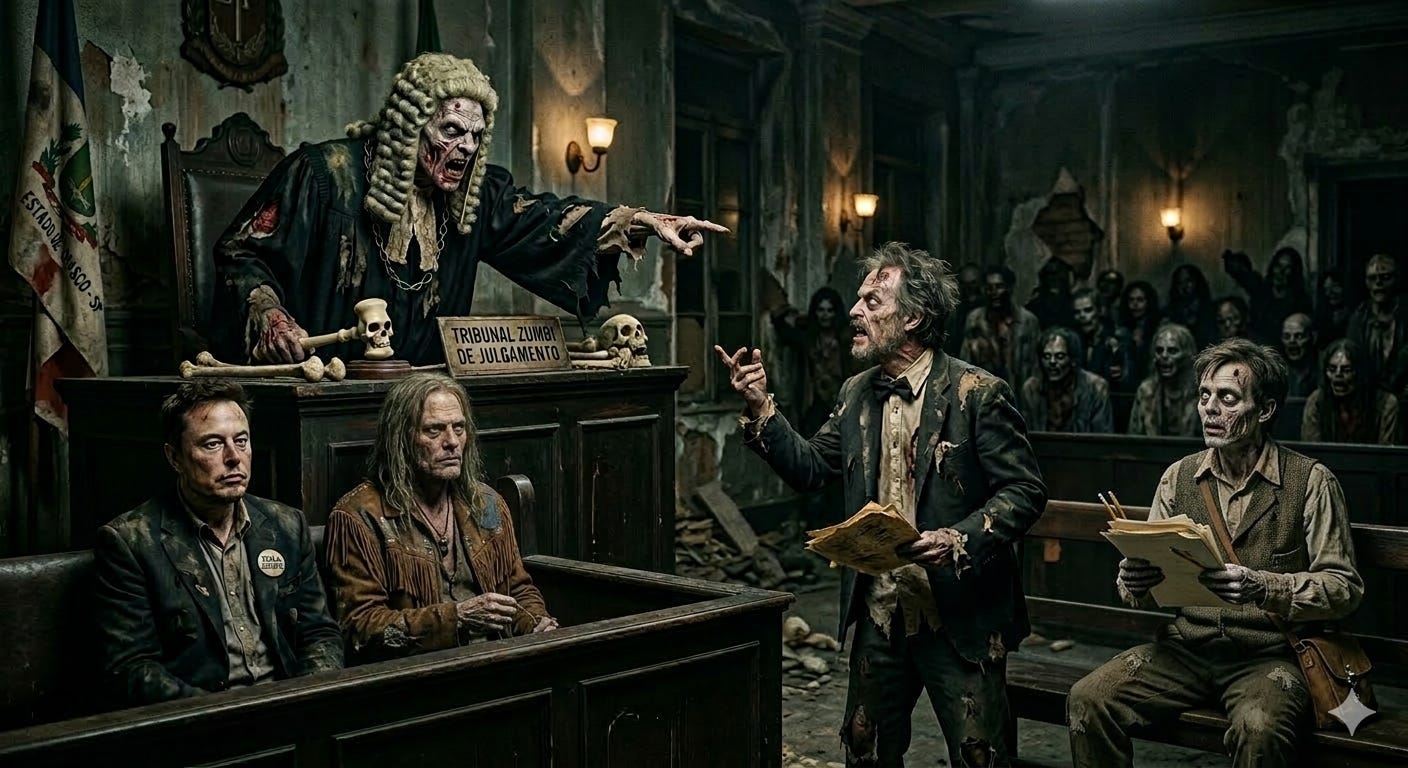
Chapter 90, evidence gathering and trial of the case involving zombies Elon Musk and Buffalo Bill. Some zombie digressions about the two medieval Popes who caused the decline and fall of that country that humans called the USA.
When studying their prehistory, zombies laugh almost as much at the political and military leaders of that country once called the USA as zombie lawyers usually laugh at human lawyers. Where humans who accelerated the decline and fall of humanity saw computerized modernity empowered by Artificial Intelligences, zombies can only see plagiarism from the Middle Ages, uselessly denied in public.
Pete Hegseth invoking Jesus to wage holy war against the infidels in Iran was a corrupted clone of Pope Gregory, who accused his adversaries of being “disciples of Satan,” “inflamed with diabolical pride,” demonstrating immense contempt for his “assembly of Satan.” He always contrasted the good kings faithful to the Holy Church who needed to declare themselves “members of Christ” as the “body of Christ” who had the inexcusable duty to fight “ministers of Satan, heralds of the Antichrist,” “lackeys of the devil, or rather, slaves of Satan who keep them captive.”
The funniest thing about that country called the USA, the zombie scholars thought, was the fact that no one could really be sure if the Pope was Donald Trump or Pete Hegseth, because while one oscillated between religious discourse and praise for pure and simple plunder, the other remained faithful to medieval fanatical religious rhetoric. It was no wonder that the USA was so fragile before the rise of zombie civilization. After all, whenever the Catholic Church had two Popes, it suffered defeats at the hands of its adversaries, whether they were pagan barbarians or Arian Christians or Muslims.
Religious intolerance was a fatality to which the undead were not subject. They could tolerate anything among humans, as long as they didn’t challenge their new status as walking food. Among the undead, few things truly caught the attention of the sleepy authorities of the zombie city. And even when they did, the investigations didn’t always end in tragedy.
The investigation that was opened to investigate the behavior of Elon Musk and Buffalo Bill, narrated at the end of the previous chapter, was a mix of farce and tragedy, all carefully staged. After all, as everyone knows, zombies were masters at staging things to entertain themselves.
The opening of the Inquiry contained a refined example of zombie rhetoric:
“There is no communication between the world of the undead and the underworld of the living. While humans, walking food, are natural prey to their miserable condition, always oppressed by hunger, greed for profit, covetousness for what belongs to others, irrational violent impulses and, above all, the fear of death; zombies can enjoy the benefits of the tranquility that comes from the condition of being undead. No one in our civilization can truly want to leave the paradise full of human flesh to eat. To wish to cross that line back to life is a sin and a crime that must be punished. Hence, making a zombie feel alive again or a zombie declaring itself alive for any reason is inadmissible, things that must be investigated and eventually punished.”
The Inquiry was sent to the Supreme Court, which ordered the collection of testimonies from the accused Elon Musk and Buffalo Bill, who could indicate witnesses and offer expert reports. In a second phase, a panel of experts would present a report that would be discussed in court before the case goes to the closing arguments of the prosecution and the defendants’ lawyers.
In his testimony, zombie Elon Musk said that he had said that only to impress the public and gain applause. He was an undead committed to the fundamentals of zombie civilization. He always eats human flesh and has never done anything unworthy, such as trying to save a human who was being eaten.
The witness he indicated said that he had participated in banquets at zombie Elon Musk’s mansion where humans were served in pieces and eventually alive. In one of them, there was even a certified baby from zombie Epstein’s baby breeding farm. On these occasions, he saw with his own eyes zombie Elon Musk delight in eating live human flesh, from the certified human baby. The witness also stated that he was not present when Elon Musk said he had come back to life and that this was probably a boast to show off the new suit he had bought from Buffalo Bill. The witness also wore human skin clothing sewn by Buffalo Bill.
When questioned, Buffalo Bill said he never had any intention of bringing zombies back to life. Initially, he only used human silk in his creations. He had developed a new fabric that combined the beauty and texture of human silk with the strength and shine of Chinese silk. Elon Musk was a client of his, but there was no intimacy between them. The rumor spread in the press that he had made a suit to make Elon Musk feel alive because he wanted the privilege of traveling to the lunar station was a shameful lie.
Buffalo Bill’s employees confirmed everything he said, adding that he was a good zombie boss. He always ate the flesh of humans recruited to parade and be slaughtered during Zombie Fashion Week, and he took his assistants along to do the same.
The panel of zombie experts quickly produced a report, in which they opined for the acquittal of zombie Elon Musk and the conviction of Buffalo Bill. The designer should close his atelier and never sew again, whatever it may be. This distinction in the assessment of each conduct stemmed from the general opinion that a zombie could ironically say he had returned to life, but no one could do anything voluntarily or involuntarily to incite a zombie to do so.
Elon Musk’s lawyer merely praised the work of the zombie scholars and reminded the Court that the witness testified that Elon Musk was a zombie who ate human flesh, irrefutable proof that he did not want to return to life nor did he consider himself equal to the walking food of zombies.
Buffalo Bill’s lawyer stood up to defend his client. But first, he removed the beautiful human skin coat he was wearing and handed it to his intern, who hung it on the back of a chair. Then he mentioned to the judges that the coat made of genuine human silk was identical to the one one of the judges was wearing, both undoubtedly made by the defendant Buffalo Bill. And just as the lawyer felt more proud to be a zombie by wearing it, no one could accuse the judge of wanting to return to life by wearing something similar.
“It is a general opinion that no one can be convicted because someone felt instigated to do something. Just as a human court could not convict someone presuming that the defendant encouraged the murderer to commit homicide, no zombie could be deprived of their rights because someone decided to make a public demonstration that offended the sensibilities of zombies.”
The prosecutor immediately stood up and objected. According to him, it was a clear demonstration of contempt for a defendant’s lawyer to dare mention the degenerate human legal tradition in defense of a zombie in a Zombie Court.
“Objection maintained. The lawyer should be polite in this court under no circumstances should he cite degenerate human legal traditions again, otherwise his tongue will be cut out by the bailiff.”
“Excuse me, Your Honor. I didn’t mean to offend the Court, quite the contrary. I only made the quote to highlight the superiority of zombie law over human law. But if that’s considered contempt, I retract what I said.”
“Go on.”
“My client never said that he made that outfit to make Elon Musk feel alive or to publicly say that he felt alive. He made that outfit because he always serves his clients in the best way. Buffalo Bill only uses genuine human silk. And he developed a new fabric that combines the beauty and texture of human silk with the durability of Chinese silk because it had become necessary. His employees testified that he is a good boss and that he never fails to eat the flesh of human models recruited to perform and be slaughtered at Zombie Fashion Week. Furthermore, not even human jurists would be able to say that the illegality of a defendant’s conduct can be caused by the behavior of another person. Each person is only responsible for their own conduct.”
It was at this point that the farce turned into tragedy. Feeling offended, the Court ordered the bailiff to cut out the tongue of the repeat offender lawyer who dared for the second time to invoke human legal principles to resolve a highly complex zombie legal dispute. In addition to losing his tongue, the lawyer was thrown out of the Court. His human silk suit was confiscated and given to the bailiff as payment for services rendered to the Court.
The defendant’s defense was resumed, and the floor was given to the lawyer’s intern.
“Your Excellencies, zombie judges. This case has a simple solution. Zombie scholars have said that a zombie can ironically say that he has returned to life. Therefore, since zombie jurists do not treat similar things differently, it is evident that Buffalo Bill could make suits out of human silk (or human silk combined with Chinese silk) without it being considered inappropriate. Furthermore, not all the undead who wear his suits feel alive or say they are alive. And that is the case of one of the judges in this court.”
The judges were speechless. That intern was eloquent and had a bright future. The case should be closed with the acquittal of both defendants and the intern promoted to lawyer with full powers in new cases. This obviously made the zombie experts very angry, but their irritation was a kind of liquor that the judges drank whenever they demonstrated their power to decide above any expert opinion. In this they were no different from human judges, but no zombie would dare say that in court at the risk of losing their tongue and lower jaw as well.
In human times, lawyers were also occasionally harassed by judges. But it seems evident to us that no human judge ever had the privilege of ordering the bailiff to cut out a lawyer’s tongue, something that many of them probably would have ordered if it had been possible at that time. In this sense, it’s reasonable to assume that human judges would likely be very envious of zombie judges, although human lawyers certainly wouldn’t envy their zombie colleagues.
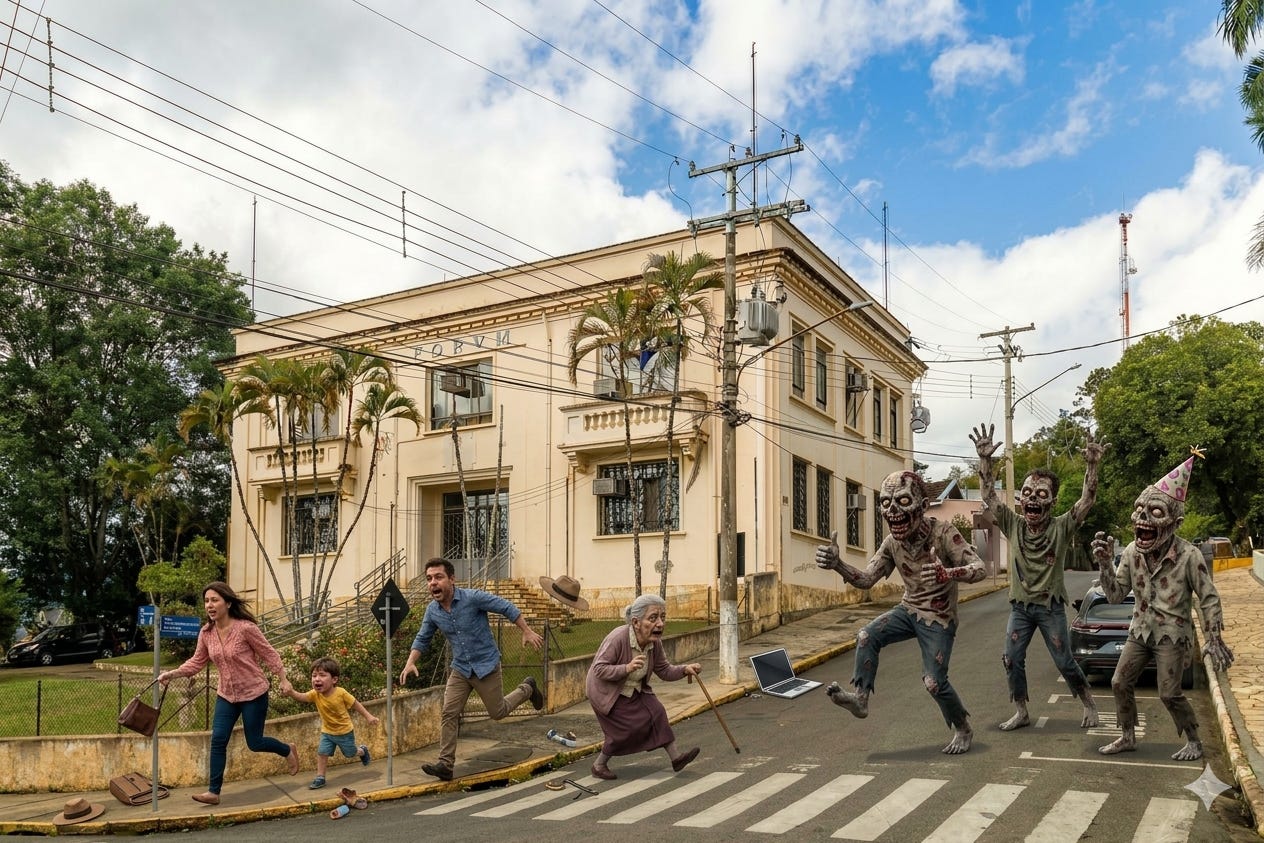
Chapter 91: The zombies reflect on the urban planning problems of humans. Zombie researchers conduct field research until they discover, in a not very developed area of Brazil, a city that could serve as a model for the new zombie cities that will be built.
With the exception of ants and bees, who have always built their cities more or less the same way everywhere, all civilizations that have roamed the planet have developed ideas about urbanism and created urban centers. After the great normalization of zombie civilization, zombies simply occupied the decrepit human cities, using them in part to house their walking human prey.
But like every civilization that becomes more and more complex, zombies also began to imagine that perhaps it would be necessary to build a city that exclusively met specific zombie needs. And some of these needs are very different from human needs, without a doubt.
Some zombie scholars began to dedicate themselves to urbanism. And as always happens, they went to study the prehistory of zombie civilization to see if they could find any inspiration. It didn’t take long for them to start laughing a lot at human urbanism.
Humans had a natural vocation for being contradictory.
For example, in the very distant past, the Romans said that they were descendants of a survivor of the Trojan War. However, no Roman city was ever planned and built from scratch to be like Troy. Curiously, the Romans did not notice, or at least did not leave written notes about, the paradox of their idealized ancestry not being reflected in the urban patterns of their cities. On the contrary, they were extremely proud of the Roman character of Roman cities and would not even think of actually adopting the urban characteristics of Troy in them.
Closer to the rise of zombie civilization, that ridiculous belligerent people who called themselves “the Americans” had as their religion and model society Judea from thousands of years before Christ. However, their cities were not like Jerusalem. On the contrary, typical American cities like New York were more like Sana’a, the capital of Yemen. But the Yemenites were neither Israelites nor Jews. And they certainly didn’t like the Americans, who shortly before the fall used to drop bombs on Yemen for no particular reason except the fact that Sana’a was an older, smaller, and certainly more beautiful version of New York.
During the Middle Ages of humanity, some theologians invented a model city that was nowhere to be found, or at least it was hidden in a place where the undead cannot visit. This celestial city was perfect; people lived in peace, had plenty of food, and were not greedy. This celestial city, however, was very different from the medieval cities where humans actually lived, always in conflict with each other, violently fighting over crumbs of bread and killing each other for gold and silver. In the celestial city, people were all healthy; in the medieval cities, they died by the thousands for lack of drinking water and a sewage system.
In medieval cities, zombies could certainly live more peacefully and safely than humans, but zombies didn’t like medieval cities very much. They were too human, you know. And to make matters worse, zombie hunters and investigators never managed to find the celestial city. Several expeditions were organized for this purpose, because, as you know, the zombies really wanted the opportunity to devour those healthy humans who lived so well and peacefully in an idealized city. Their flesh would certainly taste better, perhaps like a consecrated mass wafer, although the zombies don’t really know what those wafers taste like.
Zombies are different from humans. They are practical and prefer reality to its idealization. That is why, incidentally, their civilization dominated and subjugated humanity. Humans were always very stable and conflictive, partly because the urban models they created with thin air could not be realized, or their realization generated wars and conflicts that fortunately prevented humanity from properly defending itself against zombies. So the zombie researchers went into the field to investigate whether there was any city that could meet zombie needs.
After several years wandering the world, these researchers finally arrived in the small town of Eldorado in a sleepy, underdeveloped region of São Paulo. There they encountered the ideal zombie city and were even more surprised to discover that the new zombie masters didn’t need to do anything at all to adapt it to their specific needs. Zombie Eldorado was very similar to human Eldorado.
Here is the description of the city made by the team of zombie urban planners:
“Eldorado is a city with three urban levels. In the lowest part of the city, just above the riverbed, are the poor neighborhoods. On a not very prominent elevation is the city square where the houses of the city’s powerful figures are located and where the main public institutions operate: the city council, the mayor’s office, the gymnasium, the courthouse, the Catholic church, and of course, the bars. In the time of the humans, the bars were always more crowded than the church, because unlike the zombies, who are sober undead, humans really liked to get drunk.
In the highest part of the city, going up a street that begins at the courthouse, is the city of the dead, which humans call the cemetery. Curiously, even poor people were buried in the cemetery. A curious example of social mobility, because in Eldorado, the poor people from the lower part of the city only rose in life when they wanted to get drunk or were dead.
The first zombies arrived in Eldorado, SP, hidden in the back of a truck returning to the city after delivering a load of bananas to São Paulo. They hid in the local cemetery, where they began feeding on the occasional drunkards who competed to see who had the courage to spend the night in the cemetery. Some of these drunkards were transformed into zombies. Later, the zombies began hunting drunkards in the early morning hours on the outskirts of the city. Finally, when there were many zombies, they controlled the city and defined how the new social and urban order would function.
After conquering the city, the zombies transformed the cemetery into their citadel. Ordinary people were imprisoned in the food reserve in the lower part of the city. The zombies’ human allies could live in the plaza, but they generally didn’t go out into the street when the zombies descended from the cemetery-citadel to take care of zombie public affairs and to feed because they feared being eaten along with the humans they released into the plaza for the zombies to feast on.
In that model city, humans are eaten alive, and this seems to keep the Eldorado zombies very active and always devoted to preserving the oldest, most traditional, and important traditions of zombie civilization: to hunt and eat live human flesh. The Eldorado zombies didn’t like canned human flesh coming from the factory in São Paulo, as was evident. They reject it because they discovered that it’s possible to live the zombie dream in an urban environment perfectly adapted to their civilizational and dietary needs.
And in that, they were more zombie-like than the zombies of large cities like São Paulo, where canned human flesh was a predominant characteristic. It seems that the humans of São Paulo also liked food. Canned food back in the day, but the eating habits of ancient humans are not the subject of this report.
Many curious stories from the human Eldorado were recorded and preserved by the zombies who began to devote themselves to the prehistory of the city. But they are no more interesting than the urbanistic implications of this city for zombie civilization. The zombies’ problem, however, will be finding topographically similar regions to build their new model cities. But that is a matter for the zombie authorities, not the researchers who made this report.
According to reports gathered on site, zombie troops from Eldorado are still scouring the forest near the city in search of the Black humans who used to live in a rural settlement called Quilombo. These people seem to have sensed that something different was happening in the city and fled Quilombo before the zombies took over Eldorado.
The zombies believe that this population will add a different flavor to their diet. But to this day they have not been able to locate the fugitives, who in a remote era had settled in the backlands after fleeing their owners during a period when their ancestors were enslaved by whites. This characteristic (successfully escaping oppression) may be the key to the restoration of human power, and the zombies will not feel at ease until the people of Quilombo are imprisoned and confined to the food reserve.
This is a task that is challenging the local zombies more than the wealthy humans of the city, many of whom have allied themselves with the zombies under the promise of not being eaten. As always happens, many of them were later eaten by zombies.
The Romans planned their cities taking Rome as a model. The urbanistic model of zombie civilization should be the city of Eldorado - SP. And this is the final opinion of the zombie researchers who visited the main human cities in the world. From New York to Sana’a, from Rome to Jerusalem, no human city, modern or medieval, will ever meet the urbanistic needs of zombies better than Eldorado - SP. And that’s final.”
The completed report was taken by the researchers to the zombie authorities. It was duly registered, cataloged, and placed in the respective archive box. It will remain archived until something happens and the zombie administrators feel compelled to do something. And in this, the public administration of the zombie civilization is not very different from human public administration. Forgetfulness and waste of valuable accumulated information—these are the evils of bureaucracy in any civilization.
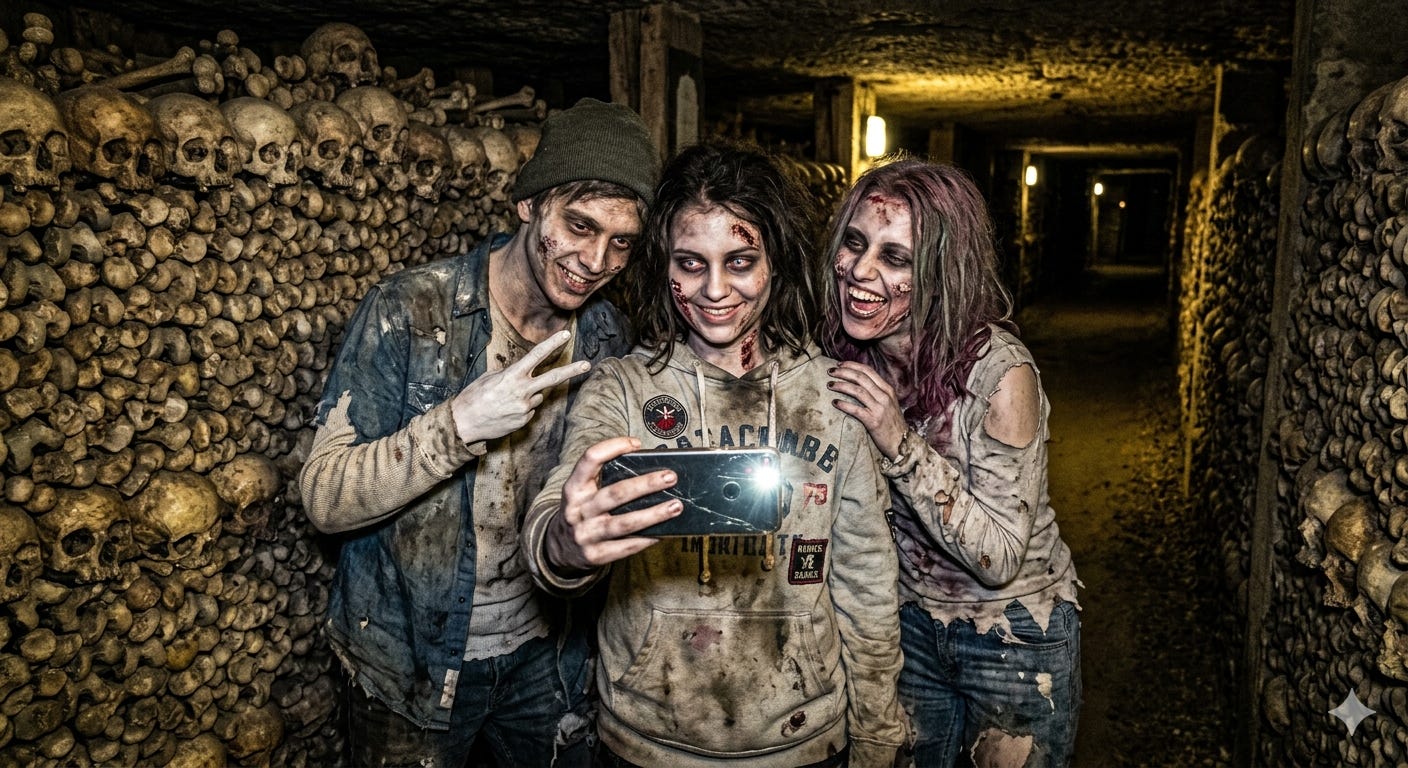
Chapter 92: As the global zombie civilization advances, new developments increase its complexity. But as always happens, the complexity of a civilization is the cause of unforeseen problems. That’s what happened with Elon Musk’s new microchip factory using alternative rare earth elements.
In France, a zombie doctor developed a new method for reusing human bones to reconstruct the damaged skeletons of decrepit zombies. This replaces imported artificial prostheses with aesthetic advantages and lower cost, because the catacombs of Paris are an almost inexhaustible source of bones of all types and sizes. In Europe, the era of zombies full of plates and screws who walked like scarecrows came to an end. And those zombies who couldn’t import modern prostheses were becoming more stylish than their countrymen on the other side of the Atlantic.
The innovation was seen as a danger by the zombies who lived in the country formerly called the USA, which had created the artificial prosthesis industry. They quickly moved to ban the import of French bones, but they couldn’t stop a veritable epidemic of research in the new area because local cemeteries also had great potential to supply bones. This was immediately banned when humans began to complain that the zombies were offending their ancestors.
Zombie Elon Musk sent his company’s scientists to conduct research to develop microchips with chemical elements found in human bones. A substantial breakthrough occurred when a researcher accidentally used the bone of a decrepit zombie who had completely lost his undead life in a crypt from which bones for research were removed to the laboratory. Since he could not repeat the results with other bones, the zombie researcher decided to analyze samples from the exposed tip of his little finger and discovered something spectacular: the zombie condition gave the zombie bones different chemical properties, transforming common minerals used as building blocks of human bones into rare earth elements, indispensable for microchips.
Upon learning of the news, zombie Elon Musk tried to convince the zombie administrators to allow the collection and use of bones from decrepit zombies without the undead condition in the microchip industry to replace the rare earths imported from China. The supreme council of zombies denied the request, because the substance of zombies who have ceased to walk on Earth should be respected. They were the heroes of the race and their bones could not be desecrated.
Annoyed, the zombie Elon Musk demanded that the supreme council at least allow the creation of a controlled transformation program for humans into zombies so that their bones, enriched by the transformation of common minerals into rare earths, could be collected after the transformation. Heresy. The dignity of a zombie’s undead condition was incompatible with the request, and the scientist-entrepreneur was warned that he was crossing a red line that could lead to harsh sanctions against his skeleton.
Not being a zombie who would give up on something potentially innovative, Elon Musk took his rocket and went to France. There he visited the clinic of the doctor who had developed the technique of transplanting bones from the catacombs of Paris into decrepit zombies. He offered to buy the bone fragments and bones removed from the zombies, which the doctor considered a good deal because, after all, those bones were just useless trash.
Elon Musk took advantage of his stay in Europe to start funding new Think Tanks on zombie TVs in the countries that were once called France, Germany, Belgium, the Netherlands, and England. These new Think Tanks would promote the prosthetic surgical technique developed by the French zombie doctor. They would also recommend cosmetic surgeries for zombies to replace unworn bones that they considered ugly or incompatible with zombie dignity.
In a short time, a large quantity of bones removed from European zombies were providing rare earth minerals used in the manufacture of microchips in Elon Musk’s factory. The reduction in the import of rare earths from China solved part of the problem, but then something strange began to happen in Europe.
First, the catacombs of Paris were emptied, which forced the European zombie doctor, by then the owner of the largest zombie bone surgery center in the world, to start obtaining raw materials from cemeteries. This began to enrage humans, because their ancestors were buried in cemeteries, and what the zombies were doing was seen as offensive and began to be used to foment rebellions in food reserves throughout Europe.
After discovering what was happening, some European zombies began to question the export of zombie bones to Elon Musk’s factory. And they began to advocate for the approval of a regulation to prevent this, because after all, it was necessary to develop the exploitation of rare earth elements from zombie bones in Europe.
But the final blow to Elon Musk’s zombie business occurred when microchips made with rare earth elements extracted from zombie bones began to behave like silicon zombies. After some time functioning as designed, the new microchips underwent an unforeseen transformation. Internal clocks in the microchips went out of sync, affecting everything around them; nano-transistors that should have added began to multiply; nano-diodes that should have closed sometimes opened, and those that should have opened remained closed; results that should have been 1 were 0, or the circuits provided no result at all. And so the programs and applications created by IT engineers no longer ran as they should on those zombie microchips. A true, unsolvable physical and virtual technological chaos.
Zombie Elon Musk couldn’t solve the problem. Equipment manufactured with the new microchips had to be recalled immediately. The importation of Chinese rare earth elements had to be resumed, and the cost of this was so great for the zombie civilization that the famous businessman ended up losing control of his microchip factory. Irritated, he ordered his European Think Tanks to stop favoring the use of human bones in prosthetic and cosmetic operations on zombies. His new business had collapsed and had to be stopped before it financially compromised the colonization of space. But zombie Elon Musk would now face a new challenge.
Stay tuned for the next chapter in the series.
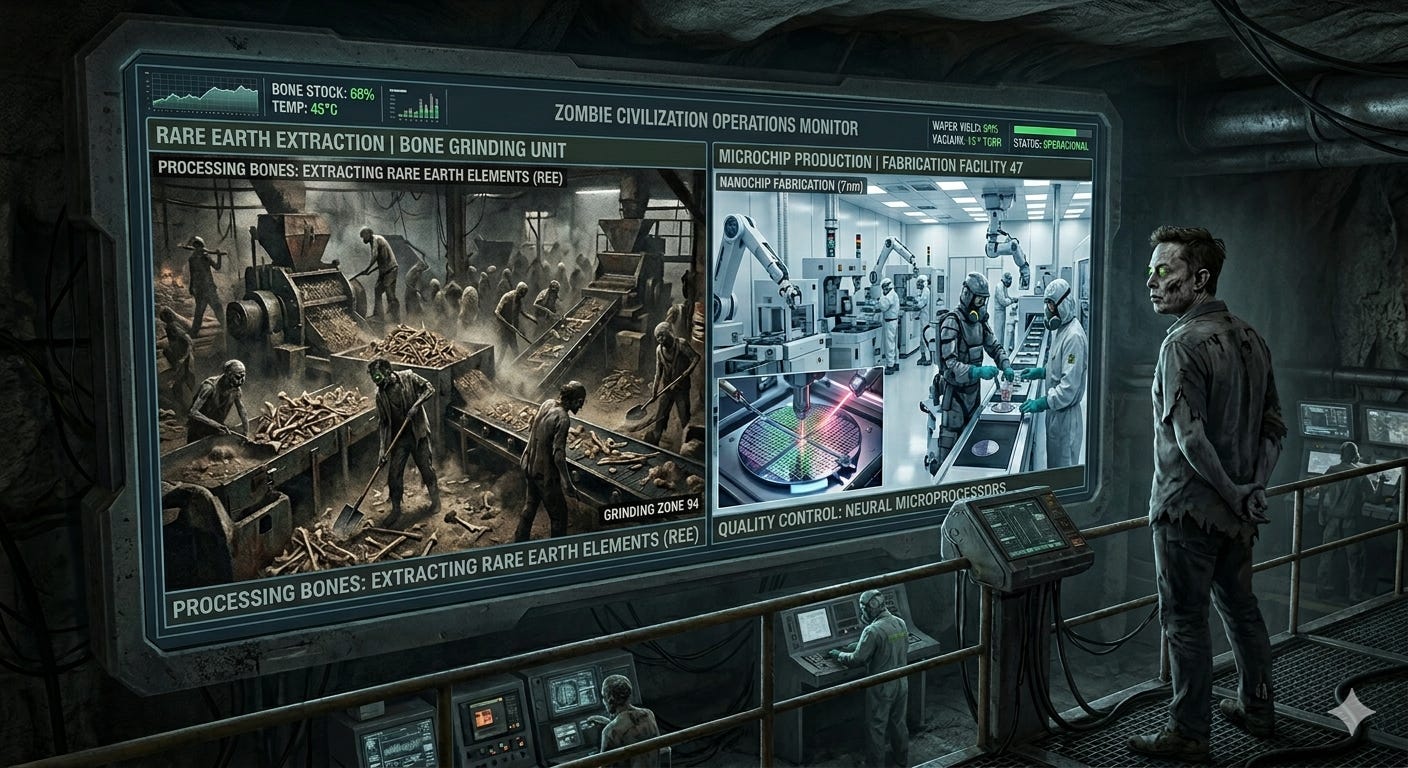
Chapter 93: This chapter recounts almost everything that tragically happened during the final climax of the end of zombie civilization.
It has been said, and reasonably proven empirically and factually, that zombies differ from humans because they are incapable of clinging pathologically to a particular ideology or belief. This allowed them to live peacefully among themselves, something humans have never managed to do for various reasons, almost all of them futile.
But not even the zombies were prepared for the unwanted and unpredictable misfortune that befell their civilization due to the exploitation of zombie bone “rare earths” set in motion by zombie Elon Musk. It turns out that these minerals, which caused insurmountable defects in the microchips into which they were incorporated, were essential for preserving the healthy zombification of zombies.
The zombie bone rare earths were created at the moment of transformation and began to decay slowly thereafter, ensuring the perpetuation of the undead condition. These elements were not present in the human bones removed from the catacombs of Paris and human cemeteries for necessary prosthetic and cosmetic operations. Incorporated into zombies, these bones remained typically human. The zombies in question certainly did not die immediately, but the reduction in the total amount of rare bone elements in their skeletons singularly affected their undeadness.
The European zombies, who underwent mass cosmetic operations, began to act erratically. They slowly began to disregard the rules of conservation and reproduction of humans in Europe’s food reserves. First, they ate all the human babies, then they increased the amount of processed and raw human flesh that was distributed. This rapidly reduced the human stocks, forcing the zombie administration to abruptly reduce the daily human flesh quota for each European zombie. When the great famine began to devour them, the European zombies with low undeadness reverted to their primordial state and began to carry out food frenzies on what remained of the food reserves.
And then they decided to invade other continents to eat as much human flesh as they desired. And they used human weapons they managed to find (and eventually manufacture) to try to forcibly impose their own disorganized, frenzied hunger on places where rational management of food stocks by other zombies prevailed. They forced the other zombies to defend their own human reserves with weapons. And that’s how the first and last zombie world war began.
I won’t go into the details of this unfortunate war that seemed never to end because whenever a soldier in a zombie army was shot, he would get up and keep advancing. Only those who were completely torn apart by cannon or mortar fire actually stopped fighting. Since the number of cannons and mortars was less than the number of zombie soldiers, the zombie armies continued fighting indefinitely. The bayonet blows exchanged between zombie soldiers were useless. But the bayonet battles between enemies continued, because they had no other prospect than continuing to fight to eat human flesh in the enemy’s reserves or to protect them with all their might from their superior undeadness.
Many humans took advantage of the zombie war to flee. Some of those who fled were devoured by platoons of European zombies who were looking for food instead of confronting the enemy on the battlefield. The wars of the humans were messy, confusing, full of ridiculous, grotesque, and frankly depressing situations; the zombie war wasn’t much better. But while men deserted the battlefield for fear of dying, the zombies didn’t do that because they were already undead.
I will abbreviate the narrative so as not to provoke disgust and the urge to vomit in readers who sympathize with zombies. Those who hate zombies, and who get excited seeing zombies practically negating the best characteristics of their civilization, deserve neither my attention nor my consideration.
But I will say that in the midst of that immense chaos of the war that he helped unleash, zombie Elon Musk boarded one of his rockets. The cargo bay of the enormous rocket was well-stocked with thousands of cans of zombie caviar, biscuits made from dried human flesh powder manufactured in England, ordinary canned human meat, and hundreds of live humans to be eaten raw. Zombie Elon Musk and a small crew of specialists he selected set off for the zombie lunar colony.
Some say the rocket exploded as soon as it left Earth’s atmosphere because the computerized unit regulating fuel flow to the engine malfunctioned because it’s still a cursed microchip made with rare earth elements from zombie bones. But this could be fake news fueled by Elon Musk’s agents who stayed behind enemy lines to discourage a European invasion of the lunar zombie colony to save what remained of zombie civilization. Who knows?
It is said that the Chinese government observed the decline and fall of the European zombie civilization with great glee. When Elon Musk stopped buying rare earth elements from zombie bones, Chinese spies in Europe reported this to the Central Committee of the People’s Republic of China. The Chinese decided to buy those minerals from the European zombies, believing that this would slow down Europe’s technological advancement. They didn’t yet know the damage they were actually doing, which helped amplify the decline of the undead zombies in Europe. They continued to perform the prosthetic operations mentioned earlier, ultimately provoking a world zombie war that would otherwise have been avoidable.
The Chinese didn’t use those rare earth elements from zombie bones in their own microchips because they knew it would cause a problem. What is very harmful in modern technology can be good in traditional art. So the Chinese conducted research until they discovered they could use the rare mineral imported from zombie Europe to change the color of common jade to rare green jade, which they highly value in decorative pieces. And so we can say that the sophisticated, millennia-old aesthetic preferences of the Chinese helped bring about the decline of the zombie civilization in Europe and the world zombie civilization.
No one knows if the Chinese intend to invade the zombie colony on the Moon. But we all know that it’s never good to feed the enemy, especially when you yourself might be their food.
The Chinese can laugh now, and the human survivors can celebrate. But humanity can never truly say it has definitively reconquered the Earth. After all, deep within some cave in a sparsely populated region, of no economic value to humans and very uninteresting from a natural standpoint, there may be a zombie that avoided the war. At this very moment, it may be lurking in the shadows, ready to resurface decades later to contaminate humans, eat the tasty flesh of the living, and restart the Zombies Who Live saga.
The end.