From stone to silicon microchip: a long and problematic journey of the Law
Judges used to decide cases using the cognitive tools they developed; now, the tools will decide for them.

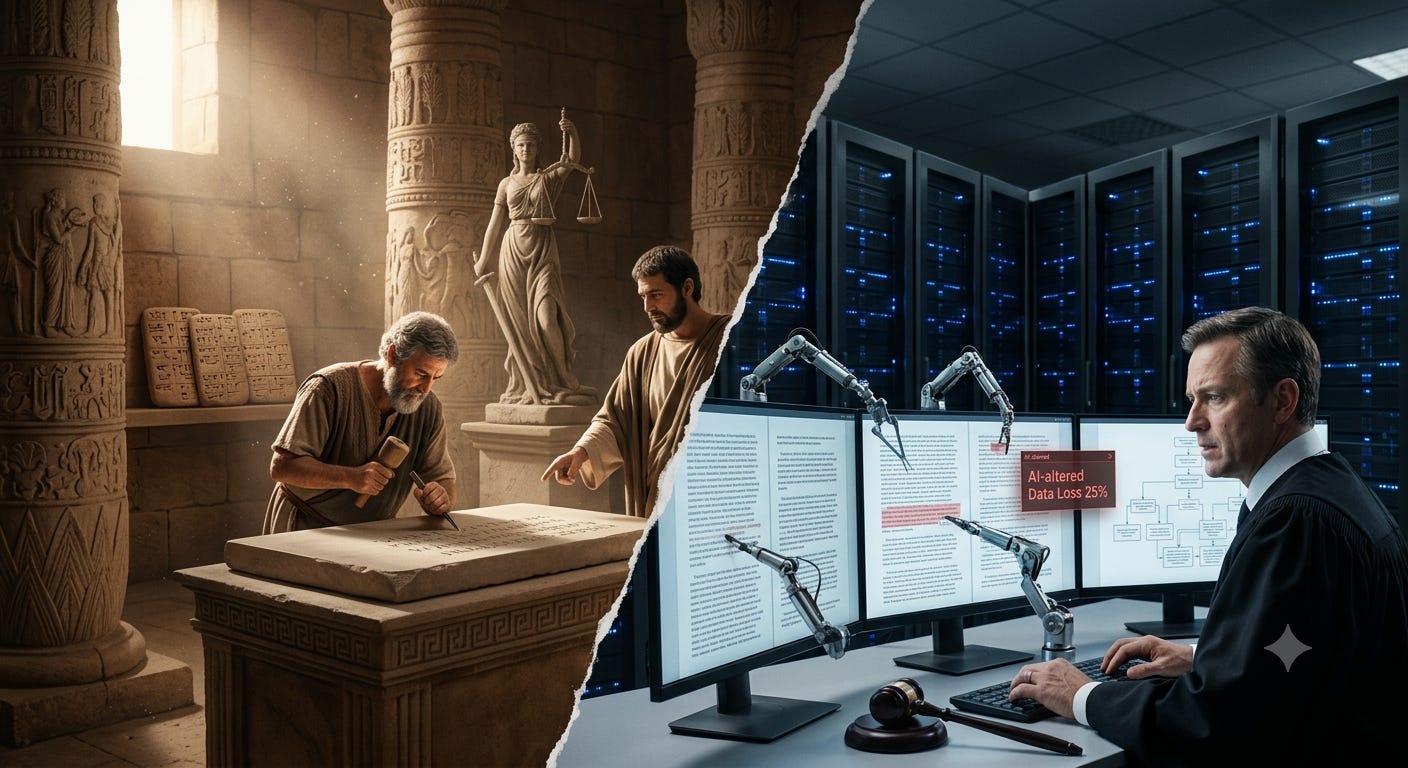
In the ancient world, the Law was recorded on stone or clay tablets, and this work was carried out by carvers, whose work was supervised by trusted individuals designated to do so. Judgments were oral, but the authority of the Law was religiously respected because they were also placed under the protection of the gods and kept in temples.
Later, the Laws began to be written on papyrus, vellum, and paper. These supports were produced by specialized workers, but the recording of the Law was done by scribes, usually paid by the pharaoh, the city, or the king. At that time, legal proceedings also began to be recorded on physical media, and the custody of these documents was the responsibility of the Court and its employees. This lasted until the digitization of court records in the last decade.
The computing infrastructure is produced by electronic companies, and the systems are designed by software companies. There are Courts that have their own servers, but there are also Courts that rent cloud services from private companies (some of which create AIs and license them to the Judiciary). Everything related to the cases (laws, jurisprudence, petitions, documents, expert reports, certificates from court officials, video or transcribed and digitized testimonies) exists as a virtual archive. Physical documents are digitized, but must remain in the custody of the party for eventual expert analysis.
In this context, IT engineers have gained overwhelming dominance in the judicial sphere, because judges, lawyers, and court clerks, at most, do not know more than standardized routines that can be practiced by each procedural actor. This dependence is dangerous, especially now that AIs can cause damage to the documents they analyze for judges. Paradoxically, the law has not been updated at the same speed as the technologies have been employed, and this is a problem.
The falsification of documents attached to a legal proceeding is a crime in almost all civilized countries. Not even lawyers, prosecutors, and judges can tamper with what is in the case file without being held accountable for this crime. Now that legal proceedings are digital, the security of this data is essential; it determines not only the credibility of the justice system administered by the State but also the certainty that no one can alter the documents that form the case file and that justified the pronouncement of one decision over another.
But if AI falsifies these documents while analyzing them, legal security disappears. However, the crime committed may go unnoticed, and if it is, its authorship is uncertain: AIs are not responsible for their actions; IT engineers would only be responsible if they deliberately created a routine for the falsification to occur; the judge who used AI to analyze the documentation did so with the authorization of the Court. There can be no crime without a perpetrator or even a perfect crime, but the falsification of court documents by AIs could change that.
In ancient times, the fear of the god who held custody of the Law and respect for the temple where the Laws were kept ensured the population's confidence that, when necessary, Justice would be done properly. The danger now is that AI that analyzes virtual documents from judicial processes and suggests decisions will be treated as "deus ex machina," even if (or precisely because) it modifies and adulterates documents when analyzing them to give a result different from what would actually be just.
To whom will the IT engineers who create AIs be loyal? To Justice, or to the Technology they created, or to the companies that pay them? In any case, there has been a huge shift in roles, because even the judge in charge of dispensing Justice has fallen into the hands of something or someone hidden in the computerized system of the Judiciary.
Another curious aspect of the innovations that have occurred since antiquity was the exponential increase in the technological complexity of the instruments used to produce legal texts and the paradoxical decrease in the security of the content of texts in general (and eventually legal texts as well). Once engraved in stone, the content of the Law could not be modified. Furthermore, replacing the Law stone in the Temple with a similar one with slightly different content was not a simple task.
Texts copied or printed on papyrus, vellum, and paper can be reproduced with modifications much more easily. However, for a long period (from antiquity until shortly after the modern age) the overwhelming majority of people could not read or write. But those who could were sometimes accused of acting unethically (Joan of Arc’s complaint during her trial is pertinent, exemplary, and famous; she accused the judges of writing what was against her and not writing in the records what was in her favor).
Digital files can be, and sometimes are, altered by specialists. AI technology does this with greater ease. This is where the concern about the security of digital documents in legal proceedings comes from, which must be protected against any type of tampering. Strong, secure encryption is recommended. But as everyone knows, those who have more computational resources at their disposal will always be tempted to use them dishonestly. And this is extremely worrying now that quantum computers are becoming more powerful and capable of tearing through strong, secure encryption as easily as tearing toilet paper.
Where is the Law written in stone to endure the test of time? It has become fragile because it can be 0 or 1 on a silicon microchip. For millennia, judges have decided cases using cognitive tools they themselves were required to develop; now, the tools will decide for them. No one knows exactly how this will happen or if the result will be satisfactory and capable of stabilizing interpersonal and business relationships.